[Image: a man with a white beard, wearing a suit, with an arm around him]
Part 7 of a series of posts honoring the Grenfell Tower victims.
Ali Yawar Jafari, from the 10th floor of Grenfell Tower
Ali Yawar Jafari, 82, was a grandfather of seven and one of the oldest victims of the fire. He loved animals and travel, his family said, and once he had caught a wild pigeon in order to free it from string wrapped around its legs. He lived in Grenfell tower with his wife and daughters, but became separated from them in the chaos as they realised how serious the fire was and tried to escape. His son searched rescue centers for him in the hope he had survived, but he had died of smoke inhalation after being pulled from the building. His wife and daughters survived.
His son Hamid told the Grenfell inquiry that in the months after the fire, he prayed to die so that he could see his father again.
“I have never dreamed or thought of going to heaven but now I fight every day, every second, because I want to join my dad.
“And I pray every day – and even I request my friends to pray for me – that I die soon to meet my father.”
In the days after the fire, his daughter Maria spoke to the Telegraph:
“We are really angry. There was no fire alarm. No water.
They don’t think about our safety…Money is not important. Life is important. No one can bring the life back.”
At the multi-faith memorial service for the victims of Grenfell, Maria read a poem by Persian poet Jalal ad-Din Muhammad Rumi in her father’s honour.
His son has a Twitter where he posts tributes to his father.
[Image: a smiling woman in a black and brown stripey hijab]
Part 6 of a series of posts honoring the Grenfell Tower victims.
Khadija Khalloufi, from the 17th floor of Grenfell Tower
Khadija Khalloufi, 52, was a pharmacist, a Marks and Spencers worker, and
the carer for her husband, Sabah, who had health problems. Both lived in
Grenfell Tower, but became separated from each other as they tried to escape. Khadija escaped the building with help from a firefighter but died of smoke inhalation, her husband was told, “in the greenery and the flowers, in the fresh air.” She was the fifth Grenfell victim to be named.
Sabah spoke of his anguish after she was confirmed to have
died:
“We had a 30-year marriage. She was my other half, she was my partner. She was everything.
Being a retired person, she was the only one to look after me. Thanks to my friends who are all here, but that was my wife. This is a different situation now.
She was always with me. Someone very important is missing. And why? What did she do? Does she really deserve that?“
She spoke frequently to her family back in Morocco. Her brother Karim told LRB:
“Khadija was the eldest child. She was always like a second mother. She came to London a long time ago and worked to send money home. That was her first aim.
…When she came home last time she seemed different. Something different in her eyes. She went to Rabat. She insisted on seeing people she hadn’t seen in years. When she was going back to Heathrow for the last time, she sat silent in the car and we cried saying goodbye.”
Sabah was granted an emergency passport to attend his wife’s funeral in Morocco, after his was lost in the fire. But her family in Morocco have said that they were “blocked” from attending the Grenfell public inquiry.
“When I went there I didn’t ask for anything, I went there to find out how my sister died, I was suffering. I didn’t have good treatment, they put me in a hotel and they forgot me. My mum was really suffering, she was crying all the time, she didn’t expect that she would be as badly treated like this. Really we are still suffering, we are still grieving and no one is helping us to get over this.”
Her brother was prevented from attending the inquiry.
Today it is nearly five months since I and my mother applied for a visa to the UK.
“We had been led to believe that we could be in London for the inquiry, but now does not seem to be the case.
“No-one seems to care about our history or relationship to this case, or to care about our pain, our heartache or our desire for answers.
I am now at a loss as to what I can do to defend my family’s rights in this case and to represent my sister, who seems to have no representation.”
[Image: a black woman dressed in orange, in an orange and red room]
Part 5 of a series of posts honoring the Grenfell Tower victims.
Mary Mendy, from the 20th
floor of Grenfell Tower
Mary Mendy was Khadija Saye’s mother, and was staying at her flat the
night the fire broke out. She was 52 years old when she died.
She and her daughter were given a joint memorial service. At
the service, Amazing Grace and Abide with Me were played, and the minister gave a speech in which he criticized perception of Grenfell as “deprived.”
“In so many ways, Mary and Khadija represented the life and
soul of this community: western and African, Christian and Muslim, creative and caring.
The deprivation of those who know nothing of the life in Grenfell Tower, who do not know, who never experienced the incredible personalities of Mary and Khadija, or whose lives are untouched by this appalling tragedy – they are the really deprived.
“We are those who have been strangely blessed, at least in the sense that we have been truly blessed to know Mary and Khadija, and we know that all our lives have been enriched by them.”
Mary’s sister Betty
issued a statement on behalf of the family:
“My beloved sister, words can never describe the pain of losing you. I can’t believe you are gone. You were a wonderful sister, an incredible aunt, the best mother any child could have wished for.
You were an amazing friend to all those who knew you. Your heart was pure, your soul was one of a kind. You will be missed for a lifetime. You will remain forever in our hearts; you and your beautiful daughter, Khadija Saye.”
“Mary Mendy was a carer who worked within her community. She
was a humanitarian who made it a passion to help those less fortunate than herself. She frequently travelled to Gambia and offered donations to hospitals and other organisations. On the night of 14 June 2017 our family lost two much-loved members. My aunt was the strong one, the fighter and the protector. The pain is unbearable. There are no words to describe the emptiness that it is in our hearts.”
“I don’t believe my soul’s going to rest… I’ve got life illnesses but they are secondary compared to this, this quest for justice. Because it’s unjust. There needs to be redress, by the grace of god’s will. Every drop of blood and bone you see in me when I’m standing, and those surrounding me, will be looking for this and we’re not going to be shortchanged.”
[Image: a smiling black woman speaking into a microphone]
Part 4 of a series of posts honoring the Grenfell Tower victims.
Khadija Saye, from the 20th
floor of Grenfell Tower
Khadija Saye, 24, was a Gambian-British art photographer and a care worker. The day before she died, an art gallery director asked to set up a meeting with her, moving her closer to recognition as a talented artist. Her artworks were also being exhibited in Venice at the time she and her mother lost their lives at Grenfell. She was “in love with images” her father Mohammedu Saye told the Grenfell inquiry.
Her friend and fellow artist Nicola Green spoke to The Guardian about her, and the scholarship she won at 16 to the famous Rugby School:
“She was incredibly grateful for the experience, but she told me it was one of the most difficult things she had done. It was a completely different world to the one she was part of – she was living at the top of Grenfell Tower and the school was full of privileged people who sometimes seemed to her to have no understanding of that privilege.
It gave her an understanding that confidence is a mysterious thing – she was in search of it because she’d seen it. I think maybe it gave her the tenacity and determination to find it in herself.”
Her best friend Charlotte Levy also spoke to the Guardian:
“She was just the most incredible person, she went through so much stuff, but she always listened and was always there for you. She was making such powerful work, but still saying she didn’t have a clue. She was such a beautiful person, she lit up a room.”
MP David Lammy, a friend of hers, told The Guardian that before the Grenfell Tower Khadija had been wrongfully arrested by the British police and they had taken her phone off her. Despite her name being cleared they had never returned it. When the fire broke out Khadija had no phone to call for help, and used Facebook instead. “I am desperate about that fact,” Lammy told the newspaper.
Khadija’s uncle Damel Carayol handed Prime Minister Theresa May a painting titled “Eyesore!! Final Straw” during a meeting. Both the picture and the photograph paints a thousand words.
You can see Khadija’s artwork here and her Instagram here.
[Image: a blurry image of a smiling Filipina woman with black earrings and glasses]
Part 3 of a series of posts honoring the Grenfell Tower victims.
Ligaya Moore, from the 21st floor of Grenfell Tower
Ligaya Moore, 78, was a Filipina woman who always dreamed of
living in London. She married a British man, Jim Moore, but was a widow at the time she died. She liked dancing and shopping, and previously worked as a nanny.
Her family released a statement in which they talked about her life:
“Forty-three years ago, Aunt Ligaya, DITE, as we fondly called her, lived her dream – to live and work in London.
She endured being away with family – not able to attend her mother’s funeral – but in exchange of all the loneliness and homesickness, she
met the love of her life, Jim Moore, a British national, had a new family, acquired new friends, and built a new life in London.
But the dream turned into nightmare on that fateful night of
June 14, when the Grenfell Tower was consumed in flames. At this time, she was already living by herself in this building, as her husband passed away several years back.
The jolly, bubbly person, the lady who loves to dance and who laughed her heart out, succumbed to a fire which turned her laughter into silence.”
Her friend Nenita Bunggay spoke about her at the Grenfell inquiry:
“Ligaya was a jolly and energetic person, she was like my mother and was my best friend. We always spent our time together and she will be greatly missed.”
“She was so proud to live in Grenfell. She would always say every time we walked past: ‘Nenita, that’s my building, 21st floor. It’s a big building and I love it so much, even though I’m alone there, I love seeing it every day. Especially the fireworks, she loved that kind of beautiful thing from her building.
“She loved to see the beauty of London from her building. She always used to say: ‘I am on top of the world, Nenita, look at my building.‘”
[Image: A dark-haired man in a blue and red checked shirt looking at the camera]
Part 2 of a series of posts honoring the Grenfell Tower victims.
Mohammed Alhajali, from the 14th floor of Grenfell Tower
Mohammed Alhajali, 23, was a Syrian refugee and civil engineering student who lived at Grenfell with his brother Omar. Omar made it out alive, but Mohammed sadly did not. He jumped from the tower and died, reports said. He was the first Grenfell Tower victim to be named by the media.
Abdulaziz Almashi, Mohammed’s friend and a co-founder of the
Syria Solidarity Campaign, spoke of his anger at his loss. “He survived Assad, he survived the war, only to be killed in a tower block in London,” he said, describing Mohammed as “kind, charitable and full of passion for his family.” Reportedly, Mohammed tried to contact his family in Syria while trapped by the fire, but couldn’t get through.
A petition was circulated demanding that Mohammad’s family be allowed into the UK for his funeral. It gained 90,000 signatures, and thankfully his funeral was able to take place with his family present. There, a family friend read out a statement:
“He was a loving and caring person, always showing support and solidarity for friends and family stuck back in Syria. His very last words to us were how much he missed us. Ever since he moved away from us, we tried to be united with him and his brothers, and now, instead, we have been united by his body.”
The Syria Solidarity Campaign, which Mohammad worked for, condemned
the conditions which led to his death:
“Mohammed undertook a dangerous journey to flee war and death in Syria, only to meet it here in the UK, in his own home. Mohammed came to this country for safety and the UK failed to protect him. We absolutely agree that a thorough investigation into building regulations should take place immediately.”
[Image 1: A woman in a pink hijab (Faouzia) smiling with her teenage daughter (Nur Huda). Image 2: A young boy in a classroom (Medhi) wearing a yellow spotted tunic. Image 3: A smiling man (Abdulaziz) with dark hair. Image 4: A smiling man (Yasin) sitting in a cafe, wearing a brown jacket.]
Part 1 of a series of posts honoring the Grenfell Tower victims.
The el-Wahabi family, from the 21st floor of
Grenfell Tower
Five members of the el-Wahabi family – two parents and three children – died in Grenfell Tower.
Nur Huda el-Wahabi, described by her family as “lovable, smart and kind” was 16 when she died. After her death, her teacher James Clements pledged £1,500 to have a character in a Philip Pullman book named after her. Bids to support his pledge soon rose to £17,000.
Clements and her other teachers spoke about her personality to the Evening Standard:
“She didn’t shy away from the limelight. She sat at the back of my room, in the middle; she was a focal point. She liked to joke but worked hard as well. In that sense she was a positive role model. I saw her mature into an impressive young lady.”
Nur Huda was planning to study PE and English at A-Level.
She enjoyed Shakespeare’s Macbeth, her teachers said.
“Lady Macbeth is a powerful female figure. Nur Huda was a powerful figure in the class, others looked up to her. I used her work as a model because it was impeccable. Beautifully presented in black pen, thoughtfully written. She included the most challenging vocabulary so she could impress.”
The campaign to have a character in The Book of Dust named after her was a success. Philip Pullman talked to the Guardian about it:
“I know how I’d have felt if a pupil of mine had been in some similar disaster … The absolute injustice of it struck home with me, and must have done with so many others. So I’m very pleased to see the success of James Clements’s initiative. I wish I’d met Nur Huda, and I’m desperately sorry she died. I hope the character I give her name to will be someone she’d have liked to know.”
Her brother, Yasin el-Wahabi was 20 years old when he died. He was the 47th victim of the Grenfell fire to be identified. His surviving family said that “his contagious smile will always be etched on our minds and hearts,” and that he was “a lovable, bubbly and caring young man. He would lend his hand to anyone who asked for help.”
He worked in a Subway sandwich shop and studied accountancy
at Greenwich University, but loved football as well. He was great with the
young children whom he mentored. His football coach Kamal Romain paid tribute
to him:
“I saw something in him that I thought to myself ‘That is the kind of young people that we need’… He would have been something big in this area. Easily, he would have been something big.”
According to The Times (behind a paywall, sorry) he wasn’t in his family’s flat at the time the fire started. He raced to the 21st floor to try and save them.
The youngest child, Mehdi el-Wahabi, was eight years old. His nine-year-old cousin and friend, Sara Chebiouni, was the youngest person to speak at the Grenfell inquiry. He liked Minecraft and Lego, she said, and “it is difficult knowing that Mehdi will never be able to play with us ever again.” His favourite foods were ice cream, curry and couscous, and his cousin thought he might have grown up to be a comedian. His school teacher paid a tribute to him too:
“Mehdi’s smile lit up any room, his kindness and generosity
to his peers and staff made him an extremely popular boy.”
Their father, Abdulaziz el-Wahabi was a NHS hospital porter known for his friendly nature. At the Grenfell inquiry his brother Hamed spoke about him.
“He was kind, a loyal family member, he had an infectious and caring personality, he left a mark on many people’s hearts and it’s evident by the endless love and support given to us by his friends and colleagues.
We, his family, intend to continue by his example.”
Nur Huda’s teacher James Clements remembered meeting Abdulaziz at his daughter’s parent’s evening:
“I gave a glowing report of her work. She was watching her father closely. As a smile crept across his face she started to smile too. She looked proud…They were similar, she inherited her cheekiness from him. They were both outgoing and liked to joke.”
His wife Faouzia, born in Larache in Morocco, was described as the “anchor” of her family. Her mother, Menana Jabari, spoke of the devastation she felt at her loss. “I will be forever waiting for my daughter and beautiful grandchildren to walk through the door,” she said.
Faouzia loved to bake and knit. She created handmade scarves and baby clothes which she sold to raise funds for the Westway Trust Community Center, where she also volunteered as a knitting and crochet teacher.
She was devoted to her children, her sister-in-law said:
“You would always see her laughing and joking with her
children – whenever you saw her out they would be with her.”
[Image 1: A wide shot of a high-rise building in London with almost all of it blackened by fire. Image 2: The same building with the damage hidden by scaffolding and a large banner reading “Grenfell, forever in our hearts” opposite a green heart symbol.]
–
Today (June 14) is the first anniversary of the Grenfell Tower disaster. 72 people died, the vast majority of them working class, black, migrants, disabled, or Muslims. (Or a combination of more than one of those descriptors.) Many were young children, as well. The whole terrible, avoidable incident remains a massive stain on modern-day Britain. The survivors and the families of the victims still haven’t got justice for what happened.
I think about Grenfell a lot and I really want to do something, but there’s so little useful stuff I can do, especially since I can’t get to London easily from where I am in the UK. So today I’m gonna do the one thing I actually can do, which is post detailed tributes to all the 72 people who died, quoting the family members they left behind and explaining who they were and what they did.
Obviously, this comes with huge trigger warnings. Any details about victims’ deaths, rather than their lives, will be described as clinically and distantly as possible. However many family members have made it clear that they want the world to know the exact way their loved ones died, and I’ll be posting quotes from those people as well. It’s incredibly difficult stuff to read so all posts will be tagged “grenfell” “grenfell tower” and “trigger warning.” I hope that’s sufficient.
For more about Grenfell, the Guardian has covered it very extensively. You may also want to look at the hashtags #justiceforgrenfell and #justice4grenfell on twitter, where many survivors’ groups have made their voices heard.
Once I’ve finished posting about the victims I’m going to make another post talking about all the people who came out to help that night when they didn’t have to, and all the people who are still fighting for justice.
Prime Minister Theresa May has said she regrets her reaction to the tragedy, and she should. Many of the people she promised to rehouse still don’t have houses.
Again please be sure to blacklist the trigger warnings if you need to! This post is tagged with them too.
#Justice4Grenfell
–
Edit: Here are all the tribute posts, in alphabetical order by last name:
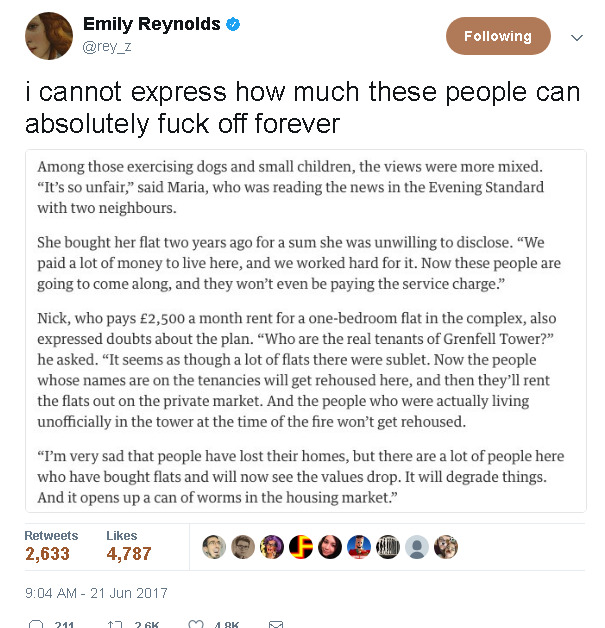
“I know many of your neighbours are dead, you’ve suffered unspeakable trauma and lost everything…but, you know, what about our property values?”
“It’s so unfair,” said Maria. “I worked hard in some unspecified capacity to afford my flat, and yet people want me to stand by and not complain about poor people doing something that barely affects me directly at all? These people whose children burned to death in an improperly made building won’t bepaying the service charge? Outrageous. Can I remind you all who the real victim here is?”