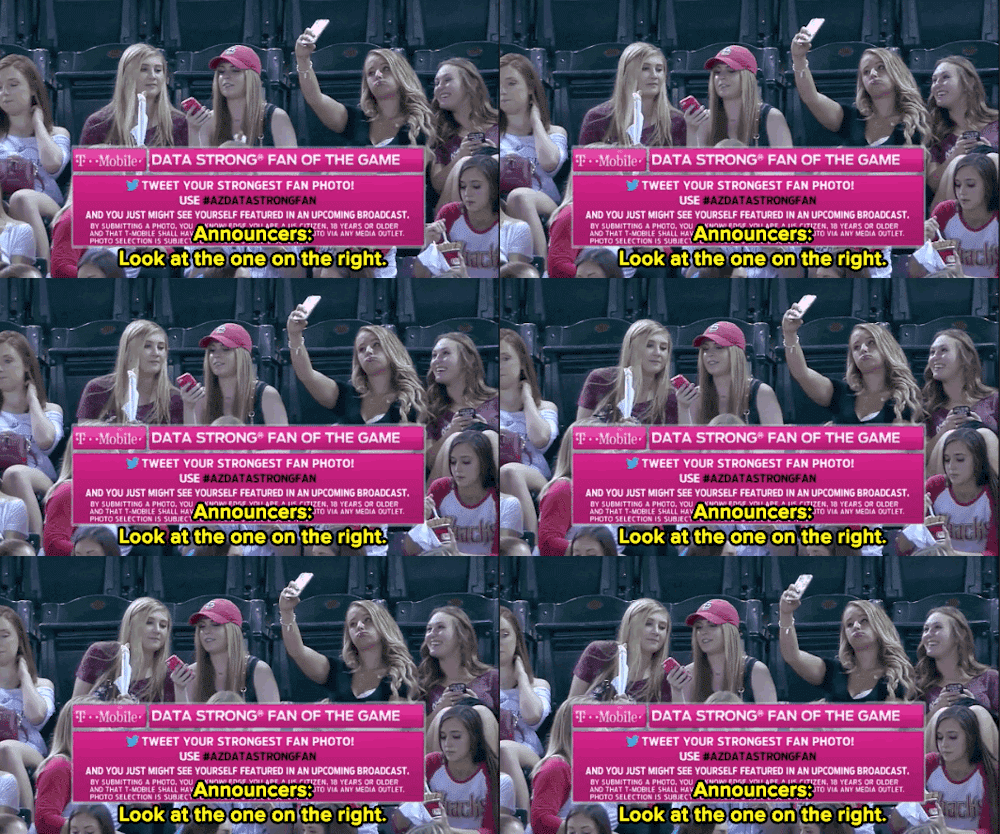
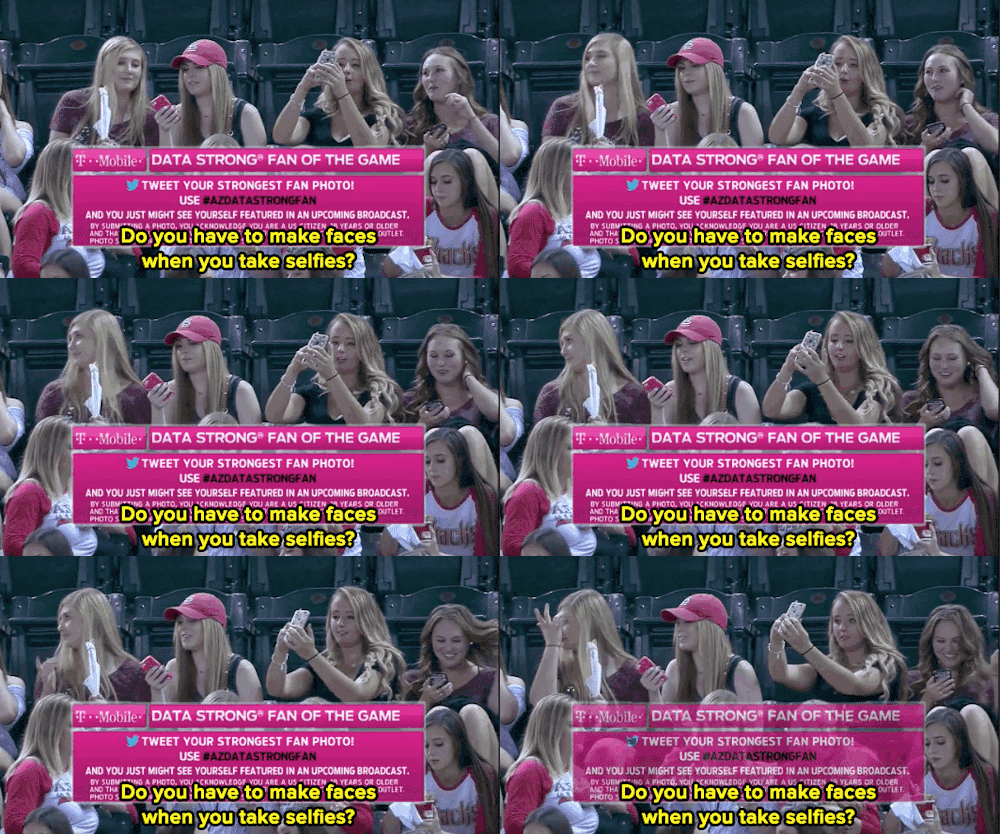
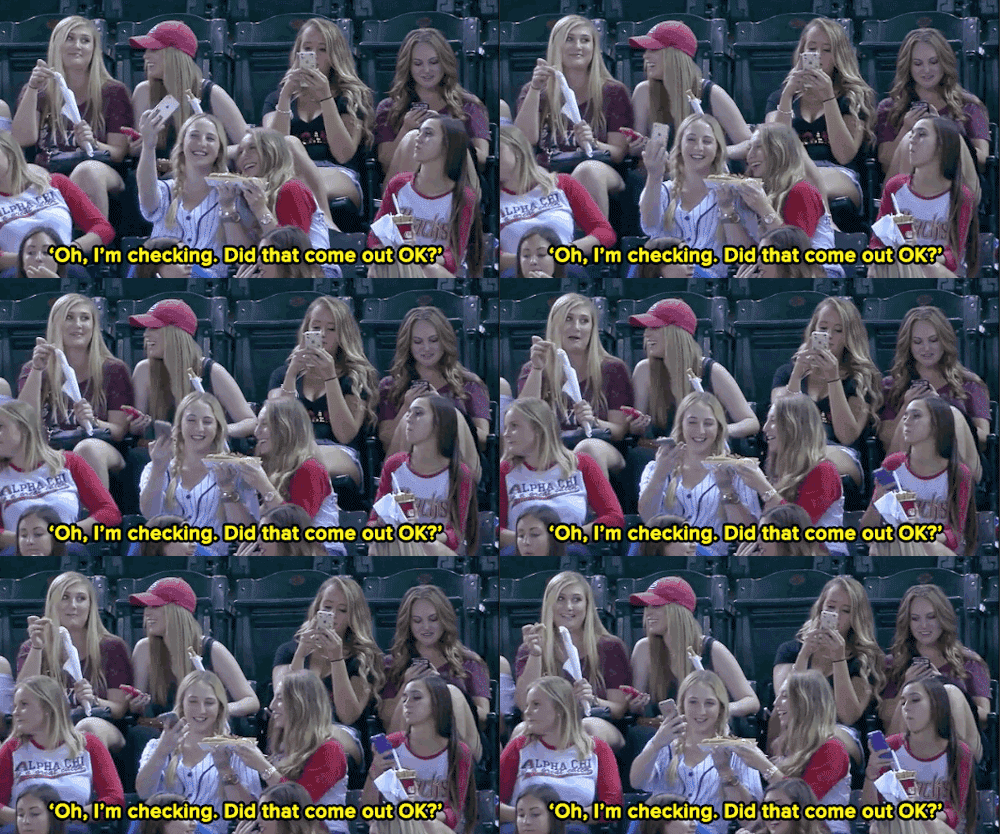

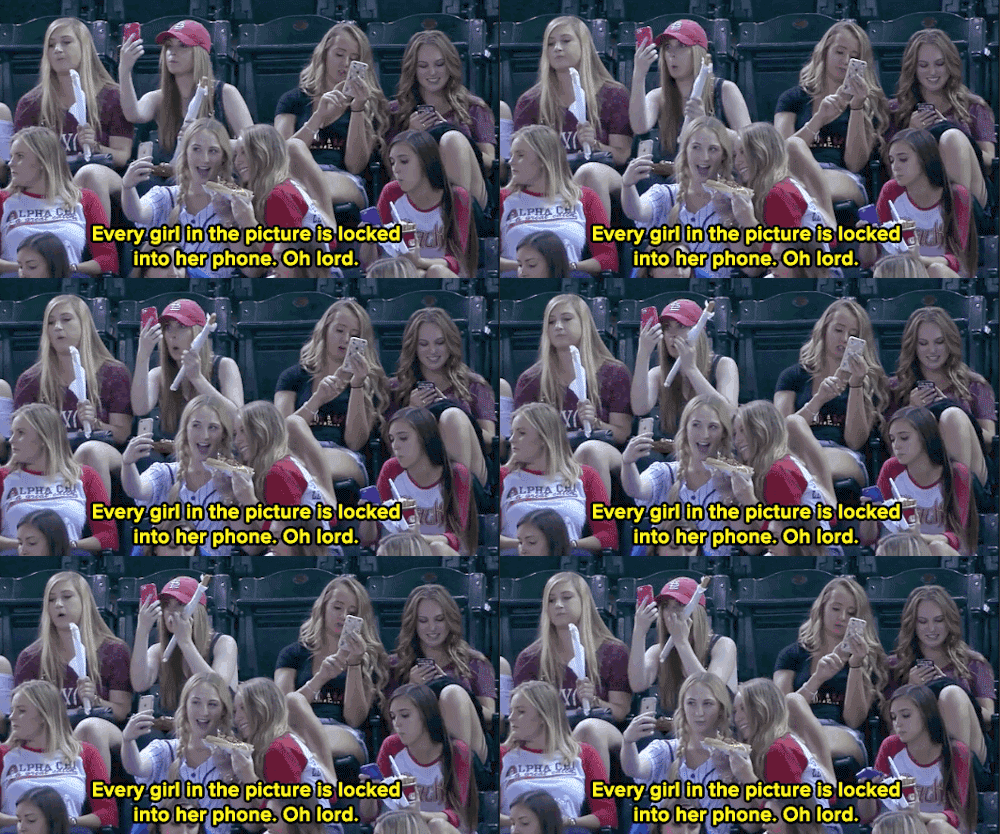

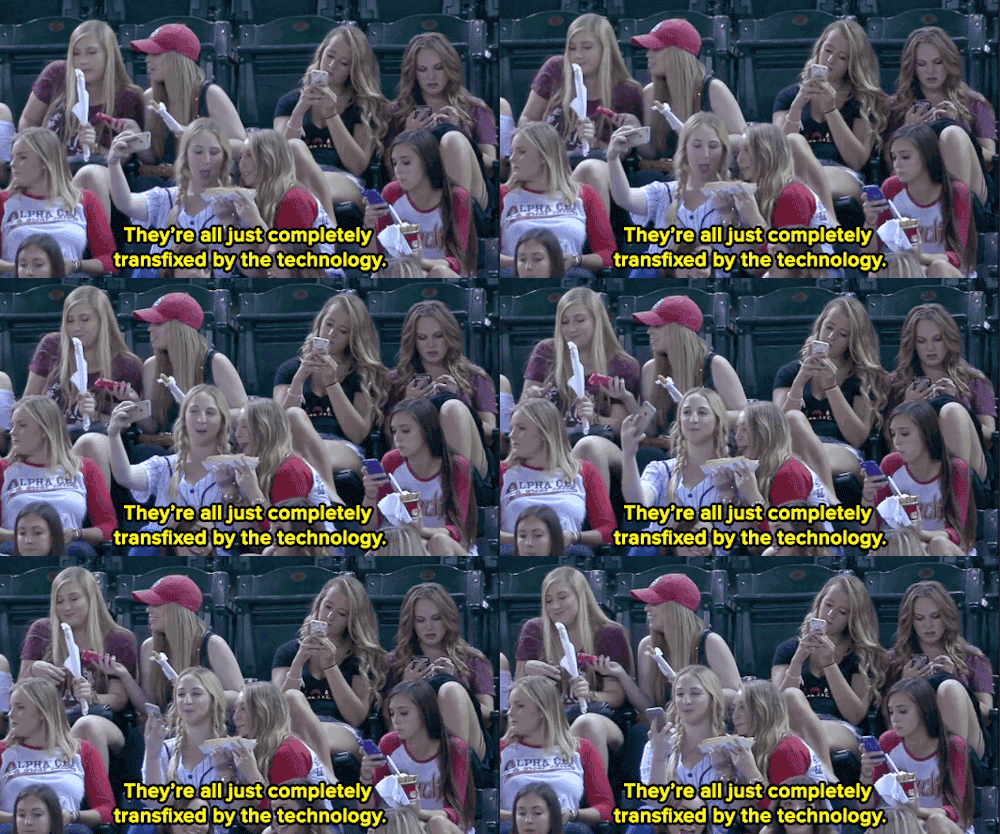
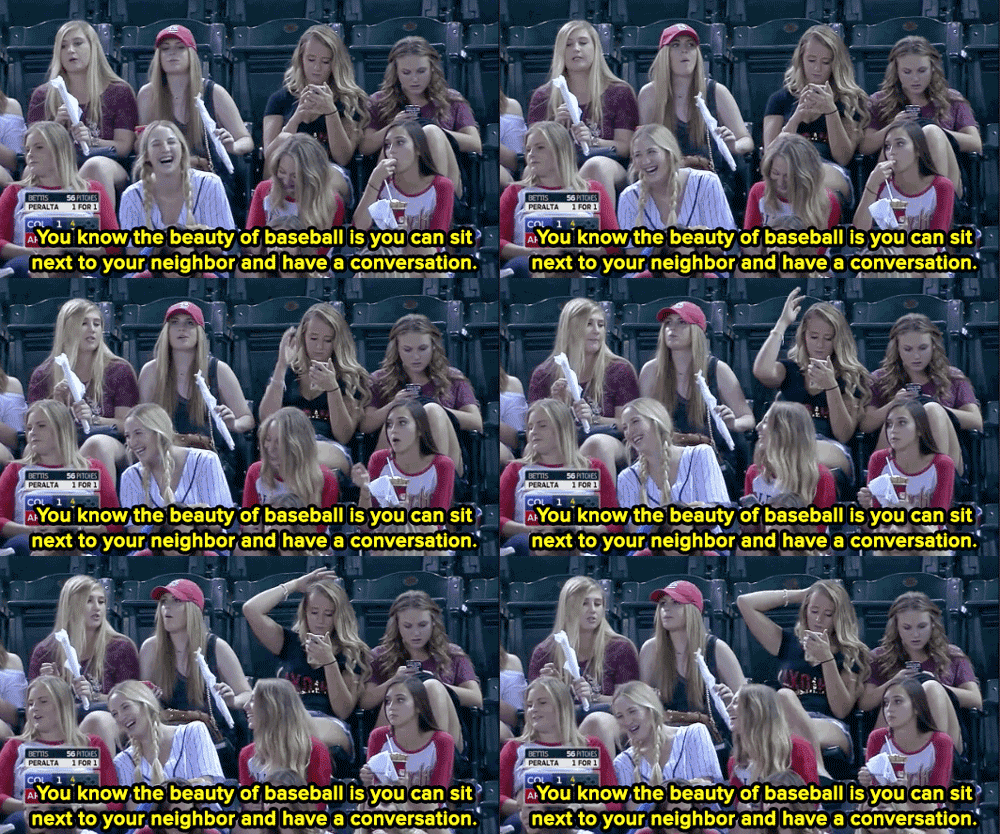
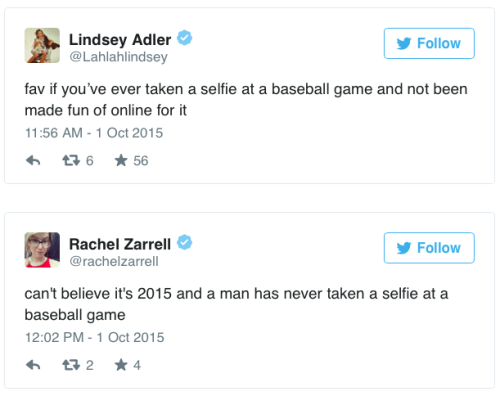
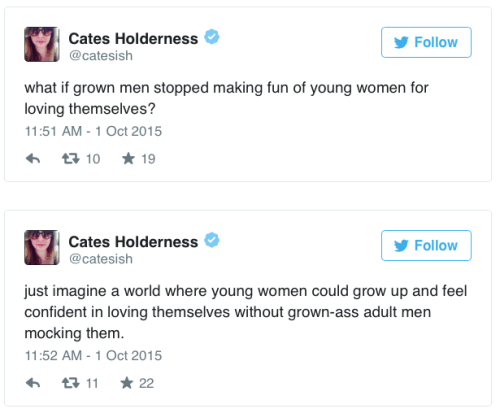
Male announcers mock young women for taking selfies during a baseball game
The clip starts with Arizona Diamondback announcers Steve Berthiaume and Bob Brenly asking fans to tweet their strongest photo, but quickly devolves into the two men making fun of the girls for doing exactly what they asked. Besides this hypocrisy, this is pretty troubling considering the sexism and stereotypes surrounding female sports fans.
After being ridiculed by the announcers, these young women received apologies from FOX Sports and free tickets to an upcoming game. However, the girls – who are all members of Alpha Chi Omega sorority – decided to donate the tickets to a non-profit for domestic violence victims. Alpha Chi Omega’s national philanthropy is domestic violence awareness and October happens to be National Domestic Violence Awareness month, and these girls turned the network’s groveling into a selfless act while drawing attention to a worthy cause. Keep being gorgeous inside and out, ladies!
Girls fucking rock.
duck lips, forever @kellysue
Teach a girl from birth the the most valuable thing about her is her appearance, then mock her for believing you. WELL PLAYED, PATRIARCHY.
sexism
I asked myself what style we women could have adopted that would have been unmarked, like the men’s. The answer was none. There is no unmarked woman.
There is no woman’s hair style that can be called standard, that says nothing about her. The range of women’s hair styles is staggering, but a woman whose hair has no particular style is perceived as not caring about how she looks, which can disqualify her for many positions, and will subtly diminish her as a person in the eyes of some.
Women must choose between attractive shoes and comfortable shoes. When our group made an unexpected trek, the woman who wore flat, laced shoes arrived first. Last to arrive was the woman in spike heels, shoes in hand and a handful of men around her.
If a woman’s clothing is tight or revealing (in other words, sexy), it sends a message — an intended one of wanting to be attractive, but also a possibly unintended one of availability. If her clothes are not sexy, that too sends a message, lent meaning by the knowledge that they could have been. There are thousands of cosmetic products from which women can choose and myriad ways of applying them. Yet no makeup at all is anything but unmarked. Some men see it as a hostile refusal to please them.
Women can’t even fill out a form without telling stories about themselves. Most forms give four titles to choose from. “Mr.” carries no meaning other than that the respondent is male. But a woman who checks “Mrs.” or “Miss” communicates not only whether she has been married but also whether she has conservative tastes in forms of address — and probably other conservative values as well. Checking “Ms.” declines to let on about marriage (checking “Mr.” declines nothing since nothing was asked), but it also marks her as either liberated or rebellious, depending on the observer’s attitudes and assumptions.
I sometimes try to duck these variously marked choices by giving my title as “Dr.” — and in so doing risk marking myself as either uppity (hence sarcastic responses like “Excuse me!”) or an overachiever (hence reactions of congratulatory surprise like “Good for you!”).
All married women’s surnames are marked. If a woman takes her husband’s name, she announces to the world that she is married and has traditional values. To some it will indicate that she is less herself, more identified by her husband’s identity. If she does not take her husband’s name, this too is marked, seen as worthy of comment: she has done something; she has “kept her own name.” A man is never said to have “kept his own name” because it never occurs to anyone that he might have given it up. For him using his own name is unmarked.
A married woman who wants to have her cake and eat it too may use her surname plus his, with or without a hyphen. But this too announces her marital status and often results in a tongue-tying string. In a list (Harvey O’Donovan, Jonathan Feldman, Stephanie Woodbury McGillicutty), the woman’s multiple name stands out. It is marked.

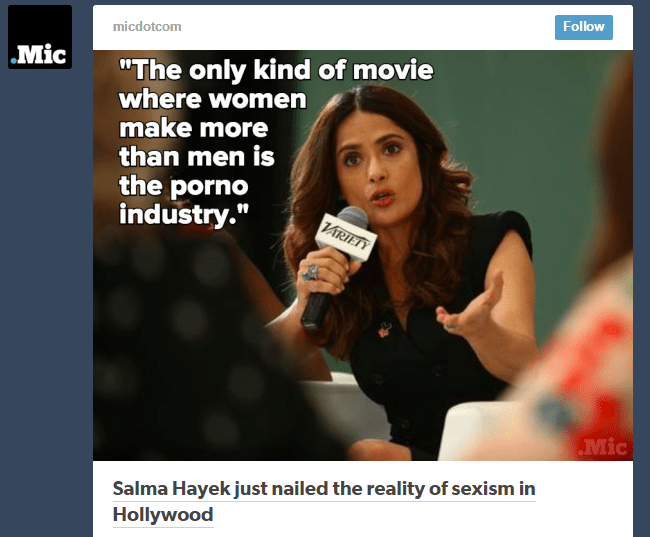
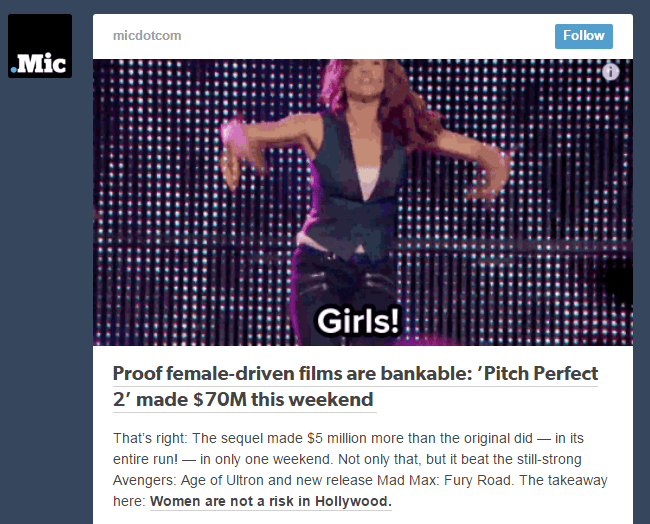
So…which one is true, feminism?
Basically: One movie doing great doesn’t remove sexism.
Both are true. Hayek’s quote was referring to Hollywood’s well-documented gender pay gap. Women are not getting the equal recognition and compensation they deserve behind the scenes.
The fact that female-led movies like ‘Pitch Perfect 2′ and ‘Max Max: Fury Road’ did well doesn’t suddenly make the aforementioned inequality go away. These films show that women are good for business in Hollywood — and can make studios a lot of money. But the industry hasn’t come to realize it fully yet.
The first quote references to
how much money women make, not whether or not the films are successful. The movies I’ve researched contract offers have usually shown the men get paid more than the women. Sometimes this makes sense given experience, other times not so much.
They really thought they dropped the mic, didn’t they? I also love how they addressed “feminism” as if its a monolithic entity.
In January of this year, a mere 4½ months ago, Charlize Theron made headlines when she, after 20 years in film, an Oscar, a Golden Globe, a Silver Bear and numerous other awards and nominations for her acting, demanded that for the Snow White and the Huntsman prequel she receive the same $10 million salary that her co-star, Chris Hemsworth, was getting.
There was an outrage. Charlize was called greedy, grasping, and people tried to make an argument that she, despite her well-documented skill as an actor, was not the box office draw that relative newcomer Hemsworth is. This was of course built upon the box office for Chris’ Marvel films, but his first big post-MCU flick, Blackhat, the film that was supposed to establish him as an action star separate from the comicbook juggernaut, was an abysmal failure, netting a mere $17 million worldwide. His “Snow White” prequel paycheck is more than half of the worldwide box office of the film. Meanwhile, Charlize is the protagonist of Fury Road which has made $280 million in 2½ weeks, which isn’t comicbook movie money, but very few films make comicbook movie money and films from other genres shouldn’t necessarily be compared to them.
In 2014, the highest earning actor was Robert Downey Jr, who raked in $75 million courtesy of his multi-picture MCU contract. His two 2014 feature releases, The Judge and Chef didn’t make it into the top 50 on the yearly box office list. The second highest earning actor was Dwayne “The Rock” Johnson, whose $52 million in earnings don’t really correlate with box office as his sole feature film release was Hercules which ranked 46th for the year with a cumulative box office of just $72 million.
The third highest earning actor was Oscar and Golden Globe winner Sandra Bullock, who made $51 million in carryover from her 2013 release Gravity for which she was nominated for all the major awards, and also from her production company and restaurant and event planning endeavors.
To get to another woman you have to skip all the way down to #11 on the overall list, where you find Oscar and Golden Globe winner Jennifer Lawrence, who made $32 million. To get that, she had to star in two of the Top 10 grossing films of the year, (#2 Mockingjay and #9 X-Men Days of Future Past) and the #1 film of the previous year (Catching Fire).
Compare her to men who ranked higher: Leonardo DiCaprio, the aforementioned Hemsworth and Will Smith, whose earnings were all carryover from prior years.
Men in Hollywood outearn all but the highest echelon of genre-crossing, award winning, highly acclaimed and personally economically diversifid women in years when they haven’t even made any movies.
If pay equity in Hollywood existed, the 2014 highest earnings list would include Zoe Saldana, Cate Blanchett, Halle Berry, Anna Paquin, Elizabeth Banks, Nicola Peltz and Sienna Miller, and not just their male co-stars from the top 10 highest grossing films of the year. The only other woman on the top 10 earning actress list with a top 10 film was Angelina Jolie, whose $18 million in earnings doesn’t even put her in the top 25 of actors overall, and includes her earnings from directing Unbroken as well as starring in Maleficent.
Numbers don’t lie. In Hollywood, the wage gap is writ in large scale.
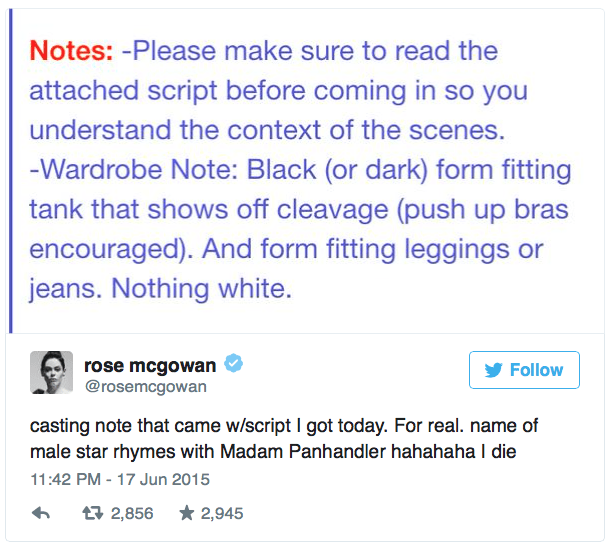
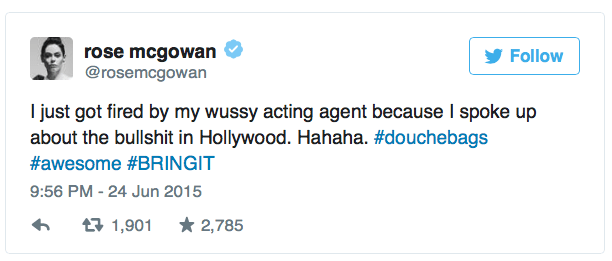
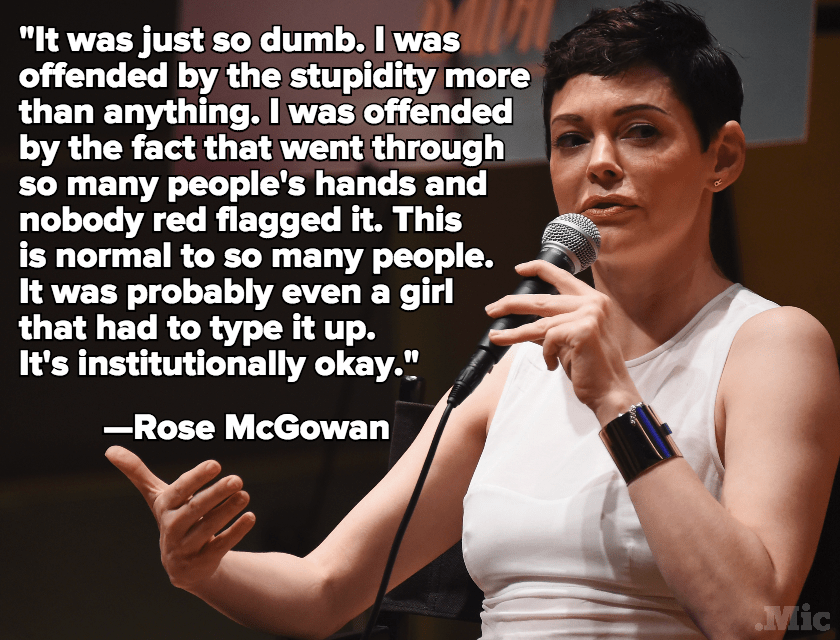
Rose McGowan was fired by her agent for criticizing Hollywood sexism
On June 17, McGowan tweeted a casting note for Adam Sandler’s next film. It told actresses to wear a “form-fitting tank that shows off cleavage.” A week later she tweeted she’d been fired. Worse though, is that few have spoken up in her defense. Only The Princess Diaries’ Heather Matarazzo defended her publicly.
Writing posts or tags about female characters being flawless and wonderfully and how they take no shit and all that, that’s good, that’s important, but at some point we have to produce fanwork about them. Like fic or meta or fanart or fanmixes or prompts or comments on stuff about them or rec lists or ANYTHING, because I’m not here to tell you how to do fandom (I say in a post where I’m telling you how to do fandom) but there’s just this gap that’s happening between the “yay ladies!” rhetoric that happens across fandoms (we’re not even gonna address the “boo ladies!” factions, we’ll have to save their souls in a different post) and the amount fic/meta/graphics produced for them.
And also the kinds of works produced for them—I’d rather have works centering on Pepper’s kidnaping and forcible injection of Extremis than another gifset of her fresh from the flames, not because I want to romanticize her pain or devalue her strength but because I’m wary of romanticizing her strength and devaluing her pain. Pain is how we connect to characters. Their suffering and their mistakes are what make them dynamic, and interacting with the difficulties of these characters’ lives is what creates a vibrant fandom. It’s like when suffragettes were agitating for votes and men were like, “but it would corrupt women to enter politics! You’re too flawless and pure to be tainted by the outside world!” And the ladies were out there marching and screaming, “Sometimes we want fucked up h/c about Natasha too!” Or something like that.
Supporting female chapters for being awesome and flawless queens something I’m so here for, especially for the kinds of women that fandom is so quick to demonize, but I’m not about this pedestal.
Saying that pushing for better representation and speaking out against sexism in movies is “the worst thing [he] can do” reads as Whedon throwing his hands in the air and saying “I’m happy to pay lip service to ‘feminism’ but you can forget about me rolling up my sleeves and encouraging my colleagues to do better, and also it’s too hard for me to make the gender politics of my own pictures better”. It suggests that he thinks it’s all just too much trouble.
It doesn’t have to be this way. Look at James Cameron, who has insisted upon featuring a prominent, strong and complex female lead in nearly every single one of his films (and TV series), as this piece by L.A Times film critic Betsy Sharkey should remind you: “It’s not merely that his films are populated by strong women – they’ve been saving mankind since his first, 1978’s 12-minute sci-fi short Xenogenesis. What makes him a potent feminist force is the way he rides the mood swings and internal debates of the movement’s second and third waves, exploring what women want, how they define themselves and how society values their worth.”
With this in mind it’s worth noting that Cameron has never dined out on his films’ gender politics, nor expressly identified as feminist. He instead just focuses on doing the work. There are other male filmmakers, like Hayao Miyazaki, Pedro Almodóvar, and Alfonso Cuarón, who are doing this, but they are, inevitably, not the ones who get widespread media kudos for being “proud male feminists”.
In 2006, at his Equality Now tribute address, Whedon famously offered an imaginary interview, where the ‘journalist’ pressed him on the gender politics of his work. Continually badgered with the question “Why do you write these strong women characters?”, he responded in a number of ways before concluding, “Because you’re still asking me that question”.
A better response might have been, “Because as a powerful white male screenwriter and director, I am the dominant paradigm in Hollywood, and it’s up to me to ensure on-screen diversity until I can help create opportunities for female filmmakers.”
It’s not enough to simply throw around a few feminist buzzwords on social media; as the man at the helm of a movie that will make billions of dollars, Whedon is in a position to insist upon real change.
Whedon is just one example, but the important take-away is this: if they’re going to insist on continuing to refer to themselves as feminists, it’s time for these powerful men to step up.
We Need to Talk about Joss Whedon’s “Feminism” (x)

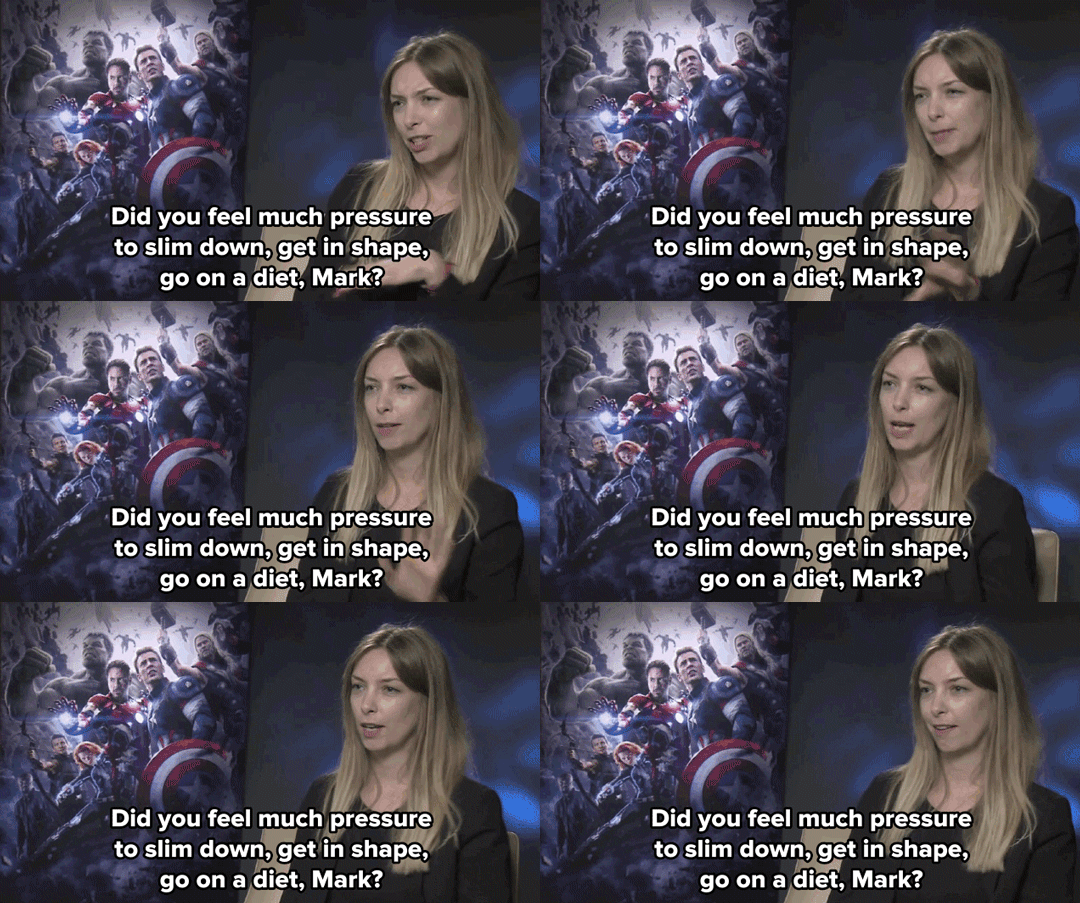
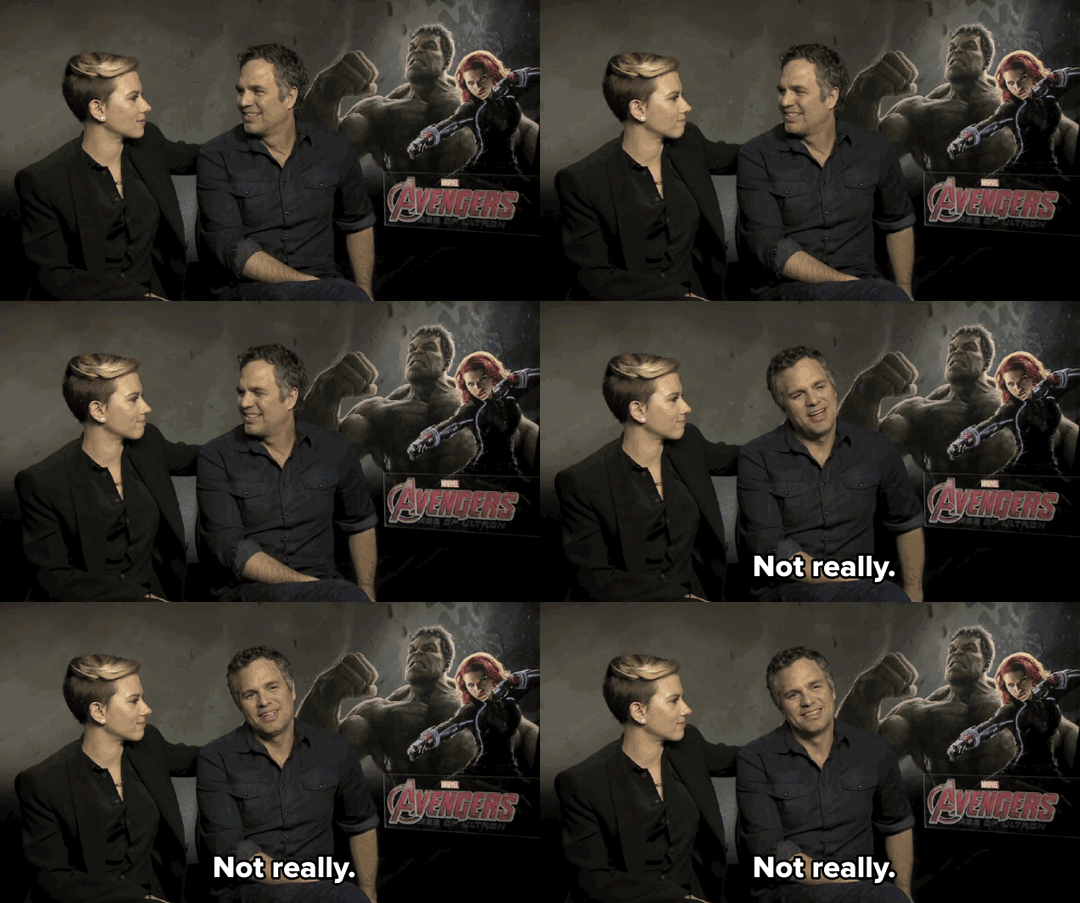
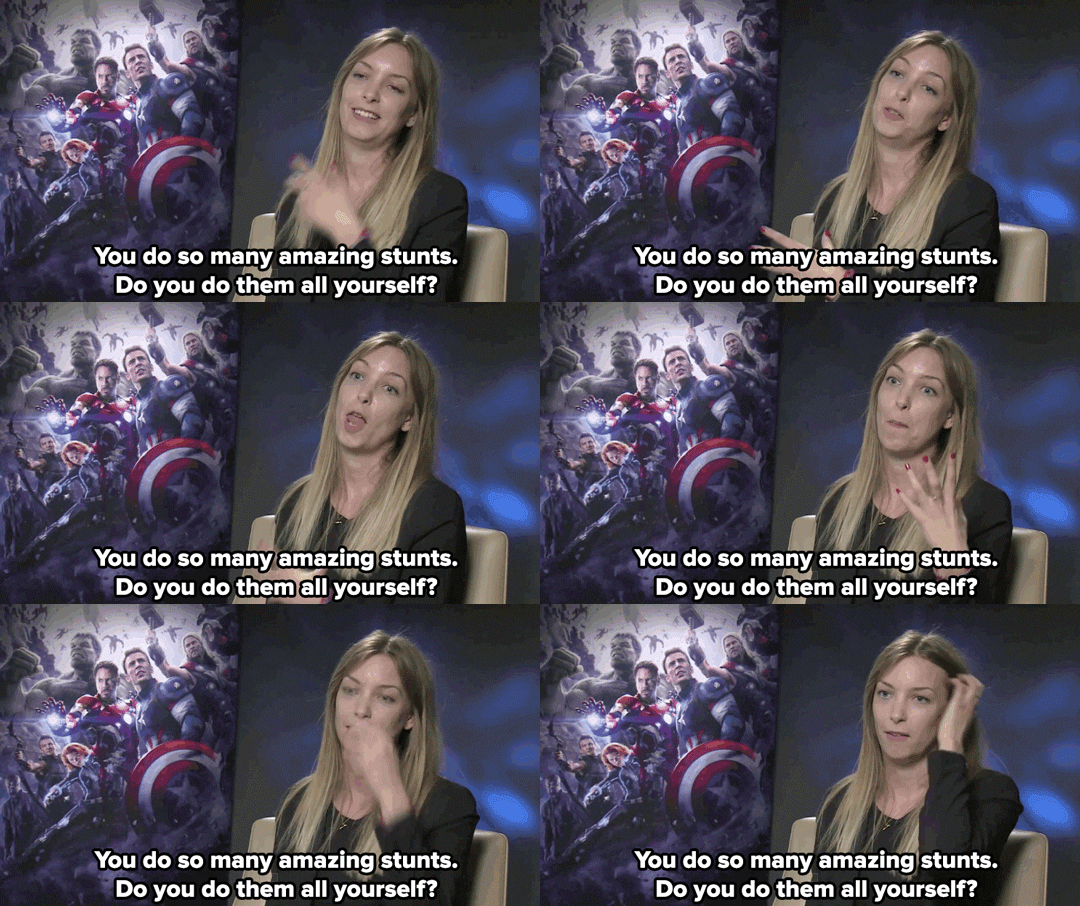
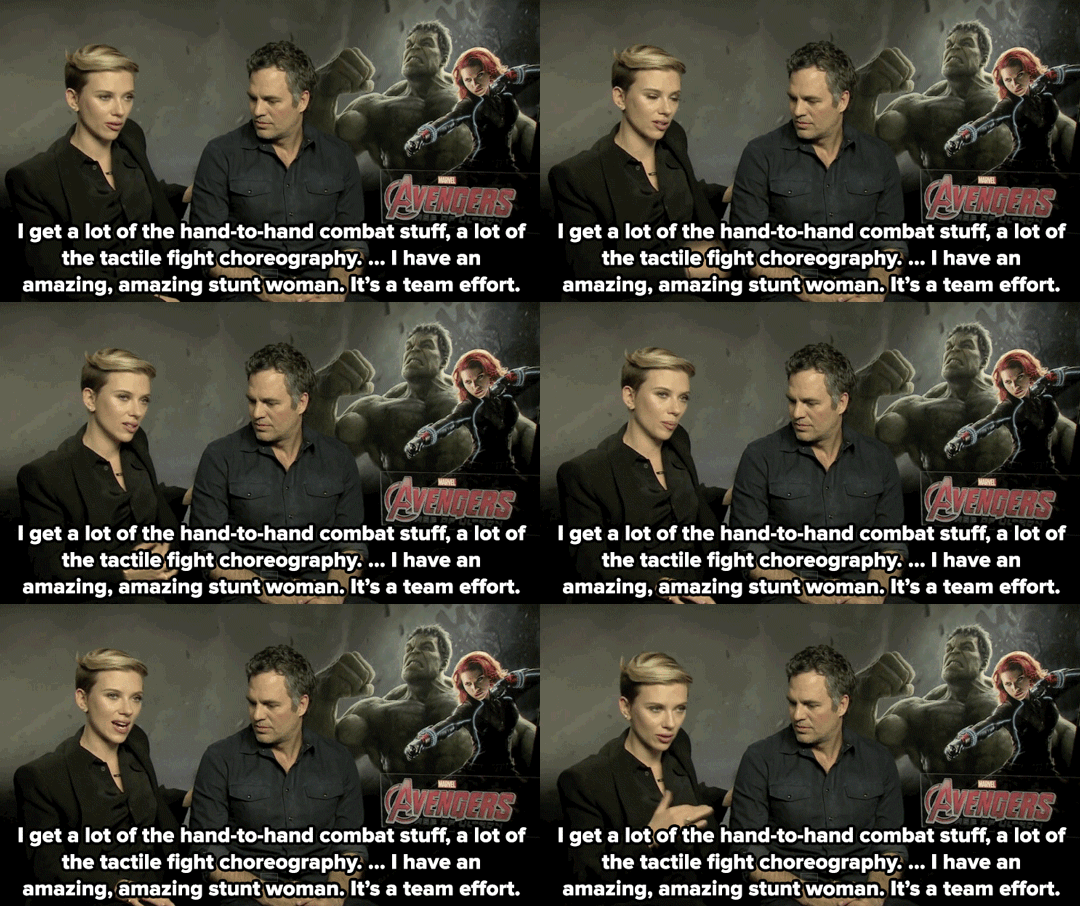
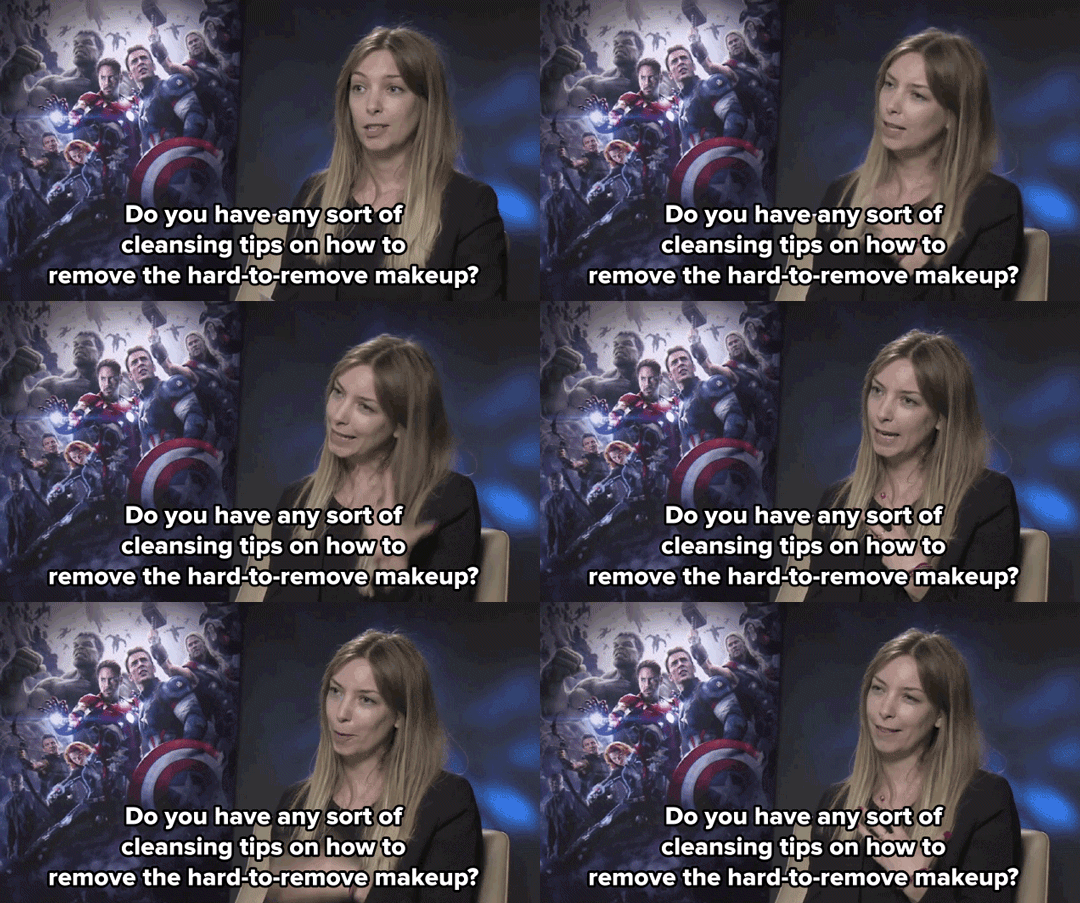
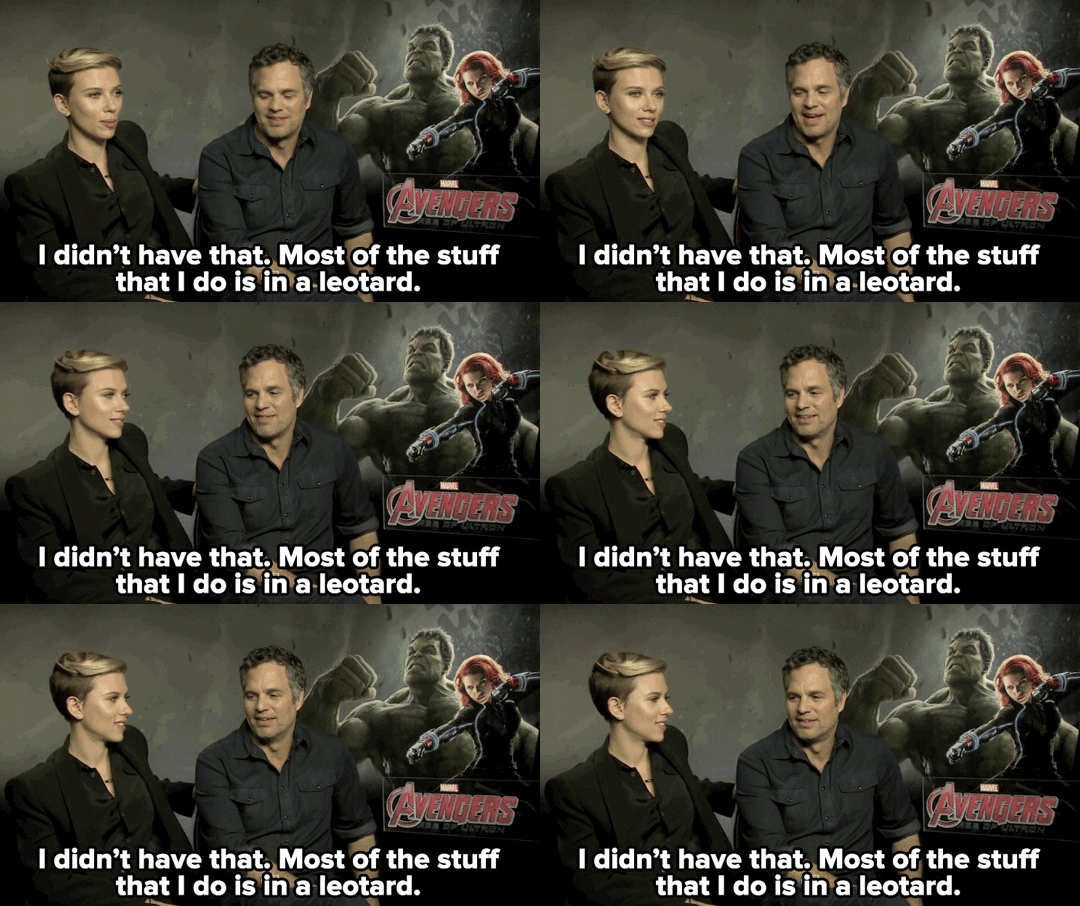
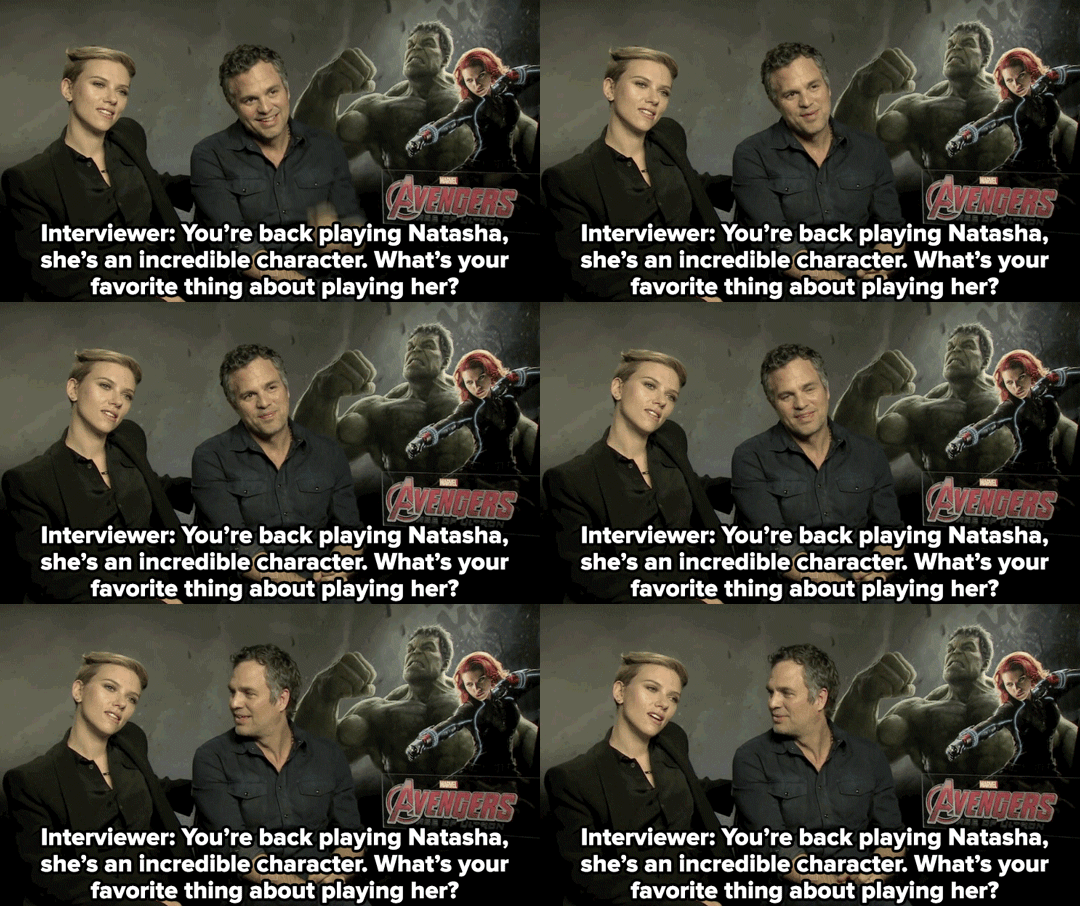
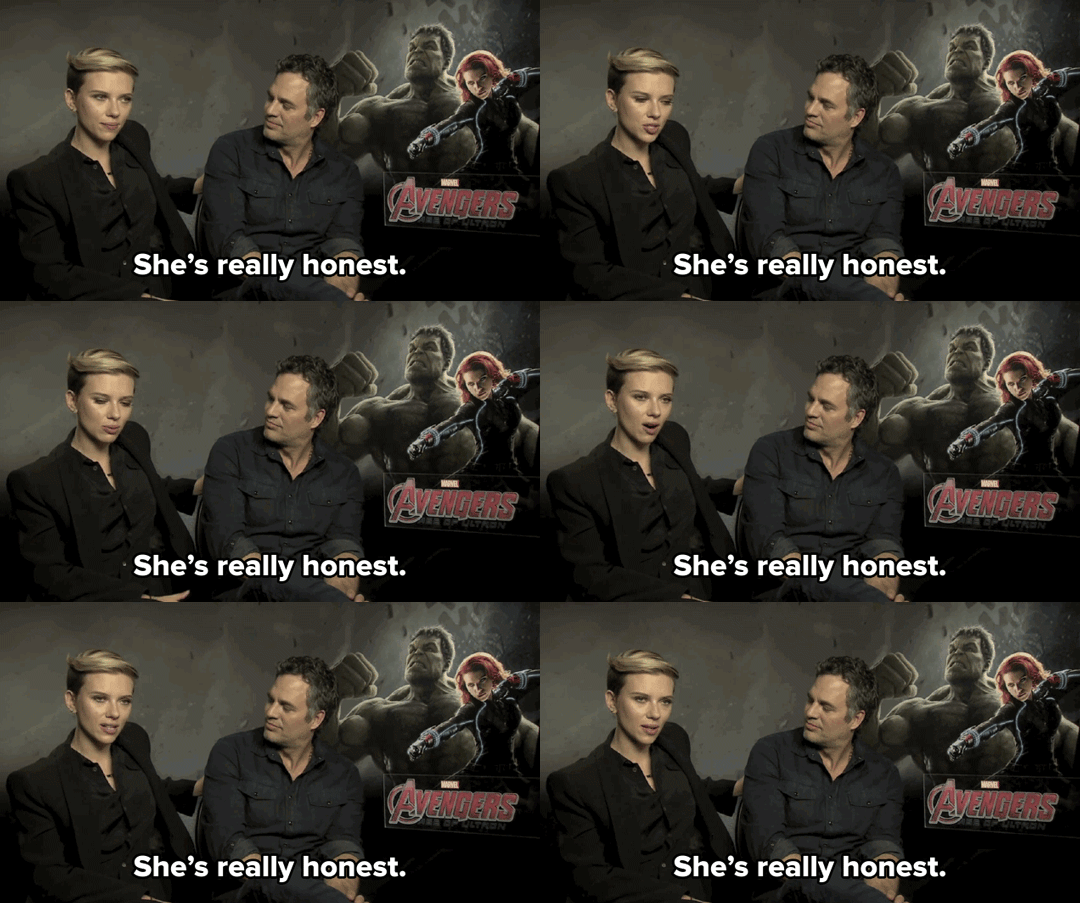
Watch: This whole interview is honestly so refreshing
I love this. And it looks like Mark totally knows what they’re doing and he’s slightly proud.
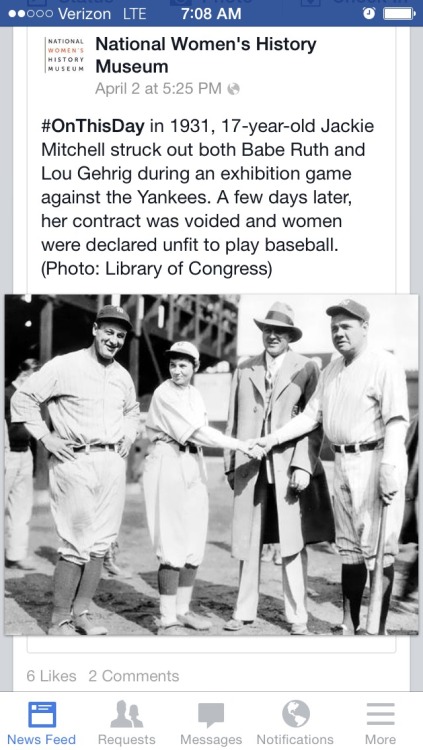
The absence of women in history is man made.
How petty
just look at babe ruth’s face tho
so confused
so lost
i love it
pure hater shit
Jackie Mitchell…a bad ass lady I had never heard of.
From her Wikipedia page: “Seventeen-year-old Jackie Mitchell, brought in to pitch in the first inning after the starting pitcher had given up a double and a single, faced Babe Ruth. After taking a ball, Ruth swung and missed at the next two pitches. Mitchell’s fourth pitch to Ruth was a called third strike. Babe Ruth glared and verbally abused the umpire before being led away by his teammates to sit to wait for another batting turn. The crowd roared for Jackie. Babe Ruth was quoted in a Chattanooga newspaper as having said:
“I don’t know what’s going to happen if they begin to let women in baseball. Of course, they will never make good. Why? Because they are too delicate. It would kill them to play ball every day.”
Next up was the Iron Horse Lou Gehrig, who swung through the first three pitches to strike out. Jackie Mitchell became famous for striking out two of the greatest baseball players in history.
A few days after Mitchell struck out Ruth and Gehrig, baseball commissioner Kenesaw Mountain Landis voided her contract and declared women unfit to play baseball as the game was “too strenuous.”[5][10] Mitchell continued to play professionally,barnstorming with the House of David, a men’s team famous for their very long hair and long beards.[11] While travelling with the House of David team, she would sometimes wear a fake beard for publicity.”
TL;DR: teenage girl strikes out two of the greatest baseball players ever, teenage girl gets her contract voided, teenage girl plays baseball wearing fake beard
These guys were so fucking injured by a teenage girl’s awesomeness that they literally threw a hissyfit and hung up a sign that said “NO GIRLS.”
They gave up.
They couldn’t handle it.
Losers.
Teenage girls are amazing.
Today in historical context.