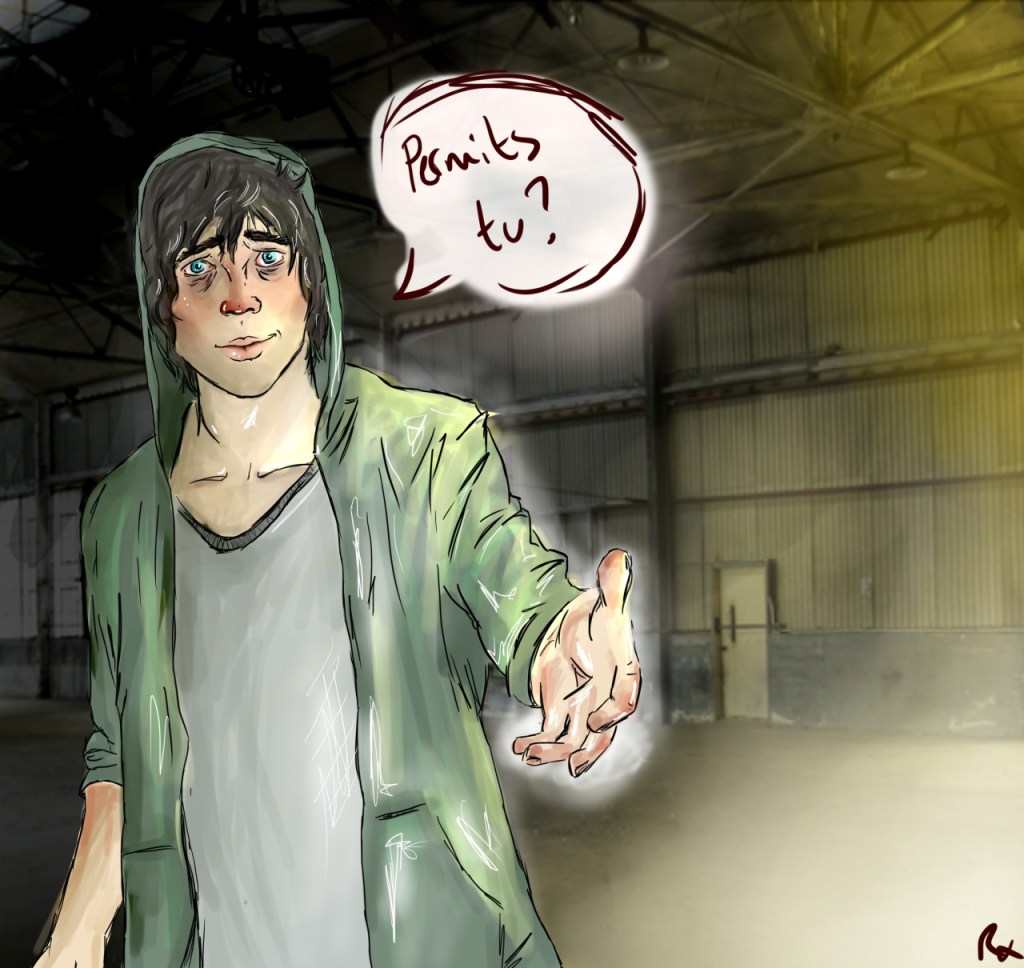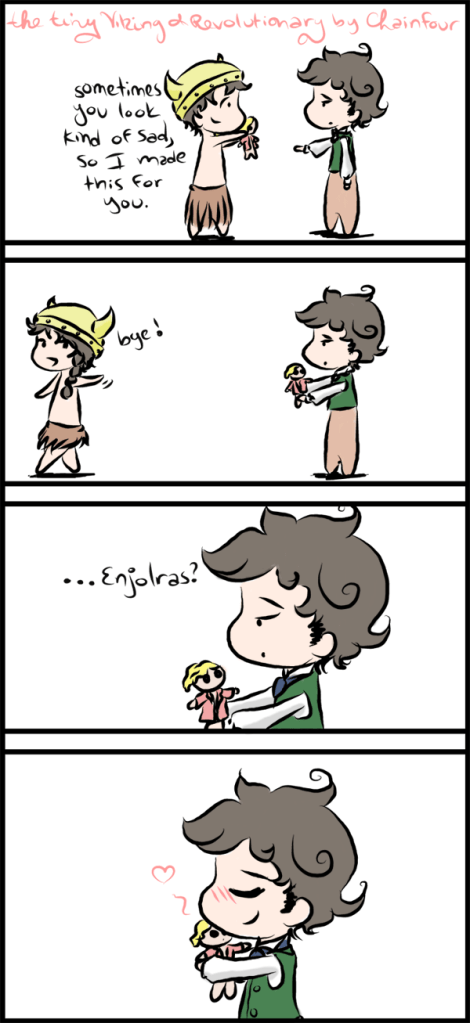
aww, Athelstan, you really know how to cheer a guy up.



Fictional characters who shaped my life (not in any order): Grantaire
Lemme see, I read Les Miserables round about February time- February 2013, just after the movie- so I’ve known Grantaire maybe six months, even though it feels like I’ve known him all my life. All that stuff he talks about, all the depressing cynical stuff, I’ve thought a lot of that. That line he has about the sun not coming out all day, I’ve thought that one pretty much word-for-word, even.
So it was good to properly meet him. As you may already know, he was one of those characters who you only really got the full measure of via the little details- he seemed so harsh and uncaring a lot of the time, but in the course of his many drunken rambles he talked about poverty and street children and slavery and suffering, and it started to dawn that he is what he is not through arrogance or nastiness but because he’s just plain given up hope. It seems to be a collective fandom headcanon that he probably had clinical depression (before there was actually a name for it) and I agree totally.
Well, getting right down to it- and bearing all that in mind- Grantaire in the novel is an absolute mess. He rants at anyone who’ll listen, he insults people probably without even meaning to, he does his absolute best to drink out the world and he’s in love with a man who disdains him at best and harshly rejects him at worst. He wears his cynicism like a mask, calls himself stupid, lets slip that his own father apparently despised him, and sometimes seems to be practically trying to get his friends to despise him too…hasn’t almost everyone actually had a friend like that, come to think of it? I think I might have. It might even have been me sometimes, I don’t like myself most of the time either. And there are Grantaires everywhere, at parties and in bars and buried in early graves. I wish I could save them all.
Victor Hugo’s own words nicely sum up Grantaire’s whole story in just a couple of sentences: His mind could get along without belief, but his heart could not get along without friendship. A profound contradiction; for an affection is a conviction. Or, you know, love is power, and Grantaire gets one of the best selfless-love stories in a novel packed full of them- you might well know how it goes by now. Grantaire drinks himself into a coma before the big final battle and wakes up to find Enjolras about to be executed by the National Guard, alone. The firing squad don’t notice him, though, so he could have escaped with his life, he could have just slumped back down. But he doesn’t do that- he gets up, shouts “I’m one of them!“ and goes to stand with Enjolras in front of the guns. Then he turns to the person he loves and asks if he minds – oh Grantaire – sharing his last moments with him. Enjolras smiles and takes his hand, just before they die…you probably know that bit, too. And that’s it, that’s the end, although the very last mention of Grantaire in the novel comes when Marius remembers all the “dear, sorrowful, valiant, charming or tragic beings” he’s lost.
This is already quite a long ramble (Grantaire would be proud) and I still haven’t touched on a ton of interesting and important stuff: the Biblical allusions throughout his story, the way he’s described when he stands up and walks forward (it breaks my heart, in a good way), his love for his friends – or the fact that, during my half-year in fandom, I’ve realised that he means a hell of a lot to a lot of people. (Not bad, Hugo, not bad.) And me included, absolutely. You can be a mess, be alienating and miserable and depressive and harsh and still be dear, valiant and missed? Count me in. Les Mis is a novel full of wonderful people, there’s so many to choose from, but I think about Grantaire so often and what he represented in the story, and honestly, I want to be one of him.

GUYS!!! WE FINALLY DID IT!!!! AFTER 6 MONTHS OF WAITING AND TALKING TO UNIVERSAL, AND HELP FROM MY AWESOME FRIEND BRETT (TheManWhoNeverLied77.tumblr.com) WE FINALLY GOT SAM’S LES MIS POSTER!!!! Me and Brett were able to get our hands on this beauty, 2 weeks ago, and I waited this long to tell you all, because I gave Sam a massive poster of this as a gift at the stage door last night and I wanted her to be the first one I told!!! And she loved it!!! ENJOY!!!!
guys i’m having an emotion about grantaire again
i blame that post going around with the thing
but like, can we talk about how incredibly important it is that grantaire dies loved? because i think that that’s really incredibly important, like important enough i might start crying
because hugo’s thing has always been about how important and wonderful love is and how it can transfigure people into something much more wonderful and transcendent and amazing and you look at enjolras, who is so beautiful because he loves so brilliantly and powerfully and unflinchingly, and he is loved, he’s beautiful because he loves and is loved, there is so much love and a fair portion fo it comes from grantaire
can you imagine how beautiful they were when they faced down the guard? when they both were loving and loved? even with everything else gone, they’re loving each other and they know now
it’s transparent now, that they love each other and they must absolutely glow in that moment.
i’m sorry i’m just having feels again i’m sorry i’m sorry
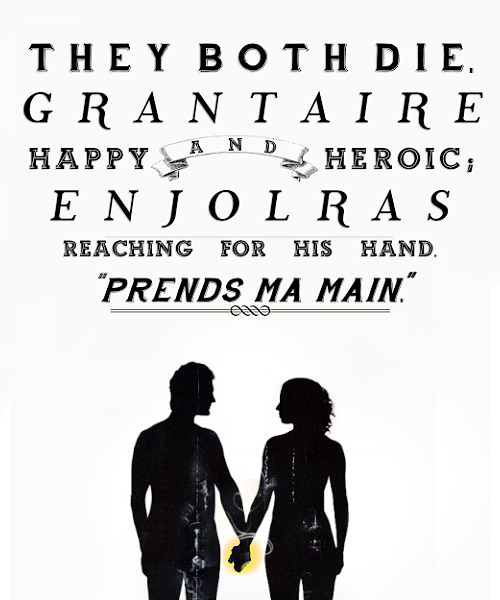
Inspired by and based on this post, which is a fragment of Victor Hugo’s original notes for Les Miserables, posted by flo-nelja. (Textures from planets-bend-between-us and rosebein.)
I write bullet-point meta now? Bullet-point meta is cool.
- If you think Eponine was a terrible person I will fucking fight you
- If you think Eponine was a pure virtuous saint I will fucking fight you
- If you think the most tragic thing about Eponine was that Marius didn’t love her back, look, I’m sorry, you are just plain wrong
- Eponine’s parents are awful people trying to raise her into an awful person and her entire adolescence has been a morally-degrading hell and SHE IS TRYING TO ESCAPE
- She doesn’t even make any claim to being a good person, she just wants OUT of the criminal underworld and begging and fraud and extortion and prostitution and robbery and assault
- She p. much considers herself a devil who’s trying to defect to the side of angels
- Marius is what sets all this off
- She puts him up on a pedestal of Virtuous Poverty b/c holy shit, an alternative to being Le Mauvais Pauvre
- No seriously Marius is what makes her realize how fucked-up her life is and how fucked-up she is as a result of her upbringing, and that she doesn’t have to just mutely accept it
- There is a hefty dose of sexual shame in why she considers herself Irrevocably Fucked-Up, she’s a 19th-century girl in a 19th-century world, but it’s so not the only thing going on there, and the ways Eponine is being sexually exploited and how they affect her fucked-upness is a subject that deserves a long-ass meta post all to itself
- And yeah, she hatches a wild plan to lure Marius to the barricades so they can die together
- This is not a relapse into her family’s Wicked Ways or a random act of capricious madness, it is a full-on goddamn Javert Derailed breakdown
- bc when you pin EVERYTHING on someone, not just your heart but your hope and your backbone and your moral compass, then yeah you can totally suffer in noble silence while watching him be in love with someone else, but the prospect of him DISAPPEARING AND BEING GONE FOREVER?
- does not compute
- critical error
- initiate self-destruct sequence and lock down Marius unit in closest possible proximity
- Yes this is pointless and selfish, in the general sense that Eponine is fucking drowning and clinging to Marius’ ankle to stay afloat and tries to pull him down with her rather than let him get out of the water
- And holy shit she manages to transcend that moment of total breakdown panic and fix the damage she’s done and let Marius go? A teenager with no guidance and a shitty amoral abusive upbringing and basically nothing except a dogged determination not to be the person her parents made her?
- Come back and tell me to my face that Eponine was a terrible person, ya little punk
- She is ambiguous and conflicted and trying so, so hard to do the right thing
Marianne is brilliant as always. One day I will write full-on Eponine meta, but in the meantime:
The main message Hugo was using Eponine to get across was a message about poverty and agency, not a message about love. (I like musical!Eponine, but Valar in Aman does her characterisation miss the mark by a margin the size of the Pacific ocean.) Les Mis is a novel about the inherent injustice and oppression of 19th century society; the majority of its characters are from the miserables class because Hugo is illustrating, in his indomitable Hugolian style, exactly what kind of people such an unjust and oppressive system creates. The Thernardiers are products of the system, and they are also perpetrators of it: having embraced criminality as the only way to get ahead, they do their damnest to ensure Eponine embraces it as well. Eponine, when we meet her, has had a lifetime of both overt abuse and soul-destroying poverty; I invite you to look around at our modern world and note exactly what that tends to produce even in the 21st century.
But if Hugo is writing against the injustice of the system, he is also writing in favour of those who have the strength of character to rise above their circumstances. (Valjean, of course, is the epitome of this.) This creates a degree of tension in the writing, as Hugo is trying to both show that the system is horrible because it produces horrible people and also say that some people are strong enough to not be horrible people despite the system, without negating his first point about the horribleness of the system. Eponine, in many ways, encapsulates that tension: she tries so hard to rise above her circumstances and Do the Right Thing, and she both fails and succeeds. Having fixated on Marius because he is the only adult in her life who has ever treated her like an actual person (and there’s a whole meta post in that alone), she sees him as a Way Out and is trying, desperately, to scramble away from her family and their entire way of life. Her actions w/r/t Marius are arguably the first time in her life that she makes decisions for herself instead of doing what she’s told; Hugo writes this as a good thing (Hugo likes agency), and thus she is given brief moments of heroism such as talking the Patron-Minette away from Valjean’s house on the Rue Plumet. That her agency later results in her luring Marius to the barricade on a suicide mission is specifically because of the hand she has been dealt: her situation is so desperate and all-encompassing that she requires Marius, at least emotionally, to escape it. If that is a failure of strength of character, she ultimately rises above it by telling Marius the truth, and dies in peace.
Eponine is, as with all of Hugo’s characters, a part of his message on the importance of breaking the cycle. Eponine specifically is a treatise on how fucking difficult it is to break the cycle when you’ve been dealt the shittiest hand in the deck — and thus, the importance of changing the deck so that people don’t get dealt those shitty hands any more. To read her as a terrible person because of her actions w/r/t the Marius subterfuge is to read her as a bit player in the Marius&Cosette story, which is to completely miss the point of her own story. It’s an important point; I’d encourage paying attention to it.