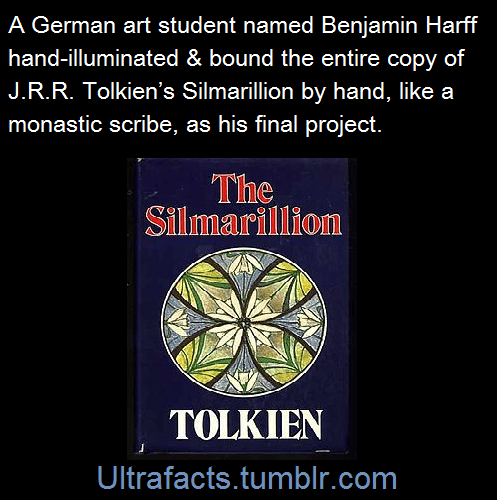
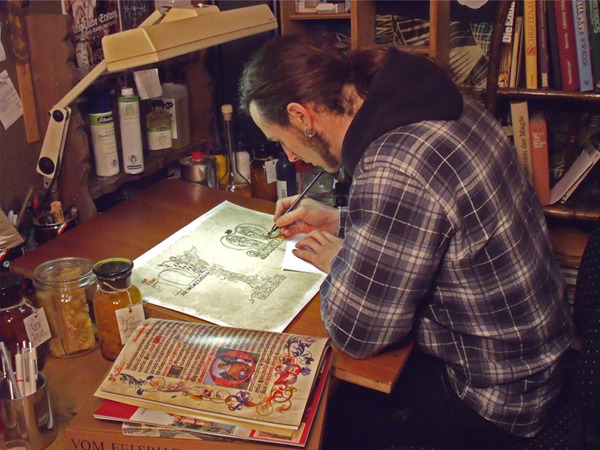
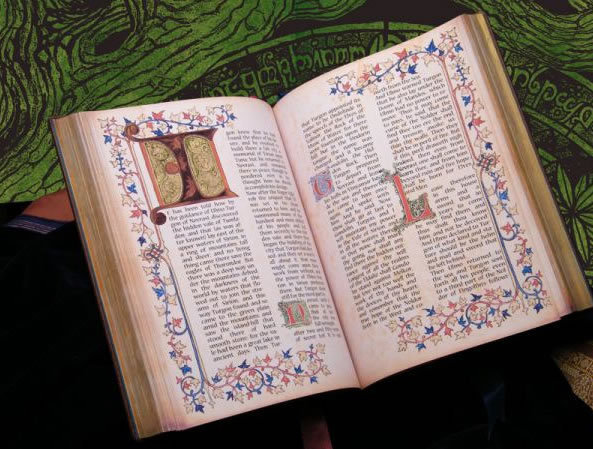
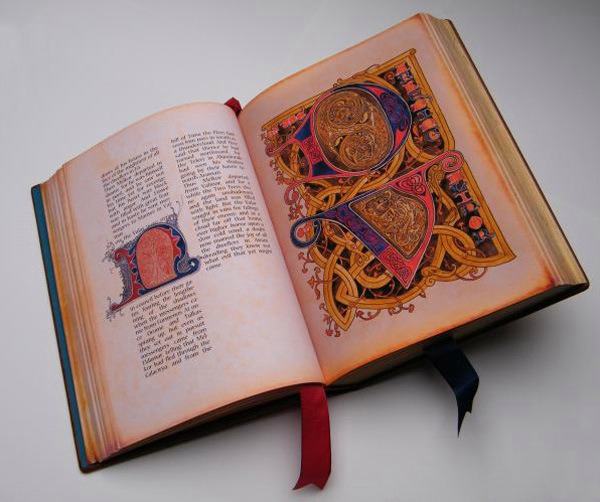
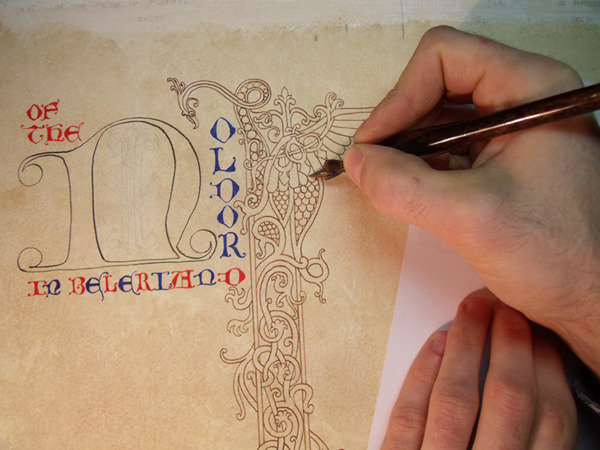
This German art student, Benjamin Harff, decided, for his exam at the Academy of Arts, to do something only slightly ambitious — to hand-illuminate and bind a copy of J.R.R. Tolkien’s Silmarillion. It took him six months of work. He hand-illuminated the text which had been printed on his home Canon inkjet printer. He worked with a binder to assemble the resulting book.
OMFG.
wow
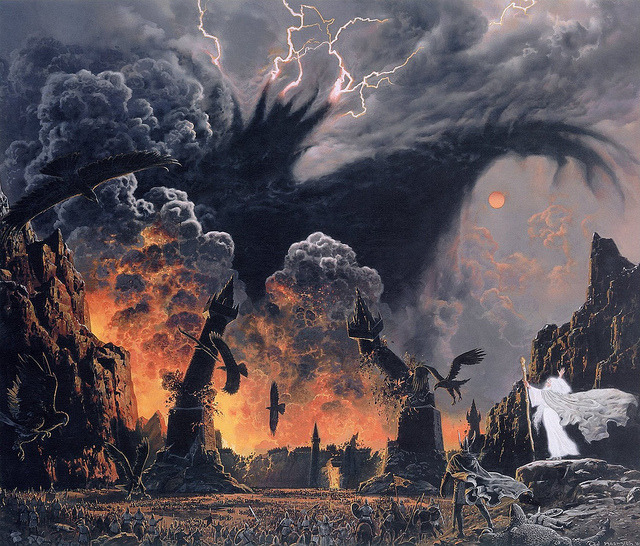
Can you tell me why Frodo is so important in lotr? Why can’t someone else, anyone else, carry the ring to mordor? – Anonymous
but someone else could.
that’s the whole point of frodo—there is nothing special about him, he’s a hobbit, he’s short and likes stories, smokes pipeweed and makes mischief, he’s a young man like other young men, except for the singularly important fact that he is the one who volunteers. there is this terrible thing that must be done, the magnitude of which no one fully understands and can never understand before it is done, but frodo says me and frodo says I will.
(when boromir is thinking of how he can use the ring to defend gondor, when aragorn is thinking of how it brought down proud isildur, when elrond is holding council and gandalf is thinking of how twisted he would become, if he ever dared—)
but then there’s frodo, who desires nothing except what he has already left behind him, and says, I will take the Ring.
it is an offer made out of absolute innocence, utter sincerity. It is made without knowing what it will make of him—and frodo loses everything to the ring, he loses peace and himself and the shire, he loses the ability to be in the world. It’s cruel, the ring is cruel, it searches out every weakness you have and feeds on it, drinks you dry and fills you with its poison instead, the ring is so cruel.
and frodo picks it up willingly. for no other reason except that it has to be done.
(the ring warps boromir into a hopeless grasping dead thing, the power of the palantir turns denethor into an old man, jealous and suspicious, it bends even saruman, once the proudest of the istari, into a mechanised warlord, sitting in his fortress and bent over his perverse creations—all the best of intentions, laid waste)
but there’s a reason gollum exists in the narrative, which is to show—well, to show what frodo might have been. because even as frodo grows mistrustful and wearied, as the burden of this ring grows heavier and heavier, he is never gollum. he is gentle to gollum. he is afraid—god frodo is so afraid for 2/3 of these books he is so tired and afraid, but he keeps moving, he walks though it would pull him into the ground, because he asked for this, he said he would.
someone else could have carried the ring to mordor, I suppose. the idea of a martyr is not dependent on the particular flesh and blood person dying for some greater purpose. but such a thing has to be chosen, lifted onto your shoulders for the right reason, the truest reasons, and followed into the dark, though it would see you burnt through and bled out.
I will take the Ring, though I do not know the way.
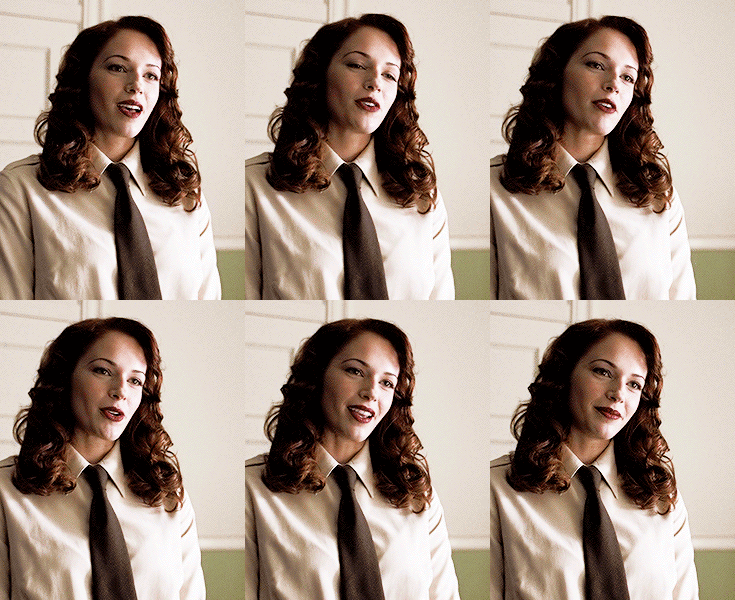
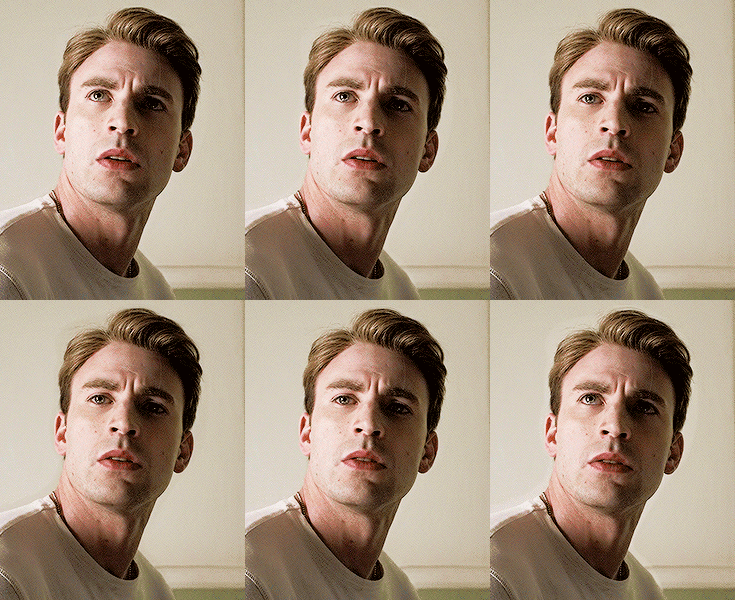
Steve Rogers did, in fact, realize that something was off when he saw the outline of the woman’s odd bra (a push-up bra, he would later learn), but being an officer and a gentleman, he said that it was the game that gave the future away.
#EXCUSE ME MA’AM BUT YOUR TITTIES ARE NOT CONES I’M CALLING BULLSHIT (via)
No, see, this scene is just amazing. The costume department deserves so many kudos for this, it’s unreal, especially given the fact that they pulled off Peggy pretty much flawlessly.
1) Her hair is completely wrong for the 40’s. No professional/working woman would have her hair loose like that. Since they’re trying to pass this off as a military hospital, Steve would know that she would at least have her hair carefully pulled back, if maybe not in the elaborate coiffures that would have been popular.
2) Her tie? Too wide, too long. That’s a man’s tie, not a woman’s. They did, however, get the knot correct as far as I can see – that looks like a Windsor.
3) That. Bra. There is so much clashing between that bra and what Steve would expect (remember, he worked with a bunch of women for a long time) that it has to be intentional. She’s wearing a foam cup, which would have been unheard of back then. It’s also an exceptionally old or ill-fitting bra – why else can you see the tops of the cups? No woman would have been caught dead with misbehaving lingerie like that back then, and the soft satin cups of 40’s lingerie made it nearly impossible anyway. Her breasts are also sitting at a much lower angle than would be acceptable in the 40’s.
Look at his eyes. He knows by the time he gets to her hair that something is very, very wrong.
so what you are saying is S.H.E.I.L.D. has a super shitty costume division….
Nope, Nick Fury totally did this on purpose.
There’s no knowing what kind of condition Steve’s in, or what kind of person he really is, after decades of nostalgia blur the reality and the long years in the ice (after a plane crash and a shitload of radiation) do their work. (Pre-crash Steve is in lots of files, I’m sure. Nick Fury does not trust files.) So Fury instructs his people to build a stage, and makes sure that the right people put up some of the wrong cues.
Maybe the real Steve’s a dick, or just an above-average jock; maybe he had a knack for hanging out with real talent. Maybe he hit his head too hard on the landing and he’s not gonna be Captain anymore. On the flipside, if he really is smart, then putting him in a standard, modern hospital room and telling him the truth is going to have him clamming up and refusing to believe a thing he hears for a really long time.
The real question here is, how long it does it take for the man, the myth, the legend to notice? What does he do about it? How long does he wait to get his bearings, confirm his suspicions, and gather information before attempting busting out?
Turns out the answer’s about forty-five seconds.
Sometimes clever posts die a quiet death in the abyss of the unreblogged. Some clever posts get attention, get comments, get better. Then there’s this one which I’ve watched evolve into a thing of brilliance.


I adore these pictures of me, Hayley and Matt Just Buy The Toad Photography took of us this weekend!
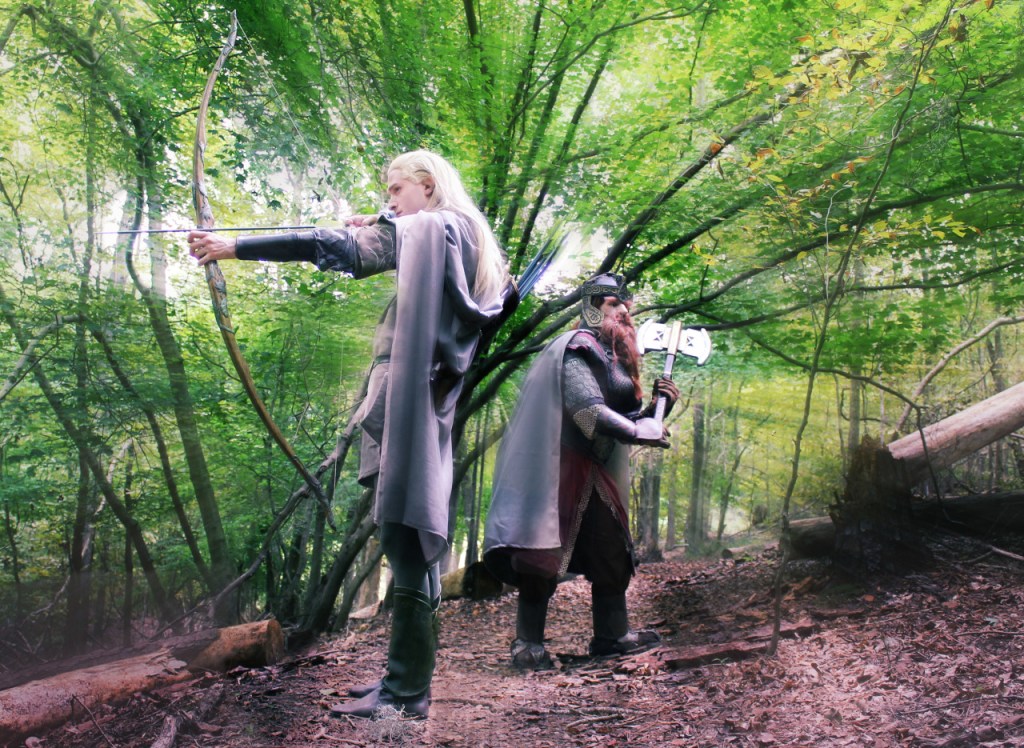

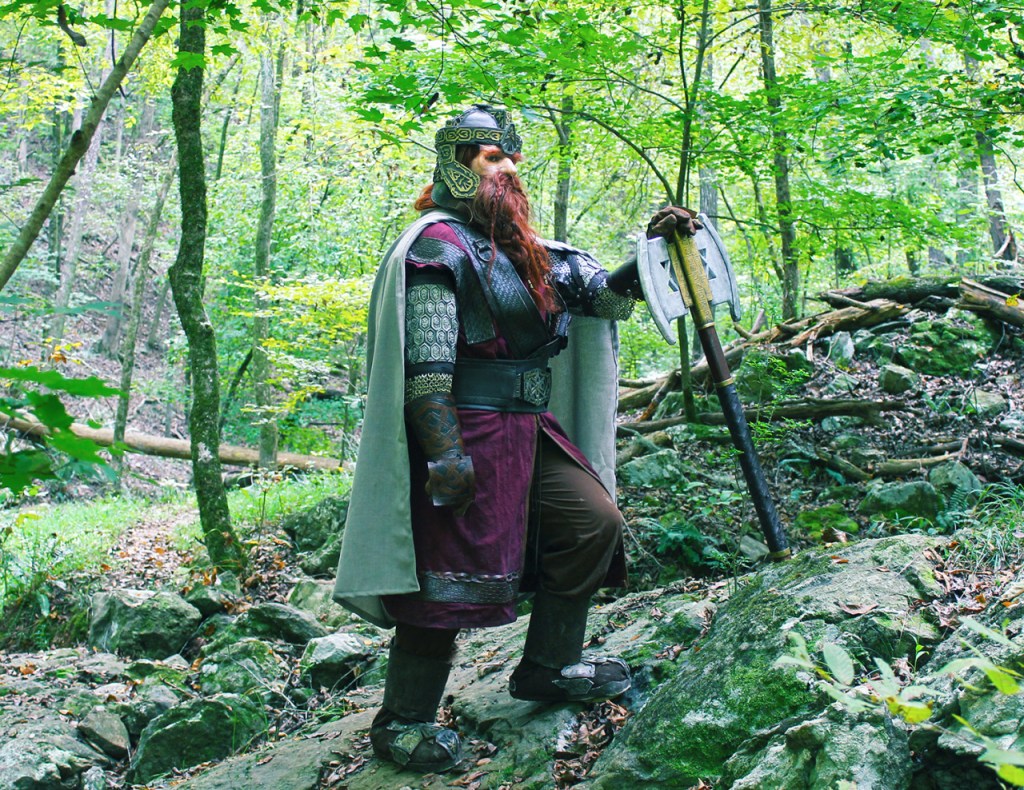
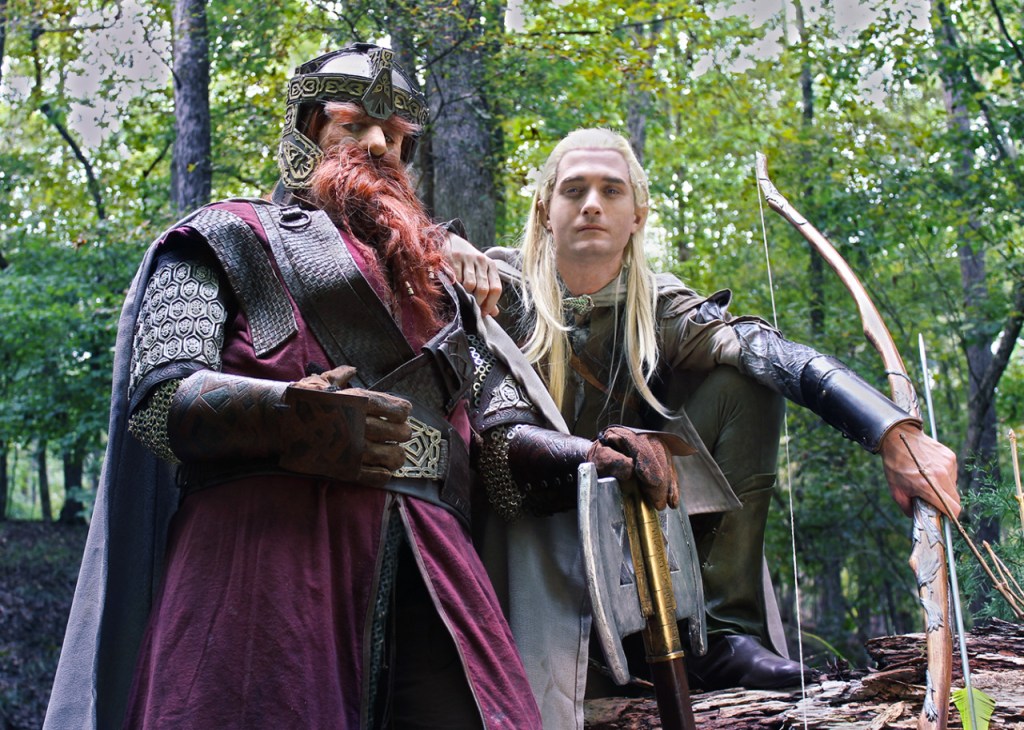
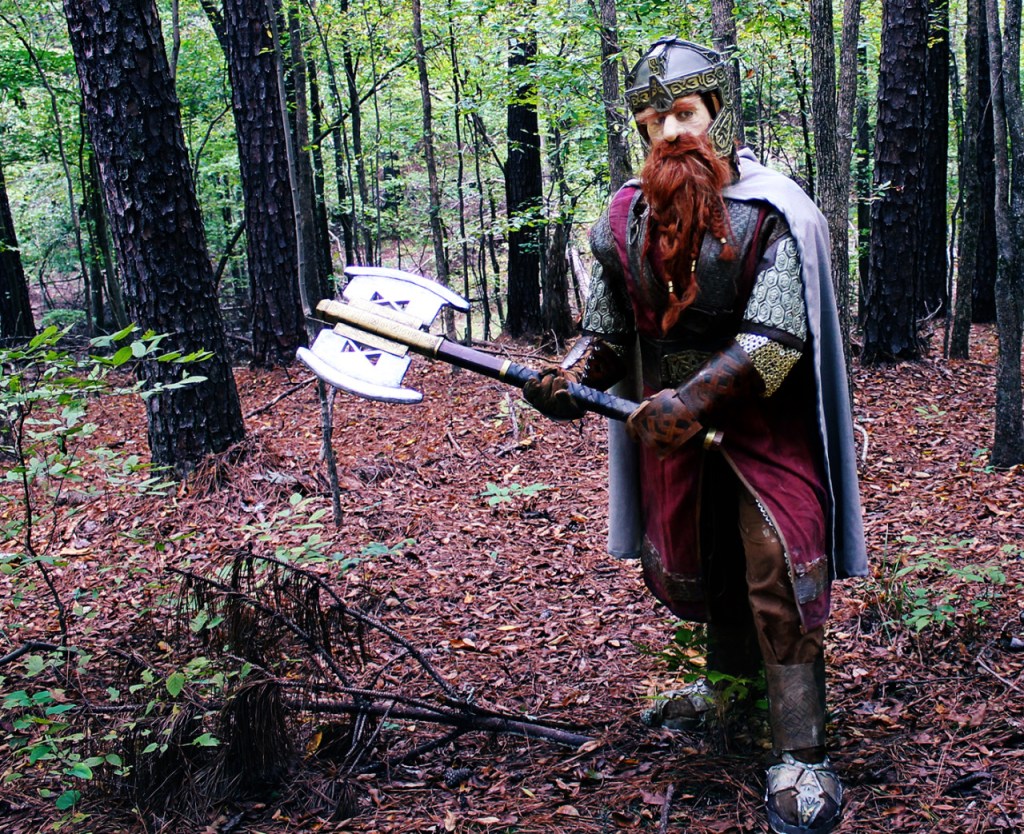
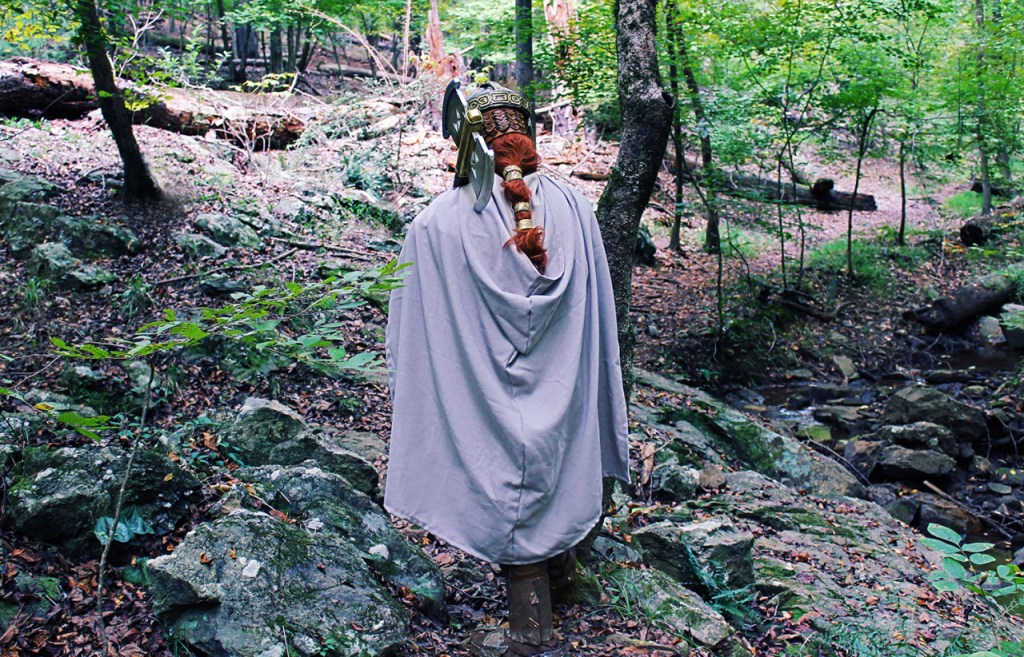
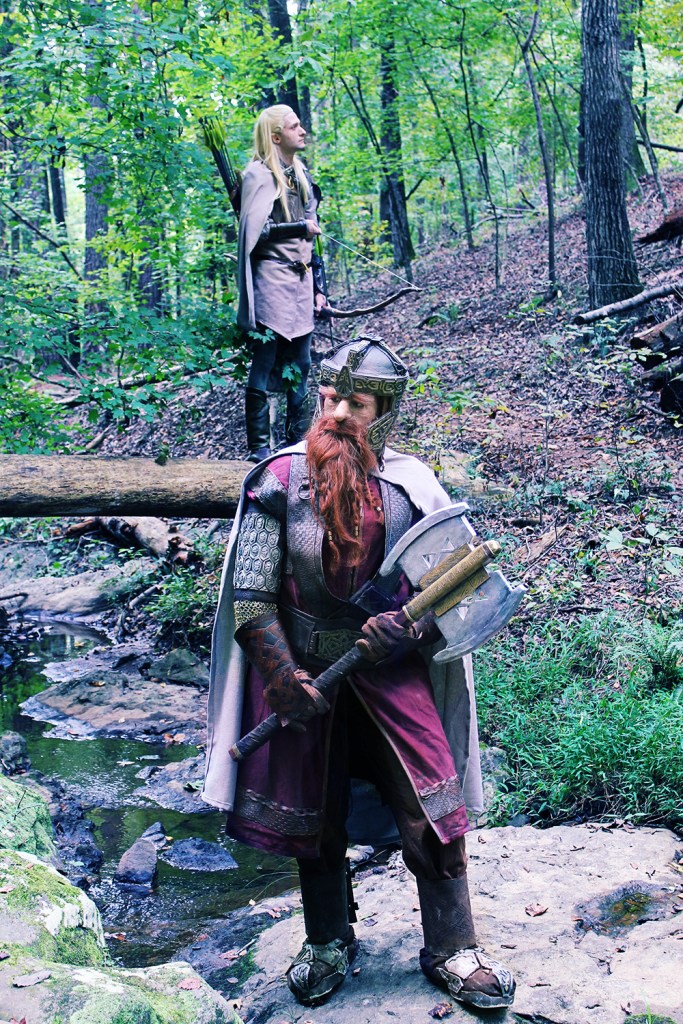
We celebrated the last day of Tolkien week, with a Legolas/Gimli romp in the woods!
Legolas and Gimli costumes by me
Gimli prosthetics, hair work and props by me
Our awesome friend Howie helped us set up these shots and manned the camera for us! We have great friends, indeed.
Wanna see more of my work? Visit my FB page and give it a like if you feel so inclined: https://www.facebook.com/CelticRuinsCostumes
This town in Russia is called Zheleznogorsk.
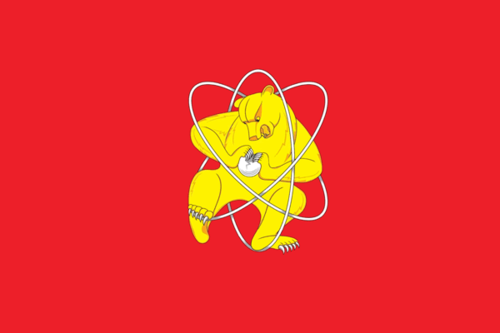
Their flag and coat of arms is a bear splitting the atom.
That is all.
*kicks down door, knocks over end table, vase crashes to the floor*
No that is NOT all, because Zheleznogorsk is really interesting.
It was a secret city, established in 1950 in the middle of Nowhere, Siberia for the purpose of researching nuclear weaponry and producing massive quantities of plutonium, the facilities for which were hidden inside a hollowed-out mountain. It appeared on no maps, and had no census data. Although more than 100,000 people lived there at one point, satellite imagery would have shown only a fairly small mining town. The mountain complex contained 3,500 rooms and three plutonium reactors, which were kept cool by one of the mightiest river in Siberia. The space had been excavated by tens of thousands of gulag slave laborers, who removed more rock from inside the mountain than was used to build the Great Pyramids. Protected under the granite peak of the mountain, these facilities would survive a direct nuclear attack.
No one called it “Zheleznogorsk.” Officially, it was “Krasnoyarsk-26,” which is something like naming a city ‘Arizona-17.’ Residents traveling outside the city called it Iron Town, if they had to refer to it at all. They were under strict instructions never to reveal to anyone the actual business of Krasnoyarsk-26.
And life there was fantastic. People living and working in the secret city received some of the best wages in the Soviet Union. There were sports stadiums, public gardens, a movie theater, and the shortages notorious in the rest of the USSR were unknown. The best nuclear scientists in Russia lived in a sealed-off utopia.
A third of all the nuclear weapons produced in Russia during the Cold War were powered by fuel from Zheleznogorsk. At the time, the image of the great Russian bear ripping an atom apart wouldn’t have seemed very funny at all.
I love the history side of Tumblr
UM, SO. MY GRANDFATHER ACTUALLY BUILT THIS TOWN, AND HELPED RUN IT FOR MANY YEARS.
He was a (Jewish) university student with a degree in electrical engineering (he volunteered for military service after his dad was killed in WWII and served during wartime even though he was underage and medically prohibited from serving in the military. He faked his papers and went to “avenge his dad” at 17.)
Anyway, after the war he started uni and graduated with a Master’s in engineering 5 years later, in the early 50s. He was then due to receive his mandatory 3 year assignment (as all Soviet uni students did – higher education was free, but you spent your first three years working wherever they sent you), except instead he was tapped by the KGB, for reasons he wasn’t clear on until his death (he has several relatives declared Enemies of the State during Stalin’s purges, and he was Jewish, so not exactly a prime candidate for top secret work.)
Anyway, they sent him to the middle of nowhere, Siberia, where he lived in a tent in the wilderness with a few other guys, and was in charge of building a city. It took over a year before any of his immediate superiors even moved out there, because it was literally in the middle of a snowy forest. My grandfather was in charge of making a city plan, laying roads, building houses, building the nuclear facilities, all of it. Eventually he and tent-mates moved into temporary houses, and then eventually real houses.
He wasn’t a nuclear scientist, he worked on the logistical side of the city, but he continued to run it until he left. They were in charge of all the infrastructure, including work inside the nuclear reactors. He was involved in an accident once, where a “minor” bomb exploded and knocked down a bunch of protective walls and he was in the hospital for a while, with radiation poisoning among other things.
Some of the most gruesome stories my grandfather used to tell were about supervising the prisoners who were extracting rock from the mountain. It was not only slave labor, it was also a death sentence. They were not given safety equipment and the rock dust would quickly settle in their lungs. Since they had nothing to lose the prisoners did everything to prolong or fuck up the process of carving the mountain. They’d set clever traps that would only be discovered months later and delayed construction. To be clear, tampering with this system, or with the fates of the prisoners, was considered treason, punishable by death. Similarly, any serious fuck up in constructing the town and facilities my grandfather was in charge of, would have similarly meant a conviction for treason and a potential execution for my grandfather.
Eventually on one of his vacations back home my grandfather met my grandma, they wanted to get married but she had to get security clearance before they let her move to a secure zone. This was actually a huge problem, and my grandparents lived apart for months when my grandpa had to go back to work and my grandma wasn’t allowed to join him. You see, my grandmother, who was 11 when WWII broke out, had to account for every single day during the war to prove she had actually been in a concentration camp the whole time and hadn’t been aiding the Germans and their allies (my grandmother was Jewish). If even one day was unaccounted for she’d be considered too risky to let into a place like Krasnoyarsk-26. She had to produce documents, witnesses, etc.
Eventually my grandparents were reunited, and life in Krasnoyarsk-26 was indeed pretty awesome. They had everything, no expense was spared. My grandmother, who had a teaching degree, became the teacher of the small school they eventually established for the children of the residents.
Probably my favorite story is how my uncle was born. My grandmother’s relatives obviously didn’t know anything about where she was, but she did write letters and tell them she was pregnant with her first child (she was also the firstborn, so it was the first grandchild for the family). Her mother, my great-grandmother, insisted on coming over to help her during and after the birth, as otherwise it was just my grandparents living on their own in their little apartment, and my grandfather would obviously not get any paternity leave.
This was strictly forbidden, no unathorized people were allowed into the town, and my grandfather wrote to his mother-in-law telling her as such. This did not even slightly deter my great-grandmother, who, among other things, managed to pull 5 little girls through Nazi concentration camps all on her own. She completely ignored my grandfather, packed her bags, went to Krasnoyarsk (the actual, non-secret city) and started asking questions about this mysterious Krasnoyarsk-26 and where she might find it. Eventually she actually managed to figure it out and showed up at the gates of Krasnoyarsk-26 asking for my grandfather. Since he was well known and well liked my grandfather was alerted to deal with the problem, and my great-grandmother made it clear to him that she wasn’t leaving. He had to sneak her in through a secret passage, basically making a long journey in the snow, and eventually illegally brought her into the city. This is probably my favorite story about my great-grandmother.
Eventually my mom was born, and as a child started having health issues. She got sick a LOT and the doctors told my grandparents that she wouldn’t survive another Siberian winter. My grandmother took her back to the south of Ukraine, to live with family, and my grandfather had to find a way to quit his job and join them. You have to understand you didn’t just quita top secret nuclear facility in the Soviet Union. No rules applied here, there were no workers’ unions. You worked there until your services were no longer needed.
My grandfather explained the situation to his superior, and his superior literally pulled out a map of the Soviet Union and said “point to any place on this map and I will find a sanatorium for your wife and children where they can live as long as they like, at the state’s expense, and enjoy every comfort and top notch medical treatment. We can do that for you, but you have to stay here.”
My grandfather refused and said he wouldn’t stay without his family, and his family couldn’t live here anymore, so. They actually eventually did let him go! He counted himself exceptionally lucky.
And then of course when he came home to Ukraine and was reunited with my grandmother he found that because the work had been top secret, it was like his record didn’t exist, and antisemitism in the real world was so severe that no one would give him a job as even a lowest level engineer. He spent months going to interviews, sending his paperwork everywhere and trying to cash in every favor he could just to get any kind of work. Eventually a friend from uni set him up somewhere, with a lower wage and a lower level position than he deserved going purely by his years of experience, nevermind the kind of work he actually did.
I only found out about all this in bits and pieces, and the majority of it started making sense in my head when my grandfather started sharing more, closer to when he died. I actually had no idea about any of this until I joined the military and became an intelligence officer. My family always used to laugh or not get why I couldn’t tell them things, but my grandfather suddenly started displaying a lot of sympathy and understanding for my position.
“There are secrets I signed my name to that I’ll never tell anyone,” he used to say. And i’d say “but grandpa, it’s been 60 years! It’s all been declassified, besides!” And he’d say “that doesn’t matter. I signed my name and I gave my word. I can talk about what daily life was like, but I’ll never talk about happened in the classified facilities. Not even when they make shows about it on television. I’ll never betray the promises I made.”
One part that was super fun/surreal though was comparing classification and information security protocols with my grandpa. “Oh did you do that as well? How interesting!”