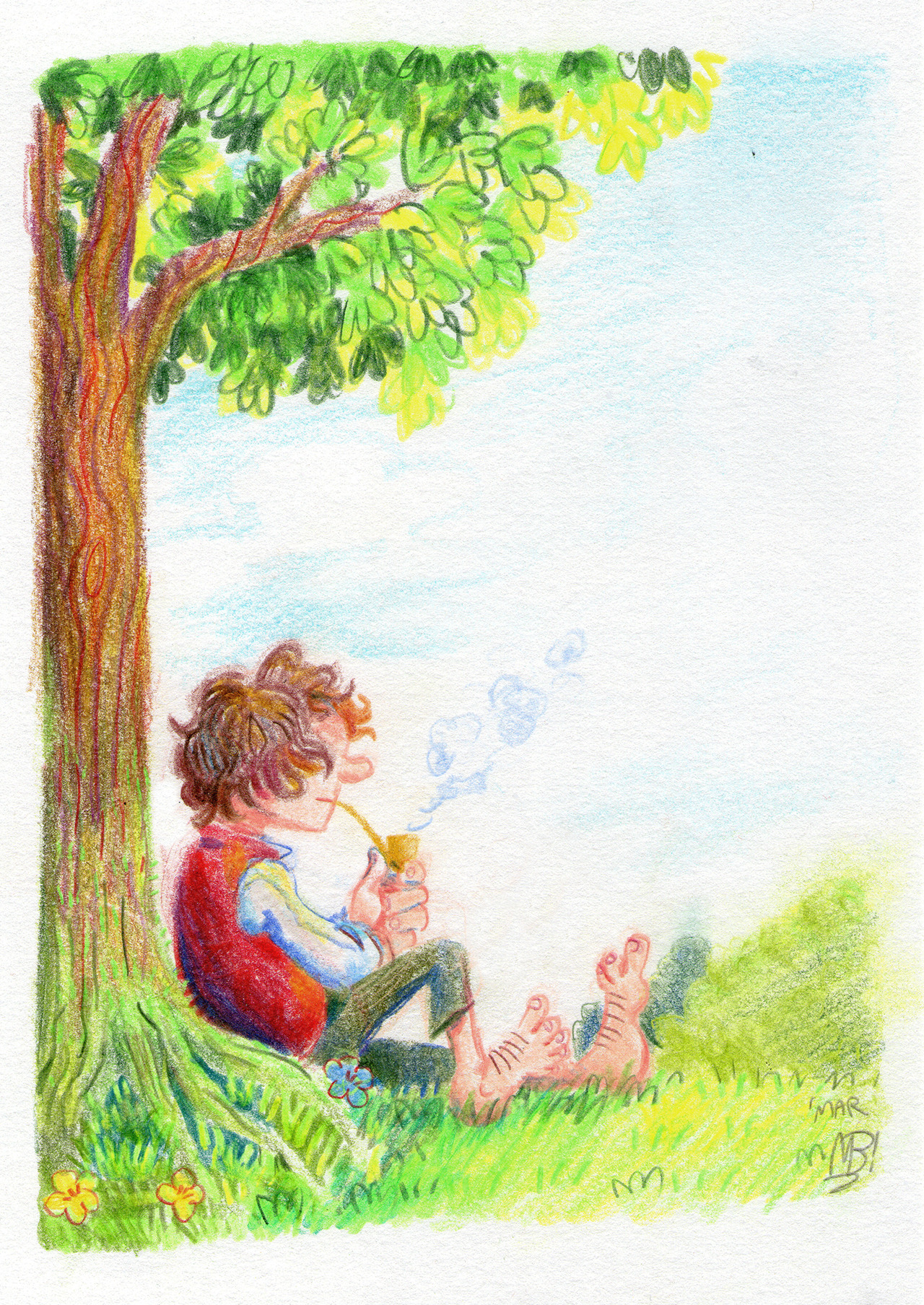
The finest pipeweed in the Southfarthing
One overlooked thing that really sets the Lord of the Rings films apart from other franchises is how earnest they are-
Most movies are so afraid of being “cheesy” that whenever they say something like “friendship is the most powerful force in the world” they quickly undercut it with a joke to show We Don’t Really Believe That! ;) Even Disney films nowadays have the characters mock their own movie’s tropes (”if you start singing, I’m gonna throw up!”) It’s like winking at the camera: “See, audience? We know this is ridiculous! We’re in on the joke!”
But Lord of the Rings is just 12.5 hours of friendship and love being the most powerful forces in the world, played straight. Characters have conversations about how much their home and family and friends mean to them, how hope is eternal, how there is so much in the world that’s worth living for…. and the film doesn’t apologize for that. There’s no winking at the audience about How Cheesy and Silly All This Is; it’s just. Completely in earnest.
And when Lord of the Rings does “lean on the fourth wall” to talk about storytelling within the film, it’s never to make jokes about How Ridiculous These Storytelling Tropes are (the way most films do)…. but instead to talk about how valuable these stories can be. Like Sam’s Speech at the end of the Two Towers: the greatest stories are ones that give you something to believe in, give you hope, that help you see there are things in a bleak violent world that are worth living for
lies:
camillavirgil
replied to your photosetBook Faramir IS the best Faramir
The change to Faramir’s character in The Two Towers was by far my biggest disappointment with the movies. I discussed it with other fans back in the day, watched and rewatched the BTS features and listened to the commentary tracks, and ended up mostly defending the filmmakers’ decision in online debates. But it was always a little (or more than a little) sad for me that they did that.
I know the arguments on both sides. I know why they felt they had to do it. No one is giving me hundreds of millions of dollars to adapt a sprawling, multi-book epic to the big screen in a way that will justify its enormous budget and satisfy everyone from lifelong lovers of the source material (*waves*) to new fans and casual “eh, sure; I’ll watch it” types.
But I’ll always regret that they couldn’t find room for the actual character from the books, the one who wasn’t going to undercut Aragorn or his struggle just by existing, but also wasn’t going to beat up Gollum or send the Ring to Denethor, because those things were wrong, and he saw himself as bound by that.
There’s a clip of David Wenham describing how he went to Jackson/Boyens/Walsh (or maybe it was just a story recounted by one of the latter trio; I can’t remember now) after he’d read the books (which he hadn’t when he was cast), and saying hey, you know, this actually seems like a significant change to my character. And them telling him yeah, we know, but we need to for all these reasons (*enumerates reasons*) and anyway he ends up in the same place, right?
Yeah, no. I mean yeah, he ends up having made the same decision. But he’s not the same person. How he gets there matters.
I want to believe a movie could have been made that didn’t sacrifice his character in the name of storytelling. It wouldn’t have been the same movie; might not have been as successful a movie. But I would have loved it.
I’ve mentioned that I’m reading the books again, out loud with my co-conspirator at night, the way we used to do. We just finished the Council of Elrond, and it was a thrill to realize that the brother Boromir referred to (though not by name) was the real Faramir, my Faramir.
I can’t wait to meet him again.
I have a Grand Unified Theory of LOTR that I created to reconcile the books and the movies; it satisfactorily resolved the Faramir issue for me, among other things.
The basic idea is that the books and the movies are two different histories of the same events created by different cultures with different sources and agendas. (Inspired by Tolkien’s conceit that the books were translated from the Red Book the hobbits wrote.)
Book-LOTR is mostly drawn from first-person hobbit accounts, with added accounts of things the hobbits didn’t see from other people. Movie-LOTR is a Gondorian history made several centuries after the events, with a clear cultural bias toward humans and Gondor.
Thus, in the movies: the humans are more prominent, the hobbits are younger (because they look like children to Gondorians), the romance of Aragorn and Arwen (their legendary king and queen) gets a lot of screen time, and Faramir… well, he’s no more comprehensible to later Gondor than he was to his contemporaries. He’s a great hero of their history, and it’s on record that he let the hobbits go, but how do they reconcile that with their cultural values? By making his story all about loyalty to his liege lord and his emotions about his father, rather than letting him be the ethical intellectual (with considerable grasp of the lore and history of his world) that the hobbits met. Movie-Faramir is written to make sense to people with a worldview and priorities more like Boromir’s.
According to this theory, Frodo’s Red Book account of his philosophical conversation with Faramir about war, Gondor, the Ring, etc. is a much better historical source for the “real” Faramir than the stories people tell in Gondor centuries later about one of their ancestral heroes. This pleases me, since I too am attached to book Faramir.
“the same events told by different people with different biases” might be the solution to every book-movie problem ever, every character continuity problem ever … so many things.


Frodo…I swore to protect you.
#lotr#sometimes I think about how real authority – real kingship especially – is at heart service and submission#and how Aragon spends his life (ranger or king or friend) serving others#kneeling before them#affirming the kingship of other kings EVEN THOUGH he sometimes outkings them!!#and the moment of his greatest authority is really a submission of his will to his vocation#when I say I sometimes think about this#I mean easily 2-3 times a week (via byjovimbeinghumble)
the hobbits with Aragorn: McDonald’s! McDonald’s! McDonald’s!
Aragorn: there’s food at home
hobbits, muttering: I fucking hate this familythe hobbits with Gandalf: McDonald’s! McDonald’s! McDonald’s!
Gandalf: [pulls into drive thru]
hobbits: [cheering]
Gandalf: one black coffee pleasethe hobbits with Boromir: McDonald’s! McDonald’s! McDonald’s!
Boromir: McDonald’s! McDonald’s! McDonald’s!
So there’s that scene in The Two Towers where everyone’s holed up in Helm’s Deep and are super outnumbers and probably gonna die.
To bolster their forces, they decide to arm the old men (ok, fair enough) and … the young boys? Meanwhile all the women cower in the caves.
What.
Like excuse me, in what way is a nine year old peasant boy with no training, who can barely see over the battlements, and who can probably barely lift a sword … in what way is that small child a more suitable combatant than an angry peasant woman who’s been slinging haybales and taming horses and rolling big barrels of mead and lifting pigs under her arms for all thirty years of her life. At the very least she can see over the battlements and lift a weapon. Depending on her place in society she almost certainly knows how to hold a rake or a scythe or a hammer or lift logs. She knows how to butcher animals, and has likely done so many times with giant knives and gotten covered in gore and viscera. Give her a cleaver on a stick and say “have at it, ma’am.”
Nobody in Helm’s Deep should be giving a flying fuck about “gender roles” when there’s an army about to come in and slaughter them to the last child. They should be thinking strategically. And strategically, arming untrained children is a bad idea, and arming strong adults with a basic grasp of how to wield a big weapon is a good idea.

Sam’s shirt says “I love my old gaffer.” Just in case you were wondering.
For the rest of the Broship of the Ring series, click here!