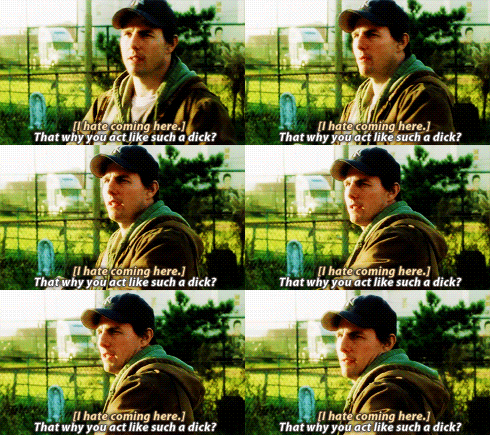
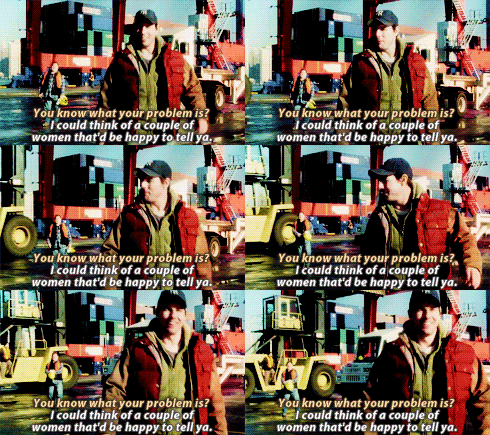
Can we just talk for a moment about Anakin Skywalker becoming Darth Vader? He and Palpatine kill Jedi master Mace Windu, and Anakin staggers back and asks himself what he’s done.
Anakin knows this is wrong. He is so disgusted with himself. And here:
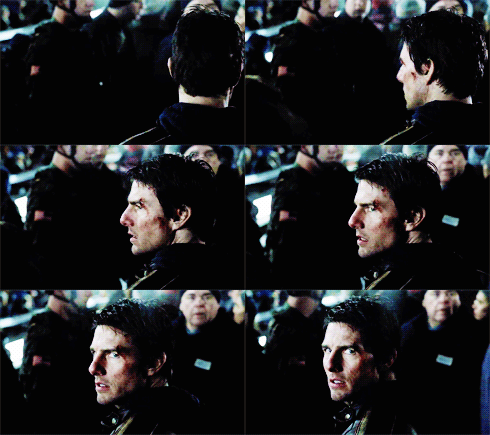
He is pledging himself to Darth Sidious.
Does this look like the face of a self assured Sith? No. This is the face of a man who is so desperate to save the one he loves that he is willing to give up everything he is.
Sure okay, Anakin has always had “a little dark side in him.” But Anakin believed in the Jedi. He wanted to help people. But according to Palpatine only a Sith could save people from death.
So here we have Anakin Skywalker, who is supposed to be a selfless Jedi, giving into his selfish desires to save Padme. This scene is so painful because we know that Anakin knows that he shouldn’t be doing this. But he loves Padme so much that he is willing to give up everything, every fiber of his being, to save her.
He is so distressed and disappointed in himself. His fall to the dark side wasn’t an easy thing to do and he knew better.
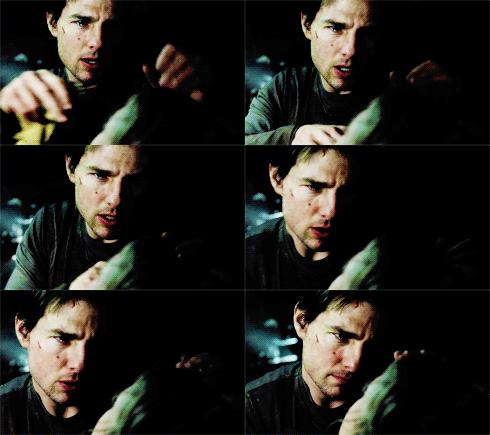
And here:
Anakin on Mustafar after he’s killed the separatists. You cannot tell me this is a man who isn’t loathing himself and what he’s become.
Flash forward to Darth Vader finding out Padme is dead, all his efforts were in vain. He cannot go back, the Jedi Order is decimated. No one would help him, surely not any remaining Jedi. He is trapped. The Emperor is the only one to give him purpose now.
Anakin convinces himself that he is irredeemable, that he has fallen so far that no one can save him or ever want him again.
That is until he meets his son, Luke Skywalker. He sees so much of Padme in him. Padme always saw the good in everything. And Luke sees right through Darth Vader, right into the heart of Anakin Skywalker.
And even though Anakin has done horrible things, Luke believes in him. Luke sees right through the masquerade that is the Sith Lord and sees the light and goodness of Anakin Skywalker. Luke sees what Anakin wanted to be but was convinced he wasn’t.
Luke Skywalker saw and deemed Darth Vader worthy of redemption when no one else would.
I’ll never forget seeing ROTS for the first time because it was such an experience, unmatched by anything else I’ve ever seen in the theatre (even ROTK, which was a pinnacle), mostly because we went to a midnight showing (and it remains the only movie I’ve ever done that for – and by unplanned happenstance I turned around and saw it again later that day, which I’ve also definitely never done for anything else. I ended up seeing it a number of times and remember each one with an odd clarity). anyway, at that first showing, the feeling and hype in the audience was so palpable. It wasn’t simply opening night excitement, it was also hushed tension. After all, we knew what was coming, but even forewarned, we couldn’t be entirely prepared.
There was a live choreographed lightsaber fight in the theatre beforehand. People screamed and cheered when the main title started, and the cheering and gasps continued on until the scene at the opera, and then the dread crept in, and everything got more and more quiet – and would remain that way until the final credits, until the return of that triumphant score we know so well, which sent everyone into applause. I had cried so much that even my waterproof mascara wasn’t totally immune, and still the rapture of hearing that music immediately uplifted me as I clapped with everyone else, as though it were a balm to our collective spirits.
I had spoiled myself and already read the novelization, yet witnessing this descent still broke my heart. And the thing is, we know it’s inevitable because we know the original trilogy, but the narrative didn’t make it feel inevitable until that last moment – there are chances that could’ve been taken, choices that could’ve been changed, by a myriad of characters, that would’ve altered this course. The dominoes fall and it isn’t fate, it’s the tragedy of free will.
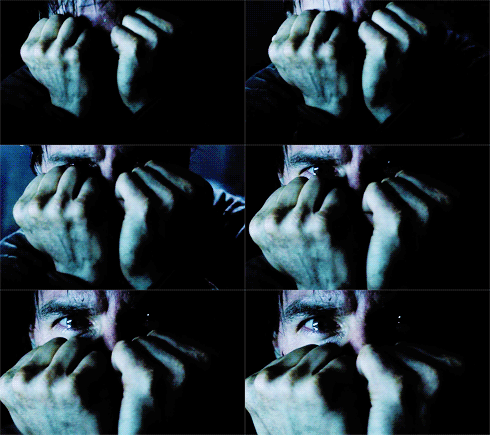
Anakin’s surrender and pledge to Palpatine in the scene cited above made me feel physically sick, I remember my hands shaking the first time I saw it, and how tightly I gripped them together. That scene plays entirely as subjugation and abuse. Palpatine has done nothing but manipulate him, lie to him, gaslight him, and because he has to hide so many of his feelings and truths, because the Jedi are so rigid that he is unable to go to them and tell them what he’s struggling with, because he can’t consult them about Padme or be honest about their relationship, he is stripped of his power, he loses every one of his support systems, and he has nowhere else to turn. He staggers and collapses to his knees in horror, and Palpatine lords over him, distorts meaning into the slaughter, convinces him that taking up the mantle of the Sith is the only way to save the woman he loves, and the Republic, and freedom in the galaxy. Crushing power as the answer, which of course is corrosive and corrupting. It’s an ugly, cruel, and very carefully crafted deceit. I’m not absolving Anakin of his decision here, he could say no, he still makes the choice to follow the Dark Side and to carry out the brutality that follows, and that is indefensible. But every vulnerability he has is exploited.
This was a little boy who was brought up in slavery. Who knew cruelty and fear and the danger of not following orders at a young age, and yet he still immediately asserts his agency when we meet him (”I’m a person and my name is Anakin”). He is bereft of his mother – a mother he later loses horrifically – and brought into an acetic order that doesn’t have the patience to work through his trauma, his anger, or his grief with him, and so it festers, turns rebellious. He’s also brave, quick-witted and talented, caring, often thoughtful. His emotions aren’t a hindrance, they’re often a strength, but the Jedi keep hammering the idea into him that feeling is somehow wrong. He dreamed of being one of them, and they tell him over and over that he’s “the Chosen One,” and yet they undermine everything that makes him who he is. His identity is constantly either undercut or obscured, and he lashes out while he’s trying to establish who he is as a person, but he also manages to gain respect, become an accomplished Jedi, a war hero and general. Initially, there is nothing in him that craves or idolizes evil. His desire to be a powerful Jedi is rooted in a want to make the galaxy more stable, to reach out to those who need help.
He rejects the philosophy forbidding love so thoroughly that he reframes it as a mission statement of sorts: “Compassion,
which I would define as unconditional love, is essential to a Jedi’s life. So you might say that we are encouraged to love.”
He falls deeply in love with a woman who is not only intelligent and beautiful and a leader, but who shows him soft kindness that he’s never known, equality, and balance (which he desperately needs – balance is such a key theme in the prequels, and to me, it’s Padme who first embodies it), she extends her mind and her heart to him, and their bond is powerful. (I could write more about why I think their relationship works better than it’s often given credit for – at first – but that’s another ten page essay). They love and console each other, they understand one another and show one another their whole selves, and they can be sweet and passionate, but they also challenge each other, and learn from one another, and expand each other’s worlds. His capacity for love and loyalty is so immense, and his fear of loss so acute (given everything he endured so young), that it twists into something that becomes his downfall.
He believes his mentor and best friend has betrayed him, he believes the Order has turned against him, he believes that if he doesn’t do something immediately, his wife and unborn child will be dead. And in that instant when he breaks, Palpatine preys on him, and that small seed of darkness is consuming. He knows what it is to say no to a master and be punished. He is shackled again, by his mistakes, by his fear, by the Dark Side, by the hideous cunning before him. Palpatine knows this isn’t enough, and sends him to Mustafar, pushes him as far to the brink as he can, lays the trap for either his death or his damnation. The tragic events that relentlessly unfold there at Anakin’s hand are the final ruination of his soul, and the scorching ground that destroys him physically allows him to be enslaved once more. Palpatine gets more than he could have anticipated – the death of everything human and light that defined Anakin, and the rise of everything artificial and ruined that define Vader. He is a shell (”more machine now than man”), and no one ever looks at him as a human being after that. He’s a towering inferno, a nightmare in the dark, a symbol of an oppressive regime. No one would know that he himself came from abuse and oppression, and that he still exists under the constant weight of it, and deflects it with fury and cruelty. He does irredeemable things, things for which there is no real atonement, and there’s a detachment to all of it, a hollowness underscored by that rattling, metallic breath.
And then he finds out his son is alive. It may be the first time he’s felt an emotion in almost 20 years, and even if that emotion is anger or confusion or frustration, it’s something. He tries to tempt him to the Dark Side, manipulate him as he was manipulated, but Luke is bright and obstinate and good, and he refuses. Every time, he refuses. He won’t fall, he won’t fail. He puts his friends ahead of his training. He doesn’t have to suppress his ability to love. Even when his supposedly wise teachers tell him Vader is beyond all hope, Luke dares to keep hoping. Luke accepts the truth of him being his father, he calls him by his real name. He insists with calm, steady defiance that his father won’t betray him, even when Vader resists this bond. I always thought that scene in ROTJ was really interesting because of the way in which Vader responds, the first time we truly hear anything more than malice in that resonant voice – there’s suddenly a regret in it. “Obi-Wan once thought as you do. You don’t know the power of the Dark Side. I must obey my Master.” It’s resignation. It’s years of heinous orders being carried out, the drowning noise of war; it’s years under threat, of continual devastation, of violence begetting violence. Luke implores, “Let go of your hate,” and the quiet, measured response is, “It is too late for me, son.” It’s the first time Luke acknowledges that his father might truly be dead, and after Luke is taken away by the Imperial guards, Vader walks to the railing of the bridge and slightly hangs his head. He’s had no reason to feel anything for years – all the horrors and sorrows have been empty – and suddenly this one little flicker of emotion is daring to spark.
And when Luke is faced with certain death, rather than fight, rather than harm his father – a father he never truly knows, someone he very understandably should fear or even revile, and yet he still sees the man beneath that mask, he still knows someone human exists there, and no one has seen that since that final day on that burning hell of a planet – Luke throws his lightsaber aside and says, “I will not fight you, father.” The Emperor comes for him, painfully tortures him, and Luke still calls out to his father, and seeing his child hurt brings back his defiance, the sense of protection he had so long ago, and Luke sees the light in him the way Padme once did, and Vader rises up in a final transcendent act of resistance and casts his master down. In that moment, Vader dies, and Anakin, while mortally wounded, lives again. It is not redemption for what he wrought, but it is an act of salvation. Lucas himself said, “Anakin can’t be redeemed for all the pain and suffering he’s caused. He doesn’t right the wrongs, but he stops the horror. The end of the Saga is simply Anakin saying, ‘I care about this person, regardless of what it means to me. I will throw away everything that I have, everything that I have grown to love – primarily the Emperor – and throw away my life, to save this person. And I’m doing this because he has faith in me, loves me despite all the horrible things I’ve done. I broke his mother’s heart, but he still cares about me, and I can’t let that die.’ Anakin is very different in the end. The thing of it: The prophecy was right. Anakin was the Chosen One, and he does bring balance to the Force. He takes the ounce of good still left in him and destroys the Emperor out of compassion for his son.” (x)
It’s a circle of compassion, forgiveness, love. He has Luke take off his dreaded mask and looks upon him with his human eyes, the gaze of a proud father, embracing humanity in his son, remembering what it was like to truly be a person. Luke, still insistent and hopeful, is saying, “I’ve got to save you,” and Anakin’s final words are, “You already have, Luke. You were right, you were right about me. Tell your sister. You were right.” (That final acknowledgement of Leia is so much, too – Leia who he knew, on some level, who he knew was a rebel and a strong leader and a courageous, resilient young woman, Leia who he interacted with, imprisoned, terrorized, who he held back while her entire planet was destroyed, who he threatened on Bespin when he harmed and separated her from the man she loves – and he so wants her to know that her brother, who is kind and empathetic and heroic, was right, that the menace she knew was not who he was, in the end.) That the conviction of their mother, who stood before him and cried out that he was a good person, passed that belief on, and it was right. Anakin falls and Vader rises because of a mangled, fearful perversion of his love; Vader falls and Anakin rises again, to be brought back into the light of the Force, when that love is healed and remade into something pure and whole. It is the binding of a circle, the final essential moment of grace that brings the universe back into balance.
ROTS tells us this, even at the end, when onscreen we’re seeing two precious, innocent babies placed into the arms of their adoptive families, solar systems apart, but always meant to be brought back together, open skies above and rays of the sun falling upon both of their new faces. ROTJ fulfills it with the catharsis of that funeral pyre, embers flying up into the night sky, back towards the heavens, as a celebration of joy and triumph occurs around it, as the heroes embrace and laugh and stand united, fireworks blooming overhead.
In the heart of the dark there will always lie weakness – one lone candle is enough to hold it back. And love is more than a candle. Love can ignite the stars.
That image set I reblogged earlier (no, I wasn’t using this heart anyway, it’s fine) made me think about how Yondu really is happy in that final scene – not that he wants to die, but he’s okay with it; he’s content – and the way it bookends his first appearance in GotG2, when he’s surrounded by people having fun and yet, he clearly isn’t happy. He doesn’t have the same kind of relatively straightforward, “I was lonely and now I have people to be with” arc that Peter and most of the others do, because he clearly does enjoy what he’s doing when he first shows up in the movies – he likes being a space pirate! he likes making money! In spite of that little voice telling him he fucked up and blew it, in spite of not really having anyone around him he can trust, he’s still a space pirate at the top of his game, with a ship of his own and a crew that he rules with an iron fist.
But I just can’t help thinking about the contrast between his first and last scenes in GotG2, and how well they bookend his entire arc in the movie. That first scene when he’s theoretically got it all and yet we see him moody and unfulfilled and isolated, lost in his own head – versus that final scene, when he’s lost everything he had at the start and knows he’s about to die, and yet he smiles at Peter and looks really, truly happy for perhaps the first time in the whole movie.
(Peter makes him smile like that at the end of the first movie, too, with the troll doll.)
Hiro wants nothing to do with the robot as he’s a reminder of Tadashi, but Baymax is determined to help. He realizes that Tadashi’s major problem is not physical but mental/emotional. He downloads an enormous database on mental health treatment then begins offering ways to help. Mental health is so often played for laughs or blown off in Hollywood treatments. But here, Baymax treats Hiro’s grief and depression as medical conditions requiring his attention and treatment. When Hiro declines his offers of assistance, Baymax, like Tadashi who programmed him, changes his approach; he begins asking questions. Mental health professionals and people who suffer from depression can tell you that that approach is often the better one.
As a result, we get a movie with a serious emotional core as Baymax focuses on trying to help Hiro feel better and deal with his rage once he finds out more about Tadashi’s death. The movie doesn’t shy away from boys showing emotion, either. Hiro’s grief over his brother’s loss is one of the most emotionally powerful moments in the film.