enjolras

notquitelostnotquitefound:

Chapter title – ā€œOrestes Fasting and Pylades Drunkā€ (Wilbour, Hapgood, Gray, FMA, Denny), ā€œOrestes Sober and Pylades Drunkā€ (Wraxall), ā€œOrestes on a Fast and Pylades Drunkā€ (Rose), ā€œSober Orestes and Drunken Pyladesā€ (Donougher). I think I can deal with all of these except Rose. ā€œOn a fastā€?

ā€œVive la RĆ©publique! J’en suis.ā€ – Long live the Republic! … ā€œI’m one of themā€ (Hapgood, Denny), ā€œI belong to itā€ (Wilbour, Wraxall, Gray), ā€œCount me inā€ (FMA), ā€œI’m with themā€ (Rose), ā€œSo say Iā€ (Donougher). I’m used to ā€œI’m one of them,ā€ but there’s something I really like about ā€œI belong to it.ā€

ā€œPermets-tu?ā€ – ā€œDo you permit it?ā€ (Wraxall, Hapgood, Gray), ā€œWill you permit it?ā€ (Wilbour, FMA), ā€œIf you don’t mindā€ (DENNY >_<) ā€œAll right with you?ā€ (ROSE >_<) ā€œWith your permission?ā€ (Donougher)

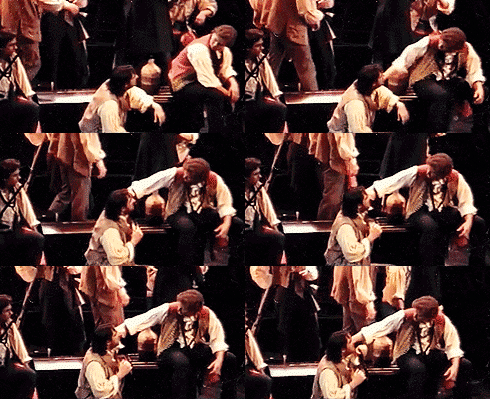
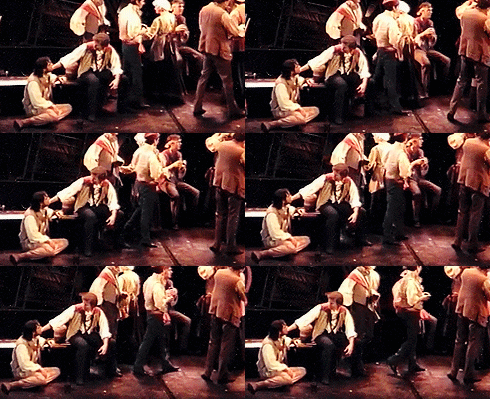
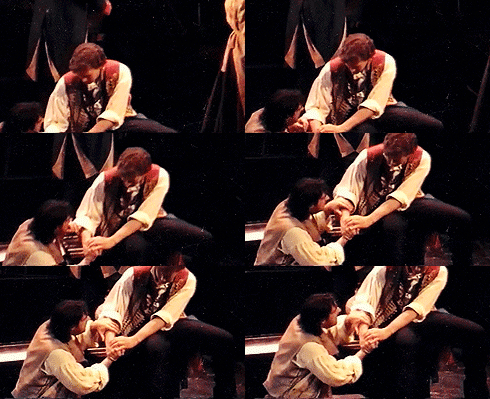
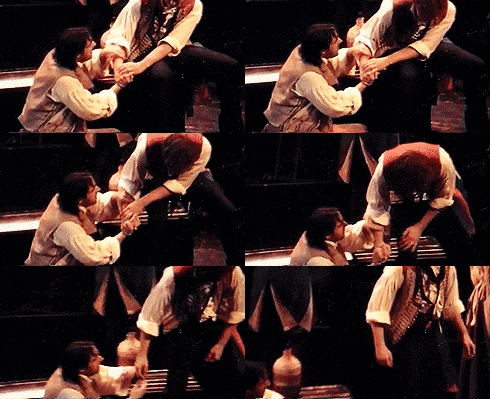
ā€œEnjolras lui serra la main en souriant.ā€ – Enjolras ā€œpressed his handā€ (Wraxall, Hapgood, Gray, Donougher), ā€œgrasped his handā€ (Wilbour), ā€œshook his handā€ (FMA, Rose), ā€œclasped his handā€ (Denny). I DON’T LIKE ā€œSHOOK HIS HAND,ā€ IT’S NOT GAY ENOUGH.

ā€œCe sourire n’était pas achevĆ© que la dĆ©tonation Ć©clata.ā€ – ā€œThis smile was not finished when the report was heardā€ (Wilbour), ā€œThis smile had not passed away ere the detonation took placeā€ (Wraxall), ā€œThis smile had not passed away ere the detonation burst forthā€ (Gray), ā€œThis smile was not ended when the report resoundedā€ (Hapgood), ā€œThe smile was not finished before the report was heardā€ (FMA), ā€œThe smile had not ended when the volley rang outā€ (Denny), ā€œHe was still smiling when the explosion ripped through the silenceā€ (Rose), ā€œHe was still smiling when the burst of gunfire cameā€ (Donougher).

(Brick!club 2/12/14-2/14/14, Les Miserables, 5.1.23)

I DON’TĀ  EVEN KNOWĀ  WHAT TO SAY ANYMORE
THIS POST IS BARELY EvEN ABOUT THE CHapter but

augh

Here’s a story:

There was a blonde, severe and modest and chaste to one great love–not a lover, that was a joke and a harsh one, but to their real love, that was the living human future that lover abandoned.Ā  And they served that love with everything they had, gave up their place in society to do it, gave up their personal share of the present for that future; and when that wasn’t enough they started sacrificing pieces of themself.Ā  The ferocity of their laughter( a smile stained with blood a black hole) (the second killed him with a bayonet) the beauty in their sadness, (ten francs, I have clothed her) (Vive la France, Vive la Avenir) , optimism and enthusiasm and learning and beauty and the sheer energy of life (give up the bird douse the candle let the rosebush wither in a corner the water freeze in the bowl ) (Bossuet died Feuilly died Courfeyrac died Joly died) and the gentleness of their own humanity (I’ll sell what’s left) (helping an injured soldier he looked to the heavens) and when that was gone they took the courage of their despair and made themselves a targetĀ  (they can do anything they like to me now I won’t budge) ( shoot me) and they condemned themselves, and made themselves marble, beyond the touch of the world.

Here’s a story:

A man couldn’t find sustenance, so he tried to steal it. He tried to make an escape and that built the walls higher. He judged himself and admitted his fault, he judged society and God and damned them for making the world that made him. He spent a meal with the faithful and the generous and damned their cause and prayed for their lives and let them lead him to joy. But he couldn’t see their horizons;Ā  their candles blinded him.Ā  He knew he wanted something More and Else, but didn’t understand what it was he was reaching for. So he swore to be more, and tried to be more, and at the same time he hid himself away from the good he might have done. Because the world is hard, the world is HUGE, and you break your neck simply living, and isn’t that enough, to dream of being Jesus with money, to smell new grass, to not ask for much, really, what else is there?

And he opened his eyes in time to see love, to really see it, what it could cost and where it could lead, to see that all his fear of that power was correct and all the danger he could fear was right in front of him

and he announced himself, and he chose where he stood, and he accepted the good only he could do;

and love saw him, (help from an impossible source the last person it could be maybe the ONLY person they’d ever really despised but )Ā  andĀ  took his hand, and he was more.

***
There’s SO MUCH I could say and probably WILL say about this chapter, someday; it tends to get a lot of discussion and RIGHTLY SO. The story of the soldiers, and how they tear into the Corinth ā€œgreatly irritated”Ā and ready to act as monsters in the name of a rumor, a lie, they’ve heard about the other side of the barricade, but they come to stop when they see the reality for a moment, and it’s JUST for a moment, but how many cracks in the foundation are made by those gunshots? And I’d like to talk about how great it is to see the fighting go on, and that the defenders were down to to TWENTY SIX men when the final battle STARTED and they’ve held on so long, and the Corinth has given everything it had to this fight, and that even though the barricade is well and truly finished the moment Enjolras dies the fight VERY MUCH goes on

But I think a lot of other posters will cover those

and I could even say more about this little bit of story reflection! How important it is that Fantine and EnjolrasĀ  both are seen as human, at the last, and by someone they’ve denounced as not capable of goodness, someone they’ve condemned, someone they’ve judged as harshly as they judged themselves, because the salvation of humanity has to come from humanity, with all its faults, because people are for each other and

skflhsfakh

And I could go in another ten different directions with this

Because this is a bigĀ  story and all of it is in the barricades in some way

But I think this is enough for one post: Here’s a story, here’s two stories, here’s a story people keep telling: what love gives away, what love gives in return.

Brick!Club 5.1.23: Orestes Fasting and Pylades Drunk

doeskin-pantaloons:

Septembrisuer wrote a fascinating post about why Grantaire and Javert both have to die at the moment of revolutionary enlightenment. So this started off as a reply to that, but I don’t think I ever addressed their arguments, so it should probably be its own post.

The question about why Grantaire dies got me thinking about similar thoughts I was having about Javert and Enjolras and why each had to die, a couple of books ago. The conclusion I reached was – to shamelessly quote myself:

Javert’s death is a reaction to his inability to cope with being an absolute in an imperfect world

and that Enjolras’ death, by comparison, is an imperfect world’s inability to cope with the absolute – a fault not with the absolute itself, as in Javert’s case, but with the world (and therefore a fault that can be fixed, leaving us with hope for the future.)

But where Enjolras and Javert both represent ideals and absolutes, Grantaire is the opposite – the anti-ideal. And yet the anti-ideal dies not when Grantaire is shot, but moments before:

ā€œVive la RĆ©publique! J’en suis.ā€

So to apply my previous hypothesis: does the anti-ideal, Grantaire-the-cynic die because he is to absolute in his cynicism (just as Enjolras is too absolute in his ideals) to cope with an inabsolute world? Or because an inabsolute world is not able to cope with his absolute nature? It seems apparent to me that for Grantaire-the-cynic it must be the former – his absolute cynicism is thwarted by the sight of Enjolras, dying for his country and his principals. And not, as Grantaire-the-cynic most likely believed, futilely. Because one needs only look at Enjolras’ death through the eyes of Hugo to see that is a transcendent experience.

The audacity of a fine death always affects men.

And therefore, it is apparent to Grantaire-the-cynic, the anti-ideal, that the world is not so hopeless as he expected. A futile death can still have a profound effect. And so Grantaire-the-cynic dies, and Grantaire-the-idealist, for a brief moment, is born.

But why must Grantaire-the-idealist die? My answer to that is that it is because he’s no longer the absolute cynic, but he has not attained the ideal. And so Grantaire, rather than being the foil to Enjolras, the cynic-beside-the-ideal, is simply a man. And die, in this horrible, brutal reality, is what men do.

Brick!Club 5.1.23: Orestes DEAD and Pylades DEAD

pilferingapples:

fizzygingr:

It’s

it’s over

all of it

the barricade and the last of the amis and everything they shared and everything they stood for

and the stragglers tried to lift the omnibus back up, but they were shot down because the bus is going nowhere, not today, and Progress will rise again but for now she is

they’re all

they’re dead

it’s

over

*WAILS*

Okay, but serious talk. I know this chapter’s been done to death on tumblr, but please let’s talk about how Grantaire, by loving Enjolras, came to love what he stood for. And honestly I’ve always been a bit uncomfortable with this scene, because how much of it is ā€œSuddenly I see the lightā€ and how much is ā€œEveryone I love is dead, might as well join them.ā€ But I guess on a more literary/symbolic level, the people he lovesĀ areĀ the Republic, and it always was that way, and if anyone’s worth his life then they are, and if anything’s worth his life then this is. ā€œI am one of them.ā€ I stand for a society that allows me to be one of them, that recognizes my value as much as the next person’s, that makes a place for us.

And Enjolras permits it, Enjolras would never deny a place to someone who wants to be a part of it, and now there are two of them, now he doesn’t have to die alone, now they form their own little Republic right there in front of the firing squad and they both die a part of something and

*deep breaths*

Okay, it’s not a real fizzpost if I don’t talk about Jesus. So. Jesus. Back when I started getting into all this, right after the movie came out, I’d just finished up a class on the Eastern theology of grace and deification. (I’m making that sound way more fancy than it is. It’s actually a 200-level C.S. Lewis class. But the primary focus was how C.S. Lewis addressed that concept.) Anyway, the idea is that people, by growing closer to God, can partake of the divine nature and become more like God ourselves. Without becoming less human, because God, by the Incarnation, sanctified human nature and made that sacred in itself, and our human nature is fallen and not quite what it should be so when we become more like God we also become more like ourselves and vice versa, and I can and will ramble about this all day but not in this post.

We have Godjolras here, and we have the Fallen Man, who finally sees the Ideal and wants to be a part of it. And when he makes that decision, he’s more himself than he’s ever been in his life. He fulfills that potential that Godjolras always saw in him and never gave up on. All he has to do is ask, and the Ideal gladly welcomes him, and presses his hand (ā€œshakesā€, FMA?), and lets him become one of them.

Here Day embraces Night, and says: ā€œI will die with you, and you will be born again with me.ā€

And, come to think of it, I may have seen this mentioned before? But there’s the line, ā€œdarkness ending is like a curtain torn away.ā€ (Not just drunkenness. Darkness. All the despair and the bitterness and). But there’s this beautiful, beautiful line in the Bible, as soon as Christ breathes his last: ā€œAnd then the veil of the sanctuary was torn in two.ā€ Old Testament theology was very much about separating the sacred from the profane, and that’s exactly the purpose the veil served. But then God ate and drank and sweat and cried and bled and suffered, and then embraced death, the least divine thing there is. And suddenly eating and drinking and sweating and crying and bleeding and suffering and dying were profoundly sacred things. Suddenly Day had Embraced Night, and Night had Embraced Day, and Night was holy now.


I’M NOT HANDLING IT WELL.

THIS IS ALSO A REALLY SOLID AND IMPORTANT INTERPRETATION,Ā  and I was really REALLY hoping you’d cover it! It was Brooke I’ve seen mention the veil thing before, and that’s definitely an allusion I’d miss without other people around! But yes please talk about the divinity of humanity, it seems really important here!

Or, you know, just have some hot tea and join us in the Wailing Blankets, that’s good too.

I was just thinking the other day, “Hey, the Brick!Club must be nearly up to OFPD by now.”

I was not disappointed.

Les Miserables deleted scenes:Ā 
The beginning of The ABC Cafe

From the ā€œCreating The Perfect Parisā€ DVD extra, a couple of cut lines from ā€œThe ABC Cafe/Red and Blackā€. (You can see Killian Donnelly bursting in and calling ā€œEnjolras!ā€ at the end there.) No idea how much of it they filmed, I still hold out hope that they filmed it in its entirety…

You probably want to watch it now, so it’s here! It starts at about 2:22.

decourfeynated:

sclez:

frankshepard:

Is your life just one more lie?

Aw man, Enjolras’s face when Grantaire hugs him. He looks like he’s genuinely upset on R’s behalf and wants to comfort him but hesitates because this is Grantaire we’re talking about and for all he knows he could get stung with a biting remark if he makes himself vulnerable, but he throws caution to the wind and does what he wants to do; hug back with gusto as though this is something he’s wanted to do for a long time. He’s even stroking the back of his head; this isn’t a garden variety bro hug, this is a passionate and desperate thing between two people who probably didn’t even realise how much the other person cared.Ā 

…And then it’s R that pulls away first. Enjolras looks like he was very willing to keep that little Hug of Mutual Understanding going because he and Grantaire are finally really communicating honestly, but Grantaire can’t seem to actually allow himself more than a fleeting moment of emotional nakedity, so he pushes Enjolras away. Enjolras, who keeps his hand behind R’s head and keeps his eyes trained on R as he falls because he cares.Ā 

They both care so much and it hurts.

I know I’m reading too far into this but just allow me to have a moment, okay.

forgive me for hijacking the post, but i don’t think you’re over thinking it at all

because right after this magical gifset ends, enjolras tips their foreheads together and (iirc) gives this tiny little smile as grantaireĀ passes him his jug.

this moment is all about them finally opening up to each other. this is when enjolras realizes why grantaire is still there and will still be there at the end, and he realizes, like in the brick, that there is something infinitely precious in that. so he tries to hold on to this last good thing at the end of their world, but he can’t stay forever, he has a revolution to run

and grantaire is absolutely stunned in the aftermath, too — and then enraged when marius starts pawing at him and singing about cosette, because he just had this watershed moment with enjolras, and they’ve established they’re both going to die. at least marius’s cosette who he loves so much will live on after him; grantaire has no such luck.

this blocking will be permanently etched into my brain until the end of time because it’s so understated and beautiful.

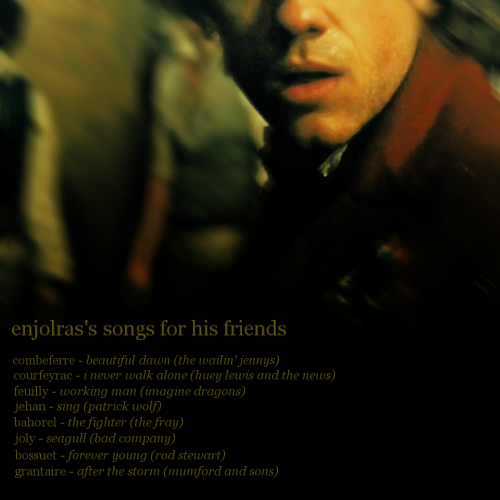
enjolras to combeferre: beautiful dawn – the wailin’ jennys
teach me how to see when i close my eyes / teach me to forgive and to apologize / show me how to love in the darkest dark

enjolras to courfeyrac:
i never walk alonehuey lewis and the news
it ain’t what you got it’s who you know / we take that with us wherever we go / we stick together and we have our fun / you know we’re taking our days one by one

enjolras to feuilly:
working man imagine dragons
i think that this life is darker than the view / so help me help me help me /be a little more like you

enjolras to jehan:
singpatrick wolf
just sing, from the bottom of your heart / sing, blossom every broken part […] if your voice is vanishing / if your life is shortening / you must sing, sing

enjolras to bahorel:
the fighterthe fray
the lover held her love / she begged him not to go […] but somehow they both know / he’s not coming home, coming home

enjolras to joly:
seagull – bad company
here is a man asking the question / is this really the end of the world / seagull, you must have known for a long time / the shape of things to come

enjolras to bossuet:
forever young – rod stewart
may good fortune be with you / may your guiding light be strong / build a stairway to heaven / with a prince or a vagabond

enjolras to grantaire:
after the storm – mumford and sons
and i took you by the hand / and we stood tall / and remembered our own land / what we lived for / and there will come a time you’ll see with no more tears / and love will not break your heart but dismiss your fears


Listen on 8tracks