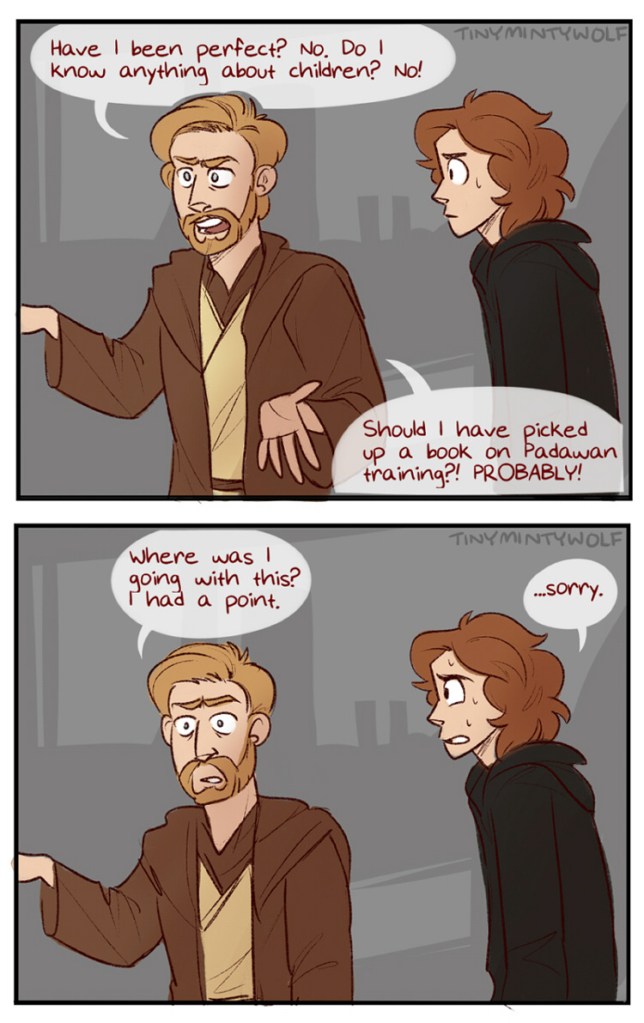
“Before their military heroism in the Clone Wars, before their tragic battle on Mustafar, and many decades before their final confrontation on the Death Star… they were Master Obi-Wan Kenobi and his Padawan learner,Anakin Skywalker. It’s been a few years since Obi-Wan pledged to train the young “chosen one,” but even as they have grown closer through training, it has been a difficult road. Now, called to a remote planet for assistance, Master and Padawan may be pushed to the breaking point. Writer Charles Soule (Lando, She-Hulk, Daredevil) and artist Marco Checchetto (Star Wars: Shattered Empire, Avengers World, Punisher) bring us a tale of the Jedi at the height of their power…“
Marvel announces 5-issue Obi-Wan and Anakin series to debut in January! (x)
“he has too much of his father in him” says beru, thinking of all the stories shmi told about her amazing jedi son
“that’s what i’m afraid of” says owen, thinking of that grumpy dude who showed up out of nowhere then disappeared for a while and came back with his step-mom’s dead body, then smashed up a bunch of their stuff, stole their droid and fucked off without saying goodbye
The hardest thing about this ask is narrowing it down to five! Expect another long post here; sorry followers.
1. Tatooine slave religion. There are quite a few variations on this theme, but here are my headcanons about the religion the Skywalkers practice. (Told in mythical form, of course.)
Once, long ago, Tatooine was a beautiful place of garden oases, and Ar-Amu was the mother to all her people. But Depur came from out of the blackness, and he threw down Ar-Amu, and bound her in chains, and took her children from her and scattered them, each to a different depur (which means “master”). And Ar-Amu could not free them. Her grief was so great that she could not even cry. But she promised her children that one day they would be free. One day, she would call out to all the seven corners of the desert, and her children would cast off their chains and throw down their masters and be free. And it was said that they would know when this day was come, for the skies would open and Ar-Amu would finally weep.
For most of her life, Shmi had a series of mystical visions in which Ar-Amu spoke to her. This culminated in a profound experience in the desert – when Gardulla sent her out to bargain with a group of Jawas, and she was caught alone with no shelter in the midst of a terrible sandstorm. She opened her eyes and saw the desert blooming, and heard the voice of Ar-Amu saying, “Daughter, will you bear this storm?” She said yes, and nine months later Anakin was born. (Anakin, in my headcanon, means “the one who brings the rain.”)
I will forever headcanon that Anakin was meant to be the Chosen One – for Tatooine. He was born for his people, to free the slaves.
(And, because I cannot handle too much sadness, I also headcanon that Luke and Leia did go back after ROTJ and lent their support and the backing of the new Republic to the liberation movement and the universal emancipation of Tatooine’s slaves.)
2. Some rituals of the slave religion:
2a. The vigil for the lost is performed both when someone dies and when someone is sold away. It involves the survivors standing in a circle around a bowl of water (sometimes not much water at all, but at least a drop is needed) and looping a cord around the left wrist of each person. This binds the survivors together in their shared grief. At the end of the ritual, each person “gives something to the waters,” representing a gift to the person who has departed. It’s usually a very small thing, like a stone or a japor snippet or a scrap of fabric. After this, they each take back the item that was given to the waters and keep it as a personal mark of connection between themselves and the person who is gone.
2b. There is also a ceremony of return, for when families and friends who have been separated (usually by sale) find one another again. Ritually, it is a ceremony of rebirth or resurrection. The person who has been returned stands in the midst of the people, and all the others circle around them with their wrists connected by the cord as in the vigil for the lost. The returning person’s hand is placed in the bowl of water, and the oldest woman present says, “We return [name] to Ar-Amu and to [their] people.” Each person in the circle then names the returning person aloud, dips their own hands in the water, marks the hands or forehead or heart of the person returning, and states their own relationship to that person. (e.g., Shmi might say, “I name you Anakin Skywalker, my son.”) When all have named the returning person, thus symbolically reenacting their communal identity, the person who is returning then names themselves in relation to each of the people in the circle. (e.g., “I am Anakin Skywalker, son of Shmi, brother of Kitster, husband of Padmé,” etc.)
When the ceremony is over the oldest woman binds a length of jerba cord around the left wrist of the returned person, and that person wears the cord for a full year, never removing it. When a year has passed, the person has been fully reincorporated into the community, and there is a celebration.
3. The slaves have a fully developed and entirely secret creole language that they speak among themselves. It’s derived from Huttese, but is incomprehensible to their masters. They don’t teach it to any outsiders.
(Years later, this will be a source of endless frustration to all of Anakin’s masters, both Jedi and Sith. They can never crack his codes.)
(Even more years later, Force ghost Anakin will eventually teach his children his mother tongue.)
4. Slaves aren’t allowed to marry legally, but they have formed their own traditions. Couples typically make an announcement to the matriarch of the community, and are considered bonded to one another afterwards. There is also a ceremony of binding before Ar-Amu, similar to the ritual of return, but it’s a private ritual in which only the two who are getting married participate. If it’s safe, there may be a community celebration afterwards, but this isn’t always possible.
(All of this means that, among other things, while Padmé found her wedding pretty unusual, for Anakin it was basically the way things are normally done.)
5. Surviving a sandstorm together is considered the greatest possible bond between people, something that outweighs even the ties of kinship and blood. According to tradition, surviving a storm together creates a kind of soul-bond between the people who survive, and this bond will last even beyond death. The bond also entails certain responsibilities – if one person is killed or sold, the other is expected to care for that person’s extended family as if it were their own.
In my headcanon, Anakin and Kitster survived a storm together when they were seven years old. Afterwards, they actually performed a ceremony of blood-brotherhood to ritualize things, but they already considered themselves brothers. (In canon this mostly ends in sadness and unfulfilled possibilities, but in all my AUs, Kitster is a major character and one of Anakin’s main ties back to his home.)
5- Surviving a storm together creates a kind of soul-bond between the people who survive, and this bond will last even beyond death.
I wonder if Hoth counts, as Luke and Han survived a storm. I wonder what Anakin would think if it did.
Actually, yes, I think that would count. And I suspect Luke thinks of it that way, too – his aunt and uncle told him all kinds of stories about Shmi, and he grew up knowing a lot of her beliefs.
I think there also is likely a very strong hospitality culture on Tatooine. Anakin invites Qui-Gon and Padme to his home because a storm is coming. Only someone shunned from society wouldn’t have that kind of hospitality extended to them (potentially slaves would be victimized this way), and it’s incredibly important to repay that hospitality when you can.
And, of course, the Jedi never do repay Shmi for it.
Stunt master Nick Gillard notes in a commentary that Anakin’s style of fighting is really far too aggressive. This is another contrast to the open, compassionate boy he once was on Tatooine. In “The Wisdom of Insecurity”, Watts notes this common problem, as he is not unlike “the sensitive boy who learns in school to encrust himself for life in the shell of the ‘tough guy’ attitude.” It would be difficult to find a more extreme example of the archetypal tough guy than Darth Vader.
Paul F. McDonald, The Star Wars Heresies: Interpreting the Themes, Symbols, and Philosophies of Episodes I, II and III (via skygawker)
It really has to do with learning. Children teach you compassion. They teach you to love unconditionally. Anakin can’t be redeemed for all the pain and suffering he’s caused. He doesn’t right the wrongs, but he stops the horror. The end of the saga is simply Anakin saying, I care about this person [Luke], regardless of what it means to me. I will throw away everything that I have, everything that I’ve grown to love – primarily the Emperor – and throw away my life, to save this person. And I’m doing it because he has faith in me; he loves me despite all the horrible things I’ve done. I broke his mother’s heart, but he still cares about me, and I can’t let that die. Anakin is very different in the end. The thing of it is: the prophecy was right. Anakin was the chosen one, and he does bring balance to the Force. He takes the ounce of good still left in him and destroys the Emperor out of compassion for his son.
George Lucas – The Making of Revenge of the Sith; page 221. (via greenkaorichan)
Death is a natural part of life. Rejoice for those around you who transform into the Force. Mourn them do not. Miss them do not. Attachment leads to jealousy. The shadow of greed that is.
I have this headcanon that Leia was a total surprise for the empire.
They probably laughed when they heard that a teenage girl had joined the Senate; they probably thought that a princess would be so easy to break. They never expected so much trouble from her or that she’d ever have much of an impact on their plans. Like most people, they underestimated the teenage girl.
But she stood face to face with two of the most feared men in the galaxy, and she withstood everything they threw at her. They never thought that she would have the strength to withstand all the pain, or that she’d have the cleverness to redirect them to Dantooine. Can you imagine how differently things might have turned out for the empire if they had not so vastly underestimated Leia’s strength and fury and intelligence?
A word to the wise: Don’t underestimate teenage girls or princesses. They just might end up destroying you.
Yes!
…I was writing something like this five minutes ago!
Leia is furious with Darth Vader, because anger and willpower is how she’s always gotten what she wants. (She is so his daughter.) How DARE he try to intimidate her? How DARE he step foot on her ship like a big luck void, sucking away all of her usual good luck?
(Something questionable is going on with the Force when Leia and Vader go toe-to-toe.)
And Vader HATES her. Because she looks so much like Padme. And she has the audacity to stand in front of him looking like his wife. And she is not diplomatic, she does not try to smooth things over, she acts nothing like Padme. How dare Bail have such a daughter? (On any number of levels–years ago the rumors about Bail and Padme had made their way freely through the Senate, and whose baby was she carrying, anyway? And Anakin had been forced to grit his teeth and endure them.)
Leia Organa has personally thwarted at least three of his plans in her brief tenure as pseudo-adult. He has a galaxy to organize, and she is in his way. How dare she stand in front of him with that look on her face–that furious, burn-it-down look? (It is his look, the face a copy of his, but he doesn’t recognize it.)