Just in time!
The words used to describe Mary Jane range from vaguely sexist to downright derogatory. She is shallow, selfish, bitchy, winey, and, yes, the old time favourite, she’s a slut. If you need a feminist translation, Mary Jane is independent, opinionated, caring, confident, self-sufficient, and has been in a relationship with more than one person (the latter should not be relevant, but until slut-shaming dies a fiery death, it sadly is). Mary Jane and Gwen are so firmly trapped in the virgin/whore dichotomy, that it should be no surprise that one character is currently experiencing a renaissance, while the other is either written out of character to serve a plot, or not written at all. Mary Jane is just a little bit too loud. A little bit too messy. A little bit too…non compliant (a little bit too on the nose? I apologize).



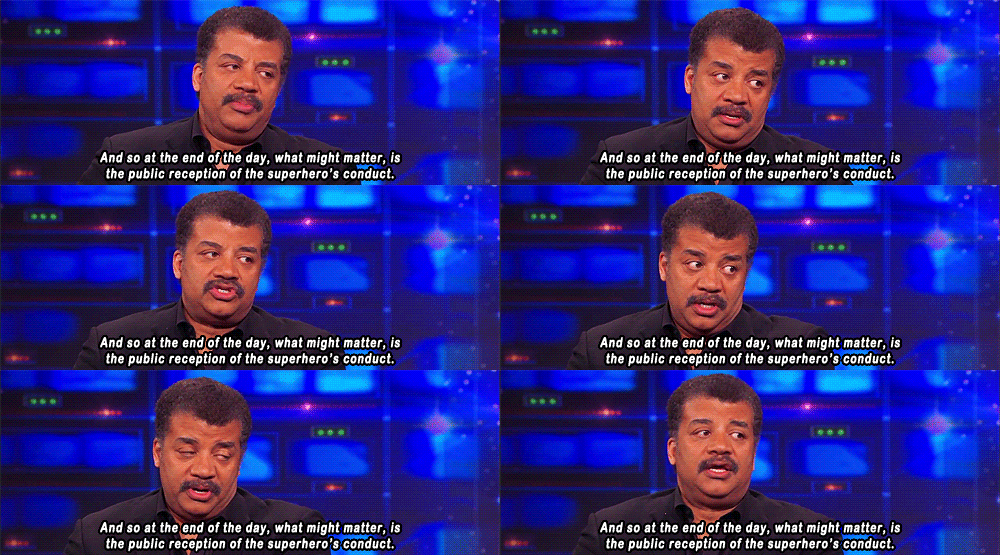

Neil deGrasse Tyson on Batman v Superman: Dawn of Justice
the B E S T thing about this is that it looks and sounds like it could actually be a clip from
the film, a continuation of his voice-over from the teaser trailer.
like Neil deGrasse Tyson went on television to discuss what the
existence of Superman really means and how it affects the world –
scientifically, philosophically, politically.


Sesame Street’s Les Mousserables x
Speaking of Les Mis adaptations, I feel like we all need to take a moment to remember this one. Truly a version for the ages.
I especially like the part where no one dies and everyone has cookies.
Never forget
Enjolfood

It’s still technically Barricade Day 2015, so here’s my humble contribution:
Rapports sur les opérations et les faits militaires auxquels la garde nationale a pris part dans les journées des 5 et 6 juin
aka
“Reports on the Operations and Military Events in which the National Guard Took Part on the Days of June 5th and 6th”
These are French military reports produced for the government in the immediate aftermath of the June Rebellion. Composed less than a week after the fall of the barricades (12 June 1832), they contain eyewitness accounts of the actions of the Army, the National Guard, and the Paris Municipal Guard. While obviously very biased against the republicans, they represent a unique, fresh perspective on the events that Hugo depicts in Les Misérables.
The reports are all in French (and can be found via Google books), but I’ve done my own (very rough) translation of certain excerpts. Here’s an account of Lamarque’s funeral:
At Madeline, some young men who were marching under a particular flag, and who were called the “Amis du people,” wanted the soldiers, after having paid respect to the funeral wagon, to take up arms behind them. They addressed the troops, saying to them, “We are counting on you, my friends, you can count ‘on the Amis du people.’” These words corresponded with the dangerous proclamations that had been disseminated the night before in the barracks, with the goal of diverting the soldiers from their duty.
And here’s a description of the barricades around the Cloister of Saint-Méry. which Hugo used as the basis for his fictional barricade in Les Misérables:
Resistance was most strongly organized at the junction of Rue des Arcis, Rue Saint-Martin, Rue Saint-Méry and Rue Aubry-le-Boucher. There, paving-stone barricades had been established in each of the streets. The four houses that stood at the intersection had been barricaded, and paving stones, rocks and pieces of wood were being thrown from every window.
The rest of my (again, super fast and likely inaccurate) translations are below the cut, as well as a rough guide of the reports. Hopefully, some of you will dig in and suss out more good stuff that I haven’t found yet!