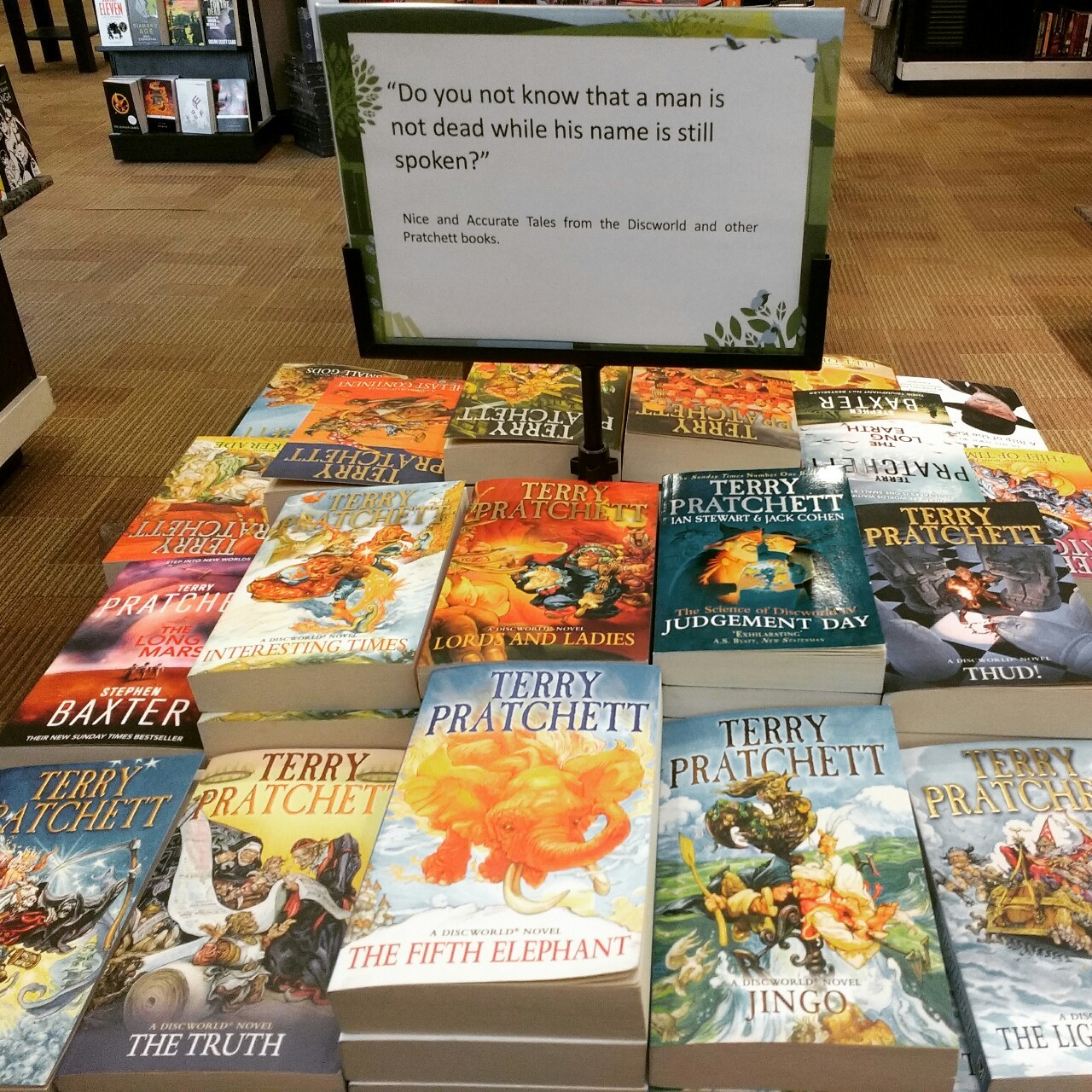
I visited six bookshops today. Waterstone’s Piccadilly has the dubious honour of being the only one to make me cry with a table display.
Vimes is fundamentally a person. He fears he may be a bad person because he knows what he thinks rather than just what he says and does. He chokes off those little reactions and impulses, but he knows what they are. So he tries to act like a good person, often in situations where the map is unclear.
Terry Pratchett, describing Sam Vimes in a Usenet post back in 2004.
Also, accidentally, describing me. Shit.
(via benpaddon)
Okay, so this is what I love about Samuel Vimes as a Heroic figure.
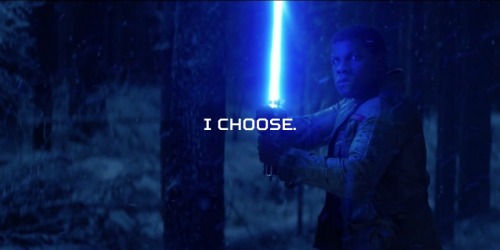
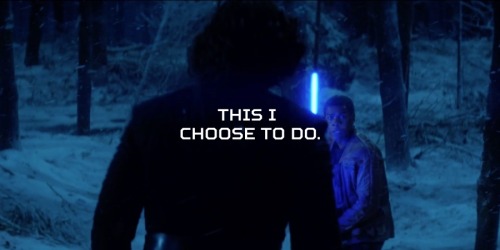
Sometimes you get Heroes who are paragons of virtue. Even if you see their internal monologues, their mindset is pure and virtuous. Sometimes, they’re tested and you get a Big Moment where they have to choose whether or not to stick to their principles or give in to temptation and expediency.
And then you’ve got the more “Pragmatic” anti-hero types, who do some nasty things in pursuit of the greater good, and who might struggle with the things they’re doing, but they do it anyway because the world is not black and white.
And then you’ve got Sam Vimes, who is dragging himself kicking and screaming into being Lawful Good. Sam Vimes would not beat a suspect into confessing, but NOT because Sam Vimes is an innocent soul who finds the idea abhorrent. Not because he dosn’t think there are some scumbags who deserve to be separated from their teeth. Sam Vimes won’t beat a suspect because that’s not what a good man would do. Sam Vimes is understanding with others, but totally uncompromising when it comes to his own behavior.
Vimes isn’t a “Good Person” by nature, but by choice. By constant, uncompromising choice.
I think this is the only way to be a decent person.
(via nimblermortal)
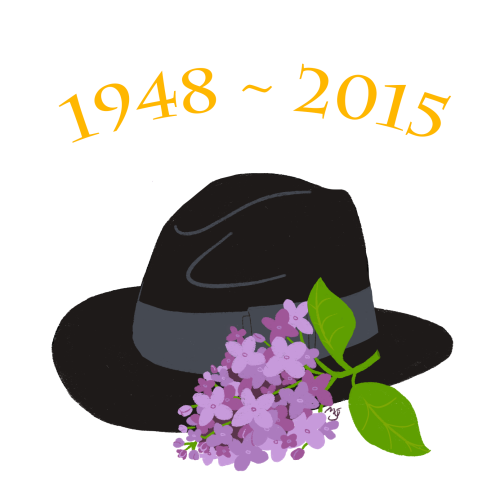
“No one is finally dead until the ripples they cause in the world die away—until
the clock wound up winds down, until the wine she made has finished
its ferment, until the crop they planted is harvested. The span of
someone’s life is only the core of their actual existence.”
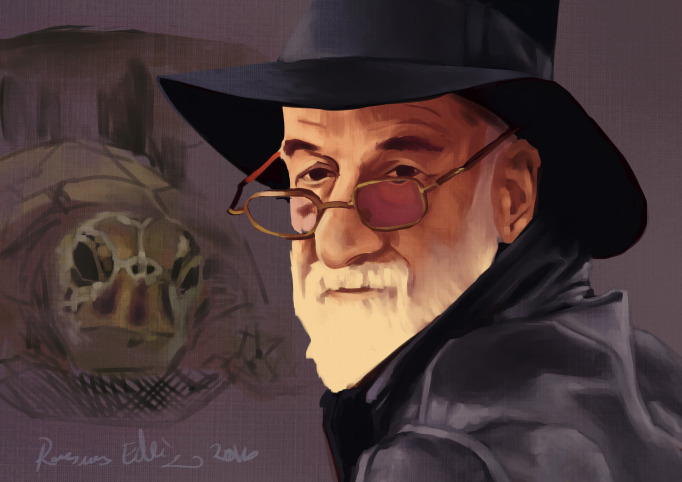
Terry
Pratchett – Reaper ManIts been a year already, but the ripples have yet to fade.
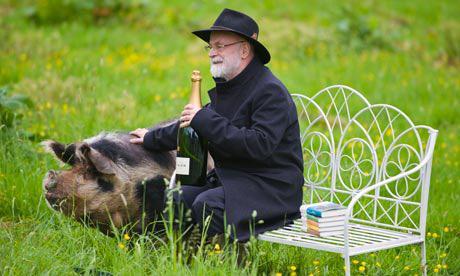
Okay but also the context for this picture is great, because these are PRIZES HE JUST WON!
AKA the Bollinger Everyman Wodehouse Prize for comic literature, for which the winner receives a complete set of Wodehouse novels, a jeroboam of bolly, and a goddamn Gloucestershire Old Spot pig named after their novel (Snuff, in this case).
Pratchett went back to older throwaway jokes (like dwarves being apparently unisex) and used them as metaphors to discuss social change, racial assimilation, and other complex issues, while reexamining the species he’d thrown in at the margins of his world simply because they existed at the margins of every other fantasy universe. If goblins and orcs and trolls could think, then why were they always just there to be slaughtered by the heroes? And if the heroes slaughtered sentient beings en masse, how heroic exactly were they? It was a long overdue start on redressing issues long swept under the rug by a parade of Tolkien successors who never thought of anyone green and slimy as anything but a notch on the protagonist’s sword, and much of the urgency in Pratchett’s last few books seemed to be related to them. “There’s only one true evil in the world,” he said through his characters. “And that’s treating people like they were things.”
And in the last of his “grown-up” Discworld books, that idea is shouted with the ferocity of those who have only a few words left and want to make them count. Goblins are people. Golems are people. Dwarves are people, and they do not become any less people because they decide to go by the gender they know themselves to be instead of the one society forces on them. Even trains might be people, and you’ll never know one way or the other unless you ask them, because treating someone like they’re a person and not a thing should be your default. And the only people who cling to tradition at the expense of real people are sad, angry dwellers in the darkness who don’t even understand how pathetic they are, clutching and grasping at the things they remember without ever understanding that the world was never that simple to begin with. The future is bright, it is shining, and it belongs to everyone.
The morality of fantasy and horror is, by and large, the strict morality of the fairy tale. The vampire is slain, the alien is blown out of the airlock, the Dark Lord is vanquished, and, perhaps at some loss, the good triumph – not because they are better armed but because Providence is on their side.
Why does the third of the three brothers, who shares his food with the old woman in the wood, go on to become king of the country? Why does Bond manage to disarm the nuclear bomb a few seconds before it goes off rather than, as it were, a few seconds afterwards? Because a universe where that did not happen would be a dark and hostile place. Let there be goblin hordes, let there be terrible environmental threats, let there be giant mutated slugs if you really must, but let there also be hope. It may be a grim, thin hope, an Arthurian sword at sunset, but let us know that we do not live in vain.
You want fantasy? Here’s one… There’s this species that lives on a planet a few miles above molten rock and a few miles below a vacuum that’d suck the air right out of them. They live in a brief geological period between ice ages, when giant asteroids have temporarily stopped smacking into the surface. As far as they can tell, there’s nowhere else in the universe where they could stay alive for ten seconds.
And what do they call their fragile little slice of space and time? They call it real life. In a universe where it is known that whole galaxies can explode, they think there’s things like ‘natural justice’ and ‘destiny’. Some of them even believe in democracy…
I’m a fantasy writer, and even I find it all a bit hard to believe.
‘Rincewind, all the shops have been smashed open, there was a whole bunch of people across the street helping themselves to musical instruments, can you believe that?’
‘Yeah,’ said Rincewind, picking up a knife and testing its blade thoughtfully. ‘Luters, I expect.’