NASA astronaut Karen Nyberg is a self proclaimed crafter. A week ago she made a stuffed dinosaur from scraps on the space station. The little T-rex is made form the lining of Russian food containers and the toy is stuffed with scraps from an old T-shirt. While many toys have flown into space, this is the first produced in space.
my brain can hardly wrap around the fact that this plushie that was made outside of earth like. im seeing this w my own two eyes and its real and its glorious
We haven’t done a #wcw in a while, so let’s take a moment to recognize Margaret H. Hamilton. She was awarded the Presidential Medal of Freedom, by President Barack Obama, yesterday. Hamilton led the team that created the on-board flight software for #NASA’s #Apollo command modules and lunar modules. A mathematician and computer #scientist who started her own software company, Hamilton contributed to concepts of asynchronous software, priority scheduling and priority displays, and human-in-the-loop decision capability, which set the foundation for modern, ultra-reliable software design and engineering.
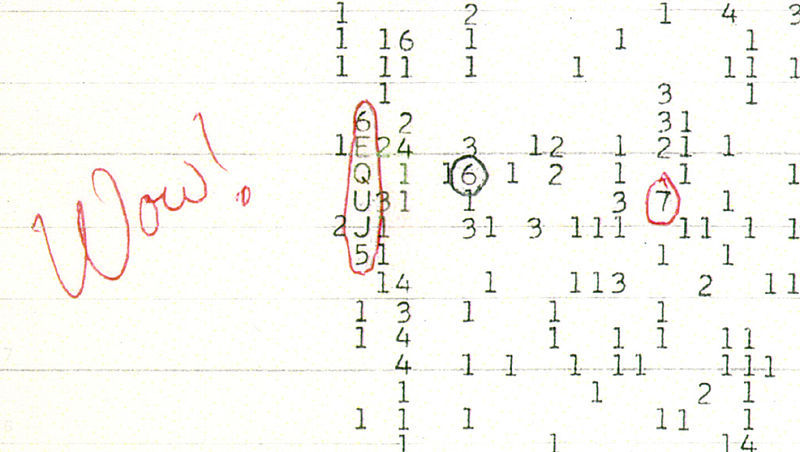
A signal sequence that lasted for 72 seconds in 1977 but has never been seen again. The signal appeared to come from a globular cluster in the Sagittarius constellation, but to this day no definite answer for where the signal originated can be given.
After numerous checks and re-checks, it’s been found to have definitely come from an extraterrestrial source.
It was broadcast at 1420 MHz. This frequency isn’t used by Earth communications for science reasons. It’s a frequency which neutral hydrogen emits at in interstellar space and is useful in radio astronomy.
Interestingly, emitting a strong signal at this frequency is a likely way to get someone’s attention if there’s anyone listening, because any other radio astronomers in the universe will definitely know of it and be making observations of it.
That really is a very strong signal. Against the backgrounds, it looks to me like about 30 standard deviations (give or take).
Actually, that globular cluster (M55) is just the closest object to the transmission’s source. It appeared to have come from a region of mostly empty space (though it’s worth remembering that distant red dwarfs or brown dwarfs could be too faint to be detectable).
The astronomer who found this and scrawled “Wow!” on that printout was Jerry Ehman at the Big Ear radio telescope in Ohio. Credit where it’s due.
Despite a lot of efforts, this kind of signal has only ever been recorded this one time. There’s a chance we may never know what it was.
It is unlike any other kind of phenomenon ever observed in astronomy. The only logical scientific explanation is that it was one of two things: Either it was a completely unknown and incredibly rare astronomical phenomenon which modern astronomy is completely unaware of – or it was an intercepted alien transmission. There are no other possibilities.
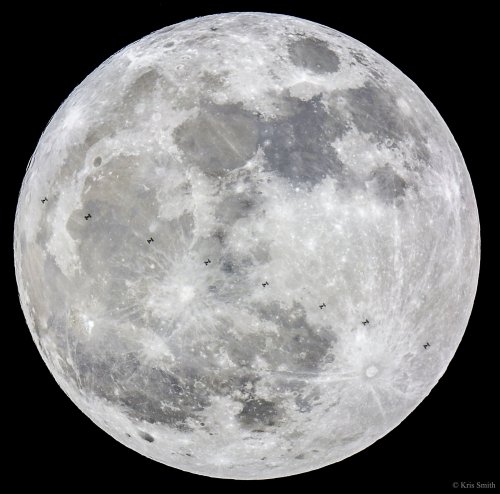
Photographer Kris Smith captured this stunning photo of the International Space Station passing on front of November 2016′s supermoon. He had been planning this shot for several years using calsky.com, a website dedicated to calculating unique opportunities to photograph objects in space.