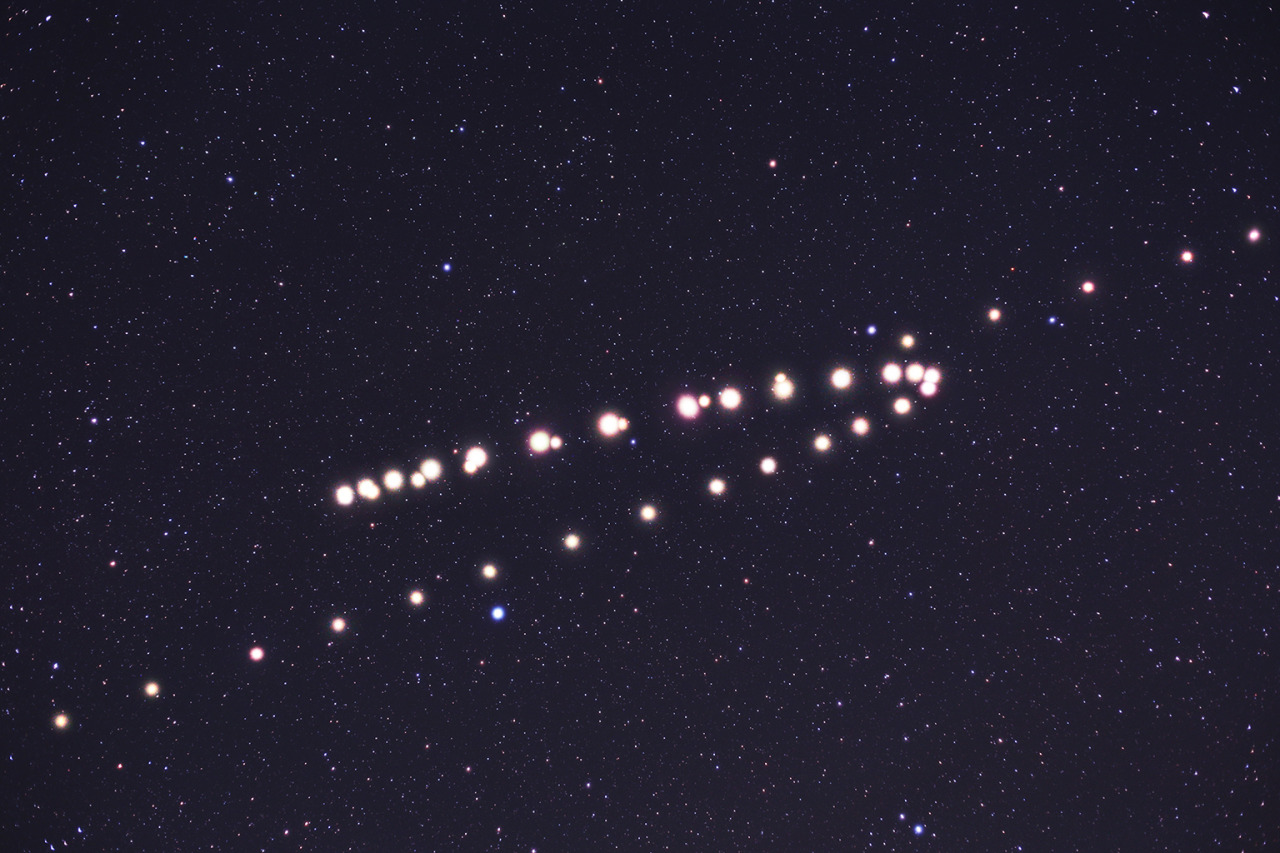
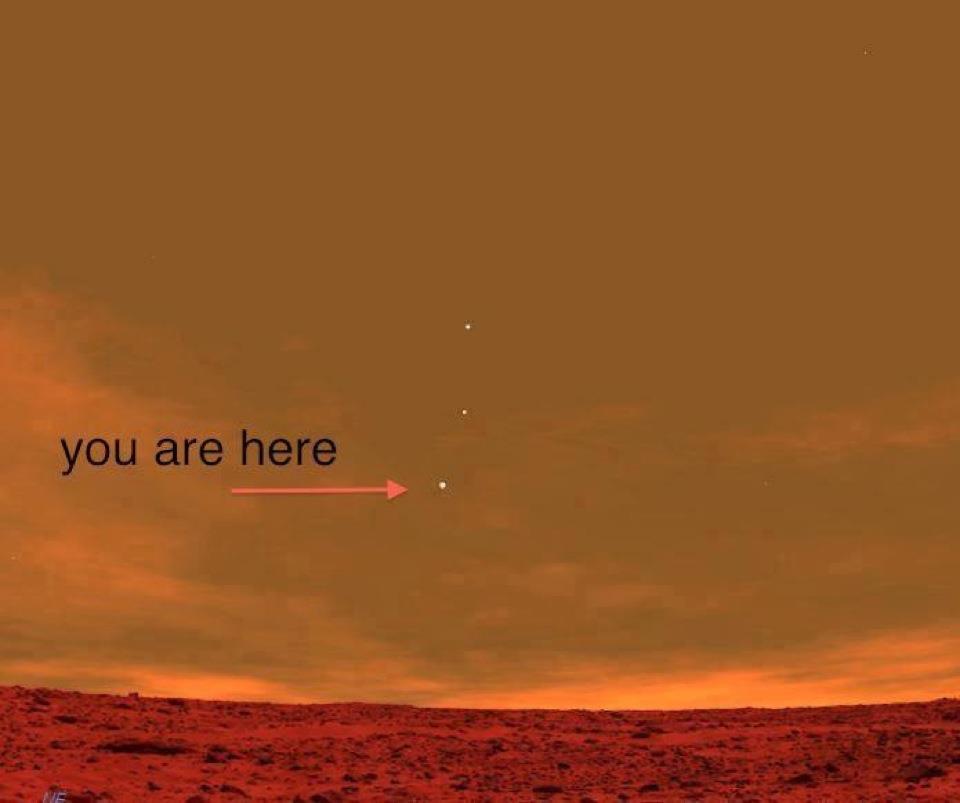
This is a picture from the Curiosity Rover on Mars showing Earth from the Perspective of Mars. You are literally looking at your home from the Perspective of another planet. Epic times indeed
gosh but like we spent hundreds of years looking up at the stars and wondering “is there anybody out there” and hoping and guessing and imagining
because we as a species were so lonely and we wanted friends so bad, we wanted to meet other species and we wanted to talk to them and we wanted to learn from them and to stop being the only people in the universe
and we started realizing that things were maybe not going so good for us– we got scared that we were going to blow each other up, we got scared that we were going to break our planet permanently, we got scared that in a hundred years we were all going to be dead and gone and even if there were other people out there, we’d never get to meet them
and then
we built robots?
and we gave them names and we gave them brains made out of silicon and we pretended they were people and we told them hey you wanna go exploring, and of course they did, because we had made them in our own image
and maybe in a hundred years we won’t be around any more, maybe yeah the planet will be a mess and we’ll all be dead, and if other people come from the stars we won’t be around to meet them and say hi! how are you! we’re people, too! you’re not alone any more!, maybe we’ll be gone
but we built robots, who have beat-up hulls and metal brains, and who have names; and if the other people come and say, who were these people? what were they like?
the robots can say, when they made us, they called us discovery; they called us curiosity; they called us explorer; they called us spirit. they must have thought that was important.
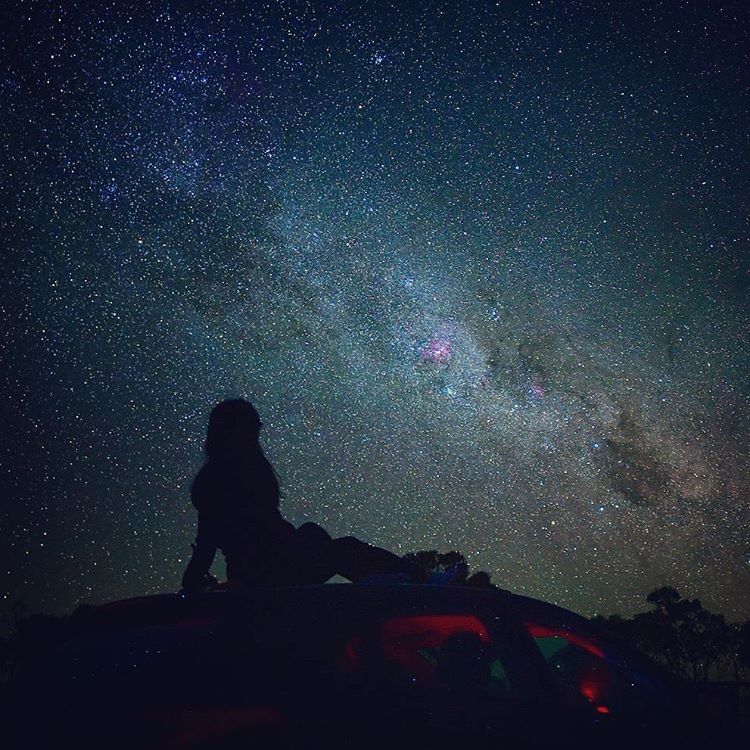
“As you lie on your back, it is natural to assume that you are looking up at the stars, but “up” is just a cultural construct. Neither Earth nor the Milky Way have an up or a down. Indeed, when you stand on Earth’s surface, you are not standing up; rather, you are sticking out into space.
So, as you lie on your back, instead of thinking of yourself as looking up, picture it so that you are on the underside of Earth looking down into the blackness of the night sky. It may take a while, but eventually you will experience all the stars as way down there below you; and you will be surprised that you are not falling down there to join them.
You don’t fall because Earth’s gravitational pull holds you. It is not your weight, but the Earth’s hold that suspends you above the stars. If Earth’s gravitational embrace were to suddenly vanish, you would descend into the dark chasm of stars below.
As you lie there feeling yourself hovering within this gravitational bond while peering down at the billions of stars drifting in the infinite chasm of space, you will have entered an experience of the universe that is not just human and not just biological.
You will have entered a relationship from a galactic perspective, becoming for a moment a part of the Milky Way Galaxy experiencing what it is like to be the Milky Way Galaxy.”
– Excerpt from Developing Ecological Consciousness: The End of Separation by Christopher Uhl
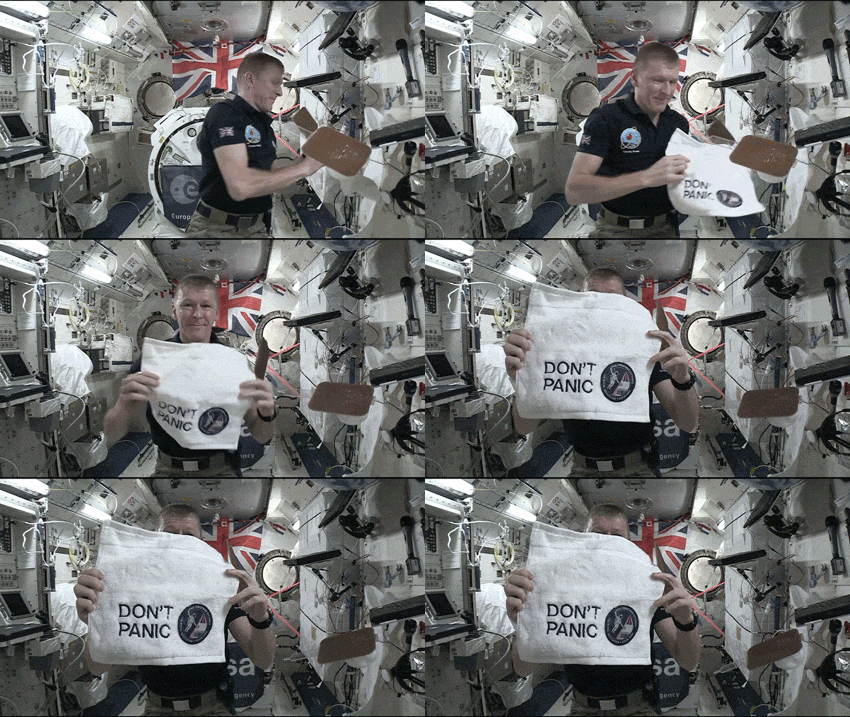
A towel is about the most massively useful thing an interstellar hitchhiker can have.
Just before astronaut Tim Peake went into space, we had a chance to send a little something up to the ISS for him to open when he got there, as a thankyou for being involved in the 2015 CHRISTMAS LECTURES. This is what we sent.
Is your favorite Star Wars planet a desert world or an ice planet or a jungle moon?
It’s possible that your favorite planet exists right here in our galaxy. Astronomers have found over 3,400 planets around other stars, called “exoplanets.”
Some of these alien worlds could be very similar to arid Tatooine, watery Scarif and even frozen Hoth, according to NASA scientists.
Find out if your planet exists in a galaxy far, far away or all around you. And May the Fourth be with you!
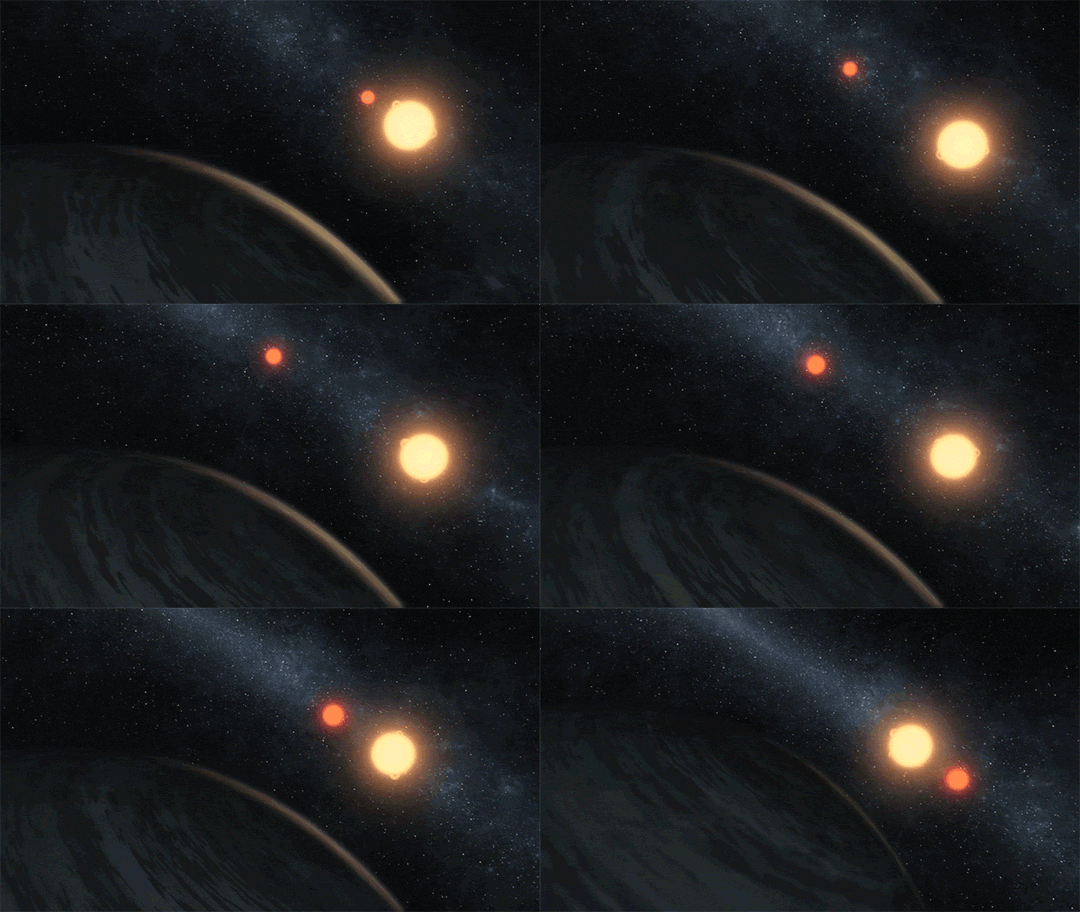
Planets With Two Suns
From Luke Skywalker’s home world Tatooine, you can stand in the orange glow of a double sunset. The same could said for Kepler-16b, a cold gas giant roughly the size of Saturn, that orbits two stars. Kepler-16b was the Kepler telescopes’s first discovery of a planet in a “circumbinary” orbit (that is, circling both stars, as opposed to just one, in a double star system).
The best part is that Tatooine aka Kepler-16b was just the first. It has family. A LOT of family. Half the stars in our galaxy are pairs, rather than single stars like our sun. If every star has at least one planet, that’s billions of worlds with two suns. Billions! Maybe waiting for life to be found on them.
Desert Worlds
Mars is a cold desert planet in our solar system, and we have plenty of examples of scorching hot planets in our galaxy (like Kepler-10b), which orbits its star in less than a day)! Scientists think that if there are other habitable planets in the galaxy, they’re more likely to be desert planets than ocean worlds. That’s because ocean worlds freeze when they’re too far from their star, or boil off their water if they’re too close, potentially making them unlivable. Perhaps, it’s not so weird that both Luke Skywalker and Rey grew up on planets that look a lot alike.
Ice Planets
An icy super-Earth named OGLE-200-BLG-390Lb reminded scientists so much of the frozen Rebel base they nicknamed it “Hoth,” after its frozen temperature of minus 364 degrees Fahrenheit. Another Hoth-like planet was discovered last month; an Earth-mass icy world orbiting its star at the same distance as Earth orbits the sun. But its star is so faint, the surface of OGLE-2016-BLG-1195Lb is probably colder than Pluto.
Forest worlds
Both the forest moon of Endor and Takodana, the home of Han Solo’s favorite cantina in “Force Awakens,” are green like our home planet. But astrobiologists think that plant life on other worlds could be red, black, or even rainbow-colored!
In February 2017, the Spitzer Space Telescope discovered seven Earth-sized planets in the same system, orbiting the tiny red star TRAPPIST-1.
The light from a red star, also known as an M dwarf, is dim and mostly in the infrared spectrum (as opposed to the visible spectrum we see with our sun). And that could mean plants with wildly different colors than what we’re used to seeing on Earth. Or, it could mean animals that see in the near-infrared.
What About Moons?
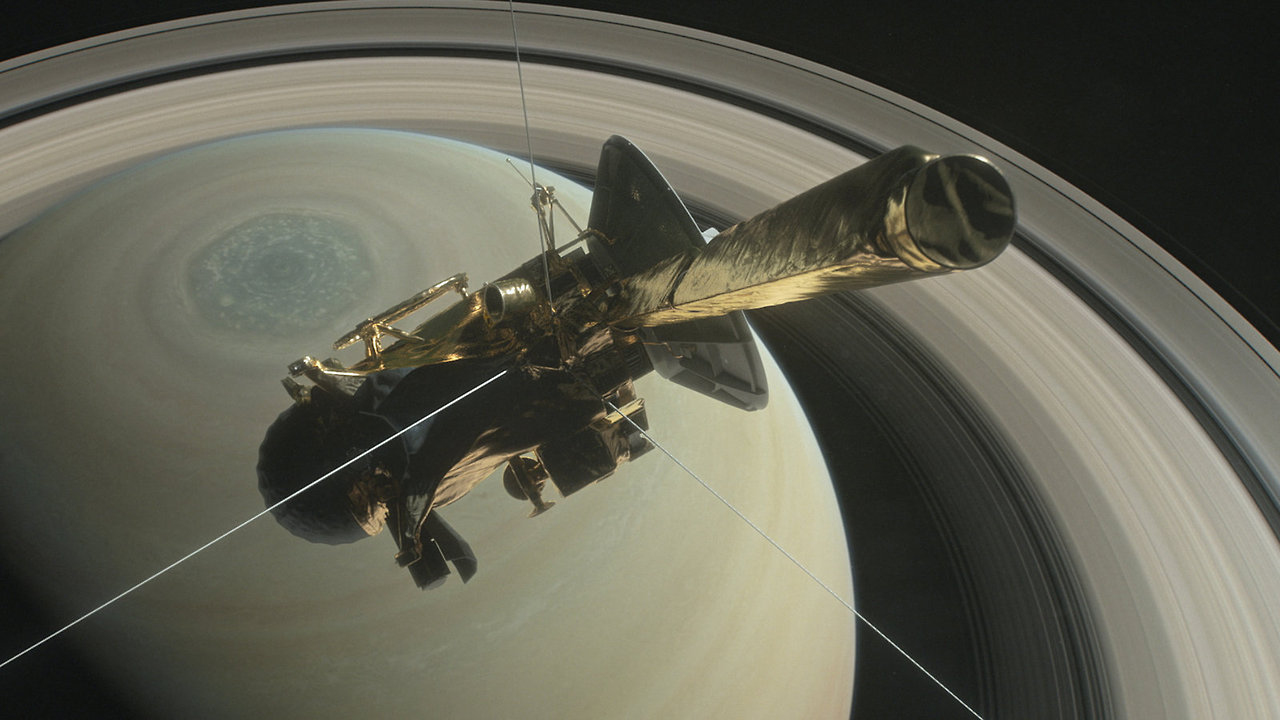
In Star Wars, Endor, the planet with the cute Ewoks, is actually a habitable moon of a gas giant. Now, we’re looking for life on the moons of our own gas giants. Saturn’s moon Enceladus or Jupiter’s moon Europa are ocean worlds that may well support life. Our Cassini spacecraft has explored the Saturn system and its moons. Watch the video and learn more about the missions’s findings.
And Beyond
The next few years will see the launch of a new generation of spacecraft to search for planets around other stars. TESS and the James Webb Telescope are slated to launch in 2018, and WFIRST in the mid-2020s. That’s one step closer to finding life.
You might want to take our ‘Star Wars: Fact or Fiction?’ quiz. Try it! Based on your score you may obtain the title of Padawan, Jedi Knight, or even Jedi Master!
You don’t need to visit a galaxy far, far away to find wondrous worlds. Just visit this one … there’s plenty to see.
If all goes to plan, NASA’s Cassini spacecraft will beam new images of Saturn and its rings to Earth early Thursday, sharing data collected Wednesday from its first dive through the gap between the planet and its striped belt of ice and rock particles.
Today’s dive also marks the start of the final phase in the craft’s 13-year visit to Saturn. Days ago, it used the gravity of Saturn’s moon Titan to bend its path toward its eventual destruction on the planet.
Cassini descended below the ring plane around 5 a.m. ET Wednesday, but the antenna it would normally use to send images is instead being used to deflect potentially harmful objects away from its instruments. As it performed the move, the craft’s Twitter feed announced, “Shields Up!”
This is a picture from the Curiosity Rover on Mars showing Earth from the Perspective of Mars. You are literally looking at your home from the Perspective of another planet. Epic times indeed
For bonus context, the actual quote they’re citing for this protest comes from Edgar Mitchell (1930-2016), who flew in Apollo 14 and was the sixth person to walk on the Moon.
The full quotation, referring to the experience of observing Earth from the Moon surface, is thus:
You develop an instant global consciousness, a people orientation, an intense dissatisfaction with the state of the world, and a compulsion to do something about it. From out there on the moon, international politics look so petty. You want to grab a politician by the scruff of the neck and drag him a quarter of a million miles out and say, ‘Look at that, you son of a bitch.’