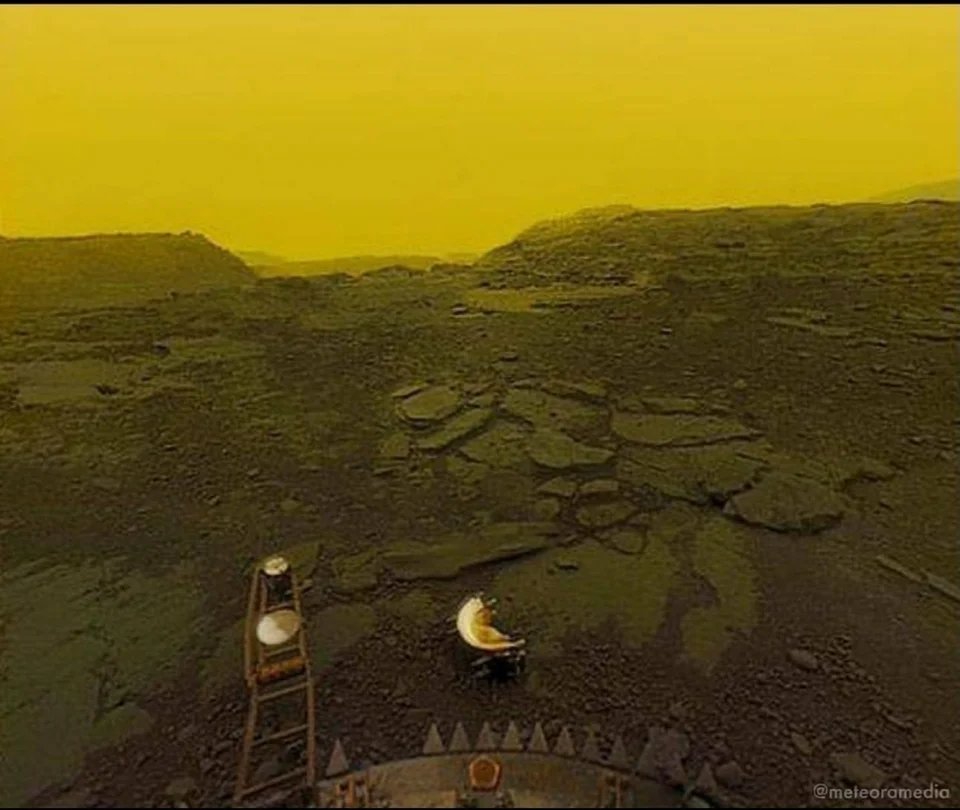
Today I stumbled upon this photograph of Venus, a ALIEN PLANET, and a lot of the comments underneath it basically consisted of, “yeah, this was taken in 1981, it’s not even good quality, who cares?” But I had never seen it and IT’S VENUS, IT’S A WHOLE NOTHER PLANET, HOW ARE YOU NOT INTERESTED? So here ya go. Next door.
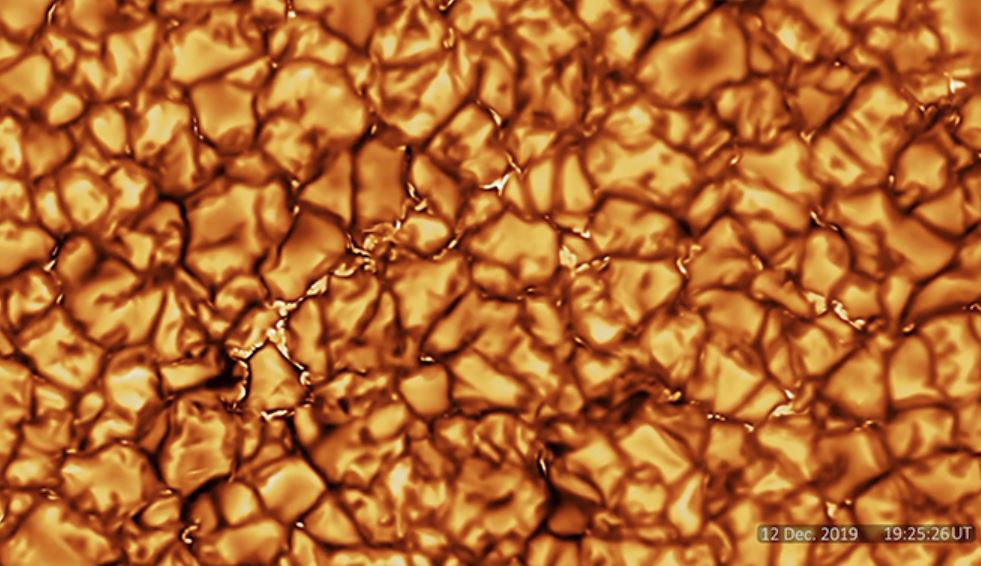
The Sun rises and falls every day, giving us plenty of opportunities to see it. From Earth, we can’t really make out what it is since it’s an ultra-bright blob in the sky that will literally damage your eyes if you stare at it for too long, but scientists have tools that can view our […]
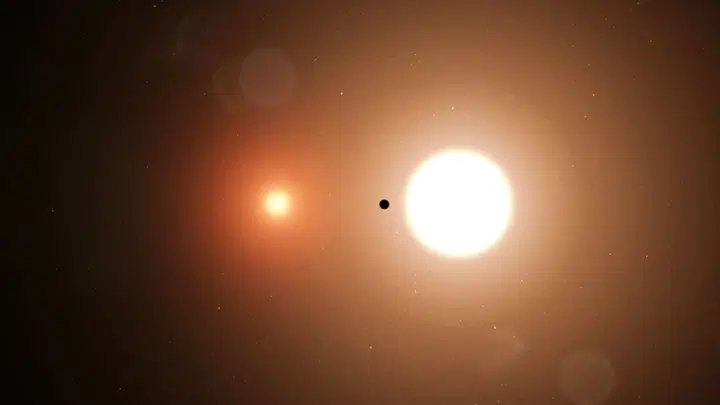
I don’t know about you, but when I was 17 years old, I wasn’t doing very much planet-hunting. Wolf Cukier of Scarsdale High School is different. Not only was he accepted as an intern at NASA’s Goddard Space Flight Center after his junior year, but he also managed to make a name for himself just […]
How many connections does America’s space program have with the fictional world of Star Wars? More than you might think…
Join us as we highlight a few of the real-world TIE-ins between us and Star Wars:
Space Laser
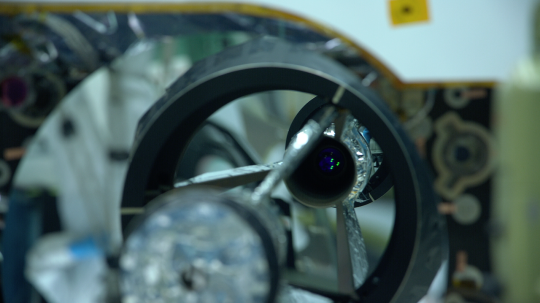
Lasers in space sounds like something straight out of Star Wars, but it’s also a reality for us. Our own GEDI (yes, like Jedi) instrument will launch later this year to the International Space Station.
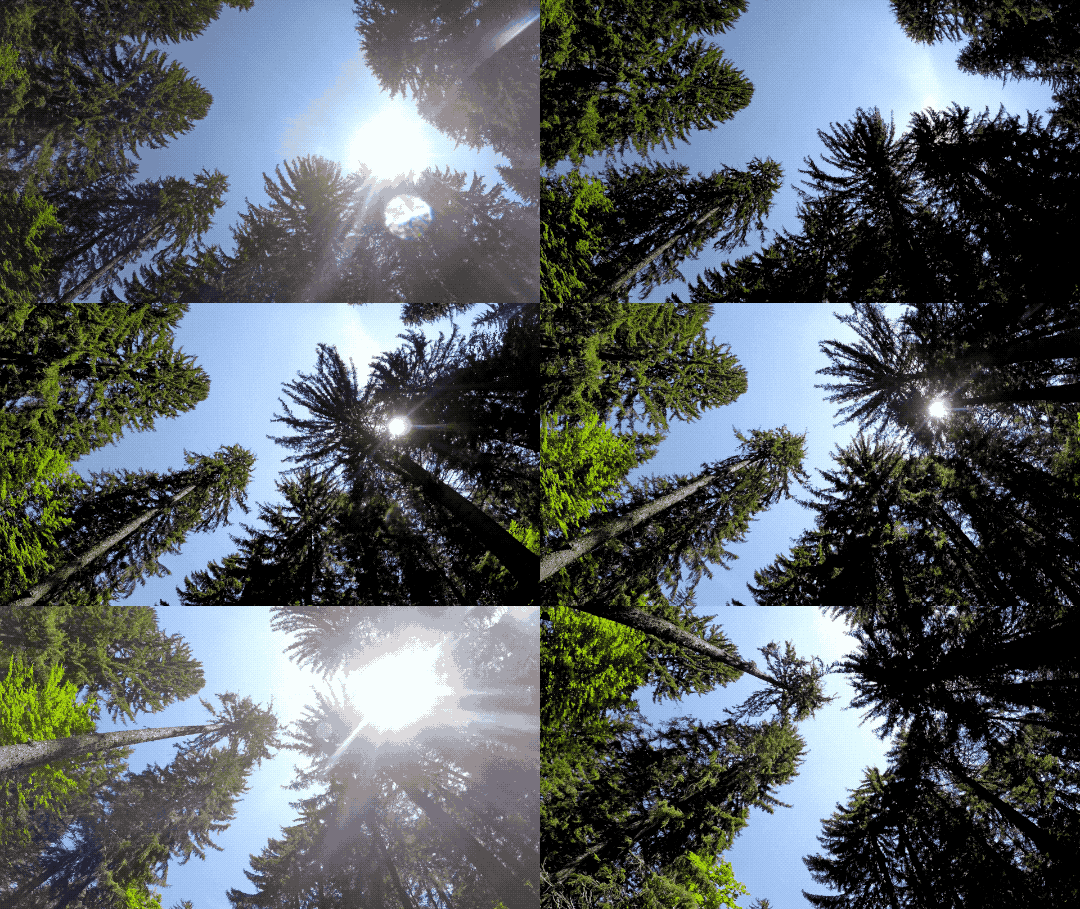
GEDI stands for the Global Ecosystem Dynamics Investigation lidar. It will study the height of trees and forests, using three lasers split into eight tracks, and create a 3D map of forests around the planet.
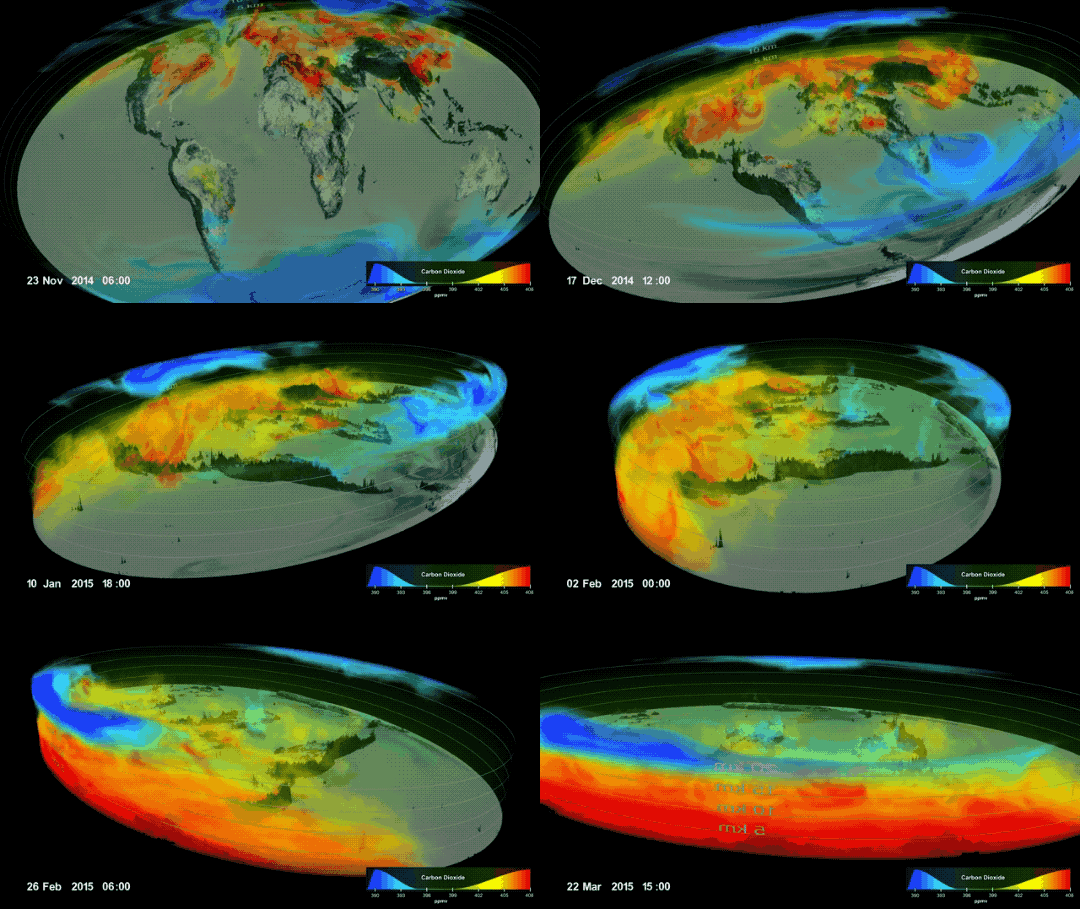
With GEDI’s new tree maps, we’ll get a better understanding of how much carbon is stored in forests all over Earth, and how forests will be able to absorb increasing carbon dioxide in the atmosphere.
The Jedi knights may help protect a galaxy far, far away, but our GEDI will help us study and understand forest changes right here on Earth.
Another JEDI
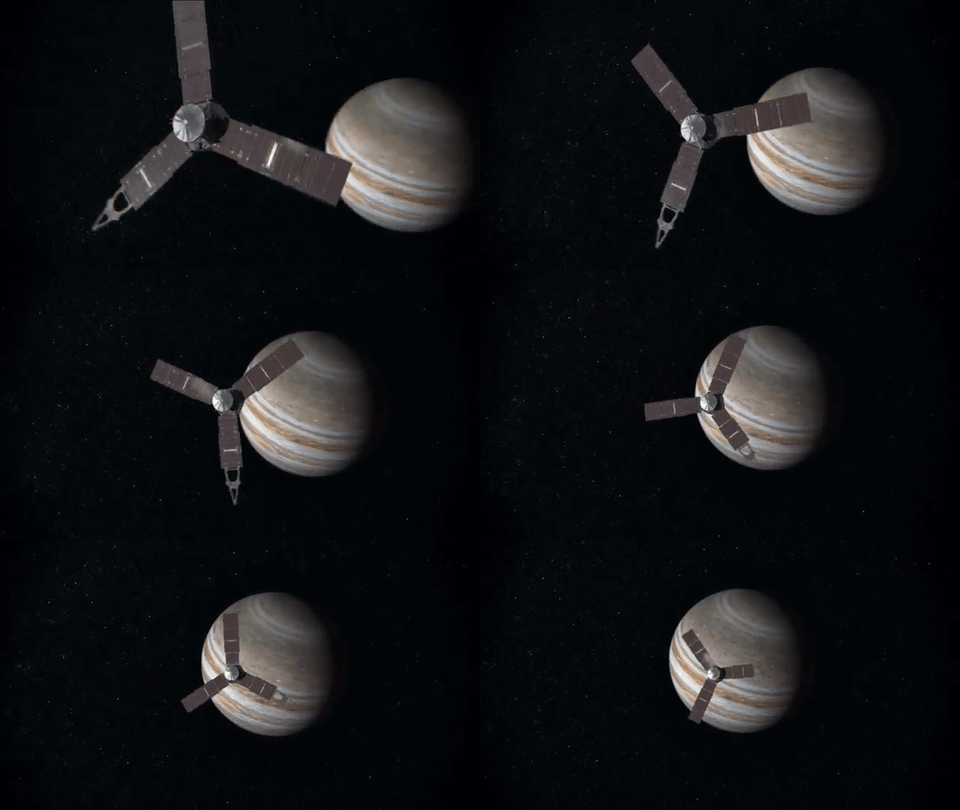
There’s another Jedi in town and it happens to be orbiting the planet Jupiter. Our Juno spacecraft, which arrived at the gas giant in July 2016, has an instrument on board that goes by the name of JEDI – the Jupiter Energetic Particle Detector Instrument.
While it doesn’t use a light saber or channel “the force”, it does measure high-energy particles near Jupiter. Data collected with the JEDI instrument will help us understand how the energy of Jupiter’s rotation is being funneled into its atmosphere and magnetosphere.
Death Star Moon
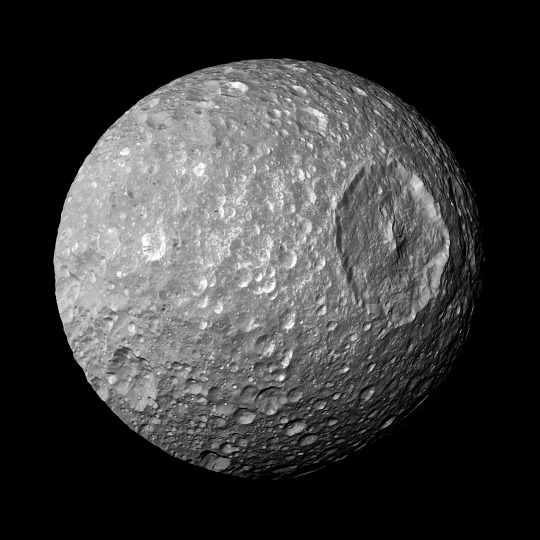
We know what you’re thinking…”That’s no moon.” But actually, it is! This is a real picture taken by our Cassini spacecraft of Saturn’s moon Mimas. In this view taken on Cassini’s closest-ever flyby of Mimas, the large Herschel Crater dominates, making the moon look like the Death Star. Herschel Crater is 130 kilometers, or 80 miles, wide and covers most of the right of this image.
We Actually Do Have the Droids You’re Looking For
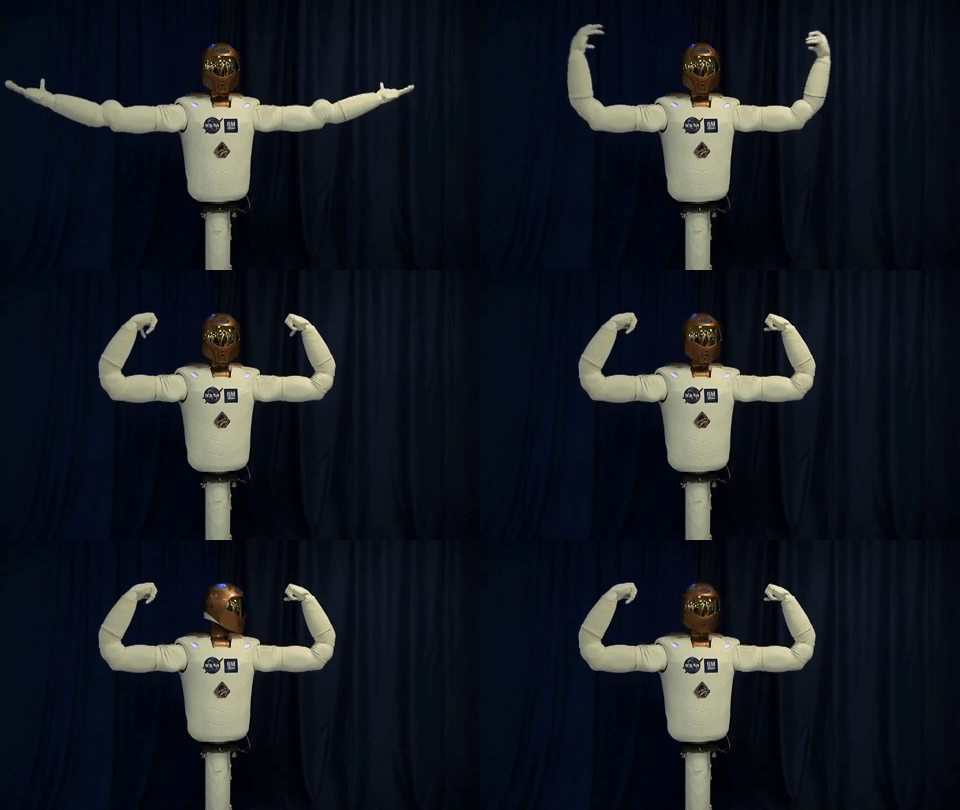
We have robots roving and exploring all over the solar system, but it’s our own “R2” that’s most likely to resonate with Star Wars fans. Robonaut 2, launched in 2011, is working along side humans on board the International Space Station, and may eventually help with spacewalks too dangerous for humans. Incidentally, an earlier version of Robonaut bore a strong “facial” resemblance to enigmatic bounty hunter Boba Fett.
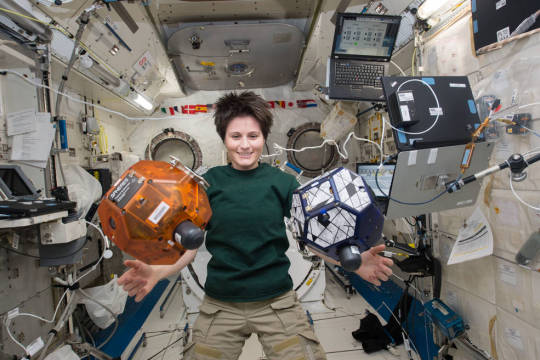
Another “droid” seen on the space station was directly inspired by the saga. In 1999, then Massachusetts Institute of Technology (MIT) professor David Miller, showed the original 1977 Star Wars to his students on their first day of class. After the scene where hero Luke Skywalker learns lightsaber skills by sparring with a floating droid “remotes” on the Millennium Falcon, Miller stood up and pointed: “I want you to build me some of those.”
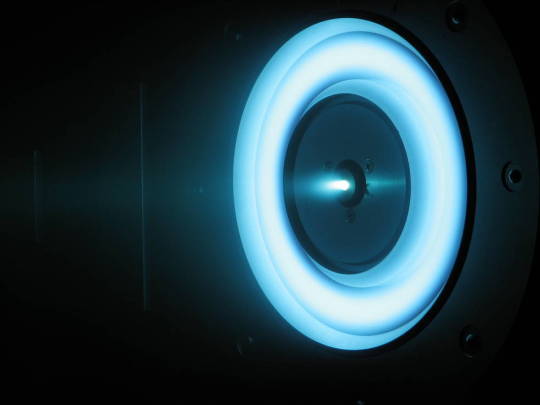
The “TIE-ins” go beyond casual resemblance to real engineering. We already use actual ion engines (“TIE” stands for “Twin Ion Engines”) on spacecraft like Dawn, currently orbiting the dwarf planet Ceres. In fact, Dawn goes one better with three ion engines.
Want more Star Wars connections? Check out THIS Tumblr to learn about the REAL planets we’ve found outside our solar system that resemble planets from the movie.
Take THIS quiz to see if you know more about the Milky Way galaxy or a galaxy far, far away.
Make sure to follow us on Tumblr for your regular dose of space: http://nasa.tumblr.com.
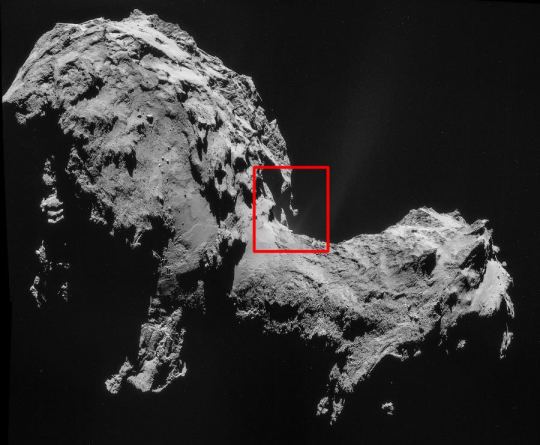
Dust, stars, and cosmic rays swirling around Comet 67P/Churyumov–Gerasimenko, captured by the Rosetta probe. (Source)
*kicks the front door in* DO YOU SEE HOW GODDAMN FUCKING COOL THIS SHIT IS
WE HAVE VIDEO. FROM THE SURFACE OF A COMET. SENT BY A ROBOT.
ROSETTA PROBE YOU’RE AMAZING WE LOVE YOU
That cliff is a kilometer high. is Here’s what you’re actually looking at:
THANK YOU
i was wondering
Not only is this shit cool as hell but you gotta realize how unbelievably remarkable of a task this is and how hard it was to pull off.
Humans managed to send a tiny hunk of metal stuffed with electronics millions and millions and millions of miles away through this hostile, airless envionent to land (without breaking it!) on the equivalent of a dirty snowball shooting though outer space
That’s like shooting a bullet from LA to London and hitting a moving target that’s only one foot across, and having the bullet survive the ordeal unscathed.
Plus! We humans developed a way to videotape and transmit pictures from this snowball in space so we know what it’s like to stand the surface.
I don’t think most people realize how terrifying the Moon Landings were. They look back at it, and see this great achievement in human spaceflight but don’t grasp the gravity of the situation. (No pun intended)
OP mentions Michael Collins, who is often forgotten. He was the third member of the Apollo 11 mission, who manned the Command Module whilst the other two landed with the Lander Module. People might hear that and thing he got the short end of the stick, but honestly… I’d argue the opposite. At 20:17:40 UTC on Sunday July 20 1969 the Landing Module touched down on the Moon. Neil Armstrong and Buzz Aldren spent 21 hours, 36 minutes on the surface of the Moon before beginning ascent to rendezvous with Michael Collins in the Command Module.
This is where things get unnerving. The thruster used on the Lunar Ascent Propulsion System used a hypergolic fuel, which is a fuel that spontaneously ignites when the fuel and oxidizer meet. Hypergolic fuels are useful for when spacecrafts need reliable ignition or repeated ignitions, however they’re nasty things. The specific fuel used for this thruster was a mixture of Aerozine 50 and Dinitrogen tetroxide. These are incredibly toxic, and more importantly incredibly corrosive. In fact, they are so corrosive that once you fire an engine you essentially have to completely rebuild it in order to reuse it. This means that the engine on the Lunar Ascent Propulsion System had never been fired before.
That engine was their bridge home. If it failed, they would be stranded on the surface of the Moon. As mentioned the Moon Landing lasted roughly 22 hours. For twenty two hours the two astronauts were on the moon, completely unsure if the never-before fired thruster would even fire up. Completely unsure if they’d be able to go home.
This picture shows the entirety of the human race on January 21st, 1969. All of it except the man who took it, that is. Micheal Collins stayed back on the Command Module during the mission to await Aldrin and Armstrong’s return… or potential lack thereof. This earned him the title “The Loneliest Man in the Universe”. For about 50 minutes for each orbit around the Moon Collins would be out of contact with the earth. That means for about 50 minutes during each orbit he’d have no way to contact any other human, completely alone over 230,000 miles from earth. For roughly 50 minutes during each orbit Collins had no clue whether his fellow astronauts were still alive, and them not returning was a very real possibility. Orders were in place that if the other two could not return to the command module that Collins would return alone.
This wasn’t just some disaster protocol either. This was a very real possibility. Both the astronauts, and NASA were very much prepared for it to happen. So much so that Richard Nixon, the president at the time, had a speech prepared if it were to happen. It doesn’t sugar coat it. It starts off
“Fate has ordained that the men who went to the moon to explore in peace will stay on the moon to rest in peace. These brave men, Neil Armstrong and Edwin Aldrin, know that there is no hope for their recovery.“
If that isn’t bone chilling, then I’m not really sure what is. People often romanticize space exploration, but back then, and even today, well… this is the reality of it. All of that is what astronauts go through.
It was a tense time. I watched them land and take off from my hospital bed because I had my tonsils removed in the middle of this all, and I remember the absolute hush that fell over the floor as we waited for them to connect. Even at eight, I knew that if they didn’t, there was no coming home.
One if the reasons I did was because my dad was one of those been one of the team that had worked to get them there. He wasn’t with NASA by the time they launched; he’d left after the capsule fire in Florida. But he understood the calculations because some of his work was in there. And the loss of Grissom — a man I’d met a couple of years before — and his crew underscored how dangerous this exploration could be.
We learned it again with Apollo 13, watching helplessly as waited to learn if those men would make it home. There were the deaths in the Cosmonaut program, even if we didn’t know the details then. Challenger — which found my father and repeating the conversation we’d had after the capsule fire of how dangerous it was and how we need those risks. Columbia.
Exploration is dangerous and the men and women who chase that dream are a special breed. But every time a flight goes up, there’s a breath thatks held until they’re safely home again. And a prayer we won’t have to hear a speech like Nixon’s.
Glowing in mostly purple and
green colors, a newly discovered celestial phenomenon is sparking the interest of scientists, photographers
and astronauts. The display was initially discovered by a group of citizen
scientists who took pictures of the unusual lights and playfully named them “Steve.”
When scientists got involved
and learned more about these purples and greens, they wanted to keep the name
as an homage to its initial name and citizen science discoverers. Now it is
STEVE, short for Strong Thermal Emission Velocity Enhancement.
STEVE occurs closer to the equator than where most aurora appear – for
example, Southern Canada – in areas known as the
sub-auroral zone. Because
auroral activity in this zone is not well researched, studying STEVE will help
scientists learn about the chemical and physical processes
going on there. This helps us
paint a better picture of how Earth’s magnetic fields function and interact with
charged particles in space.
Ultimately, scientists can use this information to better
understand the space weather near Earth, which can interfere with satellites
and communications signals.
Want to become a
citizen scientist and help us learn more about STEVE? You can
submit your photos to a citizen science project called Aurorasaurus, funded by
NASA and the National Science Foundation. Aurorasaurus
tracks appearances of auroras – and now STEVE – around the world through
reports and photographs submitted via a mobile app and on aurorasaurus.org.
Here are six tips
from what we have learned so far to help you spot STEVE:
1. STEVE is a very narrow arc, aligned
East-West, and extends for hundreds or thousands of miles.
2. STEVE mostly emits light in
purple hues. Sometimes the phenomenon is accompanied by a short-lived, rapidly
evolving green picket fence structure (example below).
4. STEVE appears closer to the
equator than where normal – often green – auroras appear. It appears
approximately 5-10° further south in the Northern hemisphere. This means it
could appear overhead at latitudes similar to Calgary, Canada. The phenomenon
has been reported from the United Kingdom, Canada, Alaska, northern US states,
and New Zealand.
5. STEVE has only been spotted so far in
the presence of an aurora (but auroras often occur without STEVE). Scientists
are investigating to learn more about how the two phenomena are connected.
6. STEVE may only appear in
certain seasons. It was not observed from October 2016 to February 2017. It
also was not seen from October 2017 to February 2018.
STEVE (and aurora) sightings can be reported at www.aurorasaurus.org
or with the Aurorasaurus free mobile apps on Android and iOS. Anyone can sign up, receive alerts, and
submit reports for free.
Make sure to follow us on Tumblr for your regular dose of space: http://nasa.tumblr.com.