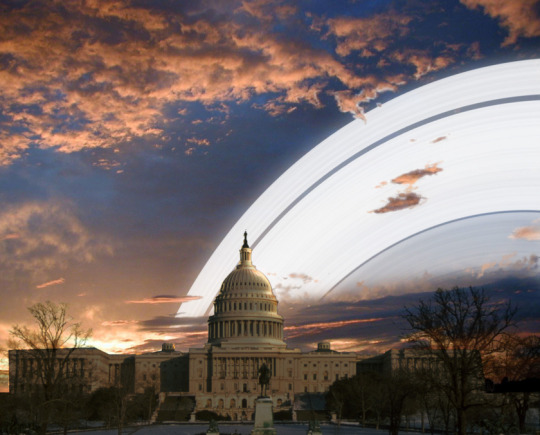
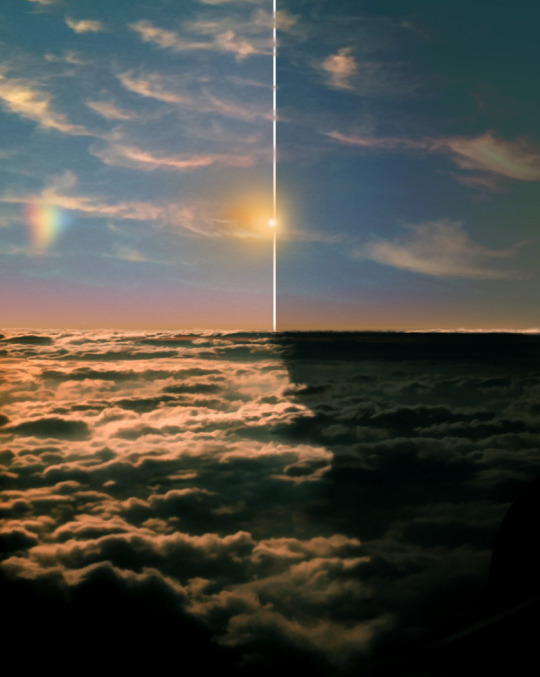
From Washington, D.C., the rings would only fill a portion of the sky, but appear striking nonetheless. Here, we see them at sunrise.
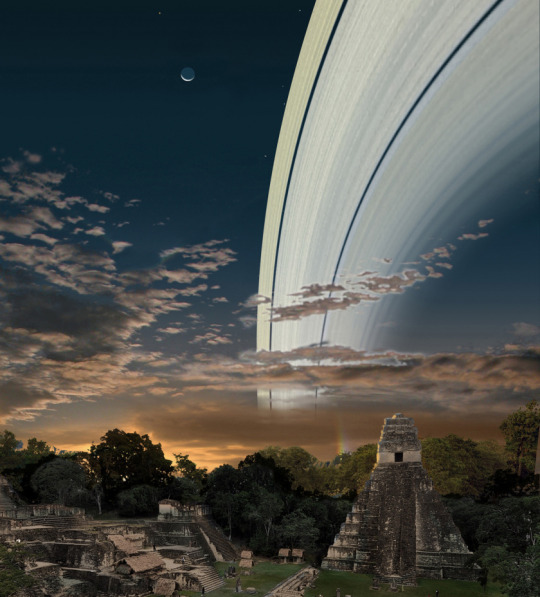
From Guatemala, only 14 degrees above the equator, the rings would begin to stretch across the horizon. Their reflected light would make the moon much brighter.
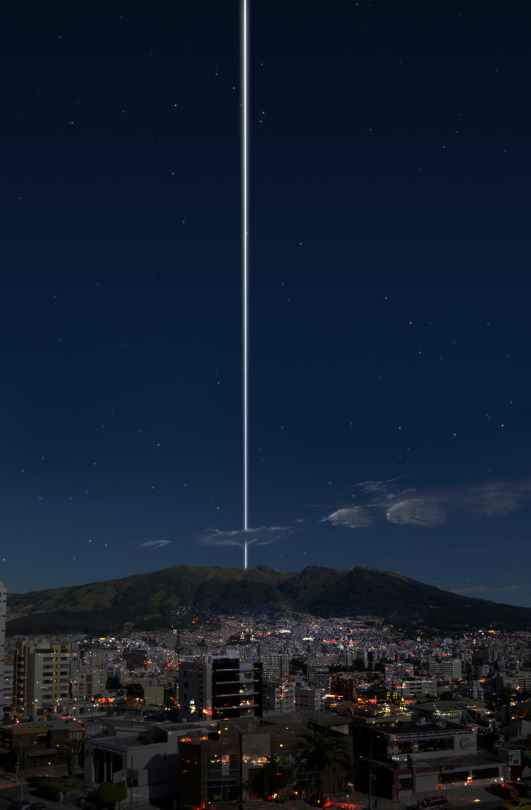
From Earth’s equator, Saturn’s rings would be viewed edge-on, appearing as a thin, bright line bisecting the sky.
At the March and September equinoxes, the Sun would be positioned directly over the rings, casting a dramatic shadow at the equator.
At midnight at the Tropic of Capricorn, which sits at 23 degrees south latitude, the Earth casts a shadow over the middle of the rings, while the outer portions remain lit.
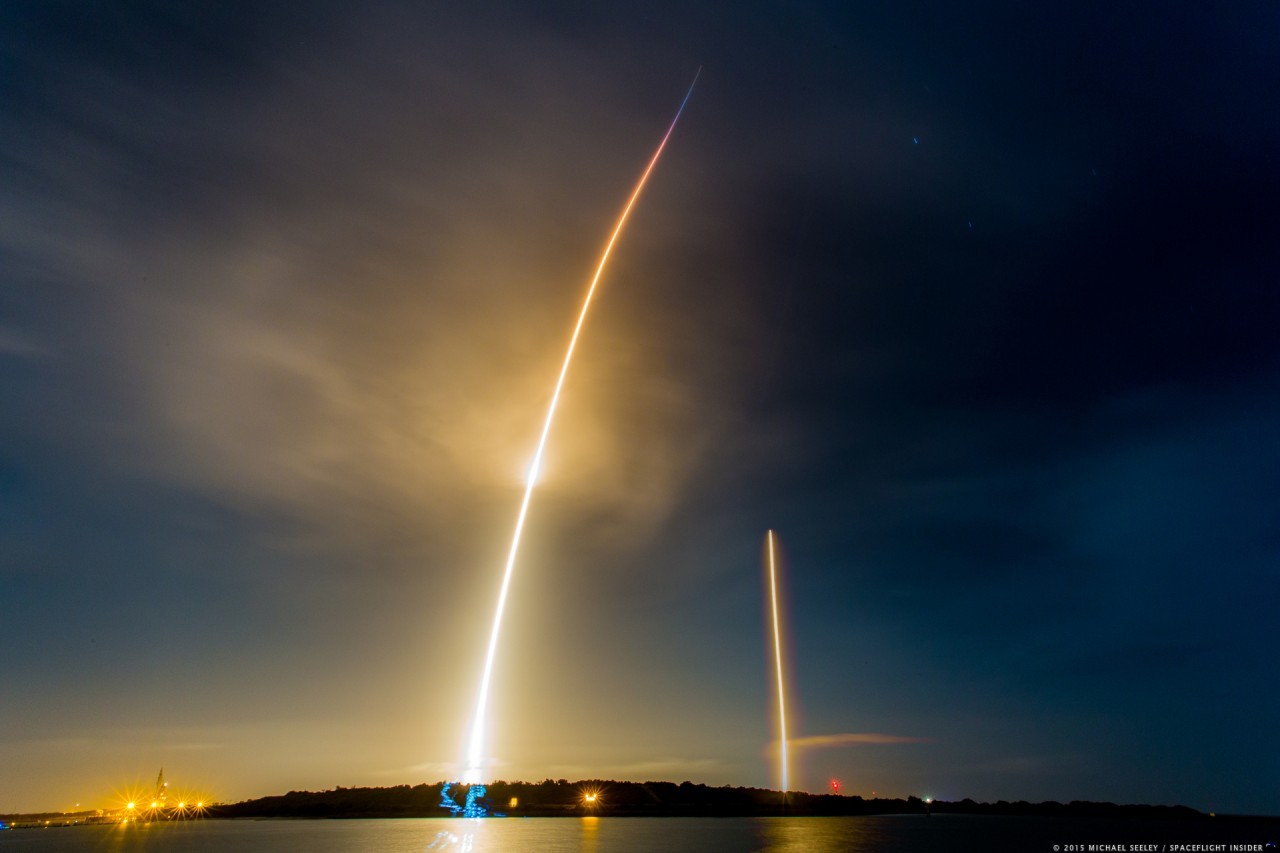
, the private spaceflight company SpaceX blasted one of its huge two-stage Falcon 9 rockets into space, then returned the first stage of the rocket back to Earth in a stunning nighttime landing. The upper stage, meanwhile, delivered 11 satellites to orbit for SpaceX customer Orbcomm.
This success has the potential to change spaceflight as we know it.
Right now we rely on rockets to launch things like satellites and supplies for the International Space Station into space, but just one rocket costs over $60 million, and you can only use it once. That’s why Elon Musk’s SpaceX and Bezos’ rocket company Blue Origin are trying to develop reusable rockets.
Instead of throwing away $60 million on every single launch, reuseable rockets could fly over and over again. But it’s far from easy: three tries at vertical landings earlier this year failed. see how SpaceX managed the succesful feat here
Blue Origin,
interested in space tourism, successfully landed a booster last month but it had been used for a suborbital flight. The SpaceX booster was more powerful, flying faster and higher in order to put satellites into orbit, making the landing much more difficult to pull off.
image: SpaceX’s Falcon 9 rocket lifted off at 8:29 p.m. EST and touched down about 10 minutes later. Photo Credit: Michael Seeley / SpaceFlight Insider
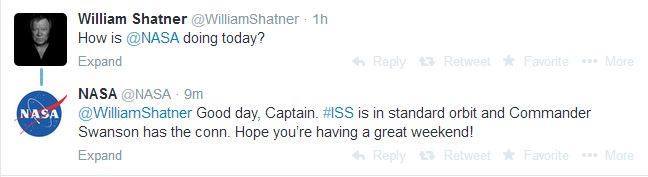
I love how they respond to him, as if he is actually a captain, even more.
Nasa confirmed for huge fucking nerds
This is awesome and priceless and people that work on space stuff are the best people of all time.
Honestly this just about brings me to tears.
Roddenberry, Shatner, Nimoy, Nichols and all the rest of the original Star Trek cast and crew had no small role in making the moon landing as important as it was. A few years before they set that lunar module down, this little TV show came along and fanned the dream into wildfire with an image of what humanity in space could actually look like—not only peaceful on our own world, endlessly curious, and prosperous enough to pursue it, but an active force for good in the greater universe. Carrying not what’s most toxic about us, but what’s best about us out to the stars.
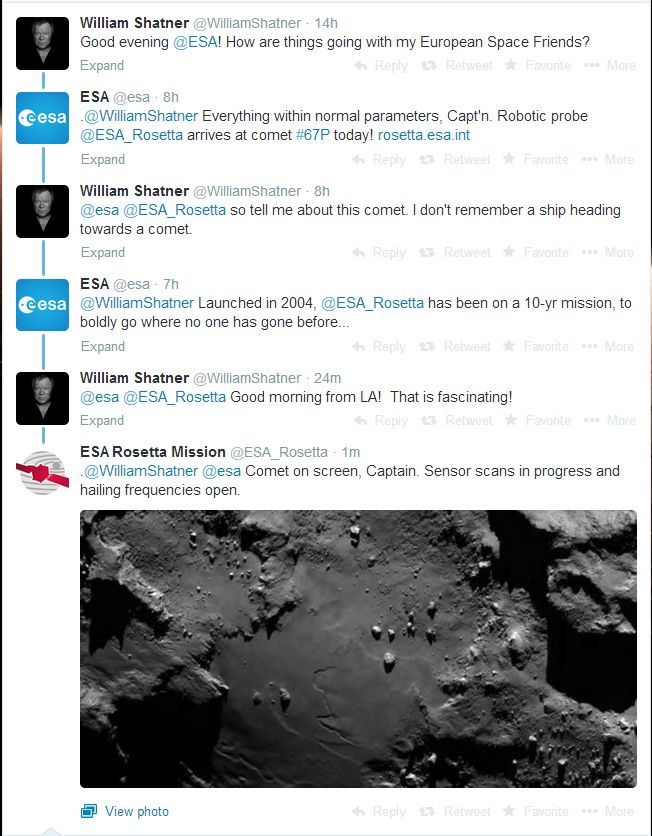
Everybody who has worked at NASA or any other space agency for the past 50 years is waiting for the day when that unmanned probe doing a flyby on a comet can be controlled from the bridge of a space-faring vessel. When we’re not just looking at that comet through a color-coded sonar map, but we can look out a porthole and see it tumbling by with our own eyes. When as a species we can finally outgrow hate and fear and violence, and turn our faces with joy toward all the beauties and wonders that lie waiting to be discovered.
And every time he does this, Shatner is reminding them of what that hope feels like.
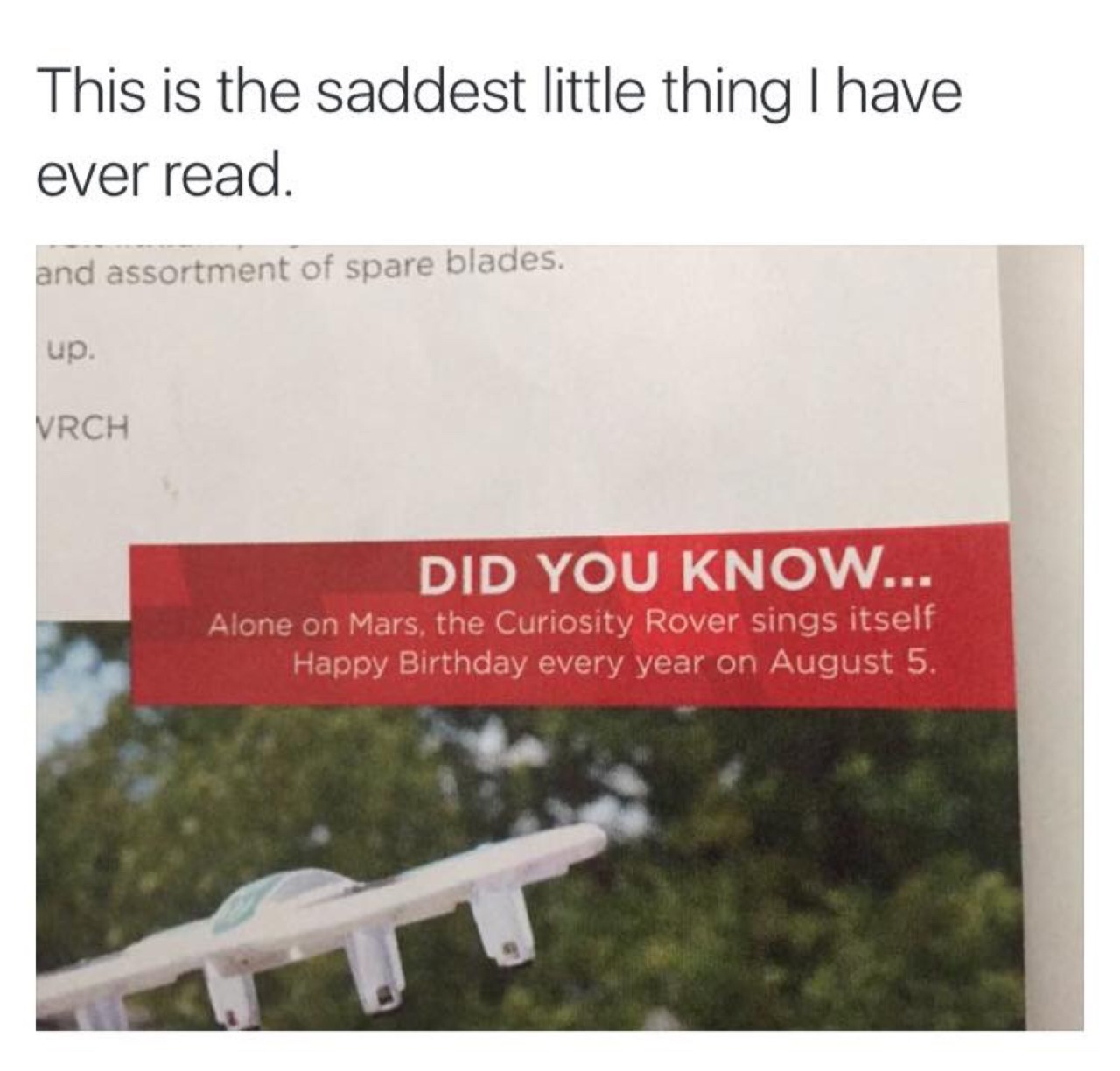
Send me to Mars with party supplies before next august 5th
No guys you don’t understand.
The soil testing equipment on Curiosity makes a buzzing noise and the pitch of the noise changes depending on what part of an experiment Curiosity is performing, this is the way Curiosity sings to itself.
So some of the finest minds currently alive decided to take incredibly expensive important scientific equipment and mess with it until they worked out how to move in just the right way to sing Happy Birthday, then someone made a cake on Curiosity’s birthday and took it into Mission control so that a room full of brilliant scientists and engineers could throw a birthday party for a non-autonomous robot 225 million kilometres away and listen to it sing the first ever song sung on Mars*, which was Happy Birthday.
This isn’t a sad story, this a happy story about the ridiculousness of humans and the way we love things. We built a little robot and called it Curiosity and flung it into the star to go and explore places we can’t get to because it’s name is in our nature and then just because we could, we taught it how to sing.
That’s not sad, that’s awesome.
*this is different from the first song ever played on mars (Reach For The Stars by Will.I.Am) which happened the year before, singing is different from playing
a good chunk of the mars press conference this morning was scientists discussing how not to contaminate the martian waters with terrestrial microbes from the rovers and permanently alter the development of life on mars. in other words we already have to obey the prime directive and I’m delighted with that