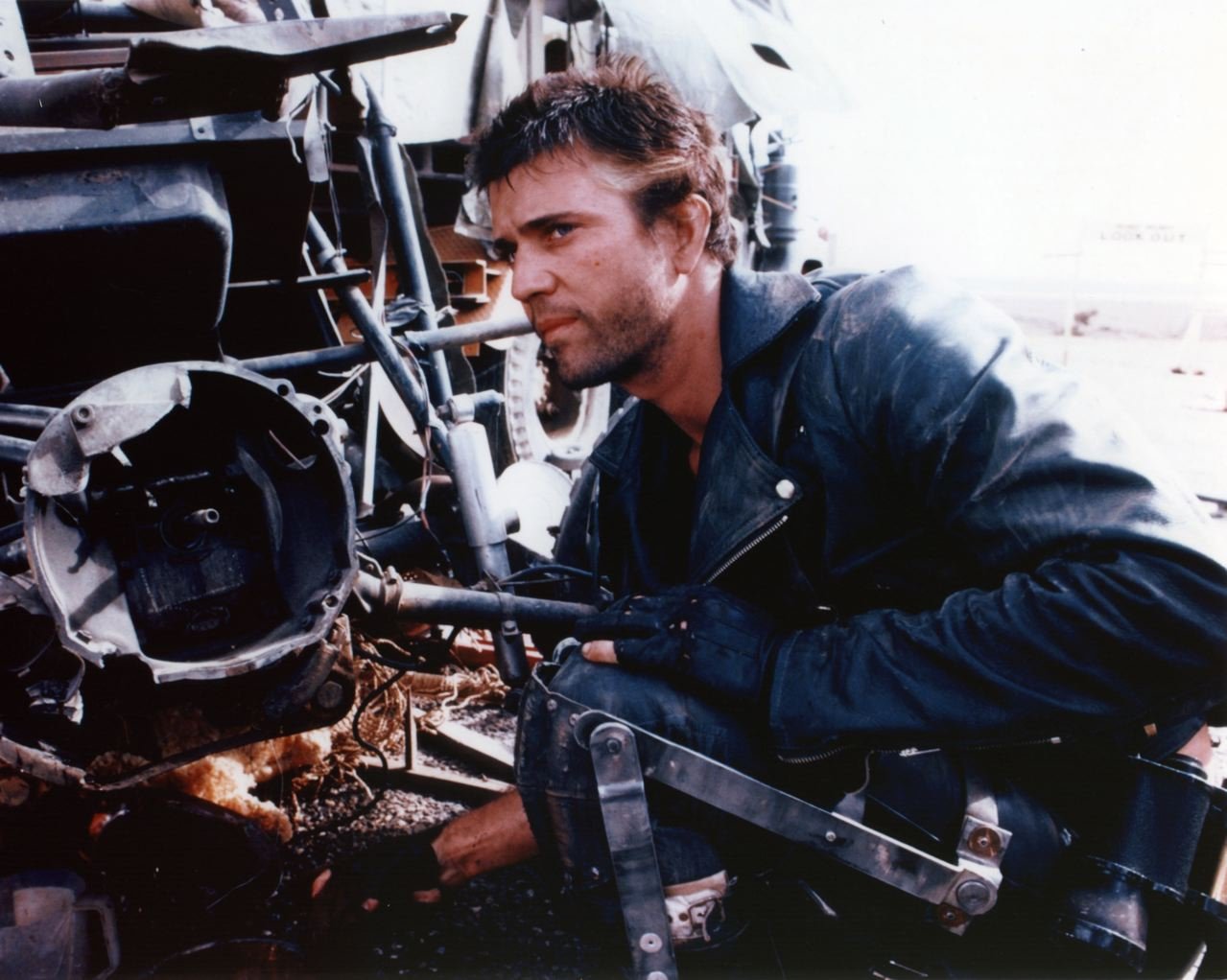
i find it incredibly strange that all the mentions i’ve seen about mad max and disability have centered entirely around furiosa’s one-handedness, but not on max’s mental illness.
max is, disabled. he is deeply, deeply mentally ill. he has auditory and visual hallucinations and is skirting the edge of non-verbal. when the dag says “i thought you weren’t crazy anymore,” it’s doubly funny because in no universe is he ever not going to be crazy. it’s just that with his new family, he has one hell of a support network and is able to be something resembling functional. his mental illness is not pretty or convenient, just like furiosa’s lack of an arm is either of those things. but it’s a part of him, and his coping with it is a part of him, just like her prosthetic arm is a part of her.
#BIG DISABLED FAMILY DRIVING THIS WAR RIG OFF INTO THE SUNSET#punchbuggy flamethrower the movie (via gatheringbones)
In the world of movies, tv shows, books, comic books, etc. how many characters can you name with physical disabilities/using mobility devices? Name as many as you can, but I’m personally looking out for chicks in wheelchairs, preferably of color, and bonus points if they’re queer.
Edit – So here’s what I have so far (bolding anyone who is not a white cisguy)
Dr. Scott – Rocky Horror Picture Show | Movie | wheelchair
Artie Abrahams- Glee | TV Series | wheelchair
Quinn Fabray (shortly) – Glee
| TV Series | wheelchair
Barbara Gordon/Oracle – Batman
| Comic Book | wheelchair
Lt. Dan – Forrest Gump
| Movie | wheelchair
Jake Sully- Avatar
| Movie | wheelchair
Joe Swanson – Family Guy
| TV Series | wheelchair
Dr. Finklestein – Nightmare Before Christmas
| Movie | wheelchair
Toothless, Hiccup, Gobber- How To Train Your Dragon
| Movie | prosthesis
Professor X- X-Men
| Movie | wheelchair
Daredevil- Daredevil
| TV Series | walking stick
Walter White Jr. – Breaking Bad
| TV Series | crutches
Raven Reyes – The 100
| TV Series | leg brace
Jimmy- Degrassi
| TV Series | wheelchair
Arizona Robbins – Grey’s Anatomy | TV Series| prosthesis
Imperator Furiosa- Mad Max: Fury Road | Movie/Book| prosthesis
Gregory House – HOUSE M.D. | TV Series | cane
Frida Kahlo- Frida | Movie | cane, wheelchair
Karma – X-Men | Comic Book | prosthesis
John Bennet | Orange is the New Black |TV Series| prosthesis
I’m a 90s Kid, so Marissa Clark from the series Early Edition (1996-2000) springs to mind. She was a WOC and she’d been blind since she was a baby due to meningitis, so she used a walking stick and seeing eye dog. She wasn’t the star of the show, but she was the second character after the lead.
Geordi La Forge from Star Trek: Next Generation (1987-1994). A MOC and blind since birth, but due to living in the far future he used a VISOR (Visual Instrument and Sensory Organ Replacement). Again, not the star of the show, but he was one of the main cast members and he went on to appear in other Star Trek films, novels, comics, etc…
Fiona Bellows from the Doctor Who episode “Last Christmas” (2014). She is a white grandmother in a wheelchair, though most of the episode took place in dream layers where she dreamed herself being able to walk. She was a guest star in the episode.
Casey Durwin from Terra Nova (2011). He was in a motorized wheelchair because he’d lost both his legs in a Carnotaurus attack. He was white.
Campbell from Switched at Birth (2014). He suffered a spinal
injury, so he was in a wheelchair. He was a recurring character for a
short period and dated Daphne. He was white.
Book!Peeta Mellark from The Hunger Games series (2008-2010).
Although not represented in the film version, Peeta had his left leg
amputated as a result of the Hunger Games and had to use a prosthetic.
He was white, a main character, and one of Katniss’ love interests.
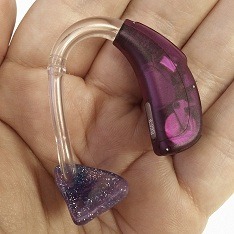
Daphne Vasquez from Switched at Birth (2011-Present). She was born to white parents but switched at birth and raised by a Latina mother and grandmother, believing they were her biological family until she was in her mid-teens. At age three she got meningitis and became Deaf. So she doesn’t use any mobility devices (so I’m not sure if she or any of the other Deaf characters work for your list), but she does use hearing aids and interpreters. She is one of the two stars of the show.
Since Deaf Culture is a huge part Switched at Birth, there are several Deaf characters on the show with fairly regular roles:
Emmett Bledsoe (2011-Present) is another main cast member. He’s white.
Melody Bledsoe (2011-Present) is a significant recurring character. She’s white.
Travis Barnes (2012-Present) is a recurring character. He’s white.
Natalie Pierce (2013-Present) is a recurring character. She’s Latina and a lesbian.
Gabriella from The Little Mermaid: The Series (1993-1994). She was a Deaf WOC with a recurring role.
Book!Katniss Everdeen from The Hunger Games series (2008-2010). Although not
represented in the film version, Katniss was a WOC and becomes deaf in
her left ear as a result of the Hunger Games. She was the star character of the series,
Dr. Emma Coolidge from Heroes (2009-2010). She was a Deaf white woman with the ability of synesthesia. She was a recurring character in the final season.
Oooh, I have a few-
1) Ada Gillyflower from the Crimson Horror episode of Doctor Who, she was blind and used a stick.
2) Another blind character from Doctor Who, Mickey’s grandmother Rita-Ann. She’s not actually named in the show but she has an important scene with Mickey.
3) Maybe Nick Fury from the MCU?
4) Tariq Siddiqui from the magnificently bad Waterloo Road, a Muslim teen whose legs were damaged in a bus crash. He used a wheelchair and I think he eventually joined the Paralympics canoe team in-show?
5) Dr. Hermann Gottlieb from Pacific Rim, he using a walking stick.
6) Last but not least, Tahl from the Star Wars YA series Jedi Apprentice. She’s a dark-skinned, stripey-eyed human (technically a Noorian) who is blind and has a ‘personal navigation droid’ as assistive technology
This week CBBC aired an episode of their show ‘Marrying Mum and Dad’ – essentially a show where kids organise their parents weddings – and this week saw a Doctor Who themed wedding where the kids had their two mothers marry as Vastra and Jenny!
It’s available to watch here for the next 27 days.
I wish I could watch this!
This just gives me so many feels. Look at how important Vastra and Jenny are to people, especially kids.
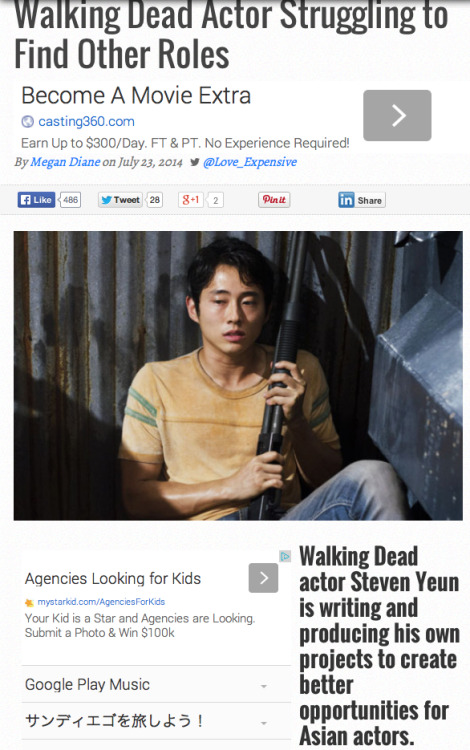
“ People ask ’ So, how are the roles now? You must be getting so many.’ And it’s like, I don’t know if you know, but I’m Asian still.It’s not a complaint, that’s just how it is now, and I have to forge my own path through it and see that through. I think that if I had not been Asian, I probably would have a whole plethora of roles, at least to audition for, but it’s just not what has been written.” – Steven Yeun
When all else fails, gotta roll up your sleeves and do it, to it.
Especially so because ScaJo is playing an Asian woman in a movie based on an anime made by Asians in a world that’s set closely resembling Tokyo.
Especially so because Akira, a movie inspired by Japanese trauma toward being Nuclear Bombed by America was going to be set in America, with the Japanese as the bad guys, directed and casted by a guy who doesn’t respect the source material.
Asian actors trying to get more representation and respect is important because white people won’t give it to us.
i really like the advice “write marginalized characters but don’t write about marginalization unless you experience it”
absolutely i think cis people should expand their horizons and write trans characters, but they shouldn’t write stories about being trans. likewise i think allistic / NT authors should write about autistic characters! but not stories about being autistic.
represent us. absolutely. but don’t tell our stories. let us do that.
OK so… i’m having trouble understanding how to apply this advice.
i’ll skip the trans characters part because that’s… (not my business? not my lane?)
but okay. say a non-autistic writer friend wants to write a story featuring an autistic character. and i and their other autistic friends tell them our advice and tips and experiences (the writer friend does their homework, basically)… so, similar to real autistic persons,
an autistic character has an autistic existence… along with all the other parts of their identity. at what point does the story pass from being a story about an autistic person to being a story about being autistic? where is the magic line that they should not cross? i would not know how to tell them where that line is, even when it’s about something connected to my own experience. i could maybe tell them where they are getting it wrong about what an autistic experience might be like… and if many of their autistic friends feel like something is ‘off’, then it probably is. but where is the line between representation and telling other people’s stories?
disclaimer, i dotry to write stories about characters whose experiences i don’t share, and i am trying to do my homework like i described above (although i should probably get a wider base of examples to draw from, because i have one person i ask a lot of questions to, and i know several other people where i just try to remember the general idea of stuff they happen to mention about that experience). but i still don’t know where that line is in my own writing (and someone else’s experiences), any more than i would in someone else’s writing (and my experiences).
I think I see where this is going. If I read OP correctly, they are asking people to incorporate and accurately represent disabled or trans (or LGBTQ, PoC, whatever) characters, but not make the storycentrally focused on the experience of one of those characters’ life experiences. Like, don’t write a story specifically about the experience of being disabled if you haven’t actually experienced being disabled.
But, I agree with you natalunasans. It is extremely difficult to separate the character from their experiences because that character would not have those experiences if they did not possess a certain characteristic. And, on top of it, not everyone’s experience will be the same. My experience as a blind person, for example, may be extremely different than another blind person’s experiences. There is room for variation.
I would not like someone to tell my story because only I can tell that, but do I want people to write accurate and believable blind characters even if the author is not blind? Absolutely. I want them to do their research and do it right. I want non-disabled writers to write realistic disabled characters, learn about them, and do them justice. Learning is the best way to come to an understanding about the experience of “other” and what better way is there for a non-disabled writer to appreciate an experience they have not had themselves than to do good research, talk to real people, and then write something which their audience approves of?
I re-blogged a picture of a little girl, dressed as Tiana, hugging the face actress who plays Tiana at one of the Disney Parks, and noted that everyone should have their princess. And a few people have now contacted me basically going “no, only straight white people can have princesses if you stick with the classics.”
Um.
No.
I am a folklorist, and it’s time for some Fun With Folklore.
First off, very few Princesses/fairy tale heroines who are going to become Princesses because that’s what you do are actually defined by specific physical attributes. You have Snow White, who yes, requires the “skin as white as snow” etc, but that’s to make her an alien beauty and justify the actions of her stepmother. She belongs to the Aarne-Thompson tale type 709, which is commonly referred to as “Snow White,” but which contains a hell of a lot more, including “Bella Venezia”, “Myrsina”, “Nourie Hadig” and “Gold-Tree and Silver-Tree.“ All those links will take you to Wikipedia. Click them. Note that NOT ONE of those girls is defined by her appearance, beyond “incredibly beautiful.“ “Nourie Hadig” is Armenian in origin; you can bet that girl was not white as snow. (Note that I do not actually care for the “Nourie Hadig” 709 variant, due to using a Roma girl as the main adversary, but that’s another story.) Any story you want to tell is going to have variants where the heroines are never described! You know why?
BECAUSE THE PEOPLE WHO WERE TELLING THESE STORIES UNDERSTOOD THAT IT WAS IMPORTANT FOR CHILDREN TO SEE THEMSELVES IN THE MIRROR OF THE TALE.
There are fairy tales about people with disabilities, ranging from the physical (missing limbs, missing eyes, missing tongues) to the emotional (girls who cannot smile, boys who cannot feel fear). There are fairy tales that end in same-sex marriage. There’s even an excellent fairy tale about gender identity, “The Princess Who Became A Prince,” in which our hero has always felt he was a boy, but tried to be a dutiful daughter, until a dragon stole a neighbor princess and he had to ride to rescue the girl in order to save the kingdom. One misaimed curse later, and wham, our new-minted prince is finally outwardly as he had been all along on the inside.
THIS IS JUST AS OLD AND TRUE AND SCHOLASTIC AS CINDERELLA AND THE OTHERS.
The “big fairy tales” of today are the ones that someone seized on as marketable. We have the power, as drivers of media, to say that we want more diversity. We want Princesses of every race, creed, and religion, and we have the folklore and fairy tales to make them real. We want our transgender Princess (although wow would the marketing be problematic). Saying “the classics” are 100% about straight white people reduces the past to a place where only straight whiteness existed, and where no other children ever needed stories. And that’s not what the past was.
Once upon a time has never stopped being right now.