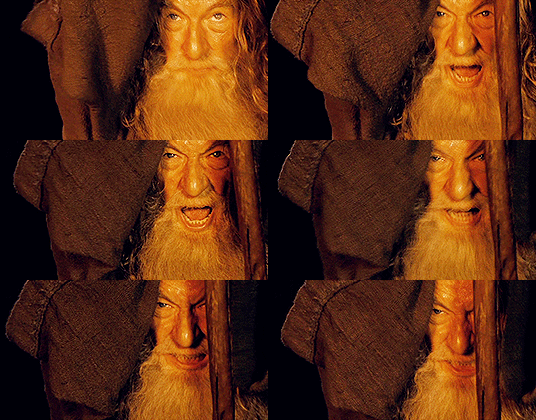
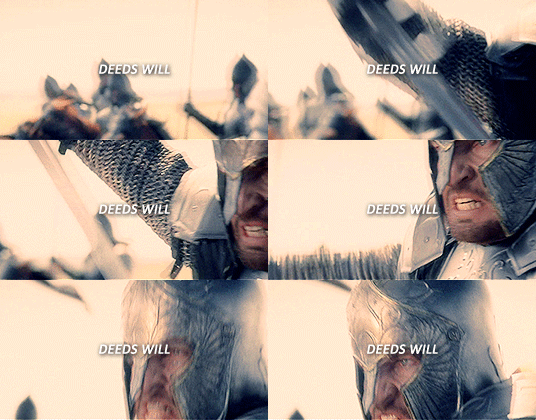
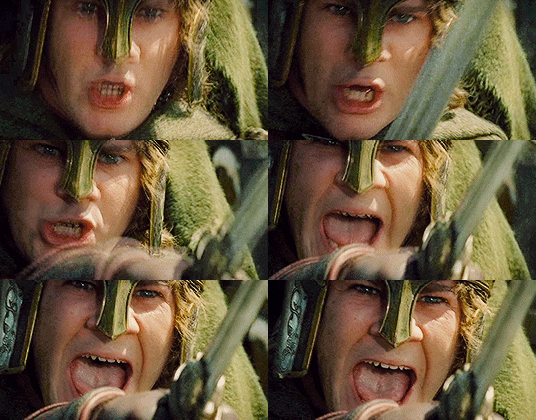
““A time may come soon,“ said he, “when none will
return. Then there will be need of valour without renown, for none shall
remember the deeds that are done in the last defence of your homes. Yet
the deeds will not be less valiant because they are unpraised.”“
it will never cease to delight me that in the trilogy, gimli is shown to be charming, with all the polish and grace of a trained diplomat—he trades wits with elrond and speaks so graciously to galadriel that she gives him a gift denied feanor; his extemporaneous description of the glittering caves is what convinces legolas to travel there with him after the war, he sings the song of durin so well that sam begs to learn it.
whereas legolas is this big cheerful lug of a hunter-tracker, incidentally a prince, only unwittingly beautiful and graceful—his speech is decidedly stiff and formal, even when he’s trying to be gentle, but then turns around and starts singing without realizing he’s forgotten half the song. He has strange moments of seriousness, when the ancientness of him shines through, but then—
I do wonder what their first conversations were, gimli dignified but a little chilly; legolas stiff even as he attempted humor, but a way forward nonetheless.
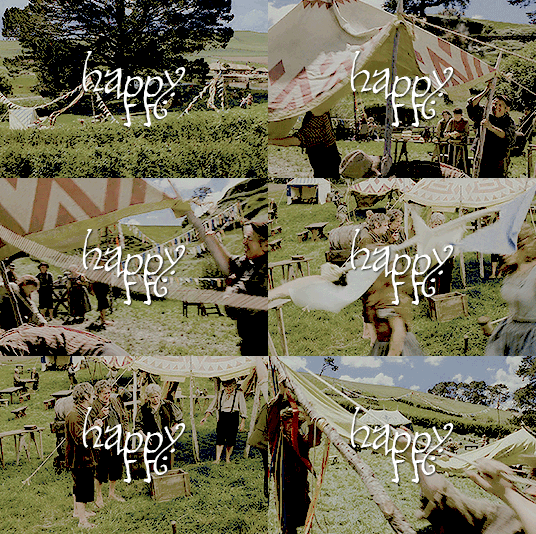
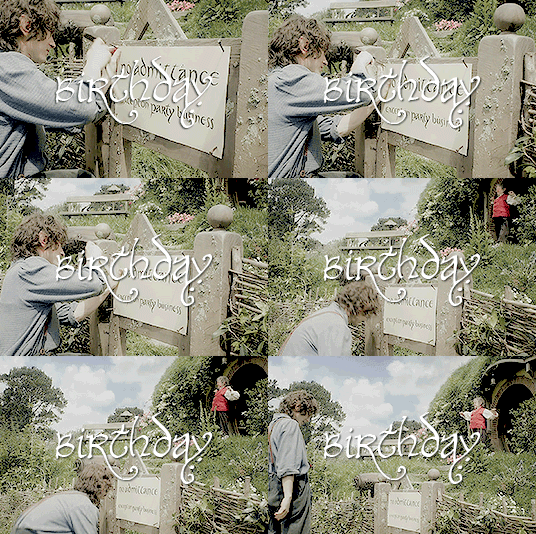
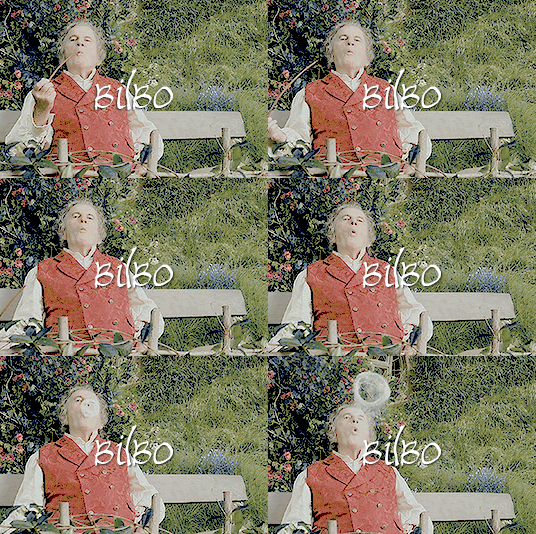
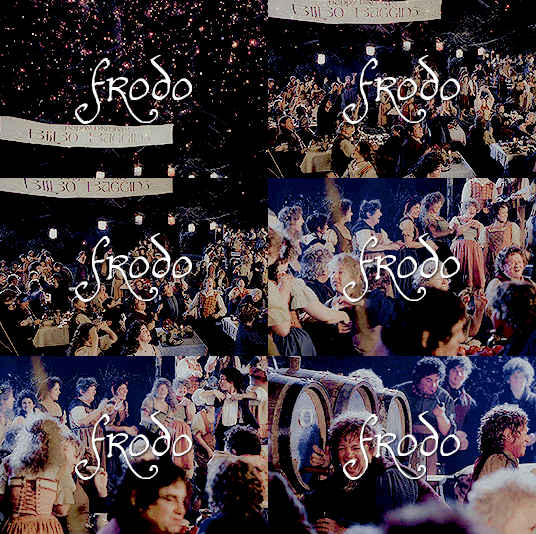
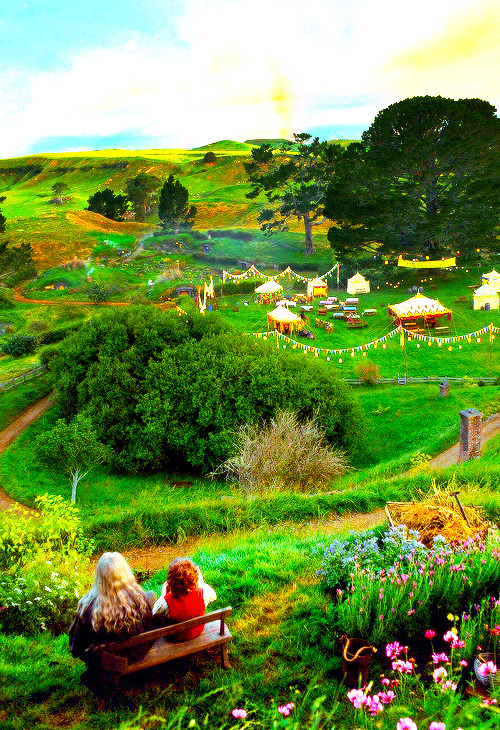
September 22 – “At last the day of the Big Party arrived. Everywhere there was too
much to eat, and by midafternoon there were broken presents lying all
over the Shire attesting to the low quality of their manufacture. Gandalf
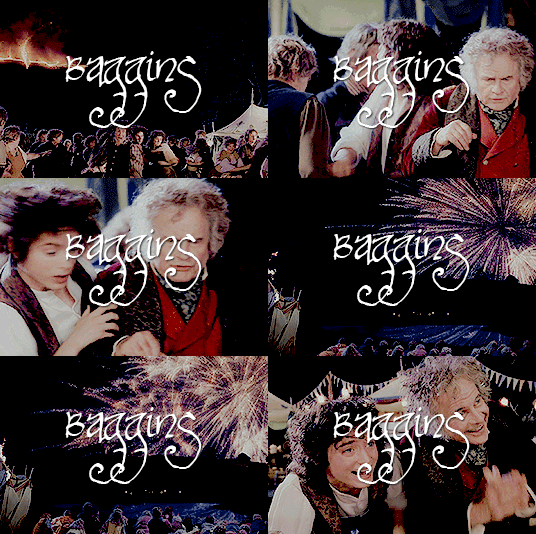
set off a series of fireworks later on in the day, including great
skywriting missiles and little flaming butterflies who took to wing,
sailed off into the Eastfarthing and burned all its trees to the ground. The last firework sent up a great black smoke which took the shape
of a giant mountain of fire. A flicker could be seen of a giant dragon
sailing about its peak; after a moment the great dragon went sailing over
the heads of the crowd, causing great panic and consternation and six
outright heart attacks before imploding somewhere over the
Sackville-Baggins’ neighborhood, causing considerable property damage
which was never properly repaired for generations afterward. ‘That is the signal for supper!’, Bilbo cried out to the survivors,
who were only partly mollified.”
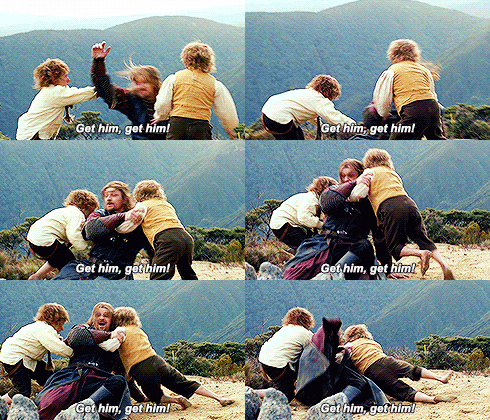
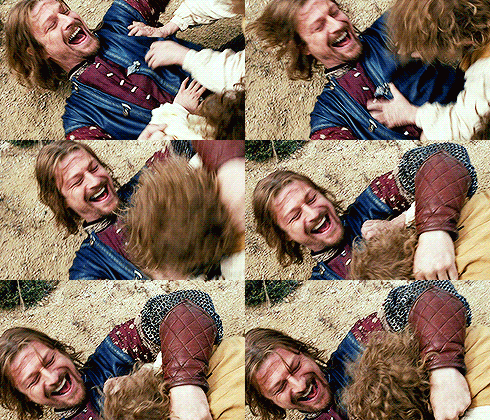
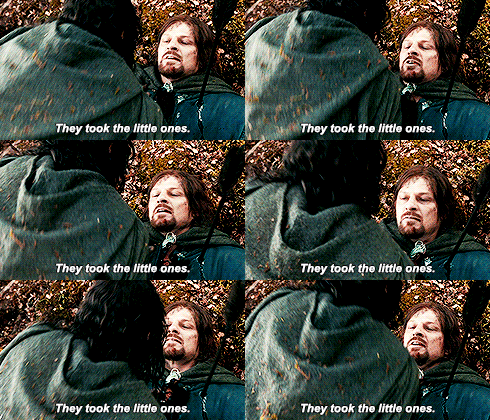
My theory is that it’s because the Hobbits showed Boromir the possibility of camaraderie based on kindness and liking, as opposed to regimentation and excellence like he grew up with.
Ah my heart!
My theory was always that it was because he was such a loving older brother. I think they sparked that protective older brother instinct in him.
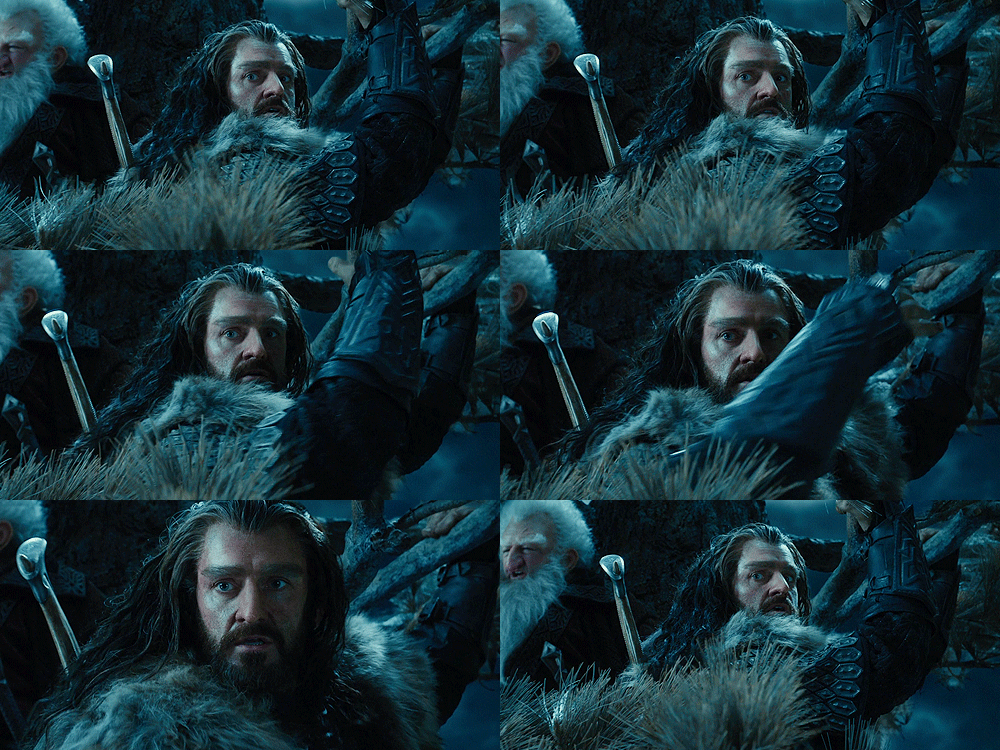
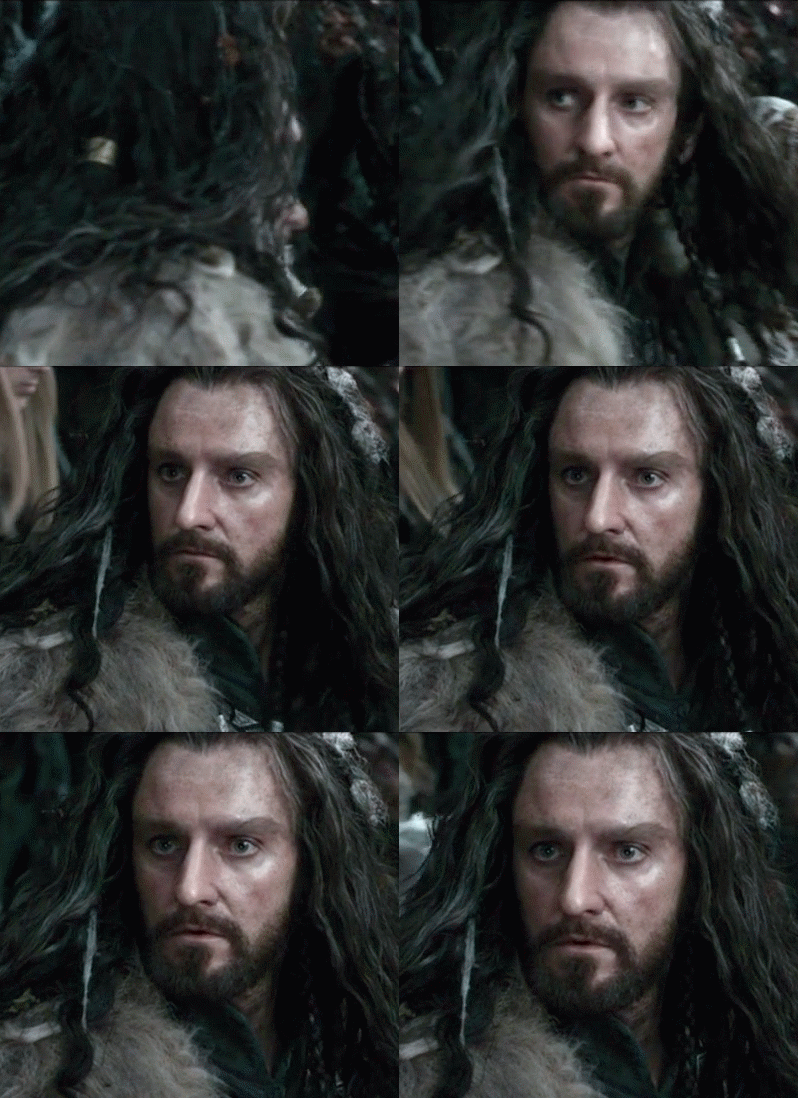
But have you considered: Thorin might be nearsighted?
Case in point:
Exhibit 2
“It cannot be.”aka Doesn’t actually recognize Azog until he starts talking…
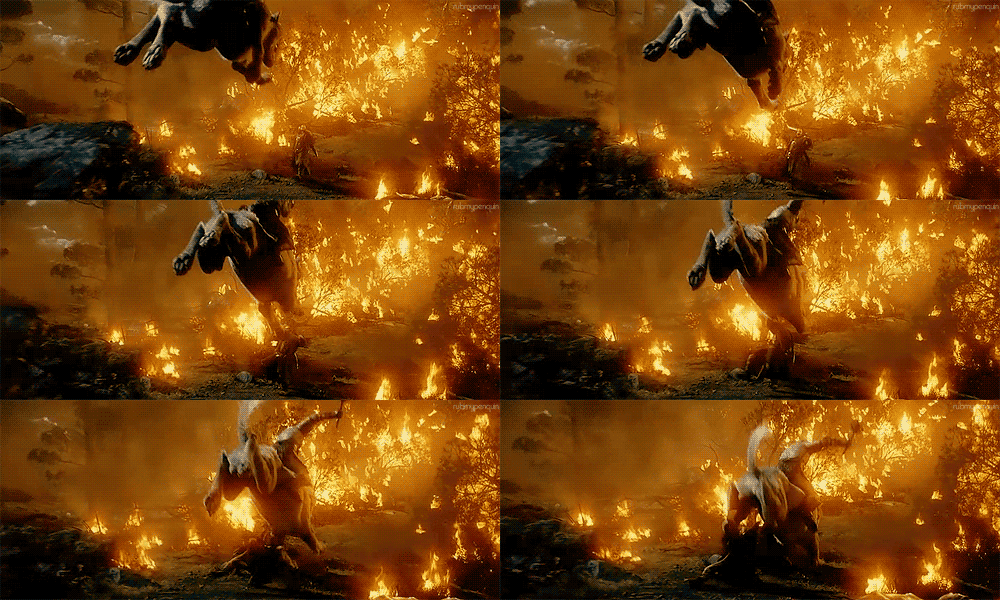
This needs no explanation:
*BOOM*
Exhibit 3:
Not subtitled, but Thorin shouts for Kili when actually Fili is the one who was almost crushed >.<
Exhibit 4
Not pictured because I couldn’t find a gif, but Thorin prompting Balin to lead them out of Rivendell because he “can see knows these paths”
Exhibit 5
Cut off Azog’s arm, was probably aiming for something slightly more fatal, couldn’t tell he was alive when dragged back inside Moria…
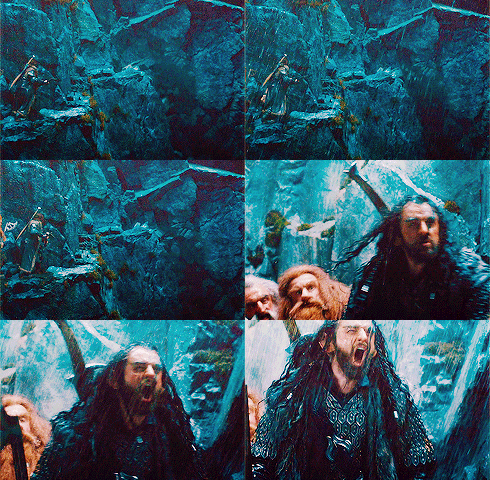
Exhibit 6
WHERE’S BILBO?
(”I have no idea because I can’t see for shit.”)
Conclusion:
Since wearing glass in front of your eyes is slightly more of a liability for a fighter than people’s faces being slightly blurry, I’m just gonna throw this out there as a possible explanation for fandom to run with ;)
Ok but I think this is my favorite post of mine that’s done well because
1) it give a humorous explanation for Thorin’s random moments of fail that’s cracky and funny
2) it actually kinda makes sense and it gives Thorin a minor (or not so minor for his life and world) disability that he works around and actually kinda explains said moments of fail realistically and honestly guys the more I think about it and replay the movies in my head the fewer contradictions I can find for this headcanon???
There is a fanfic in here somewhere
Convincing arguments!
Thorin has suddenly become more human and more pleasant (short-sighted person speaking here)
You are not wrong OP, Thorin IS nearsighted. In the book, it was even canon:
“How far away do you think it is?” asked Thorin, for by now they knew Bilbo had the sharpest eyes among them. “Not far at all. I shouldn’t think above twelve yards.” “Twelve yards! I should have thought it was thirty at least, but my eyes don’t see as well as they used a hundred years ago-” (From the chapter, ‘Flies and Spiders’
of The Hobbit, by JRR Tolkien
)
Thorin isn’t just slightly nearsighted either, he thought a large object at across-the-street distance was three-quarters of the length of a football field away. By modern standards he would be legally, coke-bottle-glasses-or-we-don’t-let-you-drive, blind.
In the movie Thorin’s nearsightedness is never actually stated, but I love the clever ways in which they worked it into the acting (as avelera highlighted very well), and also into the costume and set design (implying that Dwarves tend to be nearsighted in general): Dwarven ornamentation is always three-dimensional, be it stamped leather, cut runes, thickly-embroidered brocade, or cast-metal beads. There are no purely painted or smooth-inlaid designs anywhere that would require sight, let alone 20/20 vision.
Dwarven cities too, are violently three-dimensional and ornamented with a lot of straight-lined geometry and gigantic statues. Perhaps most telling of all, the terrifyingly high stone bridges found in both Erebor AND Moria are treated as perfectly ordinary sidewalks… which would make sense for a race that couldn’t even SEE the ground below.
What I would give for Tolkien to meet Peter Jackson and just be like “Oh hey lemme explain you a thing”
No, guys, this is fantastic because it actually happened. From a letter Tolkien wrote to a friend, complaining about a proposed movie adaptation:
Here I may say that I fail to see why the time-scheme should be deliberately contracted. It is already rather packed in the original, the main action occurring between Sept. 22 and March 25 of the following year. The many impossibilities and absurdities which further hurrying produces might, I suppose, be unobserved by an uncritical viewer; but I do not see why they should be unnecessarily introduced. Time must naturally be left vaguer in a picture than in a book; but I cannot see why definite time-statements, contrary to the book and to probability, should be made.
Seasons are carefully regarded in the original. They are pictorial, and should be, and easily could be, made the main means by which the artists indicate time-passage. The main action begins in autumn and passes through winter to a brilliant spring: this is basic to the purport and tone of the tale. The contraction of time and space in 2 destroys that. His arrangements would, for instance, land us in a snowstorm while summer was still in. The Lord of the Rings may be a ‘fairy-story’, but it takes place in the Northern hemisphere of this earth: miles are miles, days are days, and weather is weather.
Strider does not ‘Whip out a sword’ in the book. Naturally not: his sword was broken. (Its elvish light is another false anticipation of the reforged Anduril. Anticipation is one of Z’s chief faults.) Why then make him do so here, in a contest that was explicitly not fought with weapons?
Why has my account been entirely rewritten here, with disregard for the rest of the tale? I can see that there are certain difficulties in representing a dark scene; but they are not insuperable. A scene of gloom lit by a small red fire, with the Wraiths slowly approaching as darker shadows – until the moment when Frodo puts on the Ring, and the King steps forward revealed – would seem to me far more impressive than yet one more scene of screams and rather meaningless slashings.….
Rivendell was not ‘a shimmering forest’. This is an unhappy anticination of Lórien (which it in no way resembled). It could not be seen from Weathertop : it was 200 miles away and hidden in a ravine. I can see no pictorial or story-making gain in needlessly contracting the geography.
Time is again contracted and hurried, with the effect of reducing the importance of the Quest. Gandalf does not say they will leave as soon as they can pack! Two months elapse. There is no need to say anything with a time-purport. The lapse of time should be indicated, if by no more than the change to winter in the scenery and trees.
The Balrog never speaks or makes any vocal sound at all. Above all he does not laugh or sneer. …. Z may think that he knows more about Balrogs than I do, but he cannot expect me to agree with him.
A splendid sight. It is the home of Galadriel… an Elvenqueen.’ (She is not in fact one.) ‘Delicate spires and tiny minarets of Elven-color are cleverly woven into a beautiful[ly] designed castle.’ I think this deplorable in itself, and in places impertinent. Will Z please pay my text some respect, at least in descriptions that are obviously central to the general tone and style of the book! I will in no circumstances accept this treatment of Lórien, even if Z personally prefers ‘tiny’ fairies and the gimcrack of conventional modern fairy-tales.
Z has cut out the end of the book, including Saruman’s proper death. In that case I can see no good reason for making him die. Saruman would never have committed suicide: to cling to life to its basest dregs is the way of the son of person he had become. If Z wants Saruman tidied up (I cannot see why, where so many threads are left loose) Gandalf should say something to this effect: as Saruman collapses under the excommunication: ‘Since you will not come out and aid us, here in Orthanc you shall stay till you rot, Saruman. Let the Ents look to it!’
Pan III…. is totally unacceptable to me, as a whole and in detail. If it is meant as notes only for a section of something like the pictorial length of I and II, then in the filling out it must be brought into relation with the book, and its gross alterations of that corrected. If it is meant to represent only a kind of short finale, then all I can say is : The Lord of the Rings cannot be garbled like that.
I do earnestly hope that in the assignment of actual speeches to the characters they will be represented as I have presented them: in style and sentiment. I should resent perversion of the characters (and do resent it, so far as it appears in this sketch) even more than the spoiling of the plot and scenery.
– excerpts from Tolkien getting angry over “the film treatment” of Lord of the Rings, Letters, Letter 210, June 1958