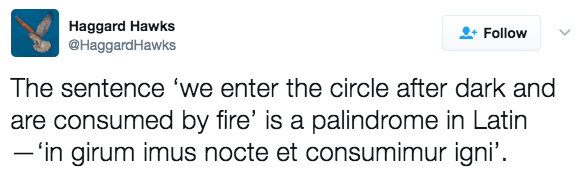
the word for brain here is cerebrum, and it’s been literally split in two
I’ve seen wordplay like this before in Latin, but with compound words that are clearly made up of separate parts
but “cere” is not a word and neither is “brum”
you could translate it something like
“he split his br apart ain with a rock”
and it’s only slightly less unreadable than that due to freer word order
needless to say something I’d expect more from a modern experimental poem than an ancient epic
okay not a Latinist but a Latinist’s wife as well as Egyptologist-writer with an undying love for wordplay, but can I suggest the following translation:
“he split his br in two ain with a rock”
this for the additional vocalised puns where when you say it out loud, ‘br in’ sounds like “brain” and ‘two ain’ sounds like “twain”.
However it originated, though, the usage of “because-noun” (and of “because-adjective” and “because-gerund”) is one of those distinctly of-the-Internet, by-the-Internet movements of language. It conveys focus (linguist Gretchen McCulloch: “It means something like ‘I’m so busy being totally absorbed by X that I don’t need to explain further, and you should know about this because it’s a completely valid incredibly important thing to be doing’”). It conveys brevity (Carey: “It has a snappy, jocular feel, with a syntactic jolt that allows long explanations to be forgone” “It has a snappy, jocular feel, with a syntactic jolt that allows long explanations to be forgone”).
But it also conveys a certain universality. When I say, for example, “The talks broke down because politics,” I’m not just describing a circumstance. I’m also describing a category. I’m making grand and yet ironized claims, announcing a situation and commenting on that situation at the same time. I’m offering an explanation and rolling my eyes — and I’m able to do it with one little word. Because variety. Because Internet. Because language.
One of my favorite linguistic phenomena is rebracketing, which is when a word or words is/are redivided differently, either two words becoming one, one word heard as two, or part of one word interpreted as part of the other. This frequently happens with articles, for example:
apron was originally napron, but “a napron” was interpreted as “an apron”
newt comes from ewt by the same process
In the opposite direction, nickname comes from Middle English nekename which in turn came from ekename (an ekename -> a nekename) where “eke” was an old word meaning “also” or “additional” (so basically “an additional name”)
ammunition comes from an obsolete dialectal French amunition, which came from munition, the phrase la munition being heard as l’amunition.
the nickname Ned comes from Ed, via “mine Ed” being heard as “my Ned” (in archaic English, “my” and “mine” had the same relationship as “a” and “an”), same with several other nicknames like Nell
The word “orange” ulimately derives from the Arabic nāranj, via French “orange”, the n being lost via a similar process involving the indefinite article, e.g., something like French “une norange” becoming “une orange” (it’s unclear which specific Romance language it first happened in)
in the Southern US at least (not sure about elsewhere), “another” is often analyzed as “a nother”, hence the phrase “a whole nother”
omelet has a whole series of interesting changes; it comes from French omelette, earlier alemette (swapping around the /l/ and /m/), from alemelle from an earlier lemelle (la lemelle -> l’alemelle)
Related to this, sometimes two words, especially when borrowed into another language, will be taken as one. Numerous words were borrowed from Arabic with the definite article al- attached to them. Spanish el lagarto became English alligator. An interesting twist is admiral, earlier amiral (the d probably got in there from the influence of words like “administer”) from Arabic amir al- (lord of the ___), particularly the phrase amir al-bahr, literally “lord of the sea”.
Sometimes the opposite happens. A foreign word will look like two words, or like a word with an affix. For example, the Arabic kitaab (book) was borrowed into Swahili as kitabu. ki- happens to be the singular form of one of the Swahili genders, and so it was interpreted as ki-tabu. To form the plural of that gender, you replace ki- with vi-, thus, “books” in Swahili is vitabu. The Greek name Alexander became, in Arabic, Iskander, with the initial al- heard as the article al-.
Similarly, the English word Cherry came from Old Norman French cherise, with the s on the end interpreted as the plural -s. Interestingly enough, that word came from Vulgar Latin ceresia, a feminine singular noun, but originally the plural of the neuter noun ceresium! So a Latin plural was reinterpreted as a singular in Vulgar Latin, which in turn was interpreted as a plural when borrowed into English!
The English suffix -burger used with various foods (e.g., cheeseburger, or more informally chickenburger, etc.) was misanlyzed from Hamburger as Ham-burger, itself from the city of Hamburg
This can happen even with native words. Modern French once is used for the snow leopard, but originally meant “lynx”. In Old French, it was lonce (ultimately from the same source as lynx), which was reinterpreted as l’once! In English, the word “pea” was originally “pease”, but that looked like it had the plural -s on it, and so the word “pea” was created from it. Likewise, the adjective lone came from alone, heard as “a lone”, but alone itself came originally from all one.
One of my favorite personal examples is the old Southern man who would come into work and ask me if I was “being have” (as opposed to the more usual “behaving”).
the word editor predated the word edit – editor was reinterpreted as edit-er, so clearly someone who edits!
when your open borders advocacy extends to morpheme boundaries
Don’t forget the Swahili kipilefti (”roundabout”), from English keep left, with a plural vipilefti – and in reverse, singular kideo (”video”) with plural video.
Note that the “editor” > “edit-er” > “to edit” transformation is a related but distinct phenomenon called back-formation. That’s where you take a noun that sounds like it ought to be derived from a verb (though it really isn’t), and work backwards to obtain the “original” verb. Hence, we have it that editors edit, burglars burgle, and butlers buttle – though we haven’t yet gone so far as to suggest that fingers fing!
Me 10 years ago: I never use online abbreviations! standard english all the time! Me a couple of years ago: u kno wat fuck it Me now: it is impossible to communicate effectively online without using internet slang due to the mixed mode format and lack of paralinguistic features. Things like lack of punctuation, abbreviations, acronyms and such all have their own connotations and communicate far more than their commonly accepted meaning. Linguistics has evolved. n u kno what i love it
Can I just… talk for a moment… about how much I love how, if you know them well, words don’t have synonyms?
English, for example, is a fantastic disaster. It has so many words for things that are basically the same, and I find there’s few joys in writing like finding the right word for a sentence. Hunting down that peculiar word with particular meaning that fits in seamlessly in a structure, so the story flows on by without any bumps or leaks.
Like how a shout is typically about volume, while a yell carries an angry edge and a holler carries a mocking one. A scream has shrillness, a roar has ferocity, and a screech has outrage.
This is not to say that a yell cannot be happy or a holler cannot be complimentary, or that they cannot share these traits, but they are different words with different connotations. I love choosing the right one for a sentence, not only for its meanings but for how it sounds when read aloud. (Do I want sounds that slide together, peaceful and seamless, or something that jolts the reader with its contrast? Snap!)
I love how many words for human habitats there are. I love how cottage sounds quaint and cabin sounds rustic. I love steadiness of house, the elegance of residence, the stateliness of manor, and tired stubbornness of shack. I love how a dwelling is different to a den.
And I love how none of them can really touch the possessive warmness of all the connotations of home.
Fandom language is so fascinating. Like, it needs to be it’s own field of study within Linguistics. A few years ago I had no idea what “headcanon,” “ship,” or “Stan” meant. You people invented your own language. You’re a strange but functional virtual tribe basically. Distance is no longer a factor in what can constitute a cohesive community. Like, you have rules, you choose to include people or kick them out, you trade stories, you’re sort of ranked by popularity, etc etc. It’s really interesting that we set up similar systems of society to the ones we use in real life. The anthropology nerd in me loves this shit.