Something that’s almost never covered in fantasy mediums is common names.
Like we all know fantasy names are unusual, but any name to a foreign culture is considered unusual English names to Indian people are very unusual for example. But naturally, given that it’s an entire culture, there will be some common names, it’d be refreshing to at one point here this exchange.
“So I was talking to Vicnae and-”
“Wait which Vicnae? You can’t just say Vicnae. There are ten Vicnae’s in my village alone.”
This has 100 notes yesterday and 300 this morning what the fuck happened.
People understand the truly important things.
DSA (a German fantasy P&P RPG) actually has the name Alrik, which is hugely popular in the universe. Everyone is Alrik.
This is also a great excuse to use “X the Y” or “X of Y” type names without being pretentious. Calling someone “Thognor The Stout” goes from pomposity to practicality if he lives down the road from Thognor The Small.
This! Some names are more common than others, and there’s always been a need to differentiate one Thognor from the other Thognor(s). Without inherited surnames, this means bynames, and let me tell you, bynames are much more interesting than the average fantasy novel would lead you to believe.
Disclaimer first: my knowledge of this doesn’t extend much outside medieval England, because it all came from research for an original fic I wrote a few years ago (Robin Hood with lesbians, as my wife likes to call it). I wouldn’t be surprised if this all holds true in other countries, but I can’t swear to it.
Anyway…
We’re all familiar with occupational bynames (Cooper or Smith) and patronymics (Johnson or Wilson), because medieval fantasy makes extensive use of these, but sometimes bynames came from other sources. You might be identified by your mother rather than your father, though, alas, few metronymics survived the transition to inherited surnames. (And ironically, Chrome’s spell-check asks if I meant “patronymic” when I type “metronymic,” but that’s a rant for another time.) A byname could also come from your siblings or your spouse, if there was something especially notable about them.
But enough about that! I think we’re all familiar with the idea of bynames based on other people’s names. Where it starts to get interesting (at least to me) is once we get into things like locative bynames. These are bynames based on where you’re from, but that’s not quite as straightforward as it sounds. If everyone lives in the same town, then saying “John of Bedford” is kind of meaningless. But “John, the one who lives by the woods” (or Atwood) makes perfect sense. So if you had a locative byname and you moved, then your byname almost certainly changed, too. You might have been John Atwood when you lived in Bedford, but when you moved to York, you became John of Bedford (or, more likely, just John Bedford).
And here’s another thing you rarely see in medieval fantasy: “of” wasn’t actually all that common. “In” or “over” or “by” or “at” were vastly more common. So
John in the field, or John over the hill, or John by the brook, or John at the wood. If you’re going to give someone a locative byname, think carefully about what would make sense given their history and where they are now.
So now we get to my favorite part: nicknames, like “the Stout” that identifies poor Thognor. Who might not have been all that stout, since there’s a decent chance a nickname was either outright uncomplimentary or intended ironically. Little John in the stories of Robin Hood isn’t little at all, and that kind of nickname isn’t unique to the character.
Of course, some nicknames were just straight-up descriptions (Sherlock is from shirloc, or “bright lock”), but few of these were names you’d give yourself. They were just like nicknames today, really, and you rarely get to pick your own nickname. Thognor the Stout or Little John wasn’t the worst they might do to you, either. You could end up as Thognor Little-worth or John Always-Drunk.
You know how, in small towns, everyone always remembers the stupid shit you did as a kid? Yeah. If we were still using bynames instead of inherited surnames, you could spend the rest of your life as John Ran-over-his-mother’s-new-boss’s-mailbox-her-second-day-on-the-job. Fun, right?
Oh, and the nicknames could be obscene, too. How about Robert Clevecunt or Bele Wydecunthe? Yes, those are actual names of actual people from 14th century England, though it’s important to note that the word cunt wasn’t considered shocking until several centuries later.
All of which is my long-winded and rambling way of saying…when it comes time to name the characters in your twenty-book epic fantasy saga? Be creative! Don’t just go for the standard “John of Medieval Town,” especially if John still lives in Ye* Olde Medievale Towne.
* ”Ye” is its own rant, but we’ll leave that one for another day, too…
linguistics
also guys i think it’s time to start spelling ‘small’ right again,, it’s been long enough
see the thing is, at this point, smol isn’t even a “mispelling” of small anymore; it has its own connotations. while small is a regular adjective, smol acts more like a diminutive marker, which English has been lacking
in essence, a smol dog will always be a small dog, but not all small dogs are smol.
THIS IS WHAT I’VE BEEN SAYING
“our teeth and ambitions are bared” is a zeugma
and it’s a zeugma where one of the words is literal and one is metaphorical which is the BEST KIND
I didn’t know about zeugmas until just now! That is so awesome, everybody:
zeug·ma
ˈzo͞oɡmə/
noun
a figure of speech in which a word applies to two others in different senses (e.g.,John and his license expired last week ) or to two others of which it semantically suits only one (e.g., with weeping eyes and hearts ).
ISN’T THAT AWESOME??
#in english class in high school my teacher had us write our own zeugmas in class#and one guy came up with ‘he fell from her favor… and the window’#i am forever looking for opportunities to use that one
She dropped her dress and inhibitions at the door.
What’s this? My favorite rhetorical device showing up on my dashboard?
IT HAS A NAMEEEE!! OH MY GOD!!!
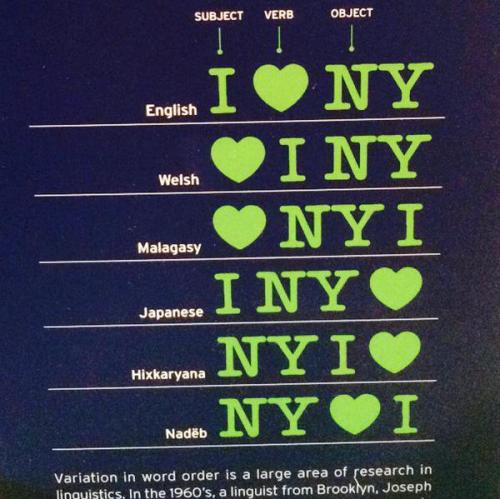
Basic order typology, New York style
(Source)
This is a really nifty way to introduce students to the idea of word order differences across languages!
Also I would totes wear this T-shirt
The linguistics of horror
There’s a very distinct pattern in what one might, if one were being… incautious, name “Internet horror-speak,” a particular patois that’s arisen in the latest years of this very era, a peculiar dialect lashed together from the flesh of Lovecraft and the sinew of internet culture and the bones of… something bony. Okay so I’m probably not going to be able to keep that gag up. It’s the language of Dread Singles
HOT SINGLES IN YOUR AREA, TRAVELING THE SUNKEN WAYS, DRINKING FROM THE LIPS OF THE LOW ONES, WISHING THEY’D WORN MORE SENSIBLE SHOESand Welcome to Night Vale
Mayor Pamela Winchell The fences in the caves. A heart throbbing for what it cannot have. A heart not having what it needs to throb. The fences in the caves. Heat from below and above, but all is cold betwixt. The fences in the caves. The fences in the caves.to which I refer.
What interests me though is that’s there’s a very distinct pattern and sort of grammar to how this Internet Horror-Speak (hereafter IHS) works, one I’ve been trying to work out for a while now. There are some very obvious patterns, as well as some subtle ones I’m not sure how to put into words. These are the rules I’ve sussed out, though:
One of the most important rules, and I think the one that might be the most surprising to a lot of people, is to use simple, mundane language. Empurpling the narrative with gratuitous polysyllabisms and grandiose prose is actually wholly deleterious to the desired effect. This actually makes a lot of sense. Purple prose has a serious abstracting effect, in that it draws the audience away from the action and makes it sound more like they’re listening to a story. So using purple prose to describe your indescribable horrors can make them feel less real, where using everyday language helps connect the audience and make them feel more like there’s some grotesque violation of normalcy going on
Use fewer ‘s-constructions. Say “the blood of the fallen,” not “the fallen’s blood;” “the intestines of dawn” not “dawn’s intestines.” This is a less solid rule, and it’s still possible to have a powerfully creepy effect with the ‘s-construction, particularly if the construction comes sentence-finally: “They beat them with sticks around which were wrapped dawn’s intestines,” but “They wrapped the intestines of dawn around thick oaken sticks.”
Use older words. “For” instead of “because,” “kin” for “family,” etc. If this makes them shorter than their modern counterparts, all the more effective.
Don’t use commas with conjunctions, just string conjunctions together. So “They laughed and writhed and screamed and died in the gaze of a smiling god,” but not *”They laughed, writhed, screamed, and died in the gaze of a smiling god.” This one’s variable, but I see the former more than the latter and to me it feels like it has more impact and is more visceral. The latter sounds more planned out, more official, more normal.
Use old-fashioned constructions. “The”+[adjective] constructions are a favorite, as are “the [adjective] one(s).” “The laughing ones steal away the dreams of the hopeful and feast on the teeth of the indolent,” “There are no innocent in this place, for to gaze on the Ancient Ones is to know that innocence is a lie, that blood and fear and corruption are the engines of all that breathes.”
Break word associations. If I start a sentence with “The toaster,” you’re probably going to expect something like, “the toasted fell off the counter,” or “the toasted exploded,” not “the toasted laughed” or “the toaster bled.” There are words we associate with animate things and words we associate with inanimate things, and mixing them up can lead to weird mental reactions. It’s why things like “SPANK HAIR — LICK EYES — WHISPER INTO ASS” are so funny. They make us build associations that we didn’t have previously. A toaster isn’t a thing that bleeds, and hair isn’t something you spank, so putting those words together tends to slightly mess with people and throw off our reading. Welcome to Night Vale does this SO MUCH.
Cecil Wednesday has been canceled due to a scheduling errorCecil Here’s something odd: there is a cat hovering in the men’s bathroom at the radio station hereCecil Alert! The sheriff’s secret police are searching for a fugitive named Hiram McDaniels, who escaped custody last night following a 9 PM arrest. McDaniels is described as a five-headed dragonLast but not least, be vague. Let your words imply terrible and alien machinations at play, let them hint at vast supernatural tableaux of incomprehensible splendor and horror hanging just out of sight waiting to be glimpsed, but don’t ever explicitly tell anybody what’s going on. I put this one last because even though it’s the most important, it’s the most obvious, and I think everybody already knows this about horror. But it’s worth noting that IHS generally dials this up way higher, to the point where it’s hard or impossible to tell what parts are literal or metaphorical. Take this sub-par example:
Moving through the ashen ways of eons past, realms of fire and smoke and emptiness rising up and twisting around its path the beast walked on, burning all it perceived.One on level, it’s possible that we’re talking about a minotaur arsonist who’s taking to the backroads during a forest fire to avoid the cops. On the other, we could be talking about some incomprehensible eldritch abomination warping its way through infernal dimensions outside space and time, ravaging worlds at its passing. Or anything between. I think this is probably the single most salient feature of IHS: its utter vagueness, and lack of proper context to distinguish the metaphorical from the literal.
But anyway. This is a fascinating memetic phenomenon and one I’d love to see some proper research done on this, beyond the idle musings of a lazy linguist with too much on her hands to spend time analyzing hard data.
Rhythm! The subtle things and the things that you ‘feel’ that you’re having trouble articulating? It’s rhythm. Rhythm is one reason why the last example is ‘sub-par’, and it’s absolutely key to (for instance) Welcome to Night Vale. There’s a pulse going through the prose that organises and structures how it’s read. English tends towards an alternation of strong and weak stresses; if you organise your words so that they start to reinforce that stress pattern, then congratulations, you’ve just invented the basics of English poetry. Part of what makes this particular brand of horror-speak so effective is a heightened control over the stress patterns of the language–not as much as in metrical verse, but still more than is usual for prose. Here’s the Mayor Winchell example from above, but with the stresses marked:
Mayor Pamela Winchell The fences in the caves. A heart throbbing for what it cannot have. A heart not having what it needs to throb. The fences in the caves. Heat from below and above, but all is cold betwixt. The fences in the caves. The fences in the caves.
It’s not perfect. Sometimes there are two or three syllables between stresses, sometimes only one–that’s normal, for English, because we speed up or slow down our reading depending on the rhythm we are unconsciously picking up from the words. Sometimes the stresses are unvoiced, in the form of pauses like rests in music. But you can see how underlying a lot of what Winchell is saying is a rhythmic pulsing that when read gives the effect of a kind of gnomic chanting that alters the atmosphere of the statement considerably. When you pronounce this aloud, it gives that characteristic Welcome to Night Vale effect; on the page, its power is lessened, but the rhythm is still strong enough that you can detect it, even if you don’t know that you’re doing so.
Most importantly, the presence of exaggerated rhythm is a conventional signal to your brain that it’s now reading poetry, and that puts you into a different mindset–a mindset where you are expecting the ambiguous, the non-literal and the metaphorical. It’s the mindset you get into when reading poetry, where your interpretative mind engages with a text that works on both a metaphorical and a literal level at the same time–exactly the ‘vagueness’ described by velartrill above.
What I’m saying, in essence, is that a (conscious or not) awareness of rhythm is key to being able to write sentences in this style. The choice between ’s constructions (“dawn’s intestines”) and old-fashioned x of y constructions (“intestines of dawn”) is down to which will best work with the rhythm of your sentence; the effect of the [adjective] ones construction can also be judged based on its rhythmic potential. Almost every effect of IHS, apart from its predisposition towards short, familiar words (which I think is more of a general horror thing; effective horror writers tend to use the vocabulary of their audience), has its roots in its essentially rhythmic nature: its constructions, its rhetorical figures, its ability to waver between metaphorical and literal without committing itself to either.
Tl;dr, IHS is basically prose poetry with a horror angle and a deliberately Anglo-Saxon focus to its words. More of an English literature approach than a purely linguistic one, I suppose, but that is my field, after all.
Another great example of Internet Horror Speak is in the gothic meme, such as Linguistics Gothic and Language Gothic.
I’ve also noticed that this style tends to over-use negation to convey a non-literal effect, which I’ve described here.
Some of my favourite linguistic developments
‘Is that a thing?’ for ‘does that exist?’
Deliberate omission of grammar to show e.g. defeatedness, bewilderment, fury. As seen in Tumblr’s ‘what is this I don’t even’.
‘Because [noun]’. As in ‘we couldn’t have our picnic in the meadow because wasps.’
Use of kerning to indicate strong bewilderment, i.e. double-spaced letters usually denoting ‘what is happening?’ This one is really interesting because it doesn’t really translate well to speech. It’s something people have come up with that uses the medium of text over the internet as a new way of communicating instead of just a transcript of speech or a quicker way to send postal letters.
Just the general playing around with sentence structure and still being able to be understood. One of my favourites of these is the ‘subject: *verbs* / object: *is verb*’ couplet, as in:
Beekeeper: *keeps bees*
Bees: *is keep*or
Me: *holds puppy*
Puppy: *is hold*I just love how this all develops organically with no deciding body, and how we all understand and adapt to it.
Man but the current usage of “is that a thing?” is not just standing in for “does that exist?” or it wouldn’t be nearly as interesting. It can, depending on context mean:
“Is that a thing (that exists)?”
“Is that a thing (that people do)?”
“Is that a thing (that’s considered normal)?”
“Is that a thing (that’s possible)?”
“Is that a thing (that’s significant)?”In a lot of cases “a thing” is standing in for the much more archaic phrasing “the done thing”, as in “is bringing host gifts to a summoning ritual (the done thing | a thing)?”
And that’s interesting in and of itself but it also encompasses all those other meanings with very few miscommunications. Despite the multipurpose phrasing we almost always understand what someone is asking when they ask if something is a thing, and that’s *really cool*
Some of my favourite linguistic developments
‘Is that a thing?’ for ‘does that exist?’
Deliberate omission of grammar to show e.g. defeatedness, bewilderment, fury. As seen in Tumblr’s ‘what is this I don’t even’.
‘Because [noun]’. As in ‘we couldn’t have our picnic in the meadow because wasps.’
Use of kerning to indicate strong bewilderment, i.e. double-spaced letters usually denoting ‘what is happening?’ This one is really interesting because it doesn’t really translate well to speech. It’s something people have come up with that uses the medium of text over the internet as a new way of communicating instead of just a transcript of speech or a quicker way to send postal letters.
Just the general playing around with sentence structure and still being able to be understood. One of my favourites of these is the ‘subject: *verbs* / object: *is verb*’ couplet, as in:
Beekeeper: *keeps bees*
Bees: *is keep*or
Me: *holds puppy*
Puppy: *is hold*I just love how this all develops organically with no deciding body, and how we all understand and adapt to it.
when did tumblr collectively decide not to use punctuation like when did this happen why is this a thing
it just looks so smooth I mean look at this sentence flow like a jungle river
ACTUALLY
This is really exciting, linguistically speaking.
Because it’s not true that Tumblr never uses punctuation. But it is true that lack of punctuation has become, itself, a form of punctuation. On Tumblr the lack of punctuation in multisentence-long posts creates the function of rhetorical speech, or speech that is not intended to have an answer, usually in the form of a question. Consider the following two potential posts. Each individual line should be taken as a post:
ugh is there any particular reason people at work have to take these massive handfuls of sauce packets they know they’re not going to use like god put that back we have to pay for that stuff
Ugh. Is there any particular reason people at work have to take these massive handfuls of sauce packets they know they’re not going to use? Like god, put that back. We have to pay for that stuff.
In your head, those two potential posts sound totally different. In the first one I’m ranting about work, and this requires no answer. The second may actually engage you to give an answer about hoarding sauce packets. And if you answer the first post, you will likely do so in the same style.
Here’s what makes this exciting: the English language has no actual punctuation for rhetorical speech–that is, there are no special marks that specifically indicate “this speech is in the abstract, and requires no answer.” Not only that, it never has. The first written record of English (actually proto-English, predating even Old English) dates to the 400s CE, so we’re talking about 1600 years of having absolutely no marker whatsoever for rhetorical speech.
A group of teens and young adults on a blogging website literally reshaped a deficit a millennium and a half old in our language to fit their language needs. More! This group has agreed on a more or less universal standard for these new rules, which fits the definition of “language.” Which is to say Tumblr English is its own actual, real, separate dialect of the English language, and because it is spoken by people worldwide who have introduced concepts from their own languages into it, it may qualify as a written form of pidgin.
Tumblr English should literally be treated as its own language, because it does not follow the rules of any form of formal written English, and yet it does have its own consistent internal rules. If you don’t think that’s cool as fuck then I don’t even know what to tell you.
I love how, because of that “Beautiful Cinnamon Roll Too Good For This World, Too Pure” Onion headline, “cinnamon roll” has become a commonly accepted phrase for “a character who is cute and kind and typically gets more pain in canon than they deserve”.
Like, we didn’t have a real phrase for that common phenomenon (wubbie maybe, but that has negative connotations ie “this character has been wubbiefied by the fandom”) and then someone used a screenshot of a headline from a satire news website to describe it, and then everyone else was like “yes good let’s use this”. You couldn’t make that shit up. I bet there are people who use that phrase now who didn’t even see that headline.
Language is evolving right before our eyes in a very weird and beautiful way and I am very very sorry for future linguist who have to puzzle this shit out.