interesting

Fandometrics In Depth: Game of Thrones Edition

thefandometrics:

Winter has finally arrived in Westeros. 

Season six of Game of Thrones had everything: Time travel, necromancy, dragons, shame… It also had 7.4 million tagged posts and 8.2 million searches here on Tumblr (that’s through the duration of the season, April 24th to June 26th, 2016). We analyzed literally everything tagged #GOT and #Game of Thrones for this special edition of Fandometrics.

image

Top Episodes

And the least popular: 6×06, “Blood of My Blood”: only 1.7% of the posts.

image

Top Characters

Jon Snow had the biggest year (of course) with more than 1.5 million of the 7.4 million GOT posts tagged with character names. To illustrate your absolute favorites, we now bring you charts!

image

Top Ships

There were more than half a million posts about 13 different pairings during season six. Interestingly, most didn’t use the common portmanteaus (think: Stucky) that are popular with modern ships. 61% of the tags used a classic “character 1 x character 2" naming structure instead. Here are your favorites:

And the least favorite: Sansa Stark x Tyrion Lannister, with just 0.22% of the posts.

image

belinsky:

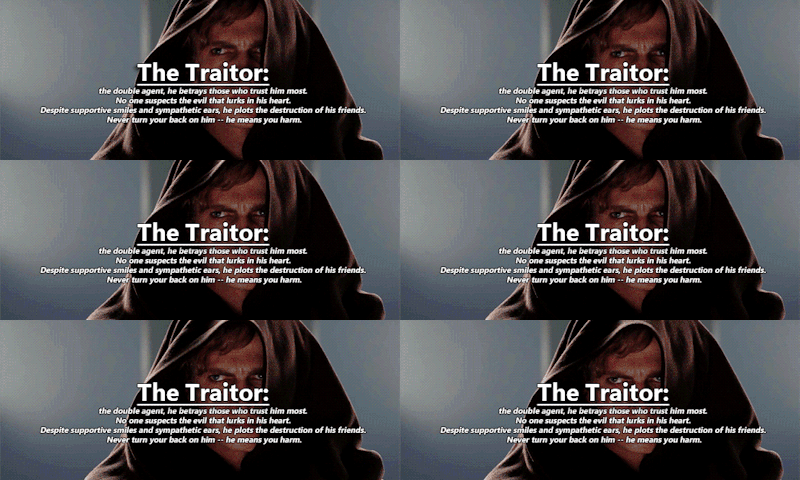
going off my tags on this post; the prequels emphasizing anakin’s love for padme as the tipping point for his fall to the dark side doesn’t, i think, make his intrinsic humanity his ultimate flaw or his passion/love, which a lot of people have critiqued the prequels for doing– and, true, the acting/script in the prequels isn’t strong enough to emphasize anything beyond this, essentially.  but i think what the anakin/padme romance actually does, and what if i want to give lucasfilm credit for the films are actually trying to do, is give further and essential strength to anakin’s final choice to murder palpatine and save luke.  because anakin’s love for padme isn’t what turns him into a sith– palpatine is.  when anakin believes padme is going to die, he doesn’t tell padme (who not only is, you know, the subject of discussion here, but has throughout the story been an avatar of calm rationality), he doesn’t tell obi-wan (who he loves probably in equality to padme and is his connection to the jedi and the force and those who actually want to help him), he tells palpatine.  and what’s essential about that choice is that anakin’s arc is all about deference.  

anakin is born a slave, lives nine years in slavery, and when he’s rescued he’s immediately dragged to the jedi (told he’s too old to be a jedi! rejected by the people who saved him! only allowed to be trained because qui gon was killed by a sith and demanded obi wan– first sithkiller in a thousand years– train him as his dying wish) and told that a) he is possibly the most powerful being in the universe b) as the most powerful being in the universe, he should shut up and listen to some people he’s never met about how to use that power and how someone that powerful should live their life.  the jedi council is very consciously i think depicted as what we would think of as an organized religion, only one where the deity empirically exists (think the catholic church if saints and prophets had laser swords).  the council have some good ideas about how to use the power of the force, how jedi should live their lives, how they should act and interact, but to take essentially the messiah– a messiah who has been a slave for nine years, ripped away from and told he must never see again the person he loves most in the world, and who is already a roiling mass of anger and pain– and tell him that he should live a completely ascetic life is just asking for it.  and indeed, the first thing anakin does when he’s given a solo mission is act like a ridiculously powerful nineteen year old boy and go after his boyhood crush.  (and then slaughter the people who hurt his mom.)  palpatine’s not an idiot.  palpatine’s probably the smartest man in the galaxy.  palpatine sees that this ridiculously powerful child is being told he can’t have feelings by the people he most looks up to and cares about in his life.  

and so palpatine sweeps in and tells him not only that feelings are great and important but most essentially that palpatine is always there for him if he needs to have feelings.  palpatine plants himself as the one person in anakin’s life he can actually be a human being around.  not the jedi, who saved him, because they’ll tell him he’s not a good person.  not obi-wan, who he most looked up to, because obi-wan will chastise him.  (whether or not obi-wan would actually have given him a tonguelashing over caring about people is debatable (see: obi-wan, crying over qui-gon’s corpse; obi-wan, biggest flirt in the galaxy; obi-wan, ‘you were my brother, anakin, i loved you’) but anakin never dares ask because obi-wan is, in his eyes, ultimately first and foremost a jedi and a mouthpiece for the council), not padme, who he loves enough to tank the republic, because she’s too reasonable and wouldn’t know the way anakin does the way people can betray and humiliate you.  palpatine is the only one around whom anakin can be himself.  and by placing himself in that position palpatine makes himself anakin’s ultimate master, before anakin even knows he’s anything but a politician.  so of course he runs to palpatine with the fear of padme’s death.  of course he doesn’t make the “right” choice.  he can’t trust anyone else, because they’ll kick him out of the jedi, out of his marriage, out of all of he knows and loves and all the way back to watto and jabba.  (obviously they probably would not do this. but anakin has been systematically conditioned through circumstance to think this way.  anakin’s story is high tragedy, where situations pile up to the point that, through one mistake, he topples a whole society.  oops.)

anakin makes the wrong choice.  anakin doesn’t love padme too much.  anakin isn’t too little of a jedi.  anakin isn’t ultimately too selfish.  anakin doesn’t stand up for himself.  passionate, angry, idealistic, firestorm anakin was never told by anyone that it was okay to make his own choices, or that what he thought was as important as what other people thought.  anakin loves padme so much he breaks the jedi code to marry her, and then never tells anybody about it because he’s terrified of the council.  anakin loves qui-gon and obi-wan so much that he agrees to leave his mother, and then never goes back for her because he’s told she’s an attachment he has to let go of.  anakin feels so guilty about never going back for her (despite, see above, being conditioned to not make his own choices) that he slaughters an entire innocent village.  anakin begins the prequels saying that he’s going to free every slave, and then ends up being ‘held on a leash’ by tarkin.  anakin thinks the woman he loves is going to die– what’s he to do?   he’s not allowed to have married her. he can’t trust the people he loves.  so of course he runs to the sith.  the sith proclaim to be about selfishness, about power, and ultimately, about freedom– but the sith, too, are run on a system of masters and servants.  anakin lives in a universe that has been shaped– with lots of help from palpatine, who’s the only person who comes out on top in this, of course– to tell him that he’s not only not allowed to make his own choices, but even thinking them will harm him and the people he loves.  and so anakin chooses the only thing he thinks he can.  the only thing that will actually save padme.  anakin chooses the sith.  and anakin becomes even more chained than before.  

and this inability to choose for himself, to try to find the right among all the things that have been (fairly literally) beaten into him, continues through the original trilogy– in anh, he’s completely under the thumb of tarkin despite demonstrably being able to murder anyone in the room with a thought.  in esb, when he’s told about luke, his first instinct is that they ‘rule the galaxy as father and son’, and when luke says no, he goes running back to palpatine.  anakin doesn’t even consider throwing over palpatine himself until palpatine attacks luke– he brings luke to palpatine to be his new apprentice.  luke’s existence isn’t enough.  padme’s death isn’t enough.  the fall of the jedi isn’t enough.  becoming palpatine’s pet isn’t enough.  what is the only thing that allows anakin to finally make an independent choice?

“father, please”.  his son– his untrained child– the only thing left of padme, who he failed, of obi-wan, who he betrayed, of himself, when he cared about something– is completely and utterly helpless, and the one man anakin thought cared about him is going to murder him, painfully, in front of his eyes.  luke is given the same choice as anakin– the people you love will die, your society will be despotic and inhumane, you will be betrayed by your family and friends, you will lose everything– and luke says, “father, please”.  luke not only demonstrates to anakin what it is to make his own choices, luke also demonstrates what it is to willingly trust someone else with your love and your life in the most dire of circumstances.  and in doing so, luke willingly hands anakin the reins.  and anakin looks between the man who’s held those reins for twenty years and the man who is looking at him saying ‘i love you enough to let you choose’, and finally gets to actually make a choice.  in these circumstances, that choice is easy.

anakinsbutt:

thishereanakinguy:

prettypastelrobot:

thishereanakinguy:

anakinsbutt:

how many times has anakin skywalker been electrocuted

does someone have a count

is this boy’s brain okay

Omg my time to shine!

1. Gungan General
2. Hostage Crisis
3. The Citadel
4. Gungan Attack
5. Prisoners
6. Shadow Warrior (at least twice, implied it was much more)
7. Slaves of the Republic
8. Escape from Kadavo (twice)
9. Crisis on Naboo (twice)
10. Sacrifice (though this was in Yoda’s vision and not real life)

So in conclusion, by the time Revenge of the Sith rolls around, Anakin has been electrocuted a minimum of 12 times. This can cause a host of physical and neurological problems, including lack of emotional control, increased aggression, etc. Strictly speaking, Anakin’s propensity towards having huge amounts of electricity (which should by all rights have killed him ages ago – there’s an entire book where Luke is dealing with the pain associated with Force lightning, whereas Anakin’s just like “whatever, just another Tuesday”) played as big of a role in his turn to the Dark Side as anything else, since it sapped his brain of the ability of cognitive reasoning.

…so are you saying that Anakin might have never joined the dark side if he wasn’t a human lightning rod?

I’m saying Anakin’s cognitive functioning and ability to control his emotions and aggression were deeply impacted by being a human lightning rod, which is the long way of saying yes.

yall out here reblogging only the first half of this but not the important stuff

Because it appears we share a common interest in it: Top five bits of headcanon about Tatooine slave culture, possibly as it relates to Anakin?

cadesama:

fialleril:

starfata:

fialleril:

The hardest thing about this ask is narrowing it down to five! Expect another long post here; sorry followers.

1. Tatooine slave religion. There are quite a few variations on this theme, but here are my headcanons about the religion the Skywalkers practice. (Told in mythical form, of course.)

Once, long ago, Tatooine was a beautiful place of garden oases, and Ar-Amu was the mother to all her people. But Depur came from out of the blackness, and he threw down Ar-Amu, and bound her in chains, and took her children from her and scattered them, each to a different depur (which means “master”). And Ar-Amu could not free them. Her grief was so great that she could not even cry. But she promised her children that one day they would be free. One day, she would call out to all the seven corners of the desert, and her children would cast off their chains and throw down their masters and be free. And it was said that they would know when this day was come, for the skies would open and Ar-Amu would finally weep.

For most of her life, Shmi had a series of mystical visions in which Ar-Amu spoke to her. This culminated in a profound experience in the desert – when Gardulla sent her out to bargain with a group of Jawas, and she was caught alone with no shelter in the midst of a terrible sandstorm. She opened her eyes and saw the desert blooming, and heard the voice of Ar-Amu saying, “Daughter, will you bear this storm?” She said yes, and nine months later Anakin was born. (Anakin, in my headcanon, means “the one who brings the rain.”)

I will forever headcanon that Anakin was meant to be the Chosen One – for Tatooine. He was born for his people, to free the slaves.

(And, because I cannot handle too much sadness, I also headcanon that Luke and Leia did go back after ROTJ and lent their support and the backing of the new Republic to the liberation movement and the universal emancipation of Tatooine’s slaves.)

2. Some rituals of the slave religion:

2a. The vigil for the lost is performed both when someone dies and when someone is sold away. It involves the survivors standing in a circle around a bowl of water (sometimes not much water at all, but at least a drop is needed) and looping a cord around the left wrist of each person. This binds the survivors together in their shared grief. At the end of the ritual, each person “gives something to the waters,” representing a gift to the person who has departed. It’s usually a very small thing, like a stone or a japor snippet or a scrap of fabric. After this, they each take back the item that was given to the waters and keep it as a personal mark of connection between themselves and the person who is gone.

2b. There is also a ceremony of return, for when families and friends who have been separated (usually by sale) find one another again. Ritually, it is a ceremony of rebirth or resurrection. The person who has been returned stands in the midst of the people, and all the others circle around them with their wrists connected by the cord as in the vigil for the lost. The returning person’s hand is placed in the bowl of water, and the oldest woman present says, “We return [name] to Ar-Amu and to [their] people.” Each person in the circle then names the returning person aloud, dips their own hands in the water, marks the hands or forehead or heart of the person returning, and states their own relationship to that person. (e.g., Shmi might say, “I name you Anakin Skywalker, my son.”) When all have named the returning person, thus symbolically reenacting their communal identity, the person who is returning then names themselves in relation to each of the people in the circle. (e.g., “I am Anakin Skywalker, son of Shmi, brother of Kitster, husband of Padmé,” etc.)

When the ceremony is over the oldest woman binds a length of jerba cord around the left wrist of the returned person, and that person wears the cord for a full year, never removing it. When a year has passed, the person has been fully reincorporated into the community, and there is a celebration.

3. The slaves have a fully developed and entirely secret creole language that they speak among themselves. It’s derived from Huttese, but is incomprehensible to their masters. They don’t teach it to any outsiders.

(Years later, this will be a source of endless frustration to all of Anakin’s masters, both Jedi and Sith. They can never crack his codes.)

(Even more years later, Force ghost Anakin will eventually teach his children his mother tongue.)

4. Slaves aren’t allowed to marry legally, but they have formed their own traditions. Couples typically make an announcement to the matriarch of the community, and are considered bonded to one another afterwards. There is also a ceremony of binding before Ar-Amu, similar to the ritual of return, but it’s a private ritual in which only the two who are getting married participate. If it’s safe, there may be a community celebration afterwards, but this isn’t always possible.

(All of this means that, among other things, while Padmé found her wedding pretty unusual, for Anakin it was basically the way things are normally done.)

5. Surviving a sandstorm together is considered the greatest possible bond between people, something that outweighs even the ties of kinship and blood. According to tradition, surviving a storm together creates a kind of soul-bond between the people who survive, and this bond will last even beyond death. The bond also entails certain responsibilities – if one person is killed or sold, the other is expected to care for that person’s extended family as if it were their own.

In my headcanon, Anakin and Kitster survived a storm together when they were seven years old. Afterwards, they actually performed a ceremony of blood-brotherhood to ritualize things, but they already considered themselves brothers. (In canon this mostly ends in sadness and unfulfilled possibilities, but in all my AUs, Kitster is a major character and one of Anakin’s main ties back to his home.)

5- Surviving a storm together creates a kind of soul-bond between the people who survive, and this bond will last even beyond death.

I wonder if Hoth counts, as Luke and Han survived a storm. I wonder what Anakin would think if it did.

Actually, yes, I think that would count. And I suspect Luke thinks of it that way, too – his aunt and uncle told him all kinds of stories about Shmi, and he grew up knowing a lot of her beliefs.

I think there also is likely a very strong hospitality culture on Tatooine. Anakin invites Qui-Gon and Padme to his home because a storm is coming. Only someone shunned from society wouldn’t have that kind of hospitality extended to them (potentially slaves would be victimized this way), and it’s incredibly important to repay that hospitality when you can.

And, of course, the Jedi never do repay Shmi for it.

It really has to do with learning. Children teach you compassion. They teach you to love unconditionally. Anakin can’t be redeemed for all the pain and suffering he’s caused. He doesn’t right the wrongs, but he stops the horror. The end of the saga is simply Anakin saying, I care about this person [Luke], regardless of what it means to me. I will throw away everything that I have, everything that I’ve grown to love – primarily the Emperor – and throw away my life, to save this person. And I’m doing it because he has faith in me; he loves me despite all the horrible things I’ve done. I broke his mother’s heart, but he still cares about me, and I can’t let that die. Anakin is very different in the end. The thing of it is: the prophecy was right. Anakin was the chosen one, and he does bring balance to the Force. He takes the ounce of good still left in him and destroys the Emperor out of compassion for his son.

George Lucas – The Making of Revenge of the Sith; page 221. (via greenkaorichan)