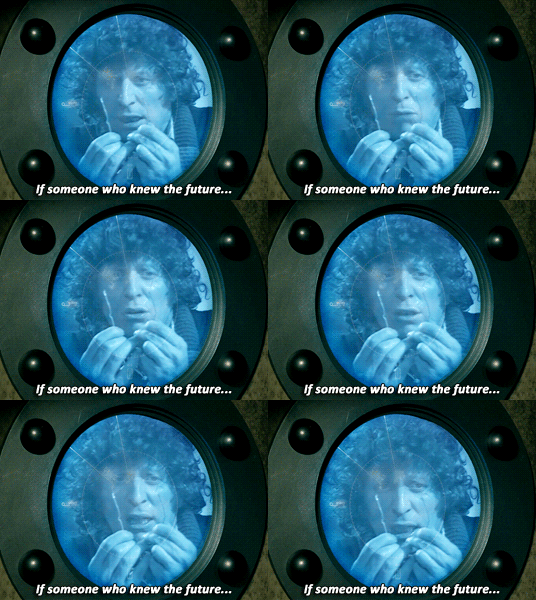
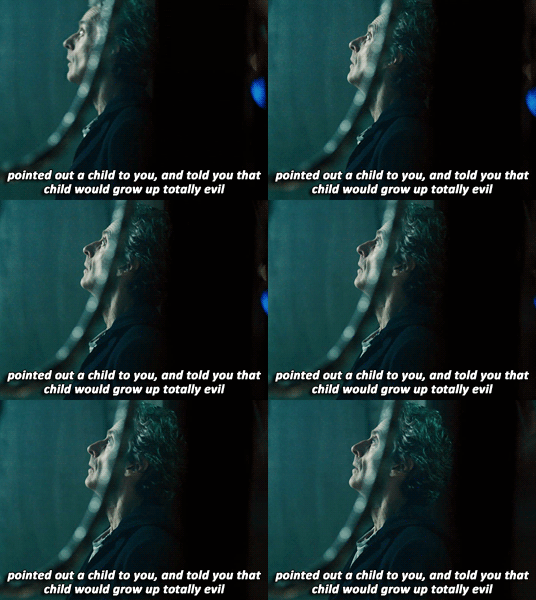
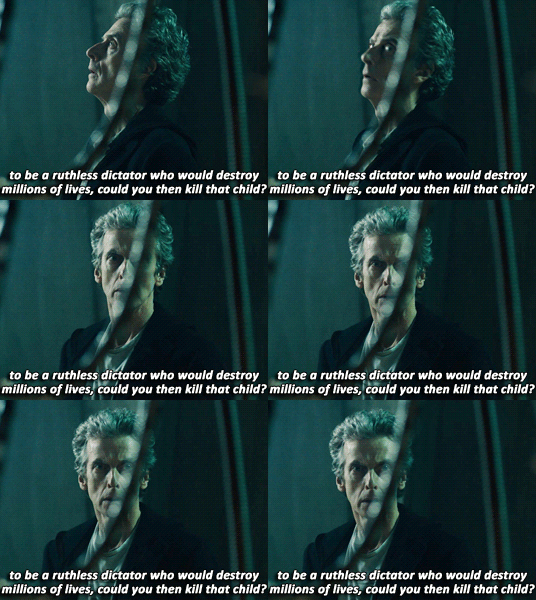
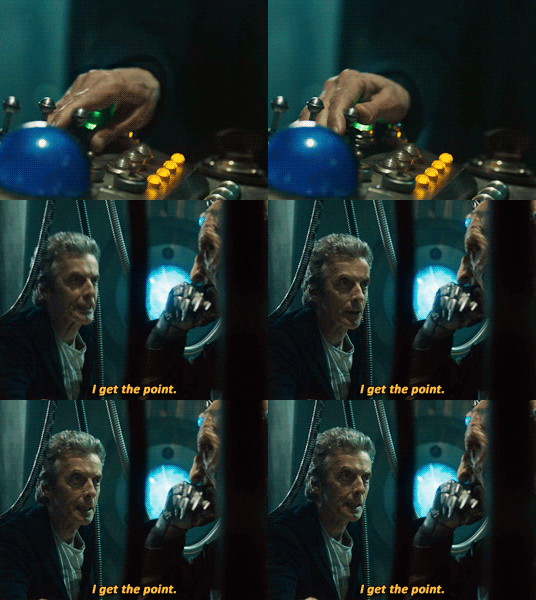
what the fuck dude this is awesome i want this too now
Okay, but what about those deep sea fish that produce light at a wavelength that *only they can see.* Predators that can somehow sense you in a completely undectable and unfathomable manner to you; they might as well be psychic.
YES, EXACTLY–vision is SUCH an asspull?? Sometimes it’s “"dark”“ and we can’t see anything. And also we’re impaired for plot reasons! Sometimes ALIEN WEAPONRY or otherwise-innocuous ship components are ”“too bright”“ and we yell and try to hide, subject to some sort of obscure, tortuous imperative. The rest of the time we can UNERRINGLY tell when anyone is trying to play pranks on us, the names and emotional/physical status of EVERY SINGLE BEING IN THE ROOM (or, when outside civilized warrens, ”“line of sight”“)–and yes, of course, can’t forget about our nigh-mythical fighting arts revolving around insane dodging skills.
And SNIPING. And also, god, fuck–don’t forget about completely arbitrary “”””atmospheric disturbances””” (fog, smoke–the new “ionic interference”) ALSO plottasatically rendering our abilities moot.
Plus, some people have more powerful Vision than others, but some people have a very short effective range of Vision. However, humans have come up with devices that “change the angles of refraction” of the “light” so that the naturally impaired have their skills enhanced–but they can always be knocked off their faces or be broken.
Also some people are terrible at normal Vision work, but have excellent night vision and are skilled at working under adverse conditions.
Oooh, and human art is almost entirely Vision based. Think about non-seeing aliens trying to access the majority of human art!
IM!!! SCREAMING!!! GLASSES. Glasses are SUCH another great Weird Alien Gimmick. God–you get all used to your Human friend and their bizarre abilities, you just start to really trust in and rely on them in tight places and problem-solving a little bit, then you get fucken marooned on a fucken planetoid somewhere and they just in this very small little voice, after you have pulled them from the wreckage and sat down to go over your options, inform you that they’ve lost their glasses.
Oh my god and an episode where we’re up against Evil Humans and our heros turn to their humans like ‘you can see them, right, you can tell when they’re near? you can counter them?’ and our hero is genuinely shaken and worried— they’ve got high-tech military mechanical enhancers, the devices strapped to their heads let them see anywhere, they can operate in near-absolute ‘darkness’, they can operate in near-lethal ‘brightness’, they can see through walls— not doors, not glass, but walls.
Then we have a heroic scene where the crew’s human is the scrappy, desperate underdog for once instead of the cool and collected superbeing. It is super cool. The human and the captain probably mack wildly on one another in medbay after this. Roll credits.
Person 1: I dunno, dude. This ‘light’ stuff sounds like a bunch of mumbo jumbo to me. I mean, how do we know it’s even real?
Person 2: Seriously, how can something be a wave and a particle? That doesn’t even make sense.
Mysterious Human: Even if you cannot perceive the light, you can feel its warmth–
Person 1: Oh my god, please shut it with the mystical hoo-hah. You’re insufferable.
Mysterious, somewhat exasperated Human: the ‘light’ enters the sensitive paired apertures in our faces, passing through biological lenses and chambers to stimulate specific nerves we call ‘rods’ and ‘cones’. one set of nerves tells us the volume of light we’re perceiving, while the other estimates the wavelength frequency. the total input creates in our mind a continuous sonarscape of immense complexity, where we can perceive ‘textures’ that are impossible to understand with mere sound or touch. this is why my people’s communication devices are small, flat, silent boards: we ‘read’ the patterns of light they emit as language and ‘watch’ the patterns of light they emit as sonarscapes.
Captain: okay…. sounds fake, but okay…
And they just keep on making up new bullshit rules for how light works, like
Navigator: Warp drive engaged. We are approaching 90% of the Lorentz limit.
Human: What now?
Navigator: Oh, uh, it’s really complex, but lemme try. So, matter can only move so fast through space, right? Like absolutely, nothing can ever ever possibly go faster than like about 3 hundred million meters per second–
Human: Ah yes. The speed of light.
Navigator: …oh for fuck’s sake.
Captain: My god! Time! Has… frozen!
Human: Fuuuuuuuuck.
Captain: What?
Human: Remember how light is a wave and a particle?
Captain: Yes, we mention this every episode.
Human: Yeah, light’s frozen along with everything else. I can’t see shit.
Captain: My god! Our sonar doesn’t work either! The soundwaves— they can’t propagate through this frozen air! We’ll have to use just our whiskers!
Human: Fuuuuuuuuck.
The fanfiction for this show has to be amazing.
“Shh. Don’t try to hide your needs, Captain,” Hue Mann soothed. “My sight has told me all about your traumatic memories of the war.”
“What?” Captain gasped. “But…how…?”
“The light knows all,” explained Hue. “Time slows down at the speed of light. It sees all of the past..and all of the future.”
“And what is it telling you now?” questioned the Captain.
Hue leaned in close. “It tells me, ‘Mate with them now, you lovestruck fool!”
“Damn you, Hue Mann. Damn you and your penetrating ‘eyes.’”
“Oh,” breathed Hue, voice husky and sexual. “That’s not all my eyes can…penetrate.”
Bioware are advertising to employ a writer, and they seem to be recruiting on ability rather than AAA studio experience.
From the ad –
How to apply to an Assistant Writer position at BioWare?
Write an outline and one dialogue for a short plot
Under 5000 words set within an existing BioWare franchise
Include a choice or complication to demonstrate player agency
Define any emotional beats
Include voice directions
It should be either composed using with Twine or a linked word document.
Requirements
Creativity. Writer will be expected to contribute to the direction of the game and script.
Ability to deliver stories on a weekly deadline.
Excellent written English skills required.
Ability to write from a variety of voices and perspectives (different genders, social classes, ages, etc.)
Willingness to work under direction while maintaining creativity.
Ability to develop a script to occur in a nonlinear manner. Story arcs will have multiple endings.
Organized – need to handle multiple story arcs and their relationships with each other.
Strong ability to communicate.
Applicants must be authorized to work in Canada
Obviously if you’ve already worked for a games company, that will give you these skills… but so will being a journalist or an independent writer, so if you can pass the audition, DO IT DO IT DO IIIIIIIIIIIT
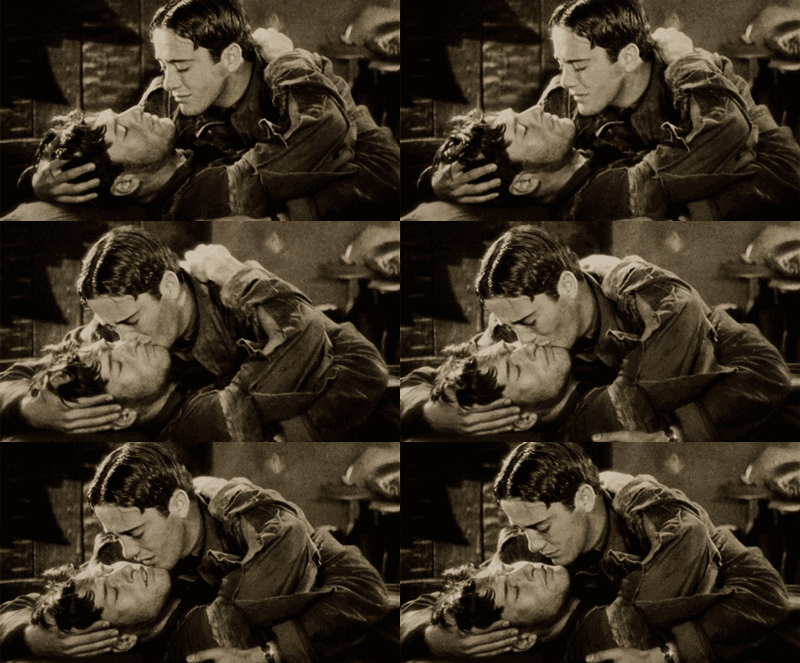
This doesn’t show exactly what the caption suggests it shows.
In this scene, the lower pilot is dying. He had been captured, managed to escape, and stole a German plane to fly back. The upper pilot–his best friend and rival for the love of Clara Bow*–shot him down, believing he was the enemy. This is him kissing his friend goodbye.
“But that’s still slashy!” you can say. Yep, it is. “You can read this as homoerotic!” Yes, you can. “Why are you denying this? Is it because you think being gay or bi is shameful?” A thousand times no. I am pointing this out because I think this is an important piece of evidence about what homophobia has done to our society and to male expressions of emotion.
In 1927, the obvious reading of this scene, for audiences, was not that this was a romantic kiss. Audiences primarily understood this as an expression of friendship and love, because of course it was perfectly natural for non-romantically involved men to embrace or even kiss, particularly at highly emotional moments. Of course a dying man would want to be held during his last breaths. Of course a guilt- and grief-stricken man would want to kiss his friend goodbye.
However, not very long after this, the commercialization and commodification of homophobia became a powerful force. The market (including Hollywood) began drawing lines and graphs and boxes, declaring which emotions, expressions, habits, and even colors “belonged” to men and to women. This kind of touch, which would not necessarily have been sexualized during many eras or in many cultures, became forbidden to men in the US, Britain and Canada (and many other places, too) within the decade–and is still lost to them today. This scene–a far more honest expression of grief and affection than anything we’re used to seeing in today’s action films–became gay.
Now, if you strongly wish to write “Wings” slash, you can still do so–and not entirely by putting on your goggles! University culture of the 1900s-1920s definitely allowed for a far wider range of sexual behavior than frats do now, etc. I don’t want to police what anybody can and does find in “Wings.” But I think we should acknowledge what we lost when capitalism decided that, for men, kisses could only be sexual.
*You may recognize Clara Bow from that goddamned photo that keeps making the rounds of the internet captioned, “A sex ed class in the 1920s!” so everyone can hoot with derision at the shocked girls in their desks. The photo is actually a still from a movie, and the star, Ms. Bow, is front and center.
I realize most people on here are too young to remember the Bush years but when you guys frame your SJ posts as “you hate[x]!!! why do you hate [x]???” it sounds an awful lot like how Bush supporters would scream WHY DO YOU HATE AMERICA???? whenever anybody would criticize the president.
So that’s something to consider if you want to reach people over 25. Because most of us have an extremely negative conditioned response to that type of rhetoric.
Yeah.
There’s a surprisingly sharp generation gap on Tumblr–when I first got on the site in 2011 it was between high-school age and college age, but I don’t think it’s defined primarily by life stage or maturity level, because it’s tracked steadily upward ever since. Anecdotally, right now the split seems to be centered around age 23, plus or minus a couple of years on either side, which corresponds roughly to the birth years 1990-1994. My hypothesis for the generation gap boils down to “how old were you on September 11, 2001?” Those solidly on the older side of the gap were at least vaguely aware of a pre-9/11 political landscape, witnessed how disruptive the first term of the Bush administration was, and have a visceral reaction anything that smacks of neoconservatism or Religious Right propaganda. Those on the younger side attained political awareness in a world where the changes wrought by the Bush administration were the new normal, and their right-wing bogeyman uses Tea Party and GamerGate rhetoric.
So for the record, Bush-era “innovations” that unnerve the FUCK out of people on the older side of the generation gap:
– Casual acceptance of fear as an excuse for hatred and pre-emptive retaliation
– An “ends justify the means” approach to stamping out the slightest trace of vulnerability, no matter how repressive the means, or how slight or unlikely the potential harm
– “If you’re not marching in lockstep with us, you’re one of THEM, why do you hate all that’s good and noble?” / “Dissent and safeguards against the abuse of power just give aid and comfort to the enemy” / “Don’t you SEE that insisting that the protections of civil society apply to THOSE PEOPLE is just going to GET OUR PEOPLE HURT, YOU’RE HURTING PEOPLE YOU MONSTER”
– Anything that smacks of religious-fundamentalist logic or rhetoric
These things are not normal. These things are not how just societies are built. They are the hot water that an entire generation of lobsters has been raised to swim in without noticing. The undercurrents in the internet movement calling itself Social Justice that disturb the older generation are, essentially, the dirty tactics of the Bush administration and its unholy marriage of neocons and fundies–rebranded with a new set of acceptable targets, but with the tactics themselves unquestioned. Are they the younger generation’s fault? Fuck no. They’re what happens when the most culturally and politically powerful nation on Earth tries to pretend it’s moved on from the Bush years, but without ever having confronted the devastation those tactics left in their wake, dismantled the self-sustaining fear-and-repression machine, or held the perpetrators accountable for their officially-sanctioned torture, shredding of civil liberties, and thinly-justified wars of aggression.
So if I were to do the annoying geezer thing (at the ripe old age of 27) and Address The Youth, I guess what I’d say isn’t just that most people over 25 get an overwhelming urge to throw up in their mouths at the slightest sign you’re playing “but why do you hate freedom” Mad Libs. (Although that’s true.) It’s more than that. It’s that “why do you hate [x]???” belongs to an entire toolbox of fear/attack, ingroup/outgroup, and absolutist tactics that we’ve left lying out without bothering to re-affix the giant warning labels that they aren’t normal, or necessary, or even effective over the long term, however tempting they may be for a quick fix. And that it’s okay to refrain from using them.
The bad guys will not win if you ease off the attack a little and give your opponents room to tell you where they’re coming from. Opening yourself up to argument-counterargument with Bad, Unacceptable, Forbidden ideas is a form of vulnerability, but finding and evaluating the weak spots in your beliefs ultimately strengthens them and strengthens your ability to win people over to your side. Doubling down on the repeated assertions that you shouldn’t even have to argue and that disagreement is harmful or immoral is an alluring way to get what you want in the short term, but it produces superficial compliance out of fear rather than genuine agreement, and the backlash it causes is ultimately more dangerous than the vulnerability of opening yourself to disagreement. And it blinds you to the possibility that you may not be entirely in the right. This isn’t some MRA sneak attack to manipulate you into ceding ground. This is how discussion normally works in a functional society. You have been handed a dysfunctional, toxic system for exchanging ideas, in online SJ as well as in wider politics–and no, it’s not normal or effective, and no, you do not have to buy into that system’s claims that it’s the only thing standing between the innocent and an orgy of destruction and victimization.
The strangest thing about this is that I would not consider myself particularly old (does anyone?) but I was in my late teens on 9/11, and yeah. This is exactly what I find unnerving about the approach of some younger people to SJ issues. For a long time I just put it down to (im)maturity, but I’m really starting to think that there’s something fundamentally toxic and broken about the way our country has been approaching these things for the last 15 years or so. That kind of black and white, ‘if your fave is problematic then they’re basically the antichrist’ thinking that demonizes and squashes any kind of disagreement is really unhealthy, and it’s something that is learned.
Same, I’m 30, married to someone older than me, and we have a lot of friends in their 40s/50s. People I encounter on a regular basis comment on what a “baby” I am. I was 15 on 9/11. I’m not like. Ancient. But there is a definitely a difference between how people my age discuss issues versus how younger folks discuss them. Neons have really done a number on out ability to talk about stuff.
This would explain a lot about how fandom conversations have been going down recently. The absolute us/them nature of some of them, and the way SJ tools are used to bully people in order to win an argument.
I thought it was largely to do with Tumblr being a poor design for actual conversation, but this makes more sense, given the patterns I’ve seen.
I…think that most of the people on Tumblr will get older. The no holds barred, right or wrong, FUCK YOU surety is part of being a teenager. Then you get it knocked out of you and learn to nuance. Both phases have value. What I’m saying here is that I think it’s more developmental than generational.
I don’t understand what this has to do with 9/11
9/11 largely serves as a convenient symbolic marker for a severe shift in public discourse– I was 14 when it happened and I very clearly remember the before-times socially and politically and the after, when there really was a huge public shift in the way things were discussed, and how people in my age group and a little younger responded to things like “national tragedies,” “us vs them,” good vs evil" etc?
Kind of dumb example but I think is illustrative– when we were 12/13, the year before 9/11, a group of kids went to DC and New York and visited all the war memorials. People whose uncles and fathers had fought in Vietnam visited the wall and Arlington, were moved, went through all the ceremonial stuff, but not to the point of dramatic hysterics. Maybe two/three years after 9/11, many of the same kids went to Pearl Harbor while we were on tour in Hawaii and everything was prefaced with this really jingoistic Us Vs Them language, and half the group spent the entire time bawling performatively. There were also a lot of recriminations for not engaging in the theatrics, because it wasn’t showing Proper Respect to Our National Heroes, none of whom any of these kids could have known because they all died in 1941.
My little brother is only 22 months younger than me but he doesn’t really remember the day at all, and doesn’t really remember anything about the politics or big news stories from beforehand, whereas I very clearly remember having an opinion about the 1996 election and my The Talk with my mom was kicked off because of the Clinton impeachment. 9/11 kicked off a lot of the worst of what we see in American political discourse today, and so people who don’t remember it as clearly or the time before may have different outlooks, especially in the States.
On the one hand this is a fairly enlightening take on the somewhat rabid state of what passes for online discourse these days.
On t’other, remind me again why we haven’t built a wall around America yet?
This is a fascinating conversation. I think there’s more to it than this–the way digital social spaces intersect with social phenomena informs the discourse hugely–but there’s a lot here worth considering.
It also occurs to me that a lot of us who were old enough not only to remember 9/11, but also to be aware of the shift in public discourse around it, are also old enough to remember the Cold War, or at least its last lingering throes.
I’m 32, and I grew up with parents who were very active in the nuclear freeze movement. One of the fundamental truths I absorbed very early was that us-vs.-them absolutism and refusal to compromise and engage in good faith with ideological opponents wasn’t just stupid; it was deadly–potentially on a massive, global scale. I remember projects to hook U.S. kids up with penpals in the U.S.S.R. in hopes that we’d learn to see each other as people and so maybe not end life on fucking Earth if by some miracle our parents didn’t beat us to the punch.
And that approach was critical to the peace movement in general: humanizing the enemy. Trying to find points of connection; to learn to disagree humanely. That was a core, fundamental value of my childhood, in ways that were very closely and directly linked to the contemporary geopolitical scene; and they’re philosophies that continue to profoundly inform and steer my discourse and my approach to conflict–personal and political–as an adult.
Which is part of what scares the shit out of me about the discourse I see online, especially from the left: it’s all about radical dehumanization. I see people who are ostensibly on my side casually call other human beings trash or garbage or worthless. Scorch earth. Go to unbelievable lengths to justify NEVER engaging. Meet overtures to peace or steps toward change with spectacular cruelty.
I mean, I’ve seen variations on this exchange more times than I can count:
“[group x] are people, too.”
“No, they’re not.”
And then people LOL, and I don’t even know where to start, because–No. You do not say that. You do not EVER say that. EVER.
And I can so easily imagine how terrifying it must be to grow up in that–to be 15 or 16 or 17 and just becoming, and trying to find and place and grow into yourself in that kind of violence, and–
–to paraphrase someone profoundly and complexly flawed and still a person worth paraphrasing: Remember, babies, you gotta be kind.
This is an extremely interesting take on this phenomena, and something I would never have considered, being one of the young’uns. I do remember 9/11, but barely (I was seven and all I cared about was if my pen pal was ok). Now I’m wondering what other effects this kind of shift has had on my generation.
Alright! So, this episode leaked in Australia about a month ago, and while we never got good visuals on the book he was reading then, we heard from people there that this might have been the case, so when it aired last night I was already looking out for it. I screenshotted the pages right away, and… upon reviewing the shots here I can’t tell you for SURE that it’s Simon’s journal. You’re gonna have to make that judgment on your own, but here’s what we’ve got.
This is the first book we see him reading. The Lighter Side of Nietzsche. The writings of Friedrich Nietzsche are pretty heavy, for what it’s worth. He wrote about the death of God and championed “the realities of the world in which we live over the idea of a world beyond.” Really deep, philosophical stuff that should or shouldn’t be talked about in a kid’s show.
But! IK’s not actually reading it! He’s reading funnies about Nihilism! Still very Nietzsche. Check out the font of the book in the background, though. That’s the important bit here. It looks handwritten, on yellowed-out pages.
We cut right away from that shot to see that his book is called The Lighters Side of Nietzsche now. Okay. We added an S.
He puts the book down and then we cut STRAIGHT to… IK reading words in a book?!!
With CAPS on white pages! And a different font from the one in The Lighter/s Side of Nietzsche!
Talking about the “stench of death” and a “mist” “hanging low like a London fog, creeping…” that has apparently done something sinister to “those who fought against” it. The author doesn’t “believe there is hope left for us anymore,” but is “still safe… still unaffected,” by the mist, and his/her condition “is an anomaly”.
It feels as though the author has been “chosen to be a ruler in the new world”. He/she watches “the sky light up once more,” accompanied by “a stench like burning metal” and “the echoes of an explosion”. And then another quote about the mist searching the “broken Earth” for the remaining people to “corrupt and mutate”? And in the far bottom right, it looks to me like the author says there’s something magical about the way the world has become [you can get another view of this text without IK’s arm in the way in the GIF below].
So, YEAH. That sounds a HECK of a lot like maybe the way the radiation spread and turned humans into the sludge monsters we saw in Simon & Marcy. And Simon is immune because of the crown’s magic turning him into Evergreen, and not a sludge monster? And Ooo is ABSOLUTELY magical. Beautiful and totally 100% consistent with what we know.
Except…. he starts to fall asleep while reading this passage and… check the title we get right here. It LOOKS like he’s still reading The Lighter [no S this time] Side of Nietzsche. The color of the pages in the book in this shot don’t line up with our second set of screenshots. They’re yellow, like the first shot of The Lighter Side of Nietzsche. So…
Just to be clear here, he falls asleep reading the caps text on white page [in spite of the previous shot clearly having yellow pages] and:
wakes up with his face stuck to a yellow-paged book [with no visible title on the front]. BUT, the books on the table HAVE been rearranged from before, suggesting he’s switched. Check it out:
The book stuck to his face is a whole lot thinner than The Lighter Side of Nietzsche, too. It’d all add up if the page colors were consistent and we didn’t get a shot of his face falling asleep while apparently reading The Lighter Side of Nietzsche still. It’s up to you how you interpret these shots, but it sounds prettttty likely to be Simon’s journal.
We can only guess that it’s Simon’s journal because of the text itself, though, because the other shots garble that meaning. To play devil’s advocate here, if the caps text book he’s reading as he’s falling asleep IS The Lighter Side of Nietzsche, then the joke is that a mutagenic apocalypse is lighter than the stuff Nietzsche typically wrote about. And that’s a pretty good joke. But it feels to me like it’s his journal.
So far as explosions go, if we accept that this is Simon’s journal from the Mushroom War, and this is obviously just a guess on my part, I’d wager that the mist is what we’ve come to associate with the Lich’s essence:
This junk. And I don’t think it’s unlikely that, kind of like in a zombie apolcalypse scenario, the surviving humans [before they were all converted?] would’ve fought against the sludge monsters like you’ll see them fight against zombies in zombie movies. It seems logical to me that humans in an apocalypse scenario might bomb infected areas to try and kill the monsters.
I can’t conclude that there was more than one Mushroom bomb since I see this as just as likely a cause for explosions.
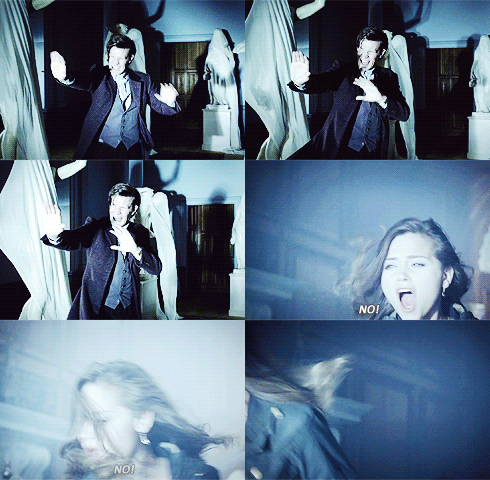
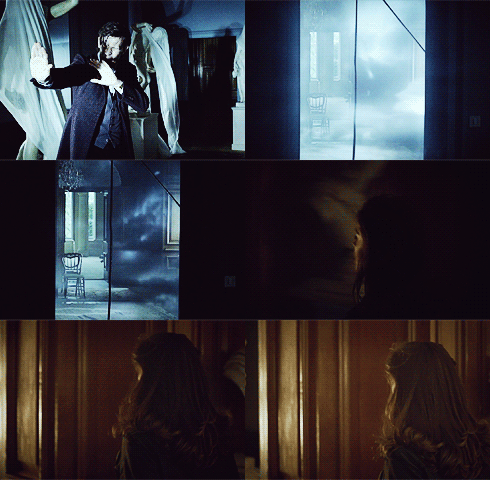
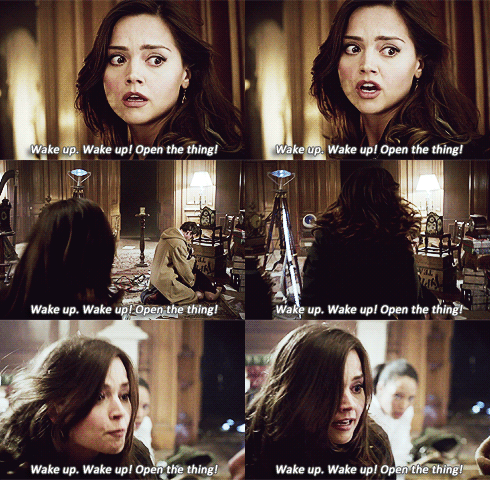
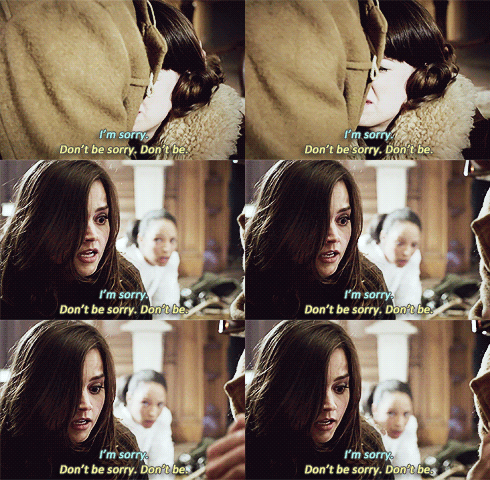
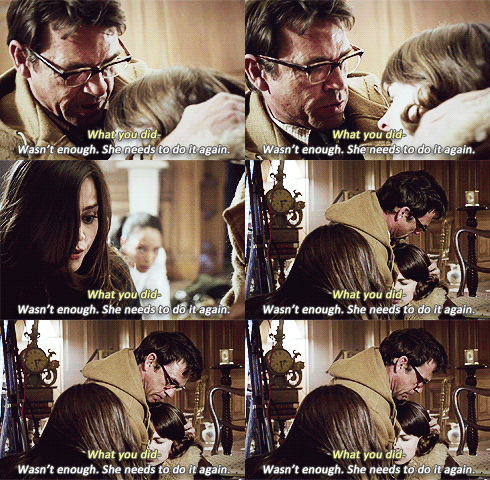
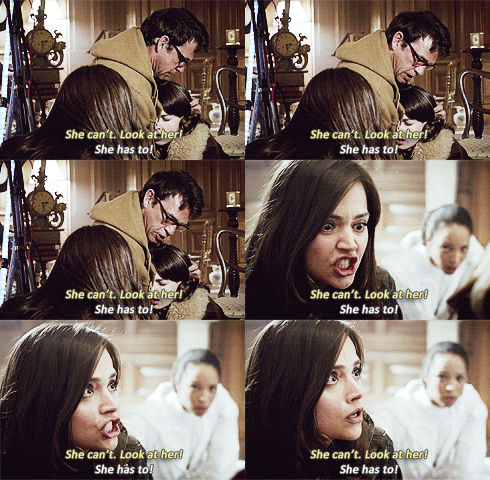
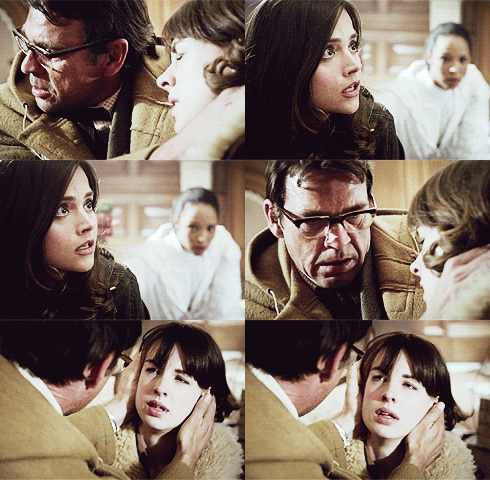
This is one of my favourite Clara scenes for this exact reason. We see her being good so many times, almost unbelievably conscious of what’s the right thing to do. But this? This is Clara under pressure, and pressure always reveals the real Clara. Sometimes it’s that she’s scared, but sometimes, like this, it shows that she’s got the sort of dark ruthlessness inside of her that the Doctor shares.
She’s not perfect, she’s not even always nice, and that’s what I love about her.