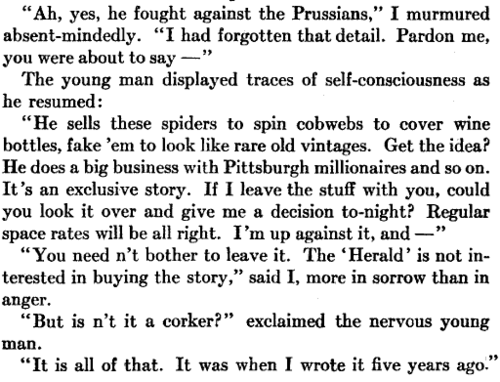
If y’all didn’t realize I was going to research the crap out of this just because I could, you clearly don’t understand this blog at all.
So, first off, I seriously doubt there was ever a French military veteran farmer named Pierre Grantaire who moved to Pennsylvania to help wine merchants defraud people and had pet spiders named after Zola and Sarah Bernhardt.
I know it’s sad. And I can’t prove there wasn’t. But you have to understand that “there were articles in a bunch of 19th century newpapers and the notes sections of some scientific journals” is basically the equivalent, accuracy-wise, of saying “I saw it on my tumblr dash”. Which is to say, they shamelessly made stuff up. All the time. And then shamelessly copied it off each other.
I can tell you that there was no person by the name of Grantaire living anywhere in Pennsylvania in the 1880 or 1900 US censuses, though, and nobody with a name even close to Grantaire who was born in France and lived there. (The 1890 records were destroyed in a fire.)
Plus there’s the fact, as needsmoreresearch pointed out, that if you want to make a cellar look spider-y, you don’t use pretty garden spiders that weave neat patterns, you use the cellar spiders that use the fluffy dusty cobwebby silk, which could be a question of art as proposed in needsmoreresearch’s post, but it seems like if you were actually committing fraud you’d go for authenticity over symmetry.
And the earliest version of this story I can find, after checking a bunch of databases, is in the April 16th Edition of the St. Paul Daily Globe. I can’t guarantee that’s the original source, since digitizing of American newspapers is still pretty patchy, but I’d make a fair bet that it is. It’s the full long-form article and includes all the quotes and wording that were copied in the other publications and tbh it really reads like a 19th century newspaper hoax.
Also, unlike any of the other papers, the Daily Globe was advertising it over a week in advance as one of their cool weird stories in the Sunday edition, which none of the other papers did. Including, for several days, under the headline “NOT A FREAK SHEET”. Daily Globe, methinks you may protest too much.
Now you may think it’s sad if this dude did not exist. But. Just imagine: A bunch of Globe reporters just off their alcohol-soaked lunch break, BS-ing about the most click-bait-y hoax stories they can come up with, and one of them says, “I need a name for a weird old rambly French dude who really likes spiders” and another immediately says “Grantaire. Definitely Grantaire.”
And since the ONLY results in Google Books for the word “Grantaire” in all of the 1890s are a) this story, and b) editions of Les Miserables, I am absolutely sure that whoever proposed that name was a Les Mis fan.
In other words, this is totally somebody’s modern-US-AU Grantaire headcanon from the 1890s that got reblogged a lot and is still merrily going viral 125 years later, because Mis fandom never dies.
okay, this post got completely out of hand, in the best possible way — i’m sorry i haven’t been back to comment, but my own research projects took over and i’ve been away from tumblr.
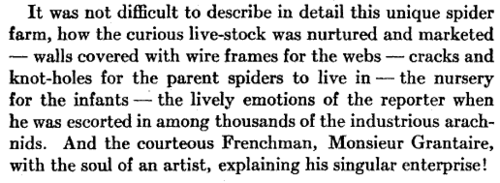
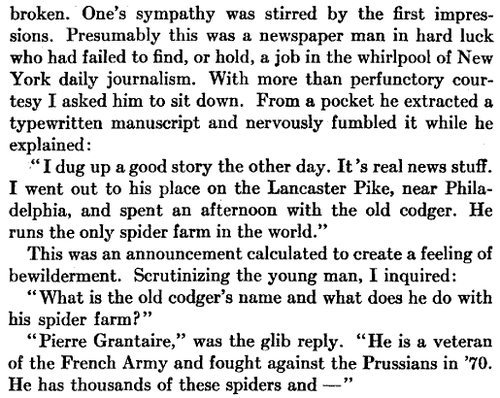
anyway, yes — pierre grantaire is actually not a real person. i’m not as familiar with doing american history research online, so i never would have thought to check census records, but back before i wrote the first post on friday, i actually found his creator: ralph delahaye paine, a young journalist who later became the managing editor of the new york telegraph and served in the new hampshire state government. paine’s autobiography is on google books, and he talks about monsieur grantaire in one chapter, provocatively titled:
apparently, paine had been tasked to write a human interest story by his editor, his original idea had been to interview a man whose claim to fame was that he had been hit by a locomotive, and survived, the three times. but paine’s creativity carried him further:
apparently, paine never expected the story to take off; in his opinion, it was too crazy to be taken seriously.
however, as verseanduniverse describes, the nineteenth century was just as credulous and as prone to sharing things as tumblr today:
the story took on steam, appearing in more respectable scientific journals and even crossing over to publications overseas. eventually, however, paine forgot about it; he took on more serious reporting jobs, traveling to cover the spanish-american war and the boxer rebellion. five years later, however, he was working for the new york herald when pierre grantaire showed up again:
BAM.
thank you to verseanduniverse for doing the american history side of digging on the story; i’m not as familiar with those digital resources, so i didn’t even think to check things like census records. i also love your idea of calling this a “modern headcanon,” because it totally is!
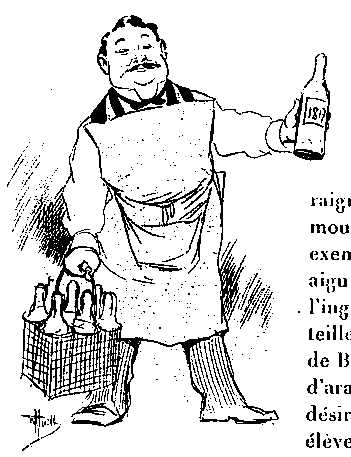
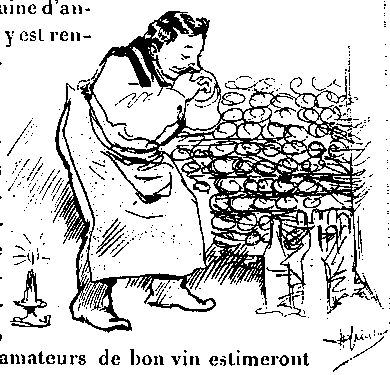
it also means that these illustrations from le journal amusant, who republished the story of grantaire the spider farmer in 1897, are modern au FANART:
omg look at him being so eager at his spiders! these sketches are even better when you know that hugo’s own sketch of grantaire playing dominoes at the infamous barrière du maine in his original manuscript gave him an equally fab mustache:
Dr. Mae Jemison, MD, the first black woman in space and first actual astronaut to appear on a Star Trek show, one of the very few people on this planet of whom two pictures can be posted depicting them doing their job on a spaceship with entirely different contexts.
Holy shit this is a serious contender for the best post I’ve ever seen on tumblr.
This is probably the coolest thing I have ever seen
‘Cause people seem to only post the 20-something Audrey Hepburn.
Audrey Hepburn was the granddaughter of a baron, the daughter of a nazi sympathizer, spent her teens doing ballet to secretly raise money for the dutch resistance against the nazis, and spent her post-film career as a goodwill ambassador of UNICEF, winning the presidential medal of freedom for her efforts.
…and history remembers her as pretty.
this is the first time I have ever seen a picture of her older than 20 and I think that’s scary
I starting looking up info about her life after reading this post and my god, she was a badass.
During the war her uncle was executed by the Nazis, her half-brother was sent to a labour camp, and she suffered malnutrition bad enough to put an end to her ballet dancing professionally, and making it difficult for her to gain weight for the rest of her life. (People today still comment on her pretty thinness, but that was where it came from.)
She related deeply to the story of Anne Frank as they were the same age, and their lives did in fact entwine a little-
If you read the diary, I’ve marked one place where she says, ‘Five hostages shot today’. That was the day my uncle was shot.
-but when offered the role of Anne Frank to play, she turned it down because she felt she couldn’t exploit Frank’s life to further her career. That’s not all-!
Her father was a Nazi sympathiser but she certainly wasn’t. She risked her life delivering messages and raising money for the Dutch Resistance. (When spotted and questioned on one of these occasions, she disarmingly smiled and handed the soldiers some flowers, and they let her go on her way.) She would dance ballet in ‘black performances’ for money.
Did she rest on her laurels after all that? No! She became a volunteer nurse, to help out all the other people who’d suffered terribly during the war. This desire to help others lasted her her entire life, and so (as most peope already know) in her later years she spent six months a year travelling the world doing humanitarian work. As well as the Presidental Medal of Freedom, she was posthumously awarded the Jean Hersholt Humanitarian Award.
Also, she was one of only a few people to have ever won all four of the Academy, Emmy, Grammy and Tony awards. She definitely deserves to be remembered as more than a pretty face people put on t-shirts, is what I’m sayin’.
In
the 19th century, the father of modern gynecology, J. Marion Sims,
conducted his research experiments on enslaved Black women. Sims
performed the invasive and torturous procedures without anesthesia. J.
Marion Sims’ justification for choosing not to anesthetize his test
subjects was that he did not believe Black women felt pain at all. In an
1857 lecture, he stated that it was “not painful enough to justify the
trouble”.
The
Tuskegee Institute and the Public Health Service began a study of the
natural progression of syphilis involving 600 Black men (399 with
syphilis, 201 uninfected) in 1932. The infected men involved in the
study were never made aware of their condition upon diagnosis and
believed they were being treated for “bad blood”. In exchange for their
participation, the men received free medical examinations and burial
insurance. They were never treated for the disease. These trials went on
until 1972 when the study was exposed by The Associated Press.
The remaining victims and their family members won a $10,000,000
reparations settlement which guaranteed them lifetime health coverage
and burial insurance.
The Pellagra Incident Pellagra
is an ailment commonly caused by a lack of niacin (vitamin B-13) in the
human diet. The symptoms include skin lesions, sunlight sensitivity,
dementia and ends in death. At the turn of the twentieth century,
millions of people in the United States died from this disease.
Scientists claimed that the cause of the disease was a toxin found in
corn. In 1915, the U.S. Surgeon General ordered government funded
experiments on Black prisoners afflicted with pellagra. Poor diet and
niacin deficiency was found to be the cause. However, these life-saving
findings were not released to the public until 1935 because the majority
of Pellagra-induced deaths affected Black communities.
In
1945, African-American Ebb Cade, a 53-year-old truck driver, was
secretly injected with plutonium, the substance used to make nuclear
bombs. After breaking several of his bones in automotible accident, he
was rushed to the emergency room. Unbeknownst to Ebb Cade, he was in the
care of doctors that were also U.S. Atomic Agency employees. For six
months, he was held in the hospital under the belief that they were
treating his injuries. During that time, he was injected with more than
40 times the amount of plutonium an average person is exposed to in a
lifetime. The doctors and researchers collected bone samples and
extracted 15 teeth to monitor the effects of his exposure. Ebb Cade grew
suspicious of his broken-bone treatments and escaped from the hospital.
Unfortunately, Cade suffered from the brutal effects of intense
radiation until he died from heart failure eight years later at the age
of 61.
In
the early 1950′s, the United States government conducted an experiment
to see if mosquitoes could be weaponized. The CIA and the U.S. military
released nearly a half million mosquitoes carrying yellow fever and
dengue fever viruses into several Black communities in Florida. In the
predominantly Black community of Avon Park, dozens of Black people
became ill, eight dying as a result of this government-issued mosquito
attack.
In
June 1990, more than 1500 six-month old Black and Hispanic babies in
Los Angeles were given what seemed to be a standard measles vaccination.
The parents were not told that this particular vaccine, Edmonston
Zagreb measles vaccine (EZ), was still in its research phase and not
approved by the FDA. The EZ vaccine already had a reputation in Senegal,
Guinea Bissau and Haiti, triggering an increased death rate among
infant girls, most not living past the age of two. The Center for
Disease Control would later confess that the infants were injected with
an experimental vaccination without their parent’s knowledge. Presently,
it is believed that many of these families are still unaware that their
babies were used as guinea pigs.
In
the year 2000, Federally funded researchers from John Hopkins
University, the EPA, HUD, The Kennedy Krieger Institute and Department
of Agriculture spread sludge from a sewage treatment plant on the lawns
of nine low-income families, and a vacant lot in Baltimore and East St.
Louis. The families and residents were told the sludge was safe and not
informed about the toxic mixture of human and industrial waste the
sludge contained. The research was conducted to see if the toxic waste
absorbed into the water supply could effectively reduce lead levels in
children.
In
December 2012, at least 500 children in Gouro, Chad were forcibly given
the MenAfriVac during school resulting in dangerous side effects
including convulsions, and paralysis. Parents were not notified of any
plans to vaccination their children at school and parental consent was
never requested. The forced vaccinations were part of an aggressive
healthcare initiative sponsored by several internationally revered
organizations including the Bill & Melinda Gates Foundation, the World Health Organization and UNICEF.