

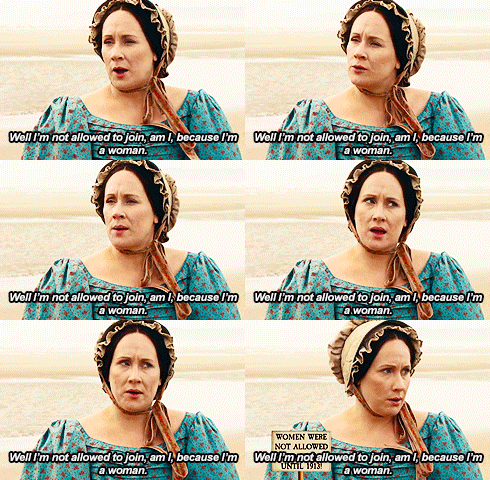


[via paulmcgann]
history
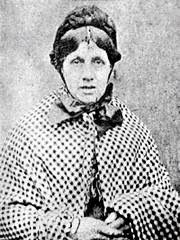
Mary Ann Cotton: Female Serial Killer
1832-1873
Mary Ann Cotton was born to a small mining town in Great Britain, and married William Mowbry in 1852. They had eight children— seven of which were dead of “gastric fever” by January of 1865 when her husband died of a “fatal stomach infection”. Cotton collected a not inconsiderable life insurance on two of the children and her deceased husband.
Mary Ann sent her surviving daughter to live with her mother, and worked at the infirmary in Herndon, England. She married one of her patients, George Ward, eight months after her first husband’s death. Husband number two was dead by 1866, from a prolonged illness associated with paralysis and intestinal problems.
Mary Ann then became the housekeeper for James Robinson, a widower. Robinson’s baby died of gastric fever not long after Cotton began working there… and Cotton became pregnant not long after working their either. She briefly returned to her mother’s home to care for her sick mother, who died after experiencing stomach pains. Mary’s surviving child from her first marriage died soon afterwards, as well as two more of James’s children by 1867. Robinson and Cotton married and had a child in November of 1867, but she died of stomach pains in the spring of 1868.
In case you lost count, that brings the body count up to fourteen.
Shockingly, Robinson grew suspicious of his new wife and former housekeeper, and discovered that she had stolen £50 (a rather large sum in those days) and forced his children to pawn household items. He unceremoniously threw her out into the street. Mary Ann still managed to find yet another husband through a friend, Margaret Cotton, who introduced her to her brother Frederick Cotton. Mary Ann and Frederick got married (bigamously, as she was still married to Robinson)… after Margaret’s death. From a mysterious stomach problem. While she was still married to Frederick, she struck up an affair with Joseph Nattress, a former lover.
Mary Ann and Frederick’s son was born in 1871, but Frederick soon died. Mary Ann collected on his life insurance policy.
Nattress moved in with Mary Ann and her three remaining children after Frederick’s death, but Mary Ann had already moved on to John Quick-Manning, a excise officer recovering from small pox who Mary Ann was nursing back to health— Mary Ann became pregnant again with his child. In March of 1872, one of Frederick’s sons and the infant child of Mary and Frederick died. Shortly after Joseph Nattress changed his will to include Mary Ann in the life insurance policy, he died. Of gastric fever.
Mary Ann’s only remaining charge, her stepson Charles Edward Cotton, was apparently too much for her to handle. Mary Ann tried to send him to live with one of his uncles, but to no avail. When she tried to get him committed to a work house, she was told by the parish official that she would have to accompany him; Mary Ann commented that he was sickly and would soon “go like all the rest of the Cottons.” Within five days, on June 12, 1872, Charles was dead.
Thank God somebody finally noticed a connection between this woman and her relatives dropping like flies. The parish official who had accompanied Mary Ann and her stepson to the work house also happened to be the assistant coroner— they autopsied Charles’s body and found that his stomach contained high levels of arsenic. In case you’re curious, arsenic was easily available, cheap, and causes the same symptoms as gastric fever (stomach sickness and diarrhea).
Her trial was prolonged until 1873, after she gave birth to her final child in January. She was hanged to death in March.
Just as a recount: she killed three husbands, her mother, a family friend, and a dozen of her own children. Not all badass women are the good kind of badass.
There used to be a children’s rhyme about her. I read it in a Horrible Histories when I was a kid…
Mary Ann Cotton
She’s dead and she’s rotten
She lies in her bed
With her eyes wide open
Sing, sing, oh what can I sing?
Mary Ann Cotton is tied up with string
Where, where, up in the air
Selling black puddings a penny a pair.
Apprently I was interested in weird stuff when I was little.
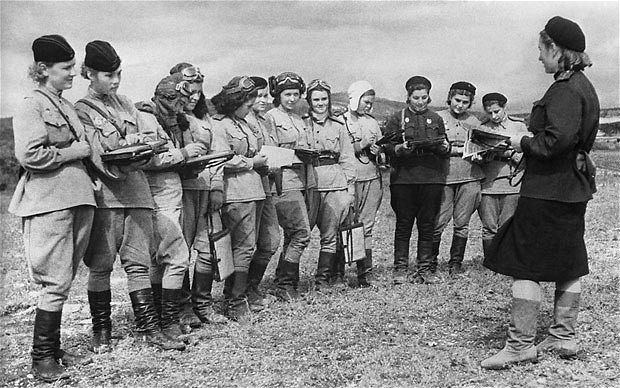
for those not in the know, night witches were russian lady bombers who bombed the shit out of german lines in WW2. Thing is though, they had the oldest, noisiest, crappest planes in the entire world. The engines used to conk out halfway through their missions, so they had to climb out on the wings mid flight to restart the props. the planes were also so noisy that to stop germans from hearing them combing and starting up their anti aircraft guns, they’d climb up to a certain height, coast down to german positions, drop their bombs, restart their engines in midair, and get the fuck out of dodge.
their leader flew over 200 missions and was never captured.
how the fuck is this not taught in every single history class ever
GET IT GIRLS.
badass
WHY isn’t this a movie?
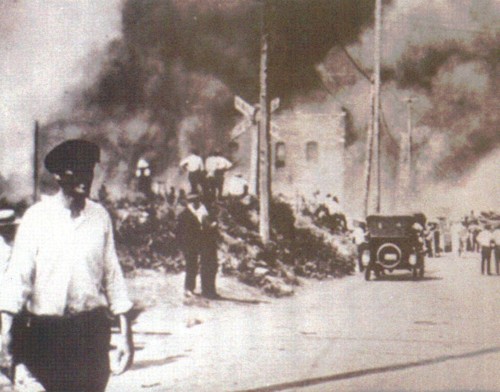
[tw: racism, bombs, explosions]
BLACK WALL STREET is not a record label started by The Game.
Black Wall Street was the most prosperous black community in America during the 1920’s located in Tulsa, Oklahoma. It was known as “Little Africa” or “Black Beverly Hills”, a prime example of racial nationalism. To put into perspective of how money flowed in Black Wall Street, a dollar took 365 DAYS to leave the community, now a dollar leaves an African American Community every 15 MINUTES. The community had hundreds of businesses all negro owned and their motto was “To educate every child”.
June 1, 1921 white supremacists bombed BLACK WALL STREET and killed over 3000 people and destroyed over 600 businesses. 21 churches, 21 restaurants, 30 grocery stores, a hospital, bank, post office, and most schools were destroyed. The dead were buried in unmarked graves. It wasn’t till 1997 that Oklahoma decided to pass the “1921 Race Riot Reconciliation Act” which provided decedents of that area a free college education.
SMH AT AMERICAN HISTORY
READ THIS. They for sure aren’t teaching this in school. Tell your babies. Share with your students.
For all those “BOOTSTRAPS” bastards.
reblogging for history that i was never taught
As many people were killed that day as on 9/11 and this is the first I’ve heard of it.
Snow White In Auschwitz
Hey, I got this book from the library called Magneto Testament, detailing the X-Men character’s past as a Jew in Auschwitz. At the back there was a small extra section, and I looked through it..it was a comic about this girl in the concentration camps who draws a Snow White picture on the wall to entertain the children, and then when that’s discovered she is ordered by Dr Mengele to paint pictures of the people he experimented on…sometimes truly horrific things. She agrees only if her mother’s and her own lives are spared, and when the camps are liberated she and her mother are among the survivors.
And that story is true. It’s the story of Dina Babbitt. I’d never heard her story before, but I was so awestruck by her bravery. She made sure to take as long as she could painting the pictures of still-living prisoners, because while she was painting them they would stay alive.
The pictures she painted ended up in the Auschwitz-Birkenau State Museum. Dina wanted them back, but they refused. She died almost exactly a year ago, still fighting for the return of the artwork that saved her.
The Past
The other day I was reading a book about my old school. My old school was quite cool in many ways, so I thought maybe I should talk about it.
The book was The Cedars by Richard Hart, and all pictures are scans from there. I’m hoping I’ve not stepped on anyone’s toes.
This is the Cedars, one-time home of Mary Norton and the house in which The Borrowers is set. It’s also where I went to school. When I went there it was called Leighton Middle; once upon a time it was called (like the house) The Cedars. The Cedars has now become a high school and moved across town.
Leighton Middle/The Cedars has a fascinating history:

This here’s the building me and my classmates called The Old House. It was built by John Dollin Bassett in 1855. His desendant, Mary Ann Bassett gave her name to another school in the area.
The Bassetts were apparently a pretty cool family- Mary Ann set up a school to teach disabled children in 1890.
The Old House was noisy, any sound you made in any of the upper rooms could be heard in the room below and we were supposed to always walk and sit down quietly when we were in there. It also had a great view of the high street from the highest rooms. When I was in Year Eight I sat next to the window that looked down on All Saint’s Church grounds, and it was fun to see people going about their business unaware that I was taking my mind off work by watching them.
Round the back of the house were the lawns. Students weren’t allowed to walk on the lawns unless given permission, in case we damaged them, apparently. We would watch the teachers walking across the grass in their high heels and wonder about that.
Once someone dared me to run across the lawn nearest to the staff room. I did. It gave me a feeling of freedom.

This was called the Exhibition Room, although as far as I remember very few exhibitions took place there. None of us schoolkids were allowed in there and the doors were always locked. I think I went in there only once or twice the entire time I was at Leighton Middle.

This is the school hall. It hasn’t changed much since 1924.
It’s been used as a banquet hall, classrooms, and for storing German prisoners during World War One. The German prisoners apparently carved their names into the roof beams. I’ve never seen any carvings. Maybe they replaced the beams.
These days it’s the assembly hall. There’s a picture of someone at the front- I’m not sure, but I think it’s a picture of Fred Fairbrother, the school’s first headmaster. From what I read about him he seems mildly eccentric. He had a yellow car (pretty unusual atthe time), and was hugely patriotic and would read Churchill’s speeches out to his students.
In the picture he looks like quite a nice man. If it’s him.

The swimming pool was opened in 1934. That guy in the picture is Mr Green, chairman of the governors. It would have been nice to have a swimming pool at school, but we didn’t. When I went there, the swimming pool was drained, full of leaves and occasionally was home to a family of ducks. Going anywhere near there was absolutely forbidden, they were probably afraid we’d fall in.
Next to the swimming pool was the memorial gardens, commemerating the people from the school who died in WWI and WW2. To the side of that there was a foresty area which led to the nearby brook. The brook was surrounded by a fence, for obvious reasons, and we weren’t meant to go in the trees. I think sometimes we were allowed down there during PE, though.

Speaking of which, this is the gymnasium. It was opened in 1939, I never knew it was that old. Like the hall, it hasn’t changed much.
I hated gym. Who doesn’t?
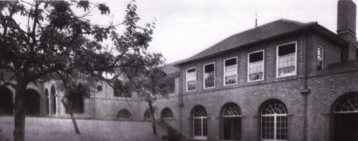
This is where the Year Five and Year Six classrooms were (and presumably still are). It was opened in December 1929. Inside the foundation stone are a boy’s cap, a girl’s hatband, and other souviners of the era. I can’t help wondering if anyone will ever actually discover these.
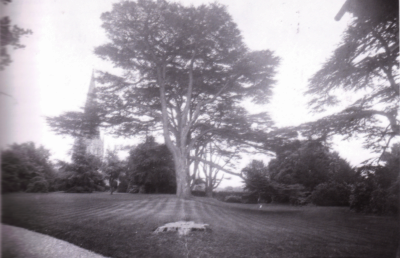
The school grounds contains loads of trees. It was really quite cool going to a school which took such pride in its surrounding nature.
The one in the picture I’m not sure is there anymore. But I remember a tree outside the dining hall which was easy to climb. We weren’t allowed to climb it but people did anyway.
The school’s motto was ‘Veritate Gaudete’ which means ‘rejoice in the truth’. When I went to Leighton Middle I believe it had a ‘statement’ instead of a motto, which I hated. Something about ‘personal excellence’. Which is all well and good but I’d have rather had something short and simple. However the Cedars High school did, I believe, adopt the motto. I think it used to be on the front of the planners they handed out.
I rather miss Leighton Middle. Sort of. I mean, I pretty much hated it while I was there, because you’d be hard pressed to find anyone who likes school when they’re thirteen, but still. I miss the trees.