I met a baby the other day who taught me that kids aren’t learning the thumb-and-pinky-out gesture for “phone” anymore. She puts her flat, open palm up to her ear and babbles into it, simulating a flat and rectangular smartphone.
It’s so interesting that a lot of seemingly obsolete hand motions still exist, though
very few people wear wristwatches, but tapping one’s wrist is still a nearly universal gesture for “what time is it?” or “hurry up”
I used classic corded phones for only a very brief time in my life (before we got those more rectangular-shaped cordless ones for my parents’ landline) and first saw a car without power windows when I was in college, and yet I’ve always used the pinky-and-thumb gesture for “call me” and the circling-fist gesture for “roll down your window.” I’m 24, so my childhood was the late 90s and early 2000s, but I still use gestures that indicate technology either gone or on its way out when I began forming reliable memories
it also makes me wonder how people indicated time or hurrying before wristwatches. did they somehow pantomime a pocket watch? what gestures have we lost as technology marches on? and since video didn’t exist for most of human history, how might we learn what they were? like the contents of the third Georgian spice jar or the location of Punt, nobody would think to write any of it down
“We had an Elocution recital last night, which was exceedingly stupid.”
Some refreshing Victorian honesty from a teenage girl attending the prestigious Ogontz School outside of Philadelphia.
The school had it’s own post office so that teachers could monitor the mail to make sure the girls were not carrying on correspondence with any unapproved young gentlemen.
This letter was sent to a cousin who was pre-law at Yale on February 11, 1897.
Horrible Histories S01E03 ↳Slimy Stuarts: Wife swap with the Miserables, a Puritan family, and the Merrys, a Restoration family
~ History ~
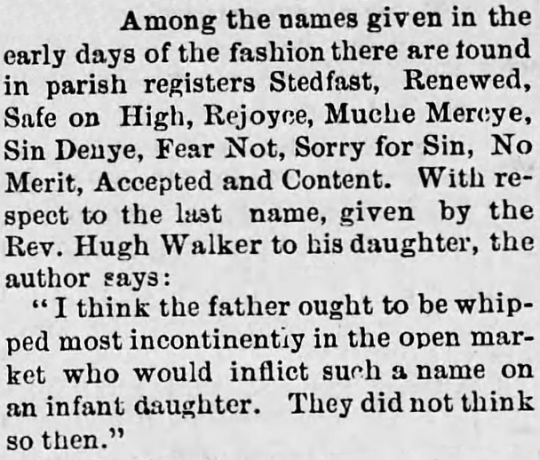
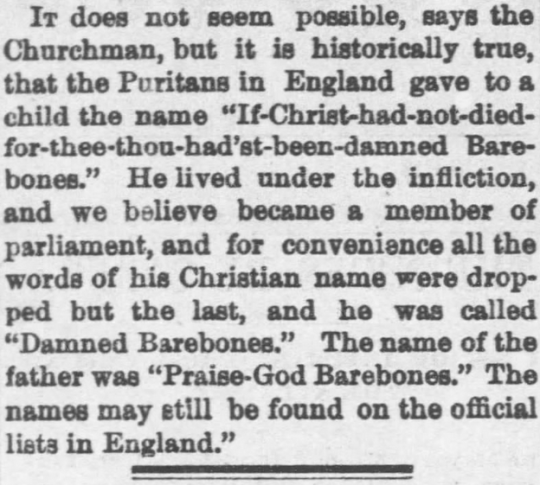
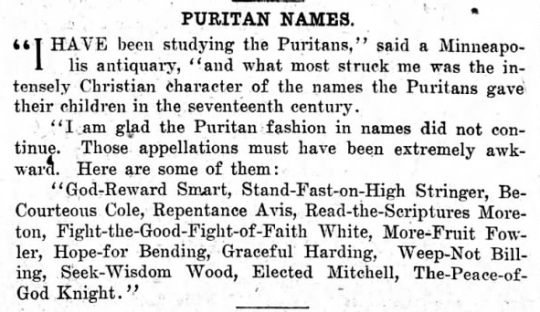
Some names such as Joy, Hope, and Mercy are still used today but others such as Silence, Discipline, and ‘If Christ had not died for thee, thou hadst been damned’ were real. Here is a list of more Puritan names
Tag yourself. I’m “Has-Descendents.”
History is one thousand times more utterly ridiculous than you might think O.O
Faint-not, perfect for the one with syncope
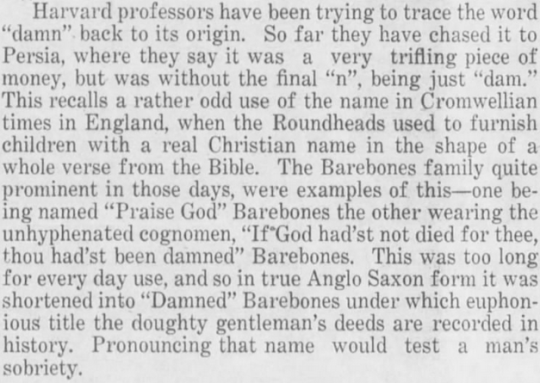
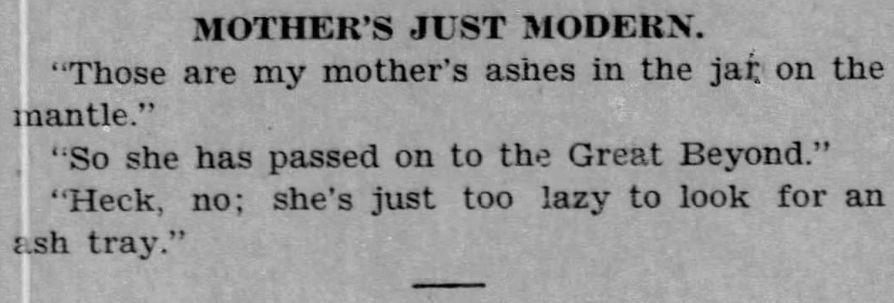
The Canton Independent-Sentinel, Pennsylvania, September 10, 1880
The Daily Commonwealth, Topeka, Kansas, June 6, 1883
The Minneapolis Journal, Minnesota, January 2, 1905
Daily Capital Journal, Salem, Oregon, April 4, 1916
(Episode 2! aka This Ended Up Longer Than I Intended and I Apologize)
Since I seemed to get some interest (and a lot of really amazing feedback) the last time I did this, I thought I would document and share another “history detective” project I’m working on.
Today’s project is this date book from 1945 kept by an ambulance driver working at the front along the Rhine in the last days of WWII.
This diary is an interesting one because, while it was very sporadically updated, its few entries are very long, very well written and contains some of the most compelling storytelling I’ve ever come across in a diary. All while mentioning hardly any personal information about our diarist! (Because why make it easy for me?)
The diary begins with one 22 page entry written on March 25, 1945.
The beginning of this entry states…
“With the New Year
come resolutions and mine are to be in the form of keeping a diary. I
wish that before I left New York I had picked up one of the same, for
now, on March 25th, that I try to begin this record, most thoughts and
experiences are old.”
This first entry covers events from December 1944 through March 1945 and ends in mid-sentence (”I had been scared never so much in my life. No one was asleep…”).
There are then 4 scattered entries throughout March and April and then the diary skips nearly seven months with no entries from April 20th to October 9th.
After picking back up on October 9th there are detailed daily entries through November 7th which tell of our diarist’s life working in Paris after the war, and then four entries in December. The last of which (December 18th) ends “Oh! Well! Life is at least interesting.”
Let’s see if we can track this guy down (as well as share some of his amazing stories from WWII and life in 1940s Paris)…
These two were supposedly based on a real couple, who said they wouldn’t board a life boat as long as there were younger people still aboard the ship. They both went below deck, presumably to their room, and that’s the last time they were seen.
;________________;
Isador & Ida Straus
The couple had been married for 41 years at the time of the disaster. They raised six children together, and were almost inseparable. On the rare occasion that they were apart, they wrote each other every day. They even celebrated their birthdays on the same day, although they were well apart from one another. During the sinking, Titanic’s officers pleaded with the 63 year old Ida to board a lifeboat and escape the disaster, but she repeatedly refused to leave her husband. Instead, she placed her maid in a lifeboat, taking her fur coat off and handing it to the maid while saying, “I won’t need this anymore”. At one point, she was convinced to enter one of the last two lifeboats, but jumped out as her husband walked away to rejoin him.
When last seen by witnesses, they were standing on deck, holding each other in a tight embrace. Their funeral drew some 6,000 mourners at Carnegie Hall.
A monument to them still stands in a Bronx cemetery, it’s inscription reads: “Many waters cannot quench love, neither can the floods drown it.”
why wasn’t the movie about them
why wasn’t the movie about them
Another few bits of trivia:
Both were Jewish, and Isidor was one of the co-owners of Macy’s.
The maid, Ellen Bird, went to their family to return the fur coat, specifically to their eldest daughter, Sara Straus Hess. She was gently refused, with Sara telling Ellen that Ida had given her the coat and she should keep it.
When her husband urged her to get into a boat, Ida told him “We have lived together for many years. Where you go, I go.”Her words were witnessed by those already in Lifeboat No. 8 as well as many others who were on the boat deck at the time. Eyewitnesses described the scene as a “most remarkable exhibition of love and devotion.”
Long story short, there should absolutely be a movie about them.
When I was a little kid I was SUPER into the Titanic story, and I learned a lot about the people who lived and died. The movie came out when I was in high school, but I never saw it, and a friend asked why and I said, “Because it isn’t about the Strauses.”
I wasn’t necessarily mad it wasn’t about them specifically, but there are DOZENS of stories like the Straus story, all of which are more compelling for being real. They could have told any one of them, or several of them intertwined, and I’m still kinda angry about it.
@spider-xan (a fellow history lover) offered me the opportunity to do a total info-dump about WWII in Britain! (Well, the corner of Britain that my grandparents were in at the time). And I got EXCITED and here we are-
Okay so Grimsby and Cleethorpes were, from what I gather, really major targets during World War 2 owing to their position on the Humber estuary. But everything that happened there was censored from news reports, to stop information leaking out to the Nazis. Whenever a bombing raid happened, it was mentioned in newspapers only very briefly and without mentioning any names at all. (Just ‘a coastal town was attacked today’, that sort of thing) So when enemy airplanes came and unexpectedly dropped three thousand butterfly bombs, the first major ‘test’ of butterfly bombs in Britain, on Grimsby and Cleethorpes in mid-June 1943… it was from what I gather ABSOLUTELY HORRIBLE. Because no-one knew what they were, and they’d never seen them before, so kids would be out playing and pick them up and… yeah. It was worse than regular bombings because you knew when they were over, but the butterfly bombs could potentially get you at ANY TIME. Based on what I’ve heard from my grandmother, Cleethorpes (for that is where she is from) was very good at doing the whole keep-calm-and-carry-on thing, but it was still a really anxious, unpleasant time.
(Butterfly bombs were also notable in that they were basically designed to kill those who came to help the injured after a initial drop. Still the most profoundly depressing war tactic I can think of.)
There is one thing I came across which kinda highlights the attitude at the time, from here –
For weeks following the raid Grimsby suffered severe disruption, including the local bus service. During the war it was the custom for some buses to be parked at night along Victoria Street and at the Cattle Market in Cromwell Road. The idea being that if the bus depot were to receive a direct hit by a bomb, at least some buses would still be available for service.
There are DEADLY BOMBS literally just LYING ABOUT and plenty more falling from the SKY but we’re damn well KEEPING THE BUSES!
Anyway, the people of Grimsby and Cleethorpes were left with the nasty task of having to warn everyone about the dangerousness of butterfly bombs without letting on to the Nazis that their bombing campaign had been unsettlingly successful. So posters were set up around the towns, and – this is a horribledetail, but the gruesome-history-loving part of me suspects it’s true – some folks tasked with warning people set up a display involving the boot of a bomb victim, a boot that had a foot still in it. That would probably do the trick, yeah.
There were also videos like this released! And OH DEAR GOD I really shouldn’t laugh at it, I’m sure it wasn’t remotely funny to people at the time, but by our standards it sort of is…kinda funny.
So yes. It was an awful time for everyone, but news of the success never did leak and there was never another attack of that scale in Britain. I’m not sure how many people the butterfly bombs claimed in the two towns, but it was definitely around the two hundred mark I think. (That’s not counting all the people killed by other bombs, that number was much higher.)
Anyway my grandparents were right there during all of this and they survived which I am very grateful for! This is already WAY too long so I’ll just mention the stuff they did/told me about under the cut (along with pictures!)
Okay my grandfather was in a reserved occupation, which basically meant “you can serve the war effort better by staying where you are and continuing to do what you’re doing”. He was a metalworker, and I actually have a picture of him at work, given to me by my uncle-
So either he or my great-grandfather or both (I get very confused around here because they both had the same name and occupation) worked on the Haile Sand Fort, one of the Humber Forts. Here it is (it’s still there)-
And here is a video of some urban explorers checking it out. When I was a kid my grandmother was always full of stories about how dangerous the sea around the fort was, so, you know, maybe don’t try this at home.
(But you can buy the fort! If you have £350,000 lying around.)
My grandad helped fix minesweepers (the big ships which swept for mines) and apparently he was once on a boat attacked by Germans, except somehow he’d gotten there by accident, and I really wanna know the rest of that story I’ll have to ask around???! But he once again obviously survived. Man, do you ever kinda look at your family and go ‘….how in the hell did it turn out I was born?’ But I remain very grateful-
My grandad also kept trying to join the army despite being needed for the minesweeper work, which just goes to show that whenever Nazis spring up there will always be people who really want to fight them, long may that continue.
As you can imagine my grandparents basically spent much of their youths dodging bombs. Some snippets I’ve picked up over the years:
– Grandad was a Cool Guy With A Motorbike who also worked as a firewatcher in addition to the minesweeper stuff, and once jumped over a flaming gas main (and still remained alive! That’s three things which could have killed him by now!)
– My great-grandfather made chains for anti-submarine nets, which is apparently and unsurprisingly also a dangerous job
-At one point the Grimsby/Cleethorpes area just set up a bunch of fake tanks to fool any approaching enemies, and people were encouraged to hang around them and smoke so the Germans would see the pinpricks of fire and think the tanks were manned. Good tactic I guess, but terrible for lungs (I heard this one from my grandmother, I’ve never found the story online, but that’s not surprising I guess)
-The chances of a building being around from one day to the next were slim, my grandad’s house was bombed (he survived thanks to the Anderson shelter, that’s four times) and the shoe shop where my grandmother worked was completely obiltarated. They absolutely saw lots of friends and neighbours die, my grandmother once told me another story about a girl she knew who refused to leave the comfort of her bed for the discomfort of the Anderson shelter and had to be dragged out by her mother, that night a bomb hit the house and she would almost certainly have been killed. Which shows just how much a part of day-to-day life the bombs were, I guess.
And there you go! My family’s World War II story. (The other side of my family almost certainly also has an interesting story, but I dunno who to ask about that one.) Thanks for giving me the opportunity to talk about it. c: