hamilton

There’s this one bit of poetry that will thoroughly get ground into your head if you go to school in Britain (and elsewhere? I don’t know) – Wilfred Owen’s Dulce et Decorum est. I still remember the last few lines –

…My friend, you would not tell with such high zest
To children ardent(14) for some desperate glory,
The old Lie; Dulce et Decorum est
Pro patria mori.

But….the last verse of “Who Lives, Who Dies, Who Tells Your Story” from Hamilton has that exact same rhyme scheme. And because that bloody poem was drilled into my head so much at school, whenever I get WLWDWTYS in my head it always switches into something like:

Let me tell you what I wish I’d known
When I was young and dreamed of glory

The old Lie; Dulce et Decorum est
Pro patria mori.

The worst thing of all? That actually kinda works.
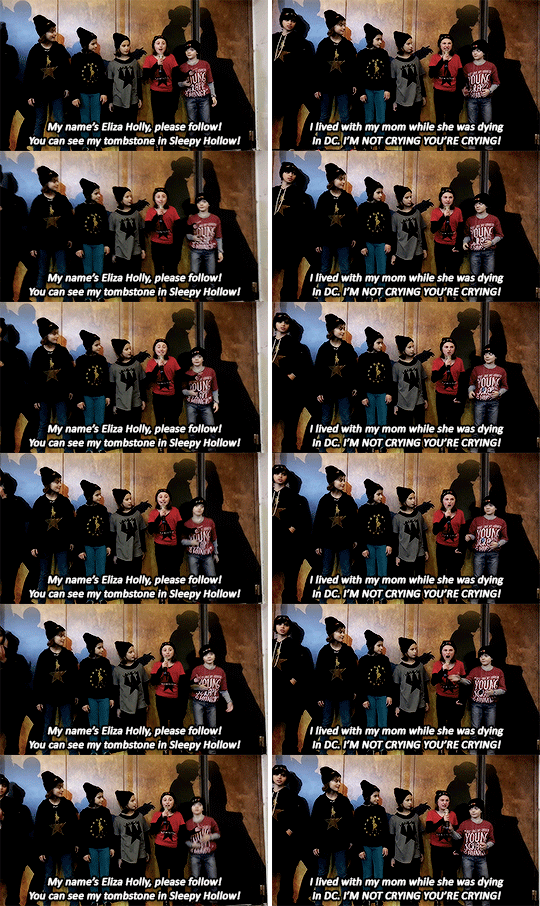
Yet Hamilton shows how historians’ reliance on documents can make telling history precarious. In a pivotal scene after Hamilton has betrayed his wife, Elizabeth (called by her nickname Eliza throughout the play), she burns the letters he has written to her over the years. It’s an imagined scene that nonetheless demonstrates powerfully how fragile the historical record can be. She sings, “Let future historians wonder how Eliza reacted when you broke her heart,” deliberately asserting her agency over what is remembered. Miranda ends the production with Eliza, too. The cast joins in song to explain that after Hamilton’s death it was Eliza who collected his papers for preservation. The lesson is clear: the sources historians rely on to craft historical narratives exist not by some consequence of nature, but because people like Eliza Hamilton worked to preserve them.

do-you-have-a-flag:

lessthansix:

falsedetective:

what i learned today: in 1800 alexander hamilton and aaron burr were both defense lawyers for a guy who was accused of murder. they tried to cast suspicion on another guy who was near the scene of the crime, richard croucher. the details of what happened next are contentious, because the court transcript is vague and it honestly sounds like something either of these two fuckos would have done, so here’s a brief run-down of the two equally beautiful stories that have evolved regarding richard croucher’s day in court, paraphrased from ron chernow who was kind enough to ensure history didn’t forget this anecdote

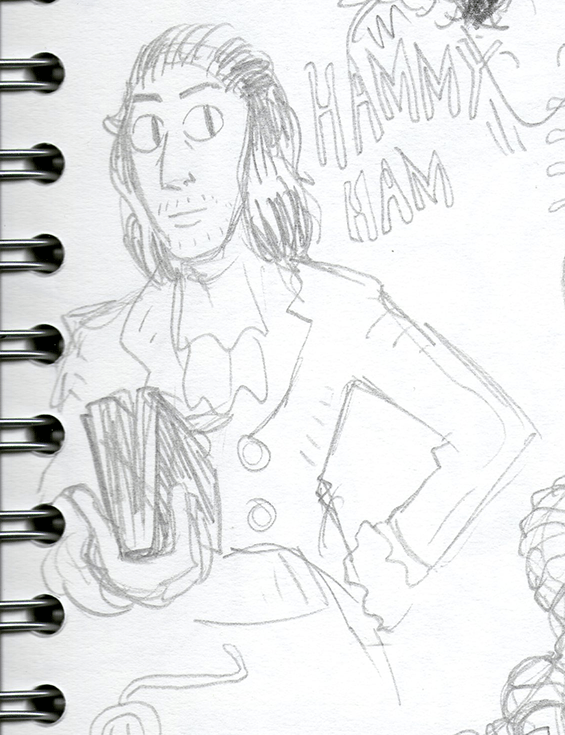
the legend is, while croucher was testifying, hamilton held two candles under the dude’s face, giving him a “sinister glow”. he told the jury, “i conjure you to look through that man’s countenance to his conscience.” apparently spooked by a-ham’s theatrics, croucher confessed on the spot.

however! aaron burr later insisted HE was the one who put on this circus show. his version of the story is, he grabbed two candelabras and thrust them at croucher, exclaiming “BEHOLD THE MURDERER, GENTLEMEN!” croucher then ran out of the courtroom in terror

A rendition of this dramatic moment. 

@deadwright

how many times people are mentioned in Hamilton the musical

nerds-are-cool:

excluded terms include: “immigrant”, “he”,
“she”, any title, “my father”, “my mother”, “my sister”, “son”, “the Schuyler
sisters”, “daddy”, “sir”, “you”, “I”, “me”, “her”, “we”, “my wife”, “this man” 

i am unconscious of intentional error – i am nevertheless too sensible of my defects not to think it probable that i may have committed many errors

that is to say i probably fucked up somewhere i am sorry

basically this was a names thing

Maria Reynolds – 1

King George – 1 (called “the king” five further times)

Philip Schuyler – 2

James Reynolds – 4

Hercules Mulligan – 4

George Eacker – 5

Peggy Schuyler – 5

John Laurens – 7

Philip Hamilton – 8

Charles Lee – 9

James Maddison – 13

Marquis de Lafayette – 14

George Washington – 25

Eliza Schuyler/Hamilton – 30

Angelica Schuyler – 32

Thomas Jefferson – 50

Aaron Burr – 57

Alexander Hamilton – one hundred and twenty three