Ahaha I just spotted another dick joke in Preliminary Gaieties~ :3
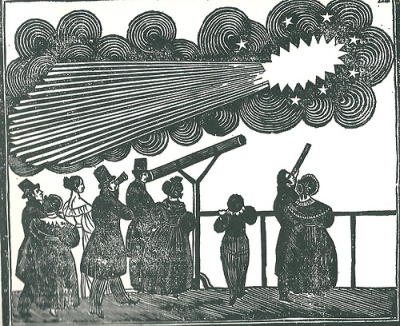
What you lot call ‘progress’ runs on two engines, people and events. But the sad thing is that, from time to time, something exceptional is called for. For events as for people, the stock company’s not enough; there have to be geniuses among people, and among events, revolutions. Great accidents are the rule, the nature of things can’t do without them, and going on the way comets appear, you could be forgiven for thinking that heaven itself needs star attractions. The moment you least expect it, God plasters a meteor across the wall of the firmament. Some bizarre star shoots out, emphasised by an enormous tail. And that’s the reason Caesar dies. Brutus strikes him with a knife and God strikes him with a comet. Hey presto! Up pops an aurora borealis, up pops a revolution, up pops a great man; ‘93 in big letters, Napoléon in the starring role, the comet of 1811 at the top of the bill – Grantaire, Preliminary Gaieties.(Rose translation)
Again for exposition: this is an excerpt from Grantaire’s ranting speech to Joly and Bossuet in the first floor of the Corinthe wineshop on the morning of Lamarque’s funeral. We’re into the ‘God is bankrupt’ phase of his rant, where he argues that the fact that revolutions occur at all proves that God is incompetent, and that the fate of the universe has slipped beyond his control – God has to call on human beings to attempt to change the course of events, because he lacks the power to intervene directly.
In this particular passage, Grantaire is snarking about the popular belief that celestial phenomena are sometimes sent as ‘messages’ by God – he refers specifically to Caesar’s Comet of 44BC, which was an exceptionally bright comet believed to have been sent to signify the deification of the recently dead emperor, and also to the Great Comet (‘Napoleon’s Comet’) of 1811, believed by some to have portended Napoleon’s invasion of Russia. Grantaire accepts that God does have a hand in producing these apparitions, but sees them as ‘smoke and mirrors’ theatrics intended to persuade us that particular men are great, or that particular events are fated, rather than legitimate evidence of divine authority. God is a showman who needs to convince us that his ‘star players’ are important, because he has no other way of influencing destiny than through their actions – so, Grantaire argues, he uses the heavens as billboards and celestial phenomena as advertising flyers – cheerleading, basically, with the aim of persuading the general populace to latch onto one of these ‘great’ men, or throw their support behind a given social movement or military campaign, and in this way – hopefully – alter the course of human history to God’s own satisfaction. Grantaire is incredibly scathing of both God – for having to resort such cheap tricks – and humanity in general, for falling for them. (His ‘badaud’ condemnation comes a few lines later).
So: dick joke? Here’s the key line:
“The moment you least expect it, God plasters a meteor across the wall of the firmament. Some bizarre star shoots out, emphasised by an enormous tail.”
In French:
“Au moment où l’on s’y attend le moins, Dieu placarde un météore sur la muraille du firmament. Quelque étoile bizarre survient, soulignée par une queue énorme.”
If you google “une queue énorme”, the first links which come up are porn sites – that’s because ‘queue’, which ordinarily means ‘tail’, is also a slang word for penis along the lines of dick/cock/etc. So, “Un queue énorme” is a slangy way of saying “a big dick” – meaning Grantaire’s line can be interpreted in two different ways:
“Some bizarre comet appears, distinguished by its long tail.”
“Some bizarre actor appears, distinguished by his massive cock.”
The word ‘étoile’ has the same dual meaning in french that it does in english – a ‘star’ can be of the sky or of the stage – so this ostensibly puerile bit of wordplay is actually (imo, at least) relatively sophisticated linguistically, in that it manages to draw together quite neatly the different themes Grantaire has been playing around with so far. The heavens are the billboards God-the-showman uses to muster up support for his ‘star players’, and comets are the equivalent of the dazzling billboard flyers he plasters there to command our attention in the direction of these ‘great men’.
If anyone’s interested, here’s the extended passage from the original french – it’s perfectly possible (probable, even!) that there are even more penis/actor/comet/whatnot punnes going on in here that I’ve completely missed, so yeah – cast your eye and see if you can spot any more dickishness?
“À sa place, je serais plus simple, je ne remonterais pas à chaque instant ma mécanique, je mènerais le genre humain rondement, je tricoterais les faits maille à maille sans casser le fil, je n’aurais point d’en-cas, je n’aurais pas de répertoire extraordinaire. Ce que vous autres appelez le progrès marche par deux moteurs, les hommes et les événements. Mais, chose triste, de temps en temps, l’exceptionnel est nécessaire. Pour les événements comme pour les hommes, la troupe ordinaire ne suffit pas; il faut parmi les hommes des génies, et parmi les événements des révolutions. Les grands accidents sont la loi; l’ordre des choses ne peut s’en passer; et, à voir les apparitions de comètes, on serait tenté de croire que le ciel lui-même a besoin d’acteurs en représentation. Au moment où l’on s’y attend le moins, Dieu placarde un météore sur la muraille du firmament. Quelque étoile bizarre survient, soulignée par une queue énorme. Et cela fait mourir César. Brutus lui donne un coup de couteau, et Dieu un coup de comète. Crac, voilà une aurore boréale, voilà une révolution, voilà un grand homme; 93 en grosses lettres, Napoléon en vedette, la comète de 1811 au haut de l’affiche. Ah! la belle affiche bleue, toute constellée de flamboiements inattendus! Boum! boum! spectacle extraordinaire. Levez les yeux, badauds. Tout est échevelé, l’astre comme le drame.”