
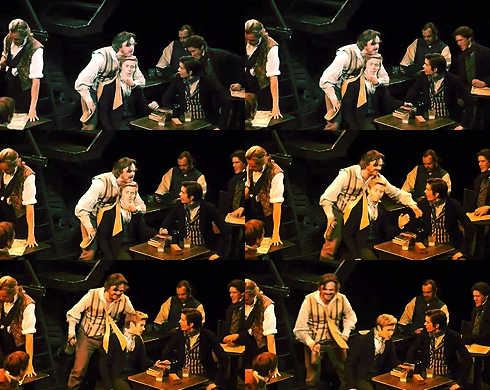
a linstead of grantaires
Grantaire finally built up the courage to ask Enjolras out, and he caught him as he walked into the Musain for a meeting and tried to ask him out; but Enjolras was exhausted and stressed about his finals and when Grantaire tried to ask, he interrupted with, “Will you fuck off, Grantaire, I don’t have time for you!”
Grantaire didn’t ask again.
You have a VERY MISLEADING url
do you ever think maybe the reason grantaire didn’t want to be involved with serious aspects of the revolution (the barriere du maine, building the barricade etc) because he knew that, by helping it to succeed, all he would be doing would be bringing enjolras’ inevitable death even closer and when it came down to it he would rather let enjolras hate him beyond all else for his apparent apathy despite the unbearable pain it would cause him than actively aid him in his own destruction lol bye
There is a lot, a LOT, of really really good Grantaire meta out there. Seriously, it’s brilliant, and this is my attempt to get it all in one place, and semi-categorised.
I’ve done my best to credit all the authors for each thing, but Tumblr being Tumblr I may have got it wrong in places. Please tell me if I did! (…also tell me if you don’t want your meta linked here, for whatever reason)
Grantaire’s cynicism/nihilism
Grantaire and Diogenes (gauzythreads)
Grantaire is not a cynic (yourstudentloandebt, punforrestpun, robertawickham)
“He sneered at devotion in all parties” (plinytheyounger)
Hugo sets Grantaire up for failure (nothing-rhymes-with-grantaire)
Regarding ‘R’
The obsolete word hère (okiswonderful)
R for refusé (punforrestpun)
Revolution, Romanticism and Robespierre (lecapunk)
Grantaire and mental illness/neuroatypicality
A conversation about Grantaire, depression and ADHD (nothing-rhymes-with-grantaire, chain-of-prospit)
Grantaire and processing thoughts (nothing-rhymes-with-grantaire)
Grantaire’s perception of himself (gauzythreads)
Grantaire and ADHD (nothing-rhymes-with-grantaire)
Grantaire, art style and depression (gauzythreads, pilferingapples, kingmundsroyalmurder) [I’m missing the first part of this conversation, anyone got it?]
Speculating on how depression affects Grantaire (nothing-rhymes-with-grantaire)
Grantaire and hypochrondria (yourpontmercyfriend, nothing-rhymes-with-grantaire, barricadeur) added 16/2/14
Grantaire’s sexuality
R not being monosexual (sclez)
A little bit about Grantaire’s interactions with women (sarah531)
R being confused over his feelings for Enjolras (rose-and-valerie)
Grantaire’s misogyny (sclez) added 16/2/14
E/R
E/R History Class (et-in-arkadia)
The Obverse (tenlittlebullets)
Why Enjolras is so frustrated with Grantaire (killjoyras)
“Often, you give the heart, we take the body” (lecapunk, nothing-rhymes-with-grantaire)
Two sides of a coin/What Grantaire can offer Enjolras (chainsawpoet, swutol-sand-scopes, robertawickham, sclez)
Chickens, eagles, humanity, determinism, and more! (gauzythreads, pilferingapples, lecapunk)
Grantaire’s happiness (pylades-funk, sclez, lecapunk)
The paradox of Grantaire needing Enjolras (melannen, pilferingapples, sinnaonthebarricade, lecapunk)
Romanticism, Revolution, and the Thematic Importance of E/R (lecapunk)
The bare bosom of Evadne [this is much more about Enjolras, but E/R features a lot] (tenlittlebullets)
How Grantaire interacts with Enjolras (faucheleventt, gauzythreads, punforrestpun, tenlittlebullets)
Why Enjolras and Grantaire are like Orestes and Pylades (ferain1832)
Love is what will bring tomorrow (ladysaviours)
Fun with wordplay
Swallowing a revolution the wrong way (punforrestpun, gauzythreads)
Lost women (sarah531)
Gross yeast infection metaphors! (gauzythreads, viventlespeuples, pilferingapples)
Dick jokes (gauzythreads)
The capitoul and master of the floral games (punforrestpun, pilferingapples, okiswonderful) added 16/2/14
Grantaire’s art studies
What studying under Gros was like (punforrestpun)
Grantaire and art and more! (gauzythreads)
Grantaire’s art styles (gauzythreads)
Grantaire, Enjolras & l’art pour l’art (punforrestpun)
Grantaire’s other talents
Grantaire’s fighting style (sclez, toastandbrokenpromises)
Who taught Grantaire fencing? (sarah531)
The Barriere du Maine
What might have happened at the Barriere du Maine (et-in-arkadia, seenonlyfromadistance)
Fog and dominoes (swutol-sang-scopes, pilferingapples)
Striking marble (tomisnom, pilferingapples)
Preliminary Gayietes (and the big speech contained therein)
Different translations of the speech (gauzythreads)
R, Joly and Bossuet (yourstudentloandebt, punforrestpun, nothing-rhymes-with-grantaire)
Does it have to be you, too? (gauzythreads, pilferingapples)
Analysis of Grantaire’s speech (sclez)
More analysis, and some boobies (not that kind) (gauzythreads)
Grantaire’s drinking in this scene (punforrestpun)
More puns (punforrestpun)
Orestes Fasting and Pylades Drunk
Two birds with one stone (sarah531, henryclervals)
Alcohol, rebirth and symbolism (spurioussymbols)
The comfort in chaos (etre-libre-dit-combeferre, nothing-rhymes-with-grantaire)
Seeing things clearly (sarah531, dancetaire, punforrestpun)
Classical allusions (nothing-rhymes-with-grantaire, sinnaonthebarricade, dancetaire)
The meaning of ‘drunk’ (lecapunk)
How someone falls when they’re shot (lecapunk)
Seeing each other as people (sarah531)
Important things keep falling at Enjolras’s feet (sarah531)
This fellow is one of them/Biblical references (sarah531, midshipmankennedy, pilferingapples)
Redemption (jehans, landofalwayswinter, edwarddespard)
More redemption (sarah531)
Why Grantaire dies (doeskin-pantaloons) added 16/2/14
Two stories (pilferingapples) added 16/2/14
God and the fallen man (fizzygingr) added 16/2/14
Deleted scenes from the book (no really!) / Victor Hugo’s original notes
Thank you (okiswonderful) added 16/2/14
Take my hand (flo-nelja, tansy-91, sarah531)
I am a swine (flo-nelja, tenlittlebullets)
What Hugo thought R looked like! (plinytheyounger)
Movie/musical exclusive meta
Ascending stairs (thelibrarina, lesbianjolras, sclez)
The hug during Drink With Me (sclez, lecapunk)
Grantaire’s scream after Gavroche’s death (nothing-rhymes-with-grantaire) added 16/2/14
Misc
Why Grantaire’s important (lecapunk)
Some analysis of “A Group That Barely Missed Becoming Historic” and R in particular (swutol-sang-scopes)
Lots of canon facts about Grantaire (spoopyrac, gauzythreads, angualupin)
Grantaire representing Paris (lecapunk)
Les Amis liked R (ladyjolras, sclez)
Grantaire as the Reader (punforrestpun)
Hugo doesn’t believe in ‘lesser’ (lecapunk)
Grantaire vs Tholomyes (sarah531)
Grantaire’s flaws/lots about Floreal and women (les-amis-de-labuttc, sarah531, gauzythreads)
Grantaire and The Love Song Of J Alfred Prufrock (nothing-rhymes-with-grantaire, etre-libre-dit-combeferre)
Statues, Grantaire and Matelote (sarah531, nothing-rhymes-with-grantaire)
Grantaire’s ugliness (leyichka, 0fficialgrantaire, punforrestpun, pilferingapples)
Grantaire’s rambles (lecapunk, pilferingapples) added 16/2/14
Unpaving hell (nothing-rhymes-with-grantaire) added 16/2/14
Meeting R for the first time (sarah531, angualupin)
Imitation and French education of the time (punforrestpun)
We’re never as bad as we think we are (athousandswifts)
A little bit of extra stuff from me
Fictional characters who shaped my life
A post I am legitimately proud of
I have accidentally stumbled upon a book with some early drafts of Hugo’s works, and the OFPD scene was there. Roughly translated:
On the first floor they’re about to shoot Enjolras. Grantaire wakes up and says: I am with him. Shoot me.
Enjolras grasps [?] his hand.
‘Thank you,’ says Gr.
And hold on, just imagine this: Grantaire stands in front of the guns and says “I am with him. Shoot me.” He doesn’t announce his support for the cause, only his allegiance to Enjolras. And it seems that he doesn’t even want to die with him, because he doesn’t feel like he’s worth it. He rather hopes he can die instead of him, or at least before him. As if he was saying “If you want to shoot him, you’ll have to shoot me first.”
Grantaire doesn’t say anything to Enjolras, so he’s probably looking at the soldiers the whole time. And here we have Enjolras, who sees Grantaire, whom he used to scorn so often, consciously choosing to die for him. And acting as if he thought Enjolras would let him be executed right there in front of him. So he has to do something to let him know that he doesn’t really think Grantaire is good for nothing, that he accepts him, that he’s grateful. So he grasps his hand. And Grantaire, surprised, finally looks him in the eyes, and understands everything. And he says: “Thank you.”
OH MY GOD
Chapter title – “Orestes Fasting and Pylades Drunk” (Wilbour, Hapgood, Gray, FMA, Denny), “Orestes Sober and Pylades Drunk” (Wraxall), “Orestes on a Fast and Pylades Drunk” (Rose), “Sober Orestes and Drunken Pylades” (Donougher). I think I can deal with all of these except Rose. “On a fast”?
“Vive la République! J’en suis.” – Long live the Republic! … “I’m one of them” (Hapgood, Denny), “I belong to it” (Wilbour, Wraxall, Gray), “Count me in” (FMA), “I’m with them” (Rose), “So say I” (Donougher). I’m used to “I’m one of them,” but there’s something I really like about “I belong to it.”
“Permets-tu?” – “Do you permit it?” (Wraxall, Hapgood, Gray), “Will you permit it?” (Wilbour, FMA), “If you don’t mind” (DENNY >_<) “All right with you?” (ROSE >_<) “With your permission?” (Donougher)
“Enjolras lui serra la main en souriant.” – Enjolras “pressed his hand” (Wraxall, Hapgood, Gray, Donougher), “grasped his hand” (Wilbour), “shook his hand” (FMA, Rose), “clasped his hand” (Denny). I DON’T LIKE “SHOOK HIS HAND,” IT’S NOT GAY ENOUGH.
“Ce sourire n’était pas achevé que la détonation éclata.” – “This smile was not finished when the report was heard” (Wilbour), “This smile had not passed away ere the detonation took place” (Wraxall), “This smile had not passed away ere the detonation burst forth” (Gray), “This smile was not ended when the report resounded” (Hapgood), “The smile was not finished before the report was heard” (FMA), “The smile had not ended when the volley rang out” (Denny), “He was still smiling when the explosion ripped through the silence” (Rose), “He was still smiling when the burst of gunfire came” (Donougher).


(Brick!club 2/12/14-2/14/14, Les Miserables, 5.1.23)
I DON’T EVEN KNOW WHAT TO SAY ANYMORE
THIS POST IS BARELY EvEN ABOUT THE CHapter butaugh
Here’s a story:
There was a blonde, severe and modest and chaste to one great love–not a lover, that was a joke and a harsh one, but to their real love, that was the living human future that lover abandoned. And they served that love with everything they had, gave up their place in society to do it, gave up their personal share of the present for that future; and when that wasn’t enough they started sacrificing pieces of themself. The ferocity of their laughter( a smile stained with blood a black hole) (the second killed him with a bayonet) the beauty in their sadness, (ten francs, I have clothed her) (Vive la France, Vive la Avenir) , optimism and enthusiasm and learning and beauty and the sheer energy of life (give up the bird douse the candle let the rosebush wither in a corner the water freeze in the bowl ) (Bossuet died Feuilly died Courfeyrac died Joly died) and the gentleness of their own humanity (I’ll sell what’s left) (helping an injured soldier he looked to the heavens) and when that was gone they took the courage of their despair and made themselves a target (they can do anything they like to me now I won’t budge) ( shoot me) and they condemned themselves, and made themselves marble, beyond the touch of the world.
Here’s a story:
A man couldn’t find sustenance, so he tried to steal it. He tried to make an escape and that built the walls higher. He judged himself and admitted his fault, he judged society and God and damned them for making the world that made him. He spent a meal with the faithful and the generous and damned their cause and prayed for their lives and let them lead him to joy. But he couldn’t see their horizons; their candles blinded him. He knew he wanted something More and Else, but didn’t understand what it was he was reaching for. So he swore to be more, and tried to be more, and at the same time he hid himself away from the good he might have done. Because the world is hard, the world is HUGE, and you break your neck simply living, and isn’t that enough, to dream of being Jesus with money, to smell new grass, to not ask for much, really, what else is there?
And he opened his eyes in time to see love, to really see it, what it could cost and where it could lead, to see that all his fear of that power was correct and all the danger he could fear was right in front of him
and he announced himself, and he chose where he stood, and he accepted the good only he could do;
and love saw him, (help from an impossible source the last person it could be maybe the ONLY person they’d ever really despised but ) and took his hand, and he was more.
***
There’s SO MUCH I could say and probably WILL say about this chapter, someday; it tends to get a lot of discussion and RIGHTLY SO. The story of the soldiers, and how they tear into the Corinth “greatly irritated” and ready to act as monsters in the name of a rumor, a lie, they’ve heard about the other side of the barricade, but they come to stop when they see the reality for a moment, and it’s JUST for a moment, but how many cracks in the foundation are made by those gunshots? And I’d like to talk about how great it is to see the fighting go on, and that the defenders were down to to TWENTY SIX men when the final battle STARTED and they’ve held on so long, and the Corinth has given everything it had to this fight, and that even though the barricade is well and truly finished the moment Enjolras dies the fight VERY MUCH goes onBut I think a lot of other posters will cover those
and I could even say more about this little bit of story reflection! How important it is that Fantine and Enjolras both are seen as human, at the last, and by someone they’ve denounced as not capable of goodness, someone they’ve condemned, someone they’ve judged as harshly as they judged themselves, because the salvation of humanity has to come from humanity, with all its faults, because people are for each other and
skflhsfakh
And I could go in another ten different directions with this
Because this is a big story and all of it is in the barricades in some way
But I think this is enough for one post: Here’s a story, here’s two stories, here’s a story people keep telling: what love gives away, what love gives in return.

Septembrisuer wrote a fascinating post about why Grantaire and Javert both have to die at the moment of revolutionary enlightenment. So this started off as a reply to that, but I don’t think I ever addressed their arguments, so it should probably be its own post.
The question about why Grantaire dies got me thinking about similar thoughts I was having about Javert and Enjolras and why each had to die, a couple of books ago. The conclusion I reached was – to shamelessly quote myself:
Javert’s death is a reaction to his inability to cope with being an absolute in an imperfect world
and that Enjolras’ death, by comparison, is an imperfect world’s inability to cope with the absolute – a fault not with the absolute itself, as in Javert’s case, but with the world (and therefore a fault that can be fixed, leaving us with hope for the future.)
But where Enjolras and Javert both represent ideals and absolutes, Grantaire is the opposite – the anti-ideal. And yet the anti-ideal dies not when Grantaire is shot, but moments before:
“Vive la République! J’en suis.”
So to apply my previous hypothesis: does the anti-ideal, Grantaire-the-cynic die because he is to absolute in his cynicism (just as Enjolras is too absolute in his ideals) to cope with an inabsolute world? Or because an inabsolute world is not able to cope with his absolute nature? It seems apparent to me that for Grantaire-the-cynic it must be the former – his absolute cynicism is thwarted by the sight of Enjolras, dying for his country and his principals. And not, as Grantaire-the-cynic most likely believed, futilely. Because one needs only look at Enjolras’ death through the eyes of Hugo to see that is a transcendent experience.
The audacity of a fine death always affects men.
And therefore, it is apparent to Grantaire-the-cynic, the anti-ideal, that the world is not so hopeless as he expected. A futile death can still have a profound effect. And so Grantaire-the-cynic dies, and Grantaire-the-idealist, for a brief moment, is born.
But why must Grantaire-the-idealist die? My answer to that is that it is because he’s no longer the absolute cynic, but he has not attained the ideal. And so Grantaire, rather than being the foil to Enjolras, the cynic-beside-the-ideal, is simply a man. And die, in this horrible, brutal reality, is what men do.

