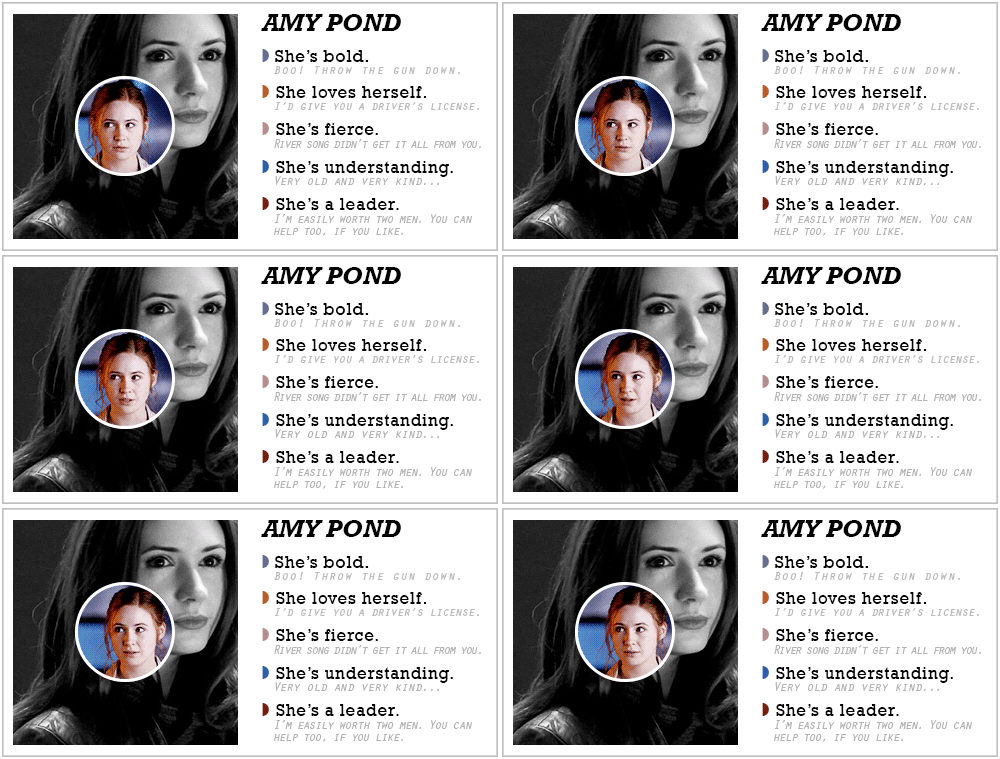




30 Days of The Ponds | Day 12: Favorite Ponds related quote (in general)
amy pond


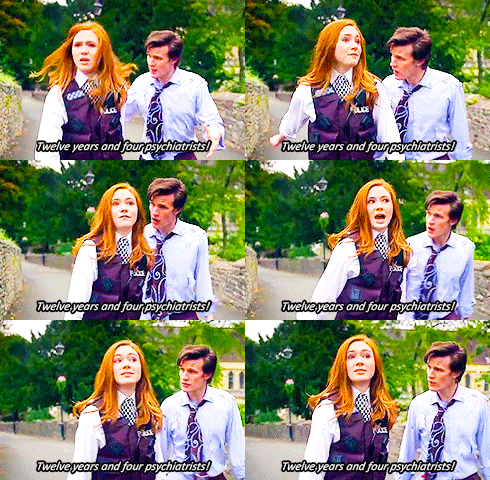

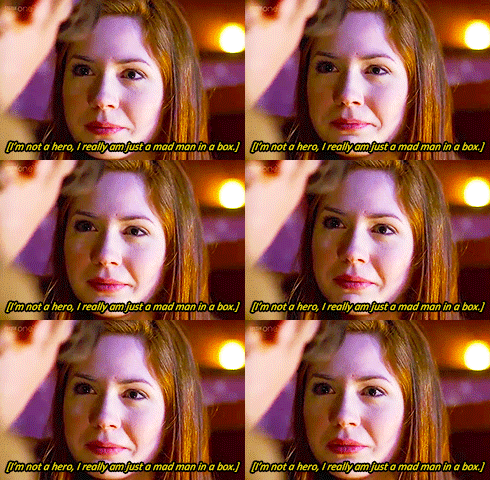


I wish Amy’s problems had become a bigger focus. I felt like the Doctor’s fun was always seen as more important than Amy’s struggles.
Agreed. I think in Amy Pond we had a great opportunity to explore mental health issues in a sensitive way that could educate audiences and also help viewers feel more compassion and empathy for the many people out there that suffer a mental illness of some sort.
It really disappointed me that the Doctor became the central focus of Eleven’s later run, because we were robbed of the rarely portrayed point of view of a young woman with mental health difficulties that didn’t define her. And that could have helped a lot of people.
I was going to wait until the morning to see if I still wanted to respond to this but I’ve decided I want to do it now. I recognize everyone’s right to write commentary on my gifsets but this has started a rather large reblog chain and I feel the need to respond.
This was a pro-Moffat gifset. This was me celebrating Moffat’s decision to write a character with mental health issues. As someone who’s seriously struggled with mental health, I found myself in Amy Pond. I found a home in Amy Pond. It’s not that it “could’ve helped a lot of people,” it did help a lot of people, such as myself and some of my followers. I’ve received frequent messages from people thanking me for this gifset and sharing their stories of how Amy helped them through recovery.
Please do not dismiss our experiences. Please do not view Amy Pond as something that “could’ve been but Moffat ruined it.” That’s very insulting to people like me who Amy Pond helped so much in the way she was already written. I like her subtle arc. I like that her mental health issues aren’t the forefront of her character. I like that she was explored as a character in tangent with the Doctor, and I disagree that she was pushed to the wayside for the Doctor’s arc. I would argue that Series 7A was much more about Amy than it was about the Doctor.
Amy Pond already built that empathy for a lot of people. Amy Pond already helped a lot of people. The links provided show mountains of evidence in addition to this gifset showing this to be true. We were not robbed of anything. We still have our glorious Pond.


rosecutietyler:
“You know when sometimes you meet someone so beautiful, and then you actually talk to them, and five minutes later they’re dull as a brick. But then there’s other people, and you meet them and you think ‘not bad, they’re okay’, and then you get to know them, and their face sort of becomes them, like their personality’s written all over it, and they just they turn into something so beautiful…”

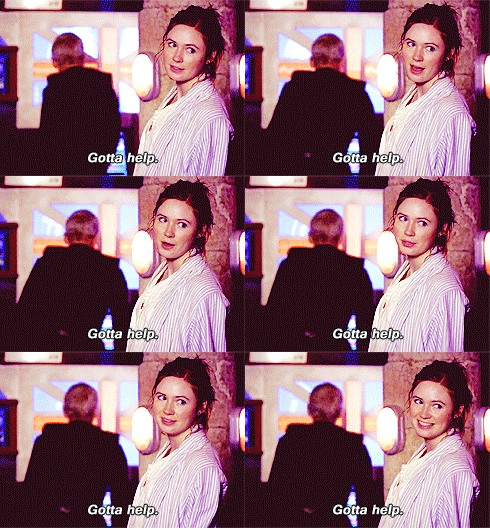










I adore these pictures of me, Hayley and Matt Just Buy The Toad Photography took of us this weekend!









I adore these pictures of me, Hayley and Matt Just Buy The Toad Photography took of us this weekend!
mccoydarling-deactivated2015041: hello i saw your tags about amy pond with depression??? could you please tell me more cos i feel this is something i can totally get behind!
First off talking about Amy Pond is one of my favorite things to do so thank you.
For a pretty comprehensive analysis I’d like to direct you to this meta that I did a while back (and am still pretty proud of) because it breaks it down pretty well. I’m going to treat this ask as a supplemental to that to avoid repeating myself so I’m going to elaborate on parts of the meta (so I suggest you go read that first).
I mean there’s references to serious depression, self-isolation, and even suicidal thoughts, all because she felt the world turn its back on her because the Doctor never came back.
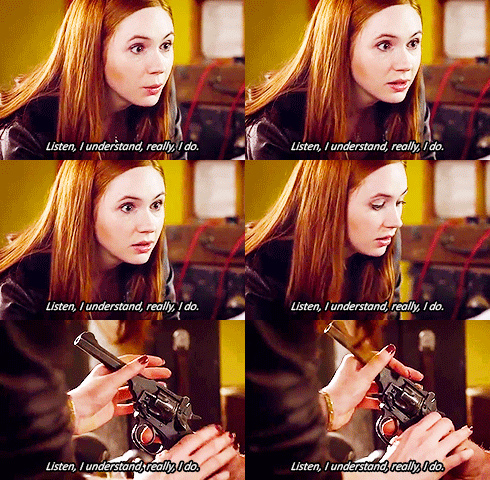
To name a few of these references there’s the part in Victory of the Daleks where the scientist-robot tries to kill himself and Amy says “I know what you’re going through, really, I do” and tries to stop him. There’s also the parts of Vincent and the Doctor where the Doctor references Vincent’s suicide and Amy gets really emotional, asking him to please stop. In both of these instances, too much of a personal, sympathetic reaction to just be kindness. She’s empathizing with these depressed people because she knows what it’s like to go through that herself.
In terms of self isolation, we know that Amy has commitment issues. She had very few friends growing up, we only seem to know about two (Rory and Mels), and she has a very carefree and flippant attitude towards making more meaningful relationships by writing off people in her life as unimportant (like she does to Rory in The Eleventh Hour by calling him her “kind of boyfriend.”) It’s why she ran away the night of her wedding; she’s too scared to be attached to people. This stems from serious abandonment issues, and depression is one result of such abandonment issues. Often, people with abandonment issues and depression willingly isolate themselves both to protect themselves and to prevent “ruining” their current relationships with their depression.
I don’t understand how anyone could blame her for finding hope in the impossible when everything else she had was fading away, and especially as she got older and was branded as delusional as more and more things disappear from her life.
This is such an important point that I have to stress. This is something the fandom really glosses over but it’s true. Amy’s entire world is disappearing around her. Everything is being sucked through the crack in her wall and all she can remember is that she’s sad and she doesn’t know why. That’s textbook depression. Sure, it comes from extraordinary circumstances, but it’s still depression. It’s so typical of people with depression to retreat into their minds and use their fantasies to help them get through the day, and that’s why Amy did with the Doctor.
She looks at all of the sadness and darkness in her life and she never let it take her, and the show is beautiful in showing that if you fight the demons inside you can be rewarded with a literal universe of happiness and adventure.
This is the most important part though: she doesn’t let it take her. She’s Amy and she’s a fighter. Doctor Who shows that you can still be strong with mental illness. You can still be smart and witty and attractive to others and even confident. And even if you aren’t, that’s okay, because Amy Pond clawed her way up to get that way, she fought and fought to make it to who she is today, she lived with her mental illness and came out on the other side, and that’s a beautiful thing to have in a show about hope. To show that your struggle doesn’t define you, but it helps to shape you, and to have a character as confident and relatable and likable as Amy as a textbook case of depression is so amazing. It gives people like me who’ve struggled with mental illness a hero, someone we can relate to and love, to show that you can be strong and you can have a life, and that your mental illness doesn’t define you.
I hope I answered your question! Sorry I posted this so late, it was sitting in my drafts but I wanted to finish it up for you.