A few notes before the list: I’m not too familiar with shows that have OCD rep, nor do I have OCD, so this list is made up of characters from things I haven’t read or watched, nor do I know if they portray OCD or OCPD. I’ve put information as best I could from what people have said about it.
And, of course, if anyone knows of any other characters please feel free to tell me or comment and I can add it in, or if you’re familiar with the character, please let me know if the rep was offensive or not.
Adrian Monk – Monk (*Sometimes played off as jokes, but mc with OCD who’s shown as brilliant and a wonderful detective)
Anarchist/Tike Alicar (Earth-616) – X-Men comics (*Unsure which versions he shows up in, but this link may help as it has footnotes which includes some of the comics he’s in).
Bea – OCD Love Story by Corey Ann Haydu (Found from this list)
Ellie Bishop – NCIS (*Non explicit)
Emma Pillsbury – Glee (*I recall some jokes but also Emma’s distress about having OCD, moreso as the show went on. However this is Glee, so the rep may not have been ideal)
Joseph Chandler – Whitechapel (*Main character, OCD was shown as a serious illness that impacts his life/job and is not joked about)
Kevin Casey – Scrubs (*I recall that this showed how it negatively affected his life and job, but I believe he was only in 2-3 episodes)
Monica Geller – Friends (*I recall there being jokes about this)
Randall Brown – The Hour (BBC) (*Not played for laughs)
Riddler – DC Comics (*Multiple versions, disorder seems to be related to his obsession with riddles)
Sheldon Cooper – The Big Bang Theory (*Often played off as a joke at Sheldon’s expense)
Ooh I just thought of someone else: possibly/probably Wasabi from Big Hero 6? It’s not outright said that he has it, but I recognise some of his behaviours… (putting things in their proper places, getting anxious if certain rules aren’t followed.)
“There are studies that show that fiction in particular builds empathy—that when you read about characters who don’t look or live like you, you begin to understand them a little bit better. You understand what makes you similar and how vast the differences are, and it helps you to be a little bit more compassionate toward people who are different from you. Right now it seems like—not just in America, but around the world—we need a little more empathy.”
Imagine being a kid in school. Your teacher comes up with an idea for class picture. Every student will draw pictures of their friends.
Everyone starts drawing enthusiasticly, and can’t wait to see what they look like in the drawings. When pictures are ready you notice that popular students have more pictures than rest, but nobody has done a drawing of you. The teacher notices that too, and asks if someone would do your picture. To your horror the class clown takes the job, and comes up with a caricature of you. Others are laughing, but you’re not. You feel awful. The teacher notices that. and asks again someone to do a drawing of you. One of the ‘good students’ starts drawing, but the result is forced. It’s just a drawing of a generic child wearing a shirt of same color as you a wearing. There’s no spirit, no soul in it. You start sensing that the class is geting frustrated with you. They want to be done with this. You ask quietly the teacher if you could do a drawing yourself.
After school your classmates confront you. Why did you have to make such a big deal out of it? The first picture was funny. The second picture was just fine! The drawing you did yourself wasn’t right, do you think you are that good-looking? There were other kids who got only one or two pictures of themselves. Who are you to demand special treatment? Maybe there would have been a picture of you if you weren’t such annoying baby, nobody likes you anyway, and nobody’s going to if you keep on being like that, you don’t deserve a drawing!
This could be story of bullying, but it’s also about how I see portraying LGBTQ+-people and PoC in mainstream entertainment.
Their Importance: During the second season, we see Fitz come to terms with his new disability. Fitz is a genius; he had a PhD by the age of 16. After his brain injury, he’s still a genius, but he struggles with expressing that. He has trouble speaking and getting words out. His hand shakes, making his engineering work more challenging. He hallucinates his best friend after his best friend leaves. But throughout the season, we see him make new friends who accept him as he is, reconcile with his best friend, and learn to accept that he is “different now, and there’s nothing wrong with that.”
Issues: He faces ableism (a character says that Fitz “can’t do anything”) and has internalized ableism (Fitz says that he is “damaged”). The effects of the brain injury aren’t really seen after season two. Fitz mentions rehab in season three and that it helped him be able to say words like ‘antithesis’ and he occasionally stutters, particularly in situations that are highly emotional/stressful, but the trouble with finding words and the psychosis have disappeared.
Thanks to anon for the submission!
My soon-to-be husband had/has (it’s a bit better now) a disability which affected his ability to kinda find words and get them out. Like the words he knew would just kinda go, I guess.
When he watched AoS he was really pleased to see Fitz going through the same thing. He said it was incredibly relatable.
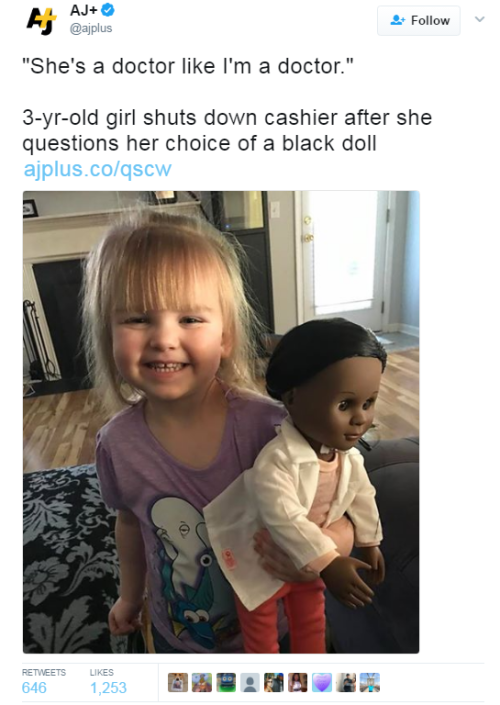
Stop filling their heads with these stupid prejudices
Im willing to bet you this choice was informed at least 50% by Doc McStuffins.
When we talk about representation remember it doesn’t only matter for us, it matters for them. Dehumanization of a people is insidious and lifelong. It happens over time. When they never see us except through the medias lens they don’t know and refuse to recognize our dynamicism. Shows like Doc McStuffins advertised for all kids send a message to just that, all kids.
Bill Potts’s sexuality will be revealed pretty much straightaway in her second line of dialogue when the show returns to BBC One on 15 April.
“It shouldn’t be a big deal in the 21st Century. It’s about time isn’t it?” Pearl Mackie, who plays Bill, told the BBC.
“That representation is important, especially on a mainstream show.”
She added: “It’s important to say people are gay, people are black – there are also aliens in the world as well so watch out for them.
“I remember watching TV as a young mixed race girl not seeing many people who looked like me, so I think being able to visually recognise yourself on screen is important.”
“[Being gay] is not the main thing that defines her character – it’s something that’s part of her and something that she’s very happy and very comfortable with.”
A transgender World War II veteran proves it’s never too late to live life truthfully.
Patricia Davies, from Leicestershire, England, didn’t decide to transition into a female until she turned 90 years old.
Davies — born Peter — has known she was a woman since she was just a toddler.
“I’ve known I was transgender since I was 3 years old. I knew a girl called Patricia, and I decided I wanted to be known by that name but it didn’t stick,” Davies told Caters News Agency.
Davies kept her identity a secret for most of her life for fear she would be shunned by her peers or forced to undergo electric shock treatment.
“The atmosphere [around being transgender] was not safe. People did not understand what transgender was,” Davies said.
Davies — who served in the army between April 1945 and 1948 — said coming out as transgender would have categorized her as a homosexual, which wouldn’t have been accepted in the army.
Despite losing friends and cheating death while serving in the armed forces, she says she’s glad she got to have the experience.
“I feel quite proud having served during the war and having done military service, in particular during the trouble in Palestine,” said Davies.
Davies, who married when she was 21, eventually came out to her supportive wife in 1987. Her wife, to whom she was married for 63 years, bought Davies jewelry and dresses that she could wear in private. Sadly, her wife passed away six years ago.
“I was 60 when it all came pouring out to my wife, she was very sympathetic and helped me all the way, but we agreed to keep it quiet,” said Davies, who first learned about transgender identity from a TV show sometime in the 1970s.
When Davies first came out to her wife, she decided to wear high heels but was deterred when teenagers saw her and threw eggs at her window.
Now a nonagenarian, Davies has begun taking estrogen to move her transition forward and has come out to her community.
“It feels like a weight has been lifted off my shoulders. I was living a lie,” she told Caters.
“I have been keeping quiet. I have slowly started to tell some of my neighbors. Everybody said, ‘Don’t worry, as long as you’re happy,‘” she added.
Patricia was inspired to make the big change from male to female after seeing the romantic comedy film “Boy Meets Girl,” which features transgender characters.
Now that transgender people are portrayed often in film and on TV, Davies feels more comfortable being herself.
“It’s not 100 percent safe now but it’s much better than it was. People that I have told seem to be very accommodating and haven’t thrown abuse at me,” she said.
“I joined the Women’s Institute. I socialize with them and have a natter [long chat]. I’m having a great time. I have a new lease on life,” she added.
Chris asked to meet with me last fall, in late September. We sat down in an office in MIT Admissions. “For the spring admissions video,” he said, “I basically want to make a two-minute trailer for the new Iron Man with Riri Williams.” This sentence, and the conversation that we had afterward, was what would eventually turn into the video you all saw posted on Tuesday… [+]