Maybe one of the reasons MJ/Gwen never took off is because it’s nigh on impossible to smush their names together a la Parksborn or Stony.
I mean, what could you have? Mwen? Watcy? Stason? THEY ALL SOUND RIDICULOUS


bearsbeetsbattlestar-galactica:
The original Spider-Man trilogy is campy and cheesy and it probably hasn’t really aged well, but I love it so much and will absolutely recommend it to anyone who likes the MCU simply because (as seen above) it is just so thoroughly uncynical and virtually everyone from Peter to Gwen to Aunt May to Peter’s neighbour to random bystander #563 is SUCH A GOOD PERSON
Me personally, I think it has aged well, sheerly because it never deliberately anchored itself to one particular generation/demographic (unlike one particular reboot which I will not name), but rather it was just an incredibly earnest representation of the source material.
What I loved so much about this series is that it never tried to run away from the “comic” aspect of it being a comic book movie. When I say that, I don’t necessarily mean that it was overly hilarious or was filled with zingers like a Joss Whedon production, but it was never afraid to embrace levity and even more camp aspects, and as the OP stated, it was just so incredibly UNcynical.
It took bits and pieces from canon and melded it with modern storytelling that allowed for a fresh and contemporary narrative throughout all 3 films (yes, even Spider-Man 3). It never tried to cut off any of its potential audience, it never tried to appeal to just ONE particular clique through the use of fumbling dialogue and an indie soundtrack, but rather it’s story focused on the people involved. Underneath the costumes and superpowers, these were honest-to-goodness lives that people were living, from trying to hold down a steady job to getting the rent paid, these were stories that anyone could get on board with, which is why I find myself incredibly disappointed when people just dismiss this franchise sheerly because they might not consider it “relevant” anymore.
It’s an incredibly human story, unafraid of depicting moments of weakness, unafraid of showing us that even our idols can fail, but also unafraid of being disarmingly sweet to show that people are often inherently valuable and kind, thus imbuing the series with a simple, yet undeniable humanity that never had to be forced, but rather we just naturally rooted for and gravitated towards.
It was light-heartedness, solemnity, and gravitas all rolled into one, and it is a tone that I have not seen in any vein since Christopher Reeves’ Superman films, and I don’t think I’ll see again in a superhero series to come, which is why I hold the original Spider-Man films in such high regard.
You nailed it, darn you!
I have a lot of behind-the-scenes stuff from these movies (books, DVD extras, that sort of thing) and they all come back to “We loved this story, we loved these characters, we loved this city and we loved the folks we were working with”. Sure, you can’t really count on any part of the blockbuster-making machine to be 100% sincere…but I really like to think they were.
Few things have disappointed me more than the recent backlash towards these movies. Even the universally mocked Spider-Man 3 has a hell of a lot to offer (more than a lot of other superhero films, actually), and if I’m being honest, no other franchise – not even Star Wars, not even Lord of the Rings – has had the sheer effect on me that the original Spider-Mans had. As much as I love the MCU (and I do) it’s never quite nailed the “there’s a hero in all of us” theme that was so integral to the Spider-Man trilogy. Like, you know that headcanon post going round about Brooklyn residents sort of adopting Steve Rogers and standing up against his enemies? An idea like that is what the entire climax of the first Spider-Man hangs on! (I’ve actually seen quite a lot of MCU and ASM headcanons that just make me think “The Spider-Man trilogy already did that. Go watch it!”)
S’like, yeah, these fims are about superheroes, but they’re also about goodness, really. Illustrated in Peter, of course, and illustrated in MJ and Aunt May and Harry’s sacrifice and Otto’s redemption, but (crucially) also illustrated in Ursula, the shy young woman who brings Peter food even though she can barely talk to him without awkwardness, and in the train passengers who put themselves at physical risk protecting Spider-Man from Doc Ock, and in Gwen who’s so sweet and nice she apologises to another woman for something that wasn’t her fault, and in Peter’s landlord who was really far nicer to him than he deserved at that point in time, and…I could go on, but you get the idea. Basically? When I was sixteen – and still, ten years on – I finished watching Spider-Man 2 and I wanted to be like Spider-Man.
But I also wanted to be like Ursula.
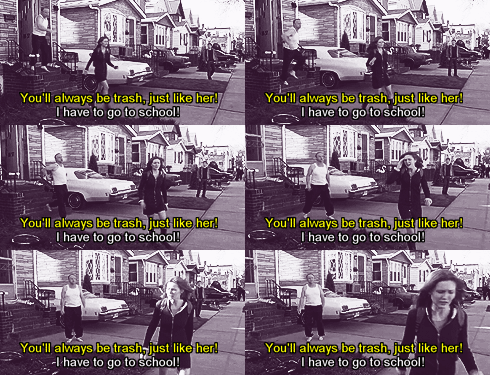
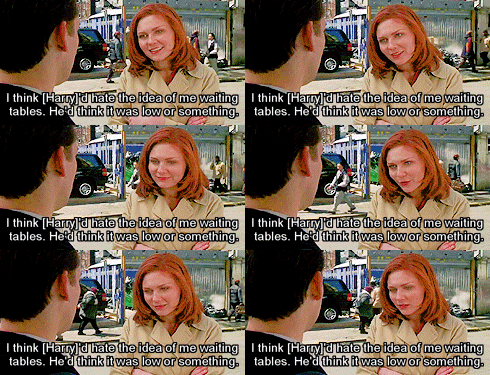
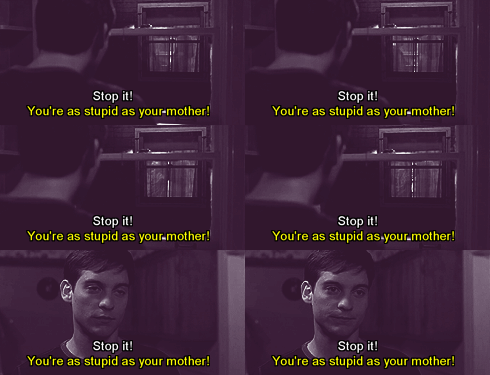
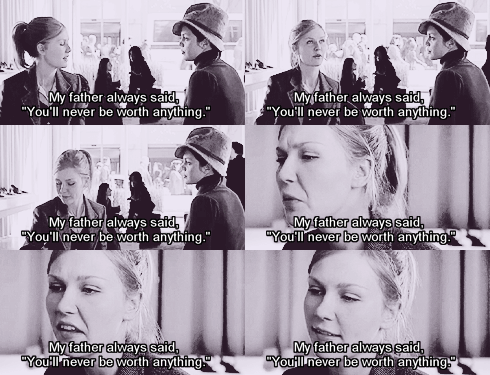
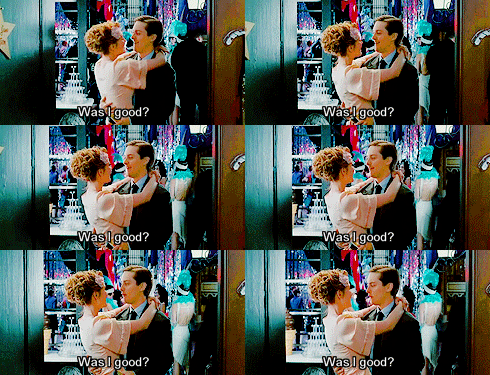
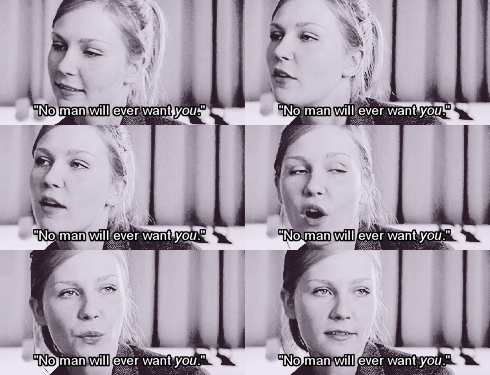
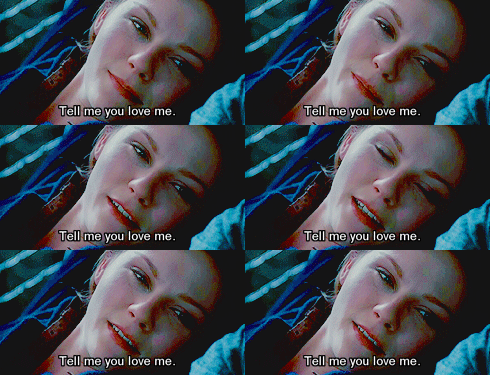
The Mary Jane Watson of the original Spider-Man films gets a hell of a lot of flak. She’s usually labelled a ‘no-personality damsel in distress’, before then being called some variation of ‘a clingy, whiny, self-centered two-timer’. Quite aside from the fact that her detractors accuse her of having no personality before immediately going on to describe her personality (well, a small part of it), they’ve somehow managed to miss why she’s ‘clingy, whiny and self-centered’:
Because she was abused!
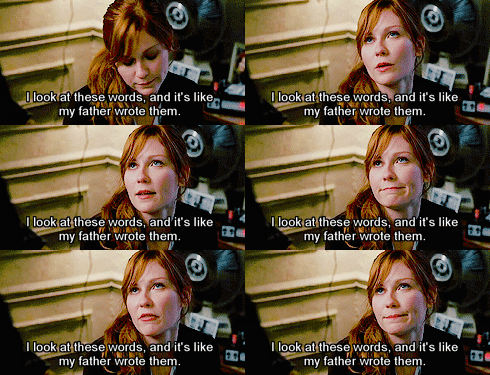
This isn’t a minor detail, either: it’s very clearly shown that MJ’s abusive father affected her self-esteem massively. In a scene between Peter and MJ in Spider-Man 3, she’s upset – really upset – because of a mildly critical review. Like, really mildly critical. Peter can’t understand why. “That’s a critic, that’s just something you’ll have to get used to.” But MJ can’t understand why he can’t understand. “I look at these words and it’s like my father wrote them.” She’s been told her whole life she’s worthless, why should it stop now? It’s an overreaction, but it makes perfect sense.
Know what else makes perfect sense? MJ’s tangled relationships with men, especially Peter and Harry. She dates Harry straight out of high school, and hey, I love Harry, I really do – but he wants a say in how she dresses, for God’s sake. He loves her but (probably due to coming from a loveless household himself) he’s a terrible boyfriend. And MJ’s doesn’t even quite trust him to accept her- she’s sensitive about the social divide between them, between ‘trash’ and people like the Osborns, but she sticks around anyway, because, like I said, Harry loves her, he thinks she’s beautiful, and he’s rich and good-looking and if someone like that (or John Jameson, another rich and successful young man) wants her how worthless can she be? MJ wants a man in her life, she wants to prove her father wrong, prove she is loveable – if one man lets her down, maybe another one won’t. As soon as Harry fails her she turns to Peter; as soon as Peter fails her a movie or two later she turns back to the now more grown-up Harry. And before you ask, yes, I’ve lost count of the amount of times she’s called ‘slut’ or ‘skank’ for this by fandom, whereas the boys get away with virtually every instance of unpleasant behaviour towards her.
I’m not saying MJ is a saint, mind. Actually, that’s pretty much the point: she isn’t. Leaving John Jameson at the altar with a note was really quite cruel; when she lost her job she should have told Peter about it; she should also have had a proper conversation with him about the Gwen situation; and she shouldn’t have prejudged Gwen herself (a totally innocent party throughout all of Spider-Man 3) so harshly. MJ fucks up, you know, she really does – but that’s okay. The movies don’t judge her for her sex life, her rough patches, her frequent need for reassurance, or her ambition. When Norman behaves in a downright misogynist way to her (remember him leering at her chest mere minutes before he calls her a gold-digger? She’s nineteen at most at that point. I think he deserved that stab in the dick) we aren’t meant to think he’s right, we’re meant to think he’s horrible. Yet I’ve seen an unnerving amount of people agree with him. Which is absolutely endemic of a wider problem, but anyway – back to MJ as a person –
There’s more than one kind of female character, and I am absolutely, absolutely here for the flawed, messed up, not-really-all-that-kickass ones. MJ’s clingy because she wants to be loved, she’s ‘whiny’ (sigh) because people treat or have treated her actually really badly, and she’s self-centered because you know what abusers try to do? Deny their victims a sense of self. Almost every part of MJ’s life is trying to prove her father wrong, trying to fight back against her abuser by succeeding in life and loving others (and herself) the best that she can, and I think that makes her easily as good a role model as Spider-Man. The movies themselves seem to agree with me. How about you?


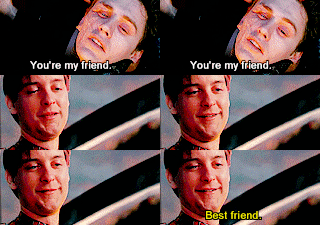


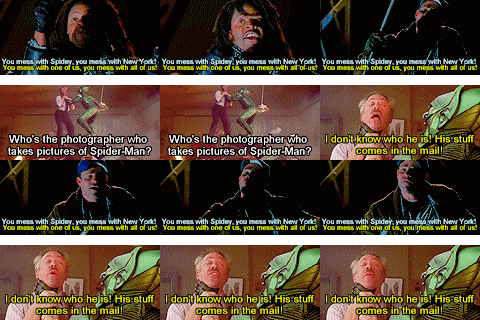

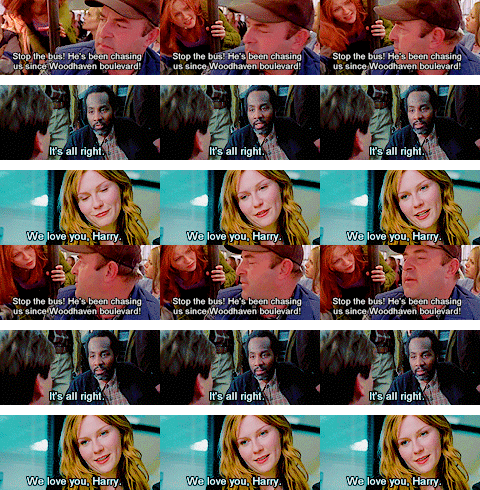
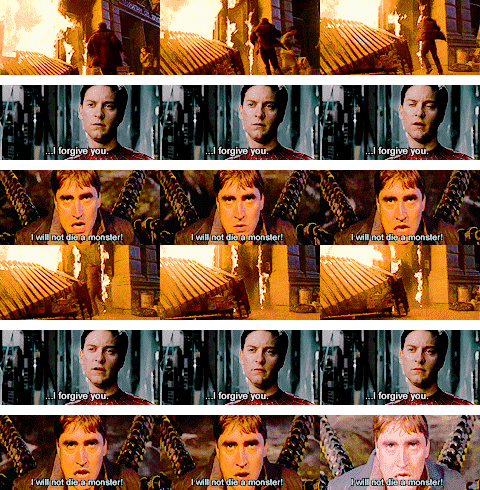

The original Spider-Man trilogy is campy and cheesy and it probably hasn’t really aged well, but I love it so much and will absolutely recommend it to anyone who likes the MCU simply because (as seen above) it is just so thoroughly uncynical and virtually everyone from Peter to Gwen to Aunt May to Peter’s neighbour to random bystander #563 is SUCH A GOOD PERSON


harry osborn meme > 3/6 scenes
Harry and MJ on the bridge
Harry kidnaps MJ and takes her to the bridge where his father murdered Gwen. MJ tells him he won’t get the satisfaction of her pleading for her life and Harry is utterly horrified. He only wanted to talk to her and let her know he would never kill her to hurt Peter, the way his father killed Gwen. The two old friends do then talk, but sadly. [Spectacular Spider-Man #200]


harry osborn meme > 1/6 scenes
Harry’s sacrifice and death
Whatever comes our way, whatever battle we have raging inside us, we always have a choice. My friend Harry taught me that. [Peter]


harry osborn meme > 2/4 relationships
Harry and MJ
“I’d never hurt you! Never! You’re my friend…one of the dearest friends I’ve ever had! I love you!”

a spider-man / game of thrones au
Winter is coming for the Parkers of the North, whose house motto is “With great power comes great responsibility”. They have a dubious alliance with the Osborns, who are extremely skilled in alchemy and have a history of killing their enemies with wildfire. (Owing to this, their house sigil is a green goblin). Each house has only one male heir, Peter of the Parkers and Harry of the Osborns. The two boys played together and were close as children: had one of them been born female they might have united the houses.
Comfortable on the Iron Throne is Norman Osborn, the Goblin King. It is a fact well known to his closest circle of advisors – the Six – that he despises his young heir and greatly prefers the orphaned Peter. Peter is known to all as the Spider Prince – a nickname partly based on his house sigil, but mostly based on his cunning, agility and recklessness in battle, recklessness that many years ago lead to the death of his uncle.
The reign of the Goblin King is fraught with misfortune. The Six, despite their alleged loyality to Norman, are each plotting against him in their seperate ways. Harry falls in love with a beautiful prostitute, Mary Jane, but she doesn’t love him back, while Peter strikes up a relationship with Gwendolyn, daughter of the Hand of the King. Then disaster strikes: Norman is maimed by his own wildfire and lies close to death. He calls on his Hand, George Stacy, to force Harry to take the black while Peter – whose parentage is dubious, who’s to say he’s not Norman’s – claims the throne. When Stacy refuses, Norman has his seemingly most loyal henchman, the Octopus, murder him.
Suddenly alliances and friendships are stretched as far as they will possibly go. As the daughter of a traitor, Gwendolyn is taken hostage, an action that ultimately leads to her death. A griefstricken Peter swears revenge, but Norman dies before any action can be taken. Harry takes the Iron Throne and sits there very uneasily: he names Peter as his Hand but dismisses him in a fit of anger when he sees him and Mary Jane together.
Things go from bad to worse as the years go by. The Octopus, in an attempt to claim some power for himself, begins to court Peter’s aunt, the Lady May. Harry marries a princess, Elizabeth, and fathers a son who many of the Six and their allies want out of the picture – the Osborns have held power for far too long. Meanwhile a young man known only as the Knight of Venom is rallying a supernatural army for an attack on the throne: rumour has it that he can bond with shadow itself and is stronger than a thousand men. On the other side of the vast sea, two of Norman’s bastard children – Gabriel and Sarah, whose maternity is a terrible secret – are seeking to strengthen their claims as well.
Peter’s code of honour may outlast him: there is very little place for responsibility in this world, only power, and they say all men must die.