empty chairs at empty tables..
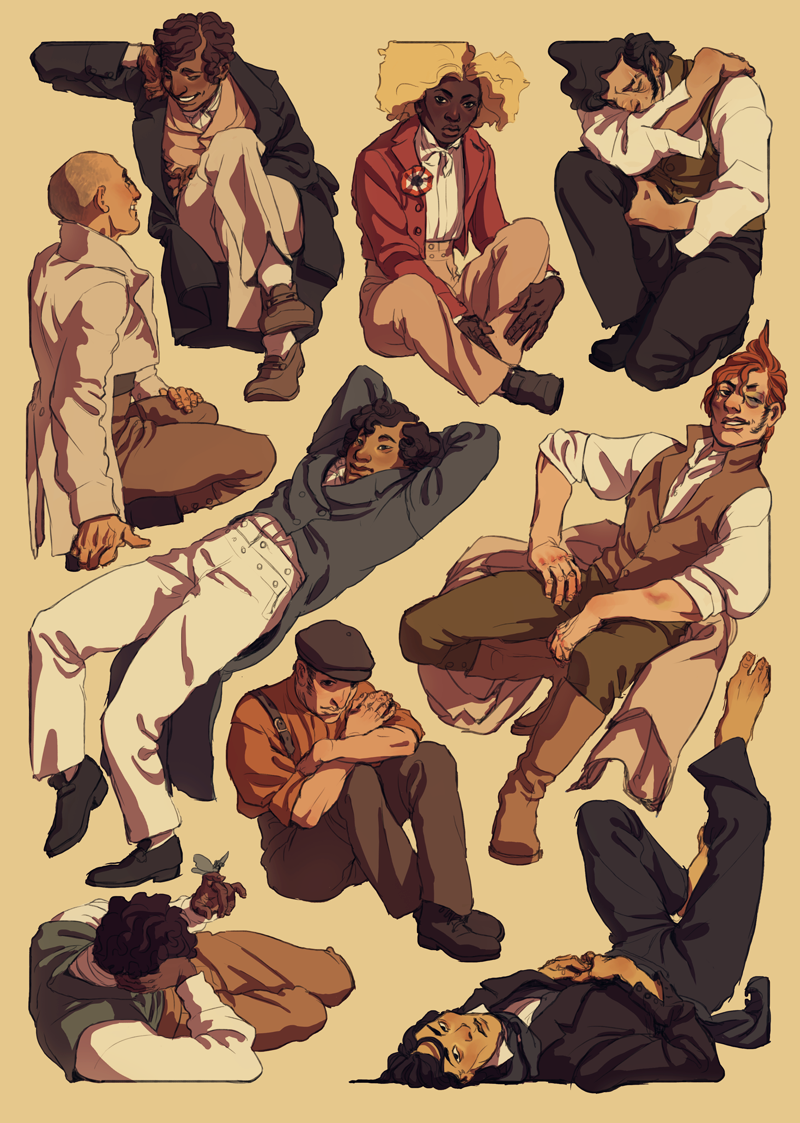
- Enjolras surviving, though not succeeding. Retreating after a long battle to heal, hiding away somewhere safe. His speech, quiet yet strong, as Les Amis mop, sew and patch themselves up is not of grand struggle and the greater meanings of their actions. It is a private thanks, words of pure gratitude to his friends, who fought bravely, sacrificed for their coming world. It is individualized, tired eyes locking onto each bleeding, suffering hero. His voice breaks more times than anyone can count.
- Combeferre wearing a pair of glasses stolen from the pocket of a dead guard too close to the barricade. His own were broken, and these are not perfect, but he needs to be able to see in order to sew up gashes and set bones with whatever they have. He’s working himself to the bone, ignoring his own wounds and his friends urges to please, sit down.
- Joly working by Combeferre’s side with only one arm fully functional, tying wounds with ripped shirts and sashes. He knows that this is begging for complication, but with their situation, this is all they have. When things have calmed down, when some are more healed than others, someone can go for better supplies, but for now he bends his head and whispers words of encouragement to his aching friends.
- Courfeyrac with a bandage over one eye, which gets crinkled and threatens to come off with each wide smile as he tries lessen the mood, as he tries to keep spirits as high as possible. He keeps his back turned on the motionless shapes under a red flag in the corner of the room. If he thinks about anything too hard, his grinning veneer would crack.
- Bahorel cannot smile. He cannot do anything much than try to breathe, try to live. His chest bleeds and aches, and he does all he can to keep his eyes open, not ready to close them one last time. He is promised life, told that, as far as they can tell, vital organs were miraculously missed. His face contorts as he TRIES to smile.
- Feuilly instructs his friends as much as possible; a life on the streets has taught him a good many skills, including how to patch up wounds without much in the way of supplies. He uses a found thin pole as a crutch, his foot mangled and useless to him. He does not have a fix for that, but announces that at least his hands remain untouched, and he will live to work another day.
- Bossuet is soaked in blood. Only some of it is his. His wild eyes are lost and confused, and he keeps glancing to Joly’s arm. He is not laughing, but speaks to Musichetta. She is not there. When this is pointed out to him, he whispers “Just my luck,” and draw into himself. Everyone keeps an eye on him.
- Marius who is missing. Marius who was taken when things look bad, Marius in Jean Valjean’s care. None of his friends know, and Courfeyrac has to be restrained from going back to search for him, or at least bring his body back.
- Jehan Prouvaire laying on a table near Bahorel, eyes glossy and mouth dyed red and pink with frothing blood, but Holy God, he is alive. Somehow how Jehan is alive, dotted with constellations of bullet holes. Forceps and forks have pulled what they could from his body, every delve into flesh a concern that they would pull the last breath from his body. In the early morning, a bird chirps outside.
- Gavroche’s body is underneath a red flag, lifeless. Someone placed his hand in that of his sisters, two corpses doused in blood, both with the frozen smiles of death on their faces. Gavroche holds an empty ammunition case in his other hand, emptied by his friends once his body was retrieved. He would not die in vain.
- Éponine, long dead, head tilted up, was captured by Feuilly’s hand in a quiet moment on the barricade. Her portrait now sits on a table near a wine bottle of flowers. Now one knows where they came from, but there are leaves plastered to the heels of Gavroche’s hands.
- Grantaire lays on her other side. His corpse is riddled with bullet holes, from the front, then the side, then the back. The only blood that is not his own dots his fingers, from the brief moment of contact when he pushed Enjolras out the the window, thinking that he was to find more luck with a fall than at the guns of the guards. He did not see the flag Enjolras carried, the flag which now covered him, catch on the window sill, leaving Enjolras to safely lower himself to the ground, to plan a retreat with a newfound bravery. Grantaire’s last act, in saving Enjolras, had provided the others with a chance to escape. All Grantaire knew was the bullets ripping through him. Laying over Grantaire’s still chest is a stained red vest, dotted with every floret and the medals someone had stripped from a dead guard. No one can look his way.
why you have to kill Gavroche yo
anything-but-one-straight-line:
Something I love about Victor Hugo’s characterization of Les Amis is his knowledge and use of the social and cultural context in which Les Amis were living. Enjolras’ politics couldn’t have developed at all before the end of the Thirty Years’ War, full-stop. Feuilly’s politics couldn’t have developed before the end of the Thirty Years’ War, because before that point, there was no sense of nationhood as we know it now.
Grantaire’s boxing is not just some sport, randomly chosen, to round out Grantaire’s character. Boxing was a relatively inexpensive and new sport in the nineteenth century that served as an example of the “commercialization of leisure.” It had begun in the villages, and only recently evolved into a competitive sport with stringent rules.
Joly’s declaration that “man is a magnet, like the needle,” is not some random “cute” thing Joly’s come up with. The idea that man was like a magnet was a popular theory among urban elites in the eighteenth and early nineteenth-century. Jehan’s romanticism is in line with his time, and he’s perhaps even a little ahead.
Who’s the total hipster? Jehan’s the total hipster.
Props to Victor Hugo for his meticulous use of detail in his characterization of Les Amis. Nothing is random. Every detail tells you something about the characters. Everything is set to depict Les Amis in a very particular social and cultural context.


I’ve already wished you all a Happy Barricade Day yesterday. So have a Maybe-A-Little-Not-As-Happy Barricade Day today. ;)
Since we all know (by now) what a cheerfully heartless, lying, impenitent bastard I really am, here, have a highly, highly abbreviated version of Combeferre’s speech on me. I realise it’s not what his actual speech is about, but I was thinking about what Hugo said about Combeferre not being an orphan and about to get himself killed, and decided that what I really wanted to do was to frame his speech mainly in the context of the named Amis* and what would follow in the days after their deaths. [— That, and if I actually illustrated his speech in its proper context, it would have taken far more pages, and a finger that was Actually Functional And Very Much Not In Pain.]
Why, for gods’ sake? Because I can.
[And yes, I’ve snuck in people and things all over the place. Also because.]
——————————————————-
* And Gavroche. Because y’know.

For the Barricade Memorial, I decided to bring flowers to the gathering, brought in by our resident flowersoul honeychild Jean Prouvaire. (flowers for: Enjolras, Courfeyrac, Combeferre; Grantaire, Joly, Bossuet, Bahorel, Feuilly, Eponine and there’s a tiny one in there for Gavroche)
The air is drenched with day, but one by one
The flowers close on cue,
Obedient to the declining sun.—from “Oswald Spenger Watches the Sun Set” by Stephen Edgar
notallthosewhowanderarelost–yet:
Enjolras: The baker’s assistant, named by his parents François but usually called “you,” “boy” or “dimwit,” lived for 8:05 sharp every morning, because that was when Enjolras would come to buy his breakfast, pay the baker, and then say “Good day, Citizen François” and make François feel like a person. Enjolras was the only one who ever did this.
Combeferre: One of his patients was an elderly woman who was an absolute shrew to everyone except Combeferre, who reminded her of her dead son. After the barricade fell she turned desperate and asked every day why Monsieur Combeferre never came anymore. Nobody had the heart to tell her.
Courfeyrac: For the last few years he had had a friend, a gamin named Nicolas. They had breakfast together on Sunday, and when the weather turned cold Courfeyrac gave Nicolas his old jackets. Nicolas died of frostbite in November 1832, at the age of 11. Draw your own conclusions.
Jean Prouvaire: He was teaching his landlady’s son to play the flute, an endeavor that seemed futile to everyone but the two of them. When the boy finally managed to produce a few sounds he wanted to show his teacher immediately, but his mother told him that Monsieur Prouvaire had gone to some General’s funeral and she didn’t know when he would be back.
Bahorel: For all he griped about law, he had become very close to one of the professors. They spent many happy hours talking about every topic under the sun, and the professor sometimes thought of Bahorel as the child he’d never had. When he heard about the barricades, he knew immediately that Bahorel was involved, and refused to read the names of the casualties when the battle was over. Because he knew.
Feuilly: He’d realized that the girl he’d been nursing a huge crush on actually felt the same way, and a romance started to develop. Every week he gave her a flower–which she dried and saved–and the night before he left for the barricade, they kissed for the first time. When the sun rose two days later, Feuilly had one kiss, Marie had thirty-seven flowers, and neither of those numbers would ever get any higher.
Bossuet: Over the years he had become friendly with one of the “regular” beggars, who always sat in the same spot beside a fountain. Every day Bossuet gave a him a few sous, plenty of schadenfreude and a sense of being something more than just another beggar on the streets of Paris. Then things changed, and it was back to only the birds for company.
Joly: After months of dithering and consulting with Bossuet, he decided that for Musichetta’s next birthday he would give her the gift of a marriage proposal. Musichetta’s birthday was June 8th.
Grantaire: His boxing partner looked forward to their weekly matches not only because he and Grantaire were great friends, but also because when they shook hands goodbye, Grantaire always slipped him some money. It wasn’t much to Grantaire, but the boxing partner was an underpaid workingman with a wife and six children, and that money sometimes meant food for the week.