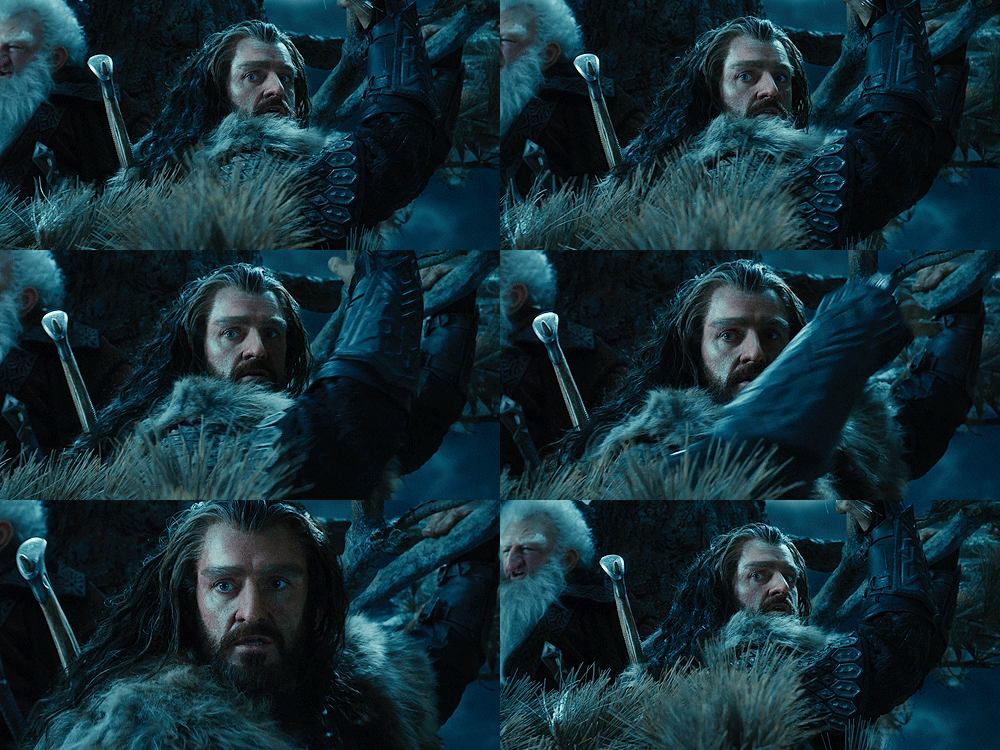
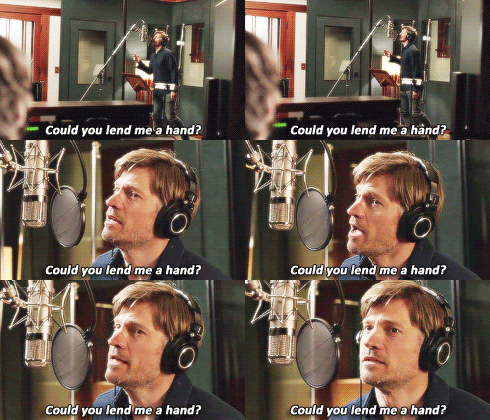
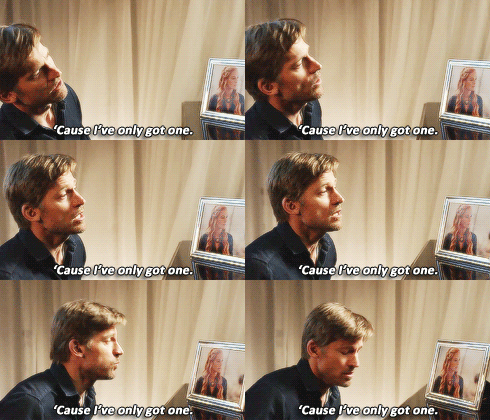
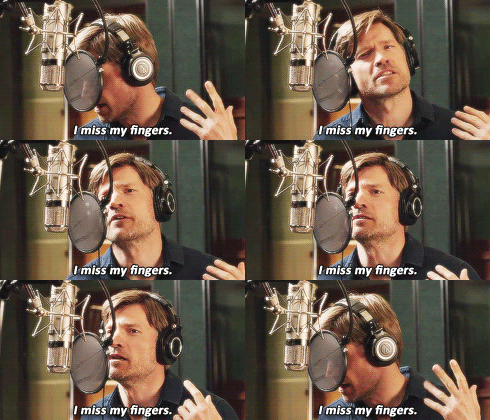
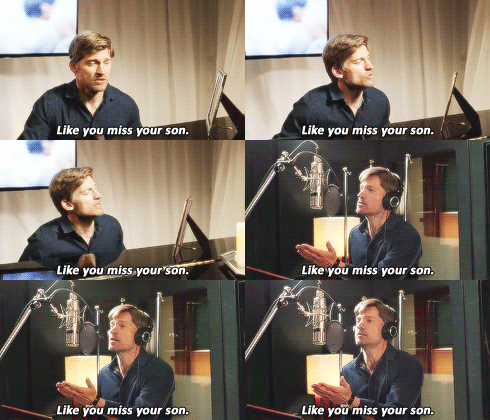
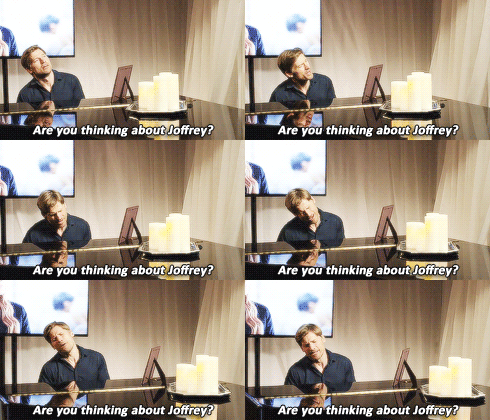
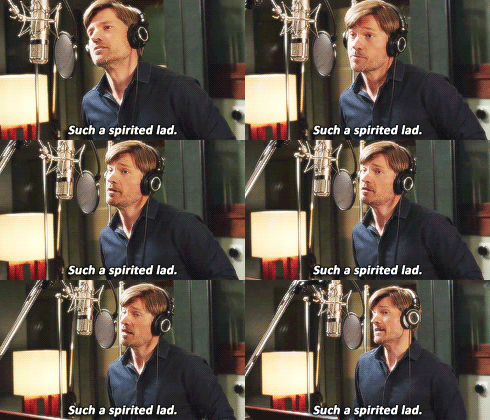
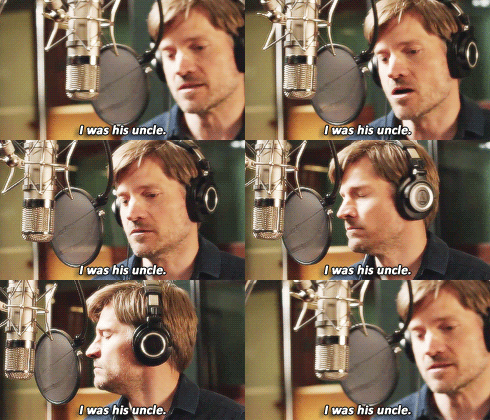
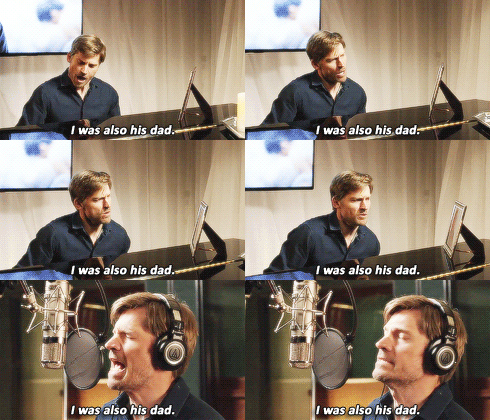
But have you considered: Thorin might be nearsighted?
Case in point:
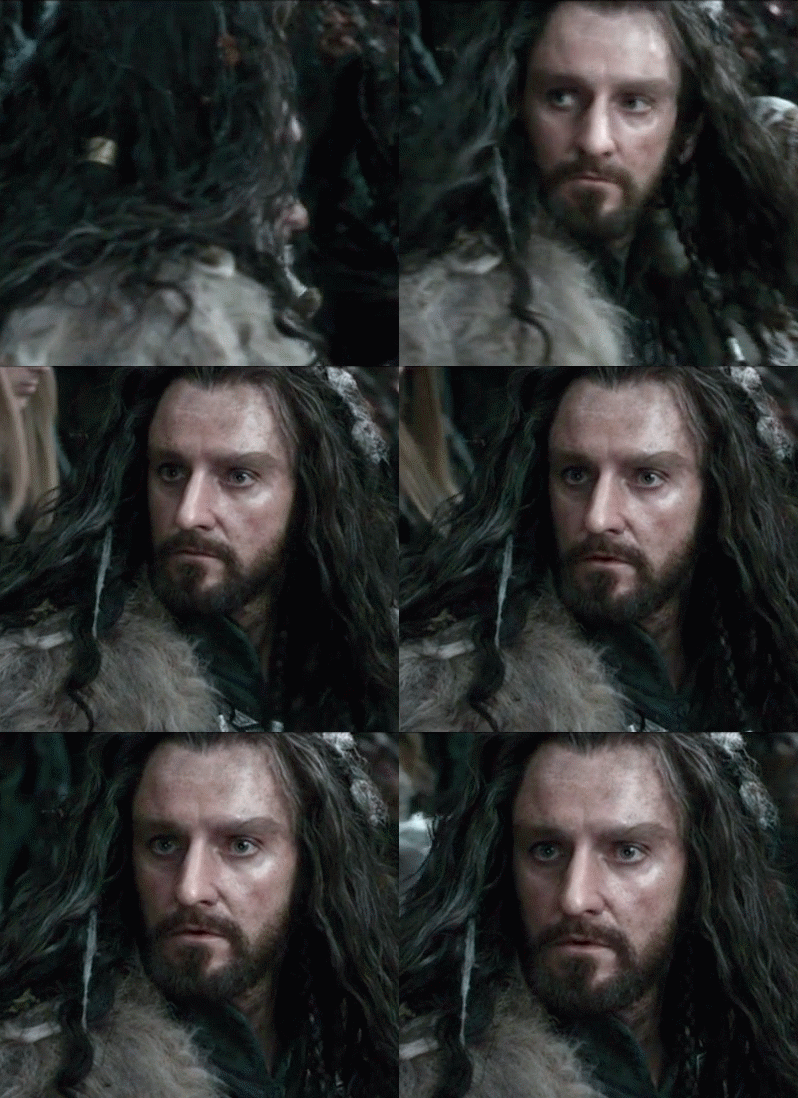
Exhibit 2
“It cannot be.”aka Doesn’t actually recognize Azog until he starts talking…
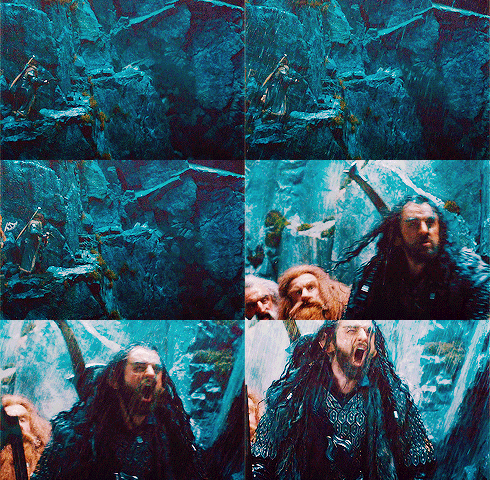
This needs no explanation:
*BOOM*
Exhibit 3:
Not subtitled, but Thorin shouts for Kili when actually Fili is the one who was almost crushed >.<
Exhibit 4
Not pictured because I couldn’t find a gif, but Thorin prompting Balin to lead them out of Rivendell because he “can see knows these paths”
Exhibit 5
Cut off Azog’s arm, was probably aiming for something slightly more fatal, couldn’t tell he was alive when dragged back inside Moria…
Exhibit 6
WHERE’S BILBO?
(”I have no idea because I can’t see for shit.”)
Conclusion:
Since wearing glass in front of your eyes is slightly more of a liability for a fighter than people’s faces being slightly blurry, I’m just gonna throw this out there as a possible explanation for fandom to run with ;)
Ok but I think this is my favorite post of mine that’s done well because
1) it give a humorous explanation for Thorin’s random moments of fail that’s cracky and funny
2) it actually kinda makes sense and it gives Thorin a minor (or not so minor for his life and world) disability that he works around and actually kinda explains said moments of fail realistically and honestly guys the more I think about it and replay the movies in my head the fewer contradictions I can find for this headcanon???
There is a fanfic in here somewhere
Convincing arguments!
Thorin has suddenly become more human and more pleasant (short-sighted person speaking here)
You are not wrong OP, Thorin IS nearsighted. In the book, it was even canon:
“How far away do you think it is?” asked Thorin, for by now they knew Bilbo had the sharpest eyes among them. “Not far at all. I shouldn’t think above twelve yards.” “Twelve yards! I should have thought it was thirty at least, but my eyes don’t see as well as they used a hundred years ago-” (From the chapter, ‘Flies and Spiders’
of The Hobbit, by JRR Tolkien
)
Thorin isn’t just slightly nearsighted either, he thought a large object at across-the-street distance was three-quarters of the length of a football field away. By modern standards he would be legally, coke-bottle-glasses-or-we-don’t-let-you-drive, blind.
In the movie Thorin’s nearsightedness is never actually stated, but I love the clever ways in which they worked it into the acting (as avelera highlighted very well), and also into the costume and set design (implying that Dwarves tend to be nearsighted in general): Dwarven ornamentation is always three-dimensional, be it stamped leather, cut runes, thickly-embroidered brocade, or cast-metal beads. There are no purely painted or smooth-inlaid designs anywhere that would require sight, let alone 20/20 vision.
Dwarven cities too, are violently three-dimensional and ornamented with a lot of straight-lined geometry and gigantic statues. Perhaps most telling of all, the terrifyingly high stone bridges found in both Erebor AND Moria are treated as perfectly ordinary sidewalks… which would make sense for a race that couldn’t even SEE the ground below.
Rey is patrolling the Greenfields border when she hears the shrieking. “I didn’t know there were lady-rangers,” the hobbit with the shock of bright-orange hair says, after Rey has beaten off the goblins attacking her and snarled a warning at their retreating backs. “And I didn’t think halflings ventured so far from home,” Rey answers, helping the little one to her feet.
Her name is Bertina Baggins the Eighth, although her long-suffering parents, who made the grave mistake of giving all their children ‘B’ names, have since resorted to calling her BB-Eighth.
“Do you have any family?” BB-Eighth asks, and graciously lets it pass when Rey flinches and does not answer as to why so young a woman is alone in the northern wild.
It takes Rey two bowls of gruel and several hours to earn enough trust to get more than that out of BB-Eighth. She’s carrying a message from one of the elves who pass through the Shire on occasion, a friend—supposedly it is a map to the secret hiding place of the great grey wizard, Skywalker.
Her elf friend was tasked with bringing it to the Grey Lady of Gondor, but he was being chased, cornered by orcs of the Black Army before he could escape.
“And now you are going to Rivendell?” Rey asks, trying not to sound too amused. “Have you ever been outside Hobbiton before?”
This is—somehow—the story of how Dunedain Rey ends up on the road to Rivendell, with a tiny chattering hobbit at her side.
Finn is one of the soldiers from Far Harad, pressed into service of the dark army, but wracked by doubt around fighting in this strange land, this strange war. When he is told by the Nazgûl-prince to slaughter the village, he cannot even raise his bow.
The captured elf is no secret (an object of fascination, they have no such creatures in Far Harad) and it is not hard to march him away from his guards, to convince him to help steal one of beasts the orc captains ride into battle.
“I’m better with horses!” he shouts as Finn clings to him desperately—he was taught to string a bow and wield a spear and grapple with a man, not ride things into battle the way they do in the north, and now this mad elf is trying to get them both killed by heading towards exactly where they took him from.
Unfortunately, in the flight their mount is wounded, and they plunge over the edge of a cliff—when Finn comes-to, it looks like the elf is dead beneath the carcass of the beast.
When he stumbles towards the road looking for civilization, he finds a pale woman with a deadly staff and what looks like a child, with a shock of bright hair.
“You stole her friend’s cloak!” the pale girl snarls as they struggle, and it takes Finn several tries to get her to listen to his story.
They steal horses from a nearby town, and Finn gets a very quick lesson in how to shoot from the back of a moving animal.
The Grey Lady of Gondor—Steward of the White City, Lady Leia of House Organa—is somewhat notorious for marrying a mercenary who served in the armies of Gondor. She is very notorious for her rumored origins, that it was the dark Witch-King who gave her birth along with her brother. (Rumors of Istari blood do not fade, too full of strangeness and fascination to be quelled.)
She is tragic for the loss of her son—a casualty of these warlike times, they say, stolen on the road, killed. She does not speak of him.
When Rey—just Rey, Rey of the north, dressed in white beneath her armor—is taken, Finn is the only one familiar enough with the Black Lands to retrieve her, and destroy the terrible siege weapon they are building. (To be fair, the aging mercenary and his hairy Druedain are a surprise.)
There is still a sword. It still fits to Rey’s hand, even though the Nazgûl-prince (just a boy, after all, beneath the heavy metal mask) reaches for the reforged blade of the Witch-King.
And at the end, there is still a wizard, dressed in grey, on an island that all of Middle Earth thought lost to the great and terrible wave.
Haha no dudes it’s totally cool I’m suuuuper chill about this and completely **fingerguns** there are no issues here AT ALL
There’s a surprise hidden in plain site the next time you are hunting for Pokemon in the streets of Texas – someone is leaving behind adorable crochet Pokemon toys at PokeStops in the crazy journey to catch ‘em all. Under the pseudonym Knotty Nicole, this “self taught and generally crafty” mother of two, has combined her love for knitting with her passion for being an “avid gamer, foodie, and crafty geek”. Her woven characters are unique collectables and relics that trainers can pick up in their pursuit of Pokemon in real life and the project has been called #CrochetGo. Find adorable Pokémon crochet toys on Etsy!
Something that’s almost never covered in fantasy mediums is common names.
Like we all know fantasy names are unusual, but any name to a foreign culture is considered unusual English names to Indian people are very unusual for example. But naturally, given that it’s an entire culture, there will be some common names, it’d be refreshing to at one point here this exchange.
“So I was talking to Vicnae and-”
“Wait which Vicnae? You can’t just say Vicnae. There are ten Vicnae’s in my village alone.”
This has 100 notes yesterday and 300 this morning what the fuck happened.
People understand the truly important things.
DSA (a German fantasy P&P RPG) actually has the name Alrik, which is hugely popular in the universe. Everyone is Alrik.
This is also a great excuse to use “X the Y” or “X of Y” type names without being pretentious. Calling someone “Thognor The Stout” goes from pomposity to practicality if he lives down the road from Thognor The Small.
This! Some names are more common than others, and there’s always been a need to differentiate one Thognor from the other Thognor(s). Without inherited surnames, this means bynames, and let me tell you, bynames are much more interesting than the average fantasy novel would lead you to believe.
Disclaimer first: my knowledge of this doesn’t extend much outside medieval England, because it all came from research for an original fic I wrote a few years ago (Robin Hood with lesbians, as my wife likes to call it). I wouldn’t be surprised if this all holds true in other countries, but I can’t swear to it.
Anyway…
We’re all familiar with occupational bynames (Cooper or Smith) and patronymics (Johnson or Wilson), because medieval fantasy makes extensive use of these, but sometimes bynames came from other sources. You might be identified by your mother rather than your father, though, alas, few metronymics survived the transition to inherited surnames. (And ironically, Chrome’s spell-check asks if I meant “patronymic” when I type “metronymic,” but that’s a rant for another time.) A byname could also come from your siblings or your spouse, if there was something especially notable about them.
But enough about that! I think we’re all familiar with the idea of bynames based on other people’s names. Where it starts to get interesting (at least to me) is once we get into things like locative bynames. These are bynames based on where you’re from, but that’s not quite as straightforward as it sounds. If everyone lives in the same town, then saying “John of Bedford” is kind of meaningless. But “John, the one who lives by the woods” (or Atwood) makes perfect sense. So if you had a locative byname and you moved, then your byname almost certainly changed, too. You might have been John Atwood when you lived in Bedford, but when you moved to York, you became John of Bedford (or, more likely, just John Bedford).
And here’s another thing you rarely see in medieval fantasy: “of” wasn’t actually all that common. “In” or “over” or “by” or “at” were vastly more common. So
John in the field, or John over the hill, or John by the brook, or John at the wood. If you’re going to give someone a locative byname, think carefully about what would make sense given their history and where they are now.
So now we get to my favorite part: nicknames, like “the Stout” that identifies poor Thognor. Who might not have been all that stout, since there’s a decent chance a nickname was either outright uncomplimentary or intended ironically. Little John in the stories of Robin Hood isn’t little at all, and that kind of nickname isn’t unique to the character.
Of course, some nicknames were just straight-up descriptions (Sherlock is from shirloc, or “bright lock”), but few of these were names you’d give yourself. They were just like nicknames today, really, and you rarely get to pick your own nickname. Thognor the Stout or Little John wasn’t the worst they might do to you, either. You could end up as Thognor Little-worth or John Always-Drunk.
You know how, in small towns, everyone always remembers the stupid shit you did as a kid? Yeah. If we were still using bynames instead of inherited surnames, you could spend the rest of your life as John Ran-over-his-mother’s-new-boss’s-mailbox-her-second-day-on-the-job. Fun, right?
Oh, and the nicknames could be obscene, too. How about Robert Clevecunt or Bele Wydecunthe? Yes, those are actual names of actual people from 14th century England, though it’s important to note that the word cunt wasn’t considered shocking until several centuries later.
All of which is my long-winded and rambling way of saying…when it comes time to name the characters in your twenty-book epic fantasy saga? Be creative! Don’t just go for the standard “John of Medieval Town,” especially if John still lives in Ye* Olde Medievale Towne.
* ”Ye” is its own rant, but we’ll leave that one for another day, too…
Obviously, I really enjoyed the new Ghostbusters, and I’ve been thinking about how much a movie like that would’ve meant to their characters when they were kids. I’m so excited for the kids who’ll grow up with this film as a part of their childhood! So here are Holtzmann, Abby, Erin, and Patty as junior high schoolers, growing up as geeks in their own respective, delightful ways.
I don’t usually have time for fan art but my drawing hand’s been giving me trouble, so I wanted to try a looser style that doesn’t strain my muscles quite so much. Perfect opportunity to do something different, right?