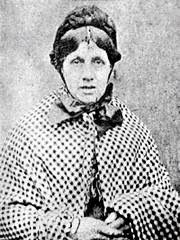
Mary Ann Cotton: Female Serial Killer
1832-1873
Mary Ann Cotton was born to a small mining town in Great Britain, and married William Mowbry in 1852. They had eight children— seven of which were dead of “gastric fever” by January of 1865 when her husband died of a “fatal stomach infection”. Cotton collected a not inconsiderable life insurance on two of the children and her deceased husband.
Mary Ann sent her surviving daughter to live with her mother, and worked at the infirmary in Herndon, England. She married one of her patients, George Ward, eight months after her first husband’s death. Husband number two was dead by 1866, from a prolonged illness associated with paralysis and intestinal problems.
Mary Ann then became the housekeeper for James Robinson, a widower. Robinson’s baby died of gastric fever not long after Cotton began working there… and Cotton became pregnant not long after working their either. She briefly returned to her mother’s home to care for her sick mother, who died after experiencing stomach pains. Mary’s surviving child from her first marriage died soon afterwards, as well as two more of James’s children by 1867. Robinson and Cotton married and had a child in November of 1867, but she died of stomach pains in the spring of 1868.
In case you lost count, that brings the body count up to fourteen.
Shockingly, Robinson grew suspicious of his new wife and former housekeeper, and discovered that she had stolen £50 (a rather large sum in those days) and forced his children to pawn household items. He unceremoniously threw her out into the street. Mary Ann still managed to find yet another husband through a friend, Margaret Cotton, who introduced her to her brother Frederick Cotton. Mary Ann and Frederick got married (bigamously, as she was still married to Robinson)… after Margaret’s death. From a mysterious stomach problem. While she was still married to Frederick, she struck up an affair with Joseph Nattress, a former lover.
Mary Ann and Frederick’s son was born in 1871, but Frederick soon died. Mary Ann collected on his life insurance policy.
Nattress moved in with Mary Ann and her three remaining children after Frederick’s death, but Mary Ann had already moved on to John Quick-Manning, a excise officer recovering from small pox who Mary Ann was nursing back to health— Mary Ann became pregnant again with his child. In March of 1872, one of Frederick’s sons and the infant child of Mary and Frederick died. Shortly after Joseph Nattress changed his will to include Mary Ann in the life insurance policy, he died. Of gastric fever.
Mary Ann’s only remaining charge, her stepson Charles Edward Cotton, was apparently too much for her to handle. Mary Ann tried to send him to live with one of his uncles, but to no avail. When she tried to get him committed to a work house, she was told by the parish official that she would have to accompany him; Mary Ann commented that he was sickly and would soon “go like all the rest of the Cottons.” Within five days, on June 12, 1872, Charles was dead.
Thank God somebody finally noticed a connection between this woman and her relatives dropping like flies. The parish official who had accompanied Mary Ann and her stepson to the work house also happened to be the assistant coroner— they autopsied Charles’s body and found that his stomach contained high levels of arsenic. In case you’re curious, arsenic was easily available, cheap, and causes the same symptoms as gastric fever (stomach sickness and diarrhea).
Her trial was prolonged until 1873, after she gave birth to her final child in January. She was hanged to death in March.
Just as a recount: she killed three husbands, her mother, a family friend, and a dozen of her own children. Not all badass women are the good kind of badass.
There used to be a children’s rhyme about her. I read it in a Horrible Histories when I was a kid…
Mary Ann Cotton
She’s dead and she’s rotten
She lies in her bed
With her eyes wide open
Sing, sing, oh what can I sing?
Mary Ann Cotton is tied up with string
Where, where, up in the air
Selling black puddings a penny a pair.
Apprently I was interested in weird stuff when I was little.