I was told by my professors that Kitty Genovese was a 28-year-old unmarried woman who was attacked, raped, and brutally murdered on her way home from her shift as manager of a bar. I was told that numerous people witnessed the attack and her cries for help but didn’t do anything because they “assumed someone else would”. Nobody intervened until it was too late.
Now… is it likely that people overheard Kitty’s cries for help and ignored them because they thought someone else would deal with it? Or, perhaps, did they ignore her because they knew she was a lesbian and just didn’t care?
Maybe that’s not the case. Maybe it was just a random attack. Maybe her neighbours didn’t know she was gay, or didn’t care.
But it’s a huge chunk of information to leave out about her in a supposedly scientific study of events, since her sexuality made her much more vulnerable to violent crimes than the average person. And it’s a dishonour to her memory.
RIP Kitty Genovese. Society may only remember you for how you died, but I will remember you for who who were.
this was one of the first lessons I had in psych too and we were never told about this either nor was it in any of the reading materials
I never knew this.
I also never knew this about Kitty Genovese, but I do know that, in fact, many of the dozen (not thirty-eight) people who witnessed some part of the attack (which took place after 3AM, on a chilly night in March when most people’s windows were closed) tried to help in some way.
One shouted out his window for the attacker to leave her alone, which did successfully scare the man off temporarily.
Another called the police but, seeing her still on her feet, said only that there had been a fight but the woman seemed to be okay.
And when Kitty Genovese was finally attacked in a vestibule where she couldn’t be seen from outside, Karl Ross, a neighbor, saw what was happening but was too frightened himself to go to her rescue–so he started calling other neighbors to ask what he should do. Eventually one of them told him to call the police, which he did, and the woman he called, Sophie Farrar, rushed out to help Kitty even though she didn’t know whether the attacker was gone.
Kitty Genovese died in the arms of a neighbor who tired to help and comfort her while they waited for the police and ambulance to arrive. Kitty was in fact still alive, although mortally wounded, when the ambulance reached the scene.
The man who saw the final stabbing? Who panicked and called other neighbors first instead of the police? The man who said, infamously, that he “didn’t want to get involved” because he was reluctant to turn to the police for help? He was thought to be gay himself. He was a friend of Kitty and Mary Ann’s. After being interviewed by the police he took a bottle of vodka to Mary Ann and sat with her, trying to comfort her.
So, no. I don’t think the evidence indicates that Kitty Genovese’s neighbors let her die because she was a lesbian, because Kitty Genovese’s neighbors tried to help.
(Also, going by the content of the murderer’s confession, it was indeed a random attack.)
how on EARTH was this “scientifically” studied but the details gotten so wrong and the wrong as hell conclusion published and taught in schools?!?!?! where were those scientists observation skills?! on vacation?!
How to take facts and turn them into an urban legend that gets taught in schools: Make a bad made-for-t.v.-movie about it, watch it, believe everything the movie says, annnnnnnd go! That’s how it gets taught as this supposed “scientific study.” Someone got fucking lazy.
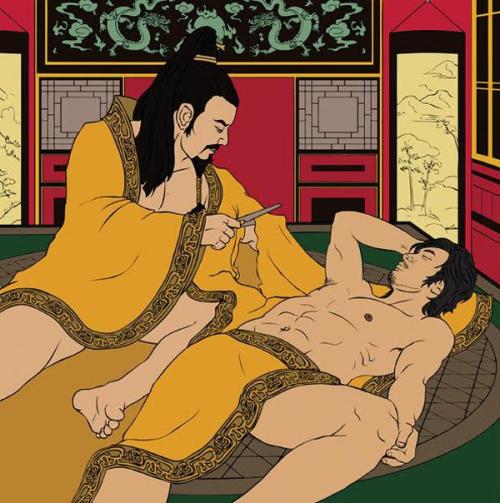
Chinese emperor Ai of Han, fell in love with a minor official, a man named Dong Xian, and bestowed upon him great political power and a magnificent palace. Legend has it that one day while the two men were sleeping in the same bed, the emperor was roused from his sleep by pressing business. Dong Xian had fallen asleep across the emperor’s robe, but rather than awaken his peaceful lover, the Emperor cut his robe free at the sleeve. Thus “the passion of the cut sleeve” became a euphemism for same-sex love in China. — R.G.L.
in ancient rome one of the careers you could have was professional mourner, and your job was just to go to funerals and wail as loudly as you could, and honestly we should bring that back because that’s the sort of career i could see myself doing in the future
Modern historians tend to characterize the time where English borrowed a lot of words from Norman French as a period of richness and innovation, but sure enough, writers at the time were grumbling about how kids these days were speaking absolutely terrible Anglo Saxon.
Full quote, from Bokenham in 1440 (notice how he’s ironically using lots of Latinate words in his complaint, like “corruption” and “familiar” and “augmentation”):
And þis corrupcioun of Englysshe men yn þer modre-tounge, begunne as I
seyde with famylyar commixtion of Danys firste and of Normannys aftir,
toke grete augmentacioun and encrees aftir þe commying of William
conquerour by two thyngis. The firste was: by decre and ordynaunce of þe
seide William conqueror children in gramer-scolis ageyns þe consuetude
and þe custom of all oþer nacyons, here owne modre-tonge lafte and
forsakyn, lernyd here Donet on Frenssh and to construyn yn Frenssh and to
maken here Latyns on þe same wyse. The secounde cause was þat by the
same decre lordis sonys and all nobyll and worthy mennys children were
fyrste set to lyrnyn and speken Frensshe, or þan þey cowde spekyn
Ynglyssh and þat all wrytyngis and endentyngis and all maner plees and
contravercyes in courtis of þe lawe, and all maner reknygnis and countis yn
howsoolde schulle be doon yn the same. And þis seeyinge, þe rurales, þat
þey myghte semyn þe more worschipfull and honorable and þe redliere
comyn to þe famyliarite of þe worthy and þe grete, leftyn hure modre tounge
and labouryd to kunne spekyn Frenssh: and thus by processe of tyme
barbariʒid thei in bothyn and spokyn neythyr good Frenssh nor good
Englyssh.
Here’s a translated version if you don’t feel like puzzling through the Middle English:
And this corruption of Englishmen in their mother tongue, begun, as I
have said, in the every-day admixture of first Danish and then Norman,
was greatly augmented and increased after the arrival of William the
Conqueror by two things. The first was by the decree and ordinance of
the aforesaid William the Conqueror that children in the grammar
schools should leave off and forsake their own mother tongue and learn
their Donatus in French and construe it in French and do their Latin in
the same way, which is something which goes against the habit and
custom of all other nations. The second cause was that in the same
decree the sons of the lords and the children of all the nobles and
worthy men were first set to learn and speak French, before they could
speak English and that all writings and indentureships and all manner of
pleas and controversies in courts of law and all manner of calculations
and accounts in households should be done in the same (language).
And seeing this, the rural people [saw] that they might seem to be the
more esteemed and honorable and the more easily open to the
acquaintance of the worthy and the great, abandoned their mother
tongue and labored to be able to speak French: and thus in the course
of time mutilated them both and spoke neither good French nor good
English.
The carriage stopped; Mr. L. went and brought us ice-creams. I swallowed a whole one, and we drank water after. Going on, I felt a strange numbness at my stomach, which brought to my mind the fate of my friend General G., who, having taken a dose of medicine, some time after drank a glass of cold water, and in an hour was dead. It seemed to me that I was about to follow his example; and, being in good company, and feeling no pain, there could not be a more charming occasion for an exit. I became very gay, and F. said I was never /si aimable/. The affair, however, took a very different course, and I was obliged “to do as people do in France.”
Private Journal of Aaron Burr. Paris, June 23, 1811.
The thing about emo (as a musical genre and a cultural phenomenon) is, I think, that it was a response to the September 11, 2001 terror attacks and the Bush administration’s painful mishandling thereof.
No, I’m serious. My Chemical Romance was formed as a direct result of Gerard Way witnessing the towers fall. Green Day’s ‘American Idiot’ (an album that, at least as far as I can tell from having been a teenager in Canada at the time, was seminal in influencing the look and sound of emo) is all about the Bush administration – all the lyrics are about life under a democratic dystopia and many reference current events from the time – and it came out in 2004, halfway through the Bush presidency. A bunch of Linkin Park’s stuff makes reference to it also, especially their album ‘Minutes to Midnight’, where they first started moving out of the nu-metal/rap sound they’d been working with before and into a more mainstream emo-rock sound. That album came out in 2007. All of the really big bands with that kind of sound – and most of the smaller ones with more of a punk/hardcore sound but similar themes – were active in the mainstream from around 2001-2010. Many of them didn’t survive past 2009, and those that did either totally reinvented themselves (Fall Out Boy, Panic! At The Disco, MCR for the five minutes it took to produce Danger Days, Linkin Park) or became near-totally irrelevant (Paramore dropped an album sometime in the last two years; did any of you know that? And Green Day haven’t mattered since 21st Century Breakdown, which was released in 2009).
Why? Well, many of you are probably too young to remember this, but the 2001 terror attacks were what really made ‘Islamic terrorism’ a real threat in the minds of most Westerners. We’d never experienced an attack of that scale on American soil, and it was just as the internet was really becoming a mainstay in every house and my generation was getting online. As a result, it was not only a major political event, but it was hugely personal – the coverage was everywhere, in everybody’s home, all the time, and there were a lot of kids being exposed to the coverage in such a way that they often had no good way to process it. I’m not exaggerating when I say it changed the way we live. I’m Canadian and I felt this shit. Before, we could fly to America domestic, without a passport. Now? Half the draconian, ridiculous rules that hold you up at the TSA today were initiated in September and October of 2001. It was the only thing anyone could think of to do – lock down, protect your own. People were scared, on a continental scale.
And to make matters worse, George W. Bush’s government, which had to somehow respond to and take point in the response to this unprecedented event, didn’t seem to have the first foggiest clue what they were doing. This was a government that not only didn’t seem to listen to its people, not only lied blatantly to its people, but did it badly. They made hugely unpopular decisions, including starting a war in the Middle East that dragged in multiple countries and completely failed to achieve its stated goal of catching Osama bin Laden or proving that he had in his control weapons of mass destruction (the whole war was predicated on the fact that these so-called weapons of mass destruction existed, that the Bush administration had good reason to believe that they existed, were under the control of the Taliban, and were going to be used against Western targets, none of which was ever proven to be true).
So, from 2001-2009, the two (TWO) full terms of the Bush presidency, there were a whole lot of people who couldn’t vote (be they under the age of majority, like most of the emo kids I knew, or Canadians unhappily dragged along with the US’ boneheaded foreign policy decisions because we’re allies, also like most of the emo kids I knew) and therefore felt, not only scared of basically the impending end of their world in a way that they hadn’t previously had to feel, and not only angry about being clearly lied to and clumsily manipulated when the truth was obvious to anyone with eyes, but also powerless to do anything to change anything about that. And meanwhile, people kept dying in this pointless war and the president kept trying to hold together the illusion that everything was hunky-dory.
And what was popular with teenagers from about 2001-2009? Yep. Emo.
Emo as a genre was very personal, very focused on the individual (with the exception of the albums I noted above), but lyrically and musically, it fit right with the cultural atmosphere of the time. People were scared of the impending end of their world/their lives? Three Cheers for Sweet Revenge and The Black Parade. People were angry about things they felt powerless to change? From Under The Cork Tree and Decemberunderground. Emo captured what kids were feeling about trying to fit into a world that was so clearly fucked up and broken and pretending to be okay, putting on a strong face to Show The Terrorists They Didn’t Win. Emo was about stripping away the mask, exposing the messy, angry, frightened, sad, true underbelly of American society at the time, and exposing hypocrisy – in individuals as much as in politicians. The hatred of ‘preps’ and ‘posers’? Totally not just a My Immortal thing. Emo was about wearing your heart on your sleeve, about it being okay to mourn, to rage, to be afraid for your life beyond this – and to keep moving forward regardless, step by slow step.
So what changed in 2009 that made the phenomenon fade without so much as a whimper? Simple. Hope. The Audacity of Hope, to be exact.
Barack Obama won his presidency largely because young people supported him. Those were the young people who suffered through feeling helpless and powerless under Bush, who wanted things to change but felt they had no chance of making it so. Barack Obama was a chance. One of his first campaign promises was to end the Iraq war, a promise he followed through on. And even if his presidency hasn’t been perfect, it has never been the Bush administration, with the feeling that the will of the people was being entirely and quietly ignored by those in power to further their own agendas.
What I am saying, then, I guess, is that it’s time to buy stocks in Hot Topic, because whatever happens in the upcoming US presidential election, there are a lot of young people who may soon be needing black, white, and red graphic band tees and Manic Panic hair dye.
From someone who was in American high school in 2001, we were also incredibly terrified for at least the early Bush years. We were all pretty sure that the draft could possibly be reinstated and we could get sucked into the war. Some of my friends and I had plans on how best to get Don’t Ask, Don’t Telled out of the draft. We were all absolutely terrified of the prospect.
in the 1960s, america would have been all to happy to extend civil rights to blacks if only they weren’t all just a bunch of lawless looters and rioters.
good thing we’ve grown as a society since then!
in the 1960s, america would have gladly listened to civil rights leaders – if only they weren’t all just stoking so much darn violence all the time!
good thing mlk’s image has been rehabilitated and black leaders are taken seriously now!
in the 1960s, the value of human life was placed above that of inert property – if only those uppity blacks would just take our word for it
thankfully the value of black life is recognized today!
in the 1960s, america really wanted to give black protestors the benefit of the doubt – if only they weren’t just so darn complicit in their own oppression
thank god those antiquated views are all behind us now!
in the 1960s, jobs, education and housing were ripe for the picking for minorities – they just insisted on wasting all that energy on aimless protests instead!
thank heavens we actually listen to their grievances now instead of just telling them to sit down and shut up!
in conclusion, everything would be fine if they had just stayed in the back of the bus instead of getting out and rocking it
(huge thanks to Rebel Blob for digging all these old cartoons up!)