Guy On Bicycle gets so smeared he leaves his hat behind to escape!
All Victorian ADULTS. Awesome.
I love this so much. Someone slowed it down so it’s not the old-fashioned herky-jerky of old films, now someone colorized it…the past feels like the present because, well, people. Lookit them having fun! *beams at everyone*
logging back onto this website to say that while i dont think (???) it was intentionally done, the scene before their “last day” where frank is working on a portrait of bill, reminded me of keith haring’s “unfinished painting”
comparison here before i explain:
keith haring’s painting was purposely made to look incomplete. haring was diagnosed with HIV in late 1988, and died in early 1990, at the age of 31. the painting is a self portrait, hitting us with the gut-punch reality of how the aids-epidemic robbed haring of the right to finish his own story. the overwhelming amount of empty space is a glaring reminder that haring didn’t just have a short life, he had an incomplete one. the piece points to all that empty space and says: this should have been filled out. this should all have been my art, my story, and my space. by claiming this empty space, haring claimed the empty space of his unlived life, that was taken from him and so many other people, by a negligent and homophobic society that refused to care about the pandemic ravaging an entire community worldwide.
now back to my original point: like i said, im really not sure if this was intentionally done by the show. but when i was watching this episode and i saw this scene, i immediately thought of this painting. the blue color of the eye trailing off onto the blank part of the canvas is, at least to me, a strong visual parallel.
and i feel like this visual parallel highlights some very important thematic parallels as well, which deserve to be talked about. in the show, the outbreak starts in 2003 which means that bill and frank have both lived through the aids-epidemic. they have seen people like them die. they have experienced the hatred and isolation that came with it. you could speculate and read into things ad nauseaum, but i thinks it’s safe to say that in this place and time, this also plays into how careful and hesitant they are, when they first start to show intimacy with each other. in their world, they didn’t even get to experience the legalization of gay marriage.
seeing as this show takes place during another, fictional, pandemic, airing at a time where the real world has just faced another actual pandemic, it is impossible to ignore this aspect of their story.
these two characters however, are not destroyed by the outbreak in the show. they find each other, they experience freedom, love, and a full life together. their life is not cut short.
in an absurd twist of fate, when the rest of the world is finally forced to experience what it’s like to be abandoned by your government during a devastating epidemic, this is when these two people find happiness. they get to go running, and have fights, and grow strawberries, and have friends over for dinner.
and after spending nearly twenty years together, frank spends his last time working not on a self portrait, but on a portrait of bill, the love of his life. this is the sort of thing that rightfully should have filled the empty space of haring’s work. finding love(s) spending your time together, that is a life lived.
and yet frank’s painting is unfinished, because of course we are never truly done living.we are never truly done loving. but he got so much more time, so much more story, than the people we lost to the aids epidemic, which the trailing off blue paint reminds us of.
at the same time their house is absolute filled with all the paintings that frank did finish, showing us all the good days he got with bill. and in a way, i feel like that is the show being very aware of what it is: a complete, beautiful story about two men loving each other, in a world that sorely lacks these stories. a world where we had so many unfinished, incomplete lives, that we lack an entire generation of older gay men.
and even though i was completely reduced to tears by the end of this episode, the ending still filled me with some sort of mournful joy. because yes, even though it was incredibly sad to see their last day, these two men got to fill so much of their empty space. they got to experience love, and they got to live their life. like bill says: “im old. im satisfied. and you were purpose.”
so many people didn’t get that. keith haring didn’t get that. a whole generation of queer people didn’t get that. that makes this episode so much more moving for me, because it is not just an incredibly beautiful love story, but it is an incredibly beautiful love story that the world should rightfully have seen millions more of. but all those lives were incomplete.
so with the undeniable, but unspoken, presence of the aids epidemic in the narrative of these characters, this visual reference to keith haring and aids, purposeful or not, is incredibly meaningful.
do i think going for a walk in a cemetery that’s open to the public 24/7 with a footpath and garden and everything is fucked up and immoral? no??? what the fuck???????????
i think it’s fucked up that we’ve made death, an inevitable thing that happens to everyone, into such a taboo subject that enjoying spending time in places where dead people exist is offensive and sinister to you
A few inscriptions on tombstones I photographed one day in Canongate Kirkyard, Edinburgh:
To the memory of Janet Cox, Wife of the Reverend Dr. Belfrage, Slateford; Who departed this Life, 28th March, 1821, Aged 35 Years; This Monument is Erected, as a tribute of Affection and Regret, by her husband. She was lovely in her life, as a Devoted Partner, Enlightened Companion, and Faithful Frind; and on her death bed Exemplified the Resignation with which the Christian can suffer, and the Peace with which the Christian can die.
Sacred to the memory of James L. Maxwell who died 18th April 1876, aged 75 years. And of Mary Welsh his wife who died 26th February 1872, aged [68] years. Also of their children William, died [12th] Sept. 1840, aged 8 [½] years. Mary Welsh, died 30 Sept. 18[42], aged 4 ½ years. William L., died 17th March 1844, aged 15 months. Alexander, died [6]th Sept., 1845, aged 5 ½ years. John Welsh, died [19]th June 184[6], aged 14 months. Adam, died 26th Sept. 1848, aged [6] months. Whosoever liveth and believeth in me shall never die. John [11:26]
In memory of James Blyth who died 6th June 1829, Aged 39 years. And Agnes his daughter who died 12th June 1827, Aged 17 months. And Marion Kerr his wife who died 18th March 1871, Aged 80 years.
Sacred to the Memory of Margaret Davidson, for [38] years the faithful housekeeper of the late Rev. John Clark M.A., minister of the old church St Giles Edinburgh, who died on the 18th April 1862. William Wright, died 4th October 18[63] aged [??] years, for many years the faithful servant of the Rev. John Clark M.A.
In loving memory of my dear husband, Pte. J. A. McConnell, Black Watch, son of the late Peter McConnell, killed in action 25th May 1918 aged 35 years. Interred at Hazelrouch.
Because I walked through these cemeteries and took these pictures, I now know (and so do you) that Janet Cox fell ill and died at age 35, and that her husband, a minister, loved and respected her so much that he wanted the world to know that she went right on impressing the hell out of him even when she was dying. That James and Mary Welsh Maxwell buried six of their children, and then lived another quarter of a century together. That Marion Kerr Blyth lost her baby daughter and her husband two years apart, and lived another 40 years without them. That the Rev. John Clark at St. Giles erected a monument to his servants among the headstones of merchants and scholars and architects. That Mrs. J. A. McConnell may never have visited her husband’s grave in France, but she had somewhere to leave flowers for him in Scotland.
And all those people erected those monuments so that you and I would know those things. They didn’t write those things for themselves; they already knew them. They wrote them, in stone, so that long after they were gone, people would still be able to read them, and would know these things. Because human lives are fragile and temporary, and when you lose someone, you can’t bear the thought that they’re just gone and that soon no one will know they were ever here.
At the churchyard near my house there’s the grave of two very young boys who died during the Victorian era. I always felt very sorry for them so I played Pokemon Go with them once.
“In 1404, King Taejong fell from his horse during a hunting expedition. Embarrassed, looking to his left and right, he commanded, “Do not let the historian find out about this.” To his disappointment, the historian accompanying the hunting party included these words in the annals, in addition to a description of the king’s fall.“
LMFAOOOOOO rip to that guy
i thought maybe this was fake, but there’s even a citation!
Taejong Sillok Book 7. 5th year of King Taejong’s Reign (1404), February 8.
Happy 618th anniversary of the day King Taejong fell from his horse!
Apparently the recorders were really intense about this. We have a record of King Taejong complaining about a recorder who followed him on a hunt in disguise and another who eavesdropped on him behind a screen. No one was allowed to see the records, even the king (one king did and killed five men based on what was written there, after which they took greater care to ensure it would never happen again), and changing the content or disclosing it was a capital punishment. Even when there were rival political factions trying to influence the writers, they wrote down what was a revision and what wasn’t and kept an original version with no revisions in it.
They also made sure to back up their data. They made four copies of it, then when three copies were lost in the Imrim Wars they decided to make five more copies just in case. One copy was destroyed in a rebellion, another was partially damaged in an invasion, and Japan stole one copy during their occupation and moved it to Tokyo University, where it was mostly destroyed in the Kanto Earthquake (47 books remained and were returned to South Korea in 2006). Now the whole thing is digitized, free on the internet, and translated into modern Korean for all to see.
It took centuries of meticulous recorders, justifiably paranoid copiers, absolutely determined historians, and painstaking infrastructure for this joke to be possible. Happy 618th anniversary to the day King Taejong fell from his horse.
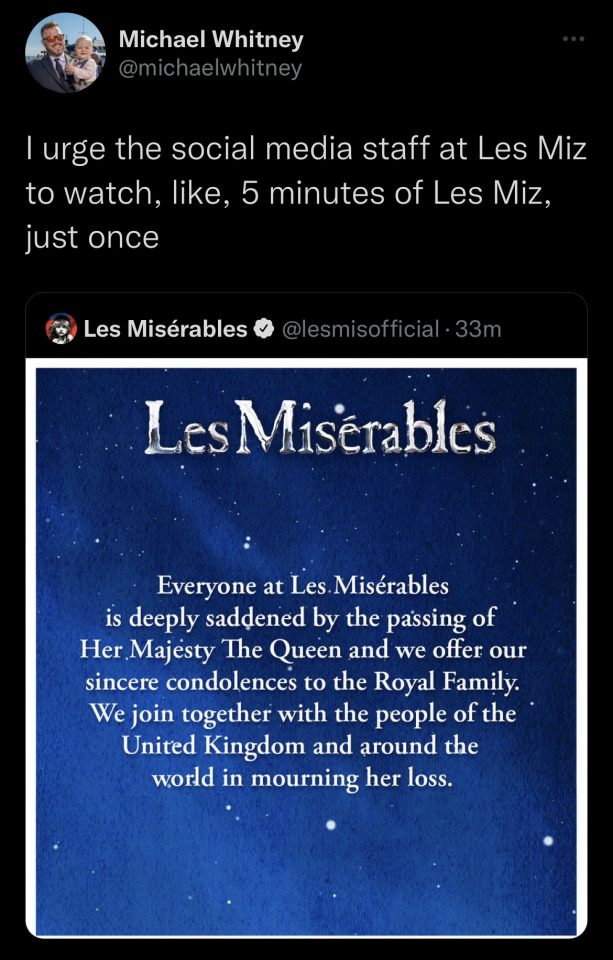
So I learned the most BEWILDERING thing today, which is that back in 2004 Queen Elizabeth II invited French President Jacques Chirac to a banquet at Windsor Castle and someone (presumably not either of them) got the idea to invite the West End Les Mis cast and have them perform the show’s greatest hits in a room of powerful Europeans.
While a protest was going on outside the castle gates. (Unfortunately it was not a protest in favour of anything good, but that’s another story.)
Someone then made a documentary about it feat. the rageful songs of Les Mis set to the backdrop of banqueting at Windsor Castle, which is accidentally FANTASTIC social commentary, and a very bemused Michael Ball.
(You can watch it here. The non-Les Mis parts are very pro-monarchy and incredibly cloying.)
Rare photos from trans history: Olympic runner and Zdeněk Koubek styles Cinda Glenn’s hair, 1936. Koubek was one of the first trans men to gain international fame after he transitioned in 1935.
this is inspiring weirdly complex emotions in me. like, it’s the fucking 1930s. I can hear the mid-atlantic newsreel voice. the fact that it plays coy with why he knows so much about women’s hairstyles, but like, as a funny surprise, not as shock and horror. the fact that it never deadnames him or uses incorrect pronouns. the fact that he looks like Mickey Rooney. idk it’s just making me feel feelings.
Doing some deep reading into Cherokee history for the project that I’m working on and I am continually amazed how fucking funny old Cherokee leaders were