Some advice for when you’re writing and find yourself stuck in the middle of a scene:
- kill someone
- ask this question: “What could go wrong?” and write exactly how it goes wrong
- switch the POV from your current character to another – a minor character, the antagonist, anyone
- stop writing whatever scene you’re struggling with and skip to the next one you want to write
- write the ending
- write a sex scene
- use a scene prompt
- use sentence starters
- read someone else’s writing
Never delete. Never read what you’ve already written. Pass Go, collect your $200, and keep going.
This is the literal best writing advice I have ever read. Period.
Special note: “Kill someone” means kill someone in the story. Please do not kill random real life passers by every time you hit a block. My lawyer says misunderstanding writing advice is not an acceptable defense. See you all in 25 to 50 years.
writing
So according to an interview with Neil Gaiman in the back of Good Omens, before Terry Pratchett became a full time writer he wrote at least 400 words a day.
I’ve been trying it out for a couple weeks now and let me tell you 400 words is a totally awesome goal. It is very approachable and not intimidating, often leads to more than 400 words cause well now I have to finish this scene.
Seriously I probably would have written nothing in the last couple weeks, instead I’ve written 1000′s of words.
10/10 would recommend.
Terry would be proud.
Writing a novel when you imagine all you stories in film format is hard because there’s really no written equivalent of “lens flare” or “slow motion montage backed by Gregorian choir”
You can get the same effect of a lens flare with close-detail descriptions, combined with breaks to new paragraphs.
Your slow-motion montage backed by a Gregorian choir can be done with a few technques that all involve repetition.
First is epizeuxis, the repeating of a word for emphasis.
Example:
Falling. Falling. Falling. There was nothing to keep Marie from plunging into the rolling river below. She could only hope for a miracle now, that she would come out alive somehow despite a twenty-foot drop into five-foot-deep water.
Then there’s anaphora, where you write a number of phrases with the same words at the beginning.
There were still mages out there living in terror of shining steel armor emblazoned with the Sword of Mercy.
There were still mages out there being forced by desperation into the clutches of demons.
There were mages out there being threatened with Tranquility as
punishment for their disobedience, and the threats were being made good
upon.Mages who had attempted to flee, but knew nothing of the outside
world and were forced to return to their prison out of need for
sustenance and shelter.Mages who only desired to find the families they were torn from.
Mages who only wanted to see the sun.
This kind of repetition effectively slows the pace of your writing and puts the focus on that small scene. That’s where you get your slow pan. The same repetition also has a subtle musicality to it depending on the words you use. That’s where you get the same vibe as you might get from a Gregorian choir.
Damn I made relatable reblog- bait post and writer Tumblr went hard with it. This is legitimately very good advice.
For more neat tricks (aka figures of rhetoric) like epizeuxis and anaphora, read THE ELEMENTS OF ELOQUENCE by Mark Forsyth. It’s both educational and delightful, not to mention overflowing with wry wit. Great book.
Hey, Writers
Yes, you. You, with the pen in hand, the laptop atop your lap. You, with the scribbles and the scrawls. You with the tappity-taps and clickity-clicks. You, with the eraser marks. You, with the red and green squiggles. You, who knows a piece of written paper equals a little more than half a typed page. You, who knows 50,000 words is about 100 regular pages. You, who doesn’t know how to spell a word because you’ve only heard it spoken, but never seen it written. You, who stuffed your work in the attic drawer. You, who saved your story inside a chain of files so nobody would read it by accident.
Your writing is important. Don’t give up.
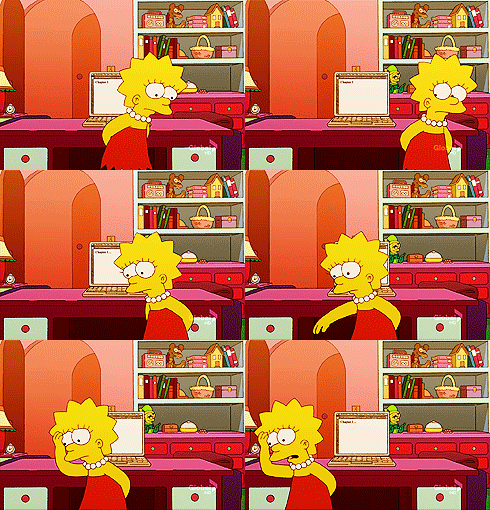
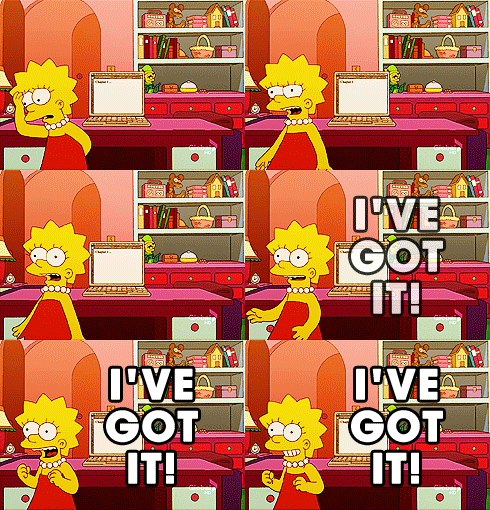
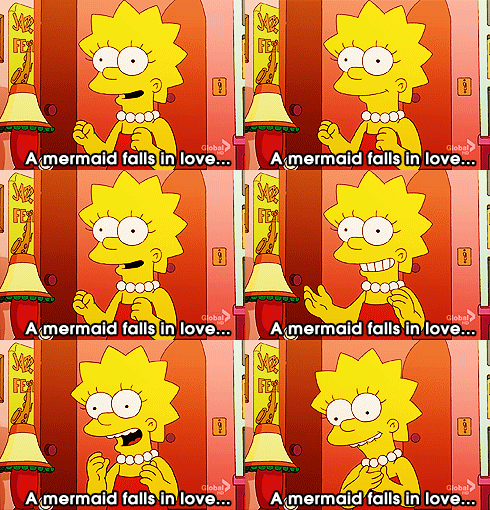
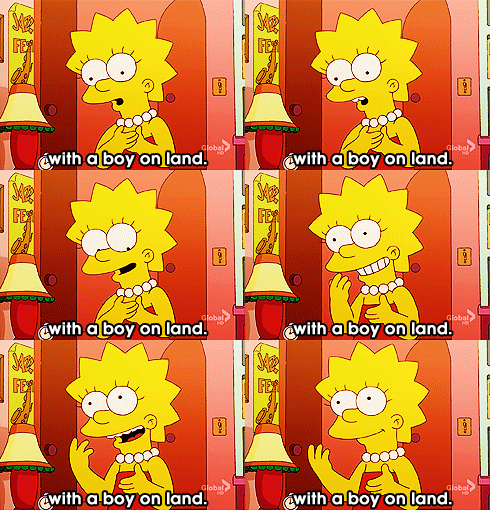
So I reblogged this before, but I actually wanted to stop and saying something, which is this:
Everyone who writes has felt that moment of “EVERYTHING HAS BEEN DONE BEFORE I’M A FAKE I’M A FAILURE I’M WORTHLESS,” and it’s always been over a moment like this one. That moment where you realize your idea has been done before. But here’s the thing. Ideas aren’t worthless, but they’re the pennies of your novel. They’re the smallest component.
Execution, on the other hand…that’s what does everything. That’s your dollar bills, stuffed into the jar until you have enough to go on the biggest adventure of your life.
So write your story where the mermaid falls in love with the boy who lives on land. Write him becoming a merman for her, or write him as a her, or write your sea witch as the heroine, or write your mermaid as a villain. Write a world. The idea, that’s a penny you found in the street. All the real value is going to come from you.
This, this, this. :)
Also
Novels have been around for more then three centuries, maybe even more.
Do you think your idea hasn’t been thought up before?
No idea is original on this earth, no matter how creative it can be, one other has probably thought of the same thing in their life time.
In turn, what does it matter if its “not creative?” Fuck em’. Write what you want to write, you’re not a failure, you’re a visionary, and you know what the difference if between you and the ones who also dared to dream of the same things you dreamt?
You have the will and the determination to put it out there.
Alien: So you’re saying that human brains sometimes just… malfunction? And see threats that aren’t really there?
Human: Yeah basically?
Alien: And then the human keeps living and doing things anyways???
Human: Yup
Alien: Woahhhhhh. Woahhhhh. Humans are badass.
Aliens would probably have fundamentally different responses to trauma than humans would,like- their brains. would be so fundamentally different. at a basic chemical and structural level we’d have to relearn everything, in this scenario the alien species is REALLY BAD at continuing to function with even a slightly impaired brain, and deals with it with LOTS OF BABIES, Oh yeah great grandpa died three years back when he got really surprised and WHAT DO YOU MEAN,THAT A HUMAN GOT STABBED THROUGH THE HEAD AND CONTINUED TO LIVE I DON’T BELIEVE YOU THAT’S IMPOSSIBLE, I bet they are all pregnant all the time and when they randomly die the baby eats their way out of the corpse, they are insectoid and look a lot like praying manti and they REALLY FREAK OUT THEIR HUMAN FRIENDS THE FIRST TIME IT HAPPENS, there is a sort of generational memory that happens which is how they managed to develop tech at all being so fragile, so when the creatures get depressed or homesick or manic and die it’s not like their human friends have lost them forever, except for how it sort of is, (via @songofsunset)
PLEASE IMAGINE THE FIRST TIME AN ALIEN HAS ONE OF THEIR HUMAN FRIENDS DIE
‘so hey, that was a great funeral, cool outfits, always glad to learn more about your culture and stuff. So, when is she coming back?’
‘She- she’s not coming back’
‘Yeah, not as Megan, but when is her replacement coming back?’
‘We’re- not hiring anyone new for a couple weeks???’
‘no no no, you’re not getting what I’m saying- I want to ask her about that book she lent me- can I keep it for another week or two, or does her new version want it back?’
The humans stare at the alien and just. slowly start to figure out what the alien is saying. The alien shuffles nervously, their six spindly legs making a skritching noise that echoes in the cold chapel. Finally, the kindest of the humans takes the alien aside and-
‘hey. so. Us humans don’t come back when we die. Not like you do.’
‘what? No, but you clearly talk about reincarnation, and-’
‘Those are just stories, Six. When humans die, we’re gone. We don’t come back.’
The alien laughs ‘No, see, cuz that would mean that- that would mean. That Megan- Megan is-’ The alien cuts off the hissing noise that is their equivalent of a sob. ‘I have to go.’
The alien spends a week in their spaceship, the only place they can send communication to their Mother. When they come back, their carapace is a glistening new shade of red, and they’ve ended up as a different gender. When the lab adviser asks them how they are feeling about Megan-
‘Megan? Oh, yes, my previous version was very fond of Megan.’ The alien cocks their head, like a particularly thoughtful bird. ‘I suppose that I regret her loss. She was a valuable member of the team.’
The lab adviser lets this be- they are aliens after all. But later, when lab hours are done, the adviser notices Six double and triple-checking all the lab equipment, especially- well. The accident that took Megan will never happen again.
The book is never returned.
Now imagine the flip side: Sevan finds out his human friend is due to have a baby in six months. Six months! He asks, and finds that no, there’s no way to delay a human birth. In six months, a new version of his friend will emerge. Will they still like space operas? What about visiting that smoothie place in quadrant 6? Will they even still want to be friends?
His friend asks him to be visit the baby, after it’s born. Of course, of course he will. It’s the least he can do. There’s always that vulnerable phase after birth when you haven’t got the hang of the new motor controls, and everyone needs a helping palp for the first few months.
The night he hears that the new baby has been born, he wails quietly and recites the qualities of his friend that he will miss the most.
Three days later, he gathers his resolve and knocks on the hatch of his friend’s place. Strangely, the access panel hasn’t been lowered – rude. He’ll make sure that’s one of the first things changed. His friends partner opens the door and lets him in and there – there is his friend,looking tired but well, a miniature copy of herself held in her arms. Imagine his joy when he finds out that not only will he get to spend longer with his current friend, but there will be another friend to get to know!
I find it impossible to write fiction that’s set after 2002. [….] It’s just that it’s inconceivable to depict contemporary times authentically without including interludes where characters stare at their cell phones instead of advancing their plotlines – their lives – towards some conclusion. Which is, as a thing to read, mind-numbingly dull. Unless I write “and then his Galaxy 4’s battery died” no one can ever get lost, forget an important fact, meet a partner outside of a dating site, or do anything that doesn’t eventually have them picking up a phone. So I’m stuck writing about an era where Ethan Hawke was considered the pinnacle of manliness. Is
“Your Phone Is Ruining You For Us“ – Robert Lanham, The Awl
It is just unbelievable how “old man yells at cloud” neo-luddites come off when they go on rants about how technology is destroying everything interesting about humanity. I mean, leaving aside the bizarre circlejerk that is the second half of the article, which is its own trek into evidence-free weirdness, it’s just like…how much of a fucking dinosaur do you have to be to write paragraphs like this? And it’s not just this dude.
I mean, you can’t throw a rock without you hitting some cranky middle-aged white-dude author who’s been kind of successful (or really successful) for a while now going “Kids these days with their Honeys Boo Boo and their feetball and their Pokemons and their cell phones and their utterly banal and uninteresting alienation that occurs even while they’re simultaneously more connected than ever before.”
You, as a writer, honestly cannot come up with any way to either incorporate phones interestingly or a way to ignore them convincingly? None? To the point that you’re “stuck” being unable to set your work past the ’90s? You do realize that you’re self-identifying as less adaptable and clever than like 80% of sitcom writers in that case, yeah?
I mean, the only way you can come to the conclusion that this is just impossible to do is if you were either tragically unimaginative to begin with or if your refusal to engage with the technology is so complete that you’re left sincerely judging these things by their ad campaigns.
You don’t want to engage with the technology? Fine. Leave it on the cutting-room floor. Nobody wants to read about somebody playing CandyCrush for half an hour on the subway if that’s the only thing going on. (Other things nobody wants to read about: A character watching tv for half an hour, a character reading a book for half an hour, a character knitting for half an hour, a character spending half an hour doing nothing but plowing a fucking field, etc.) You can’t come up with a way to make phone-use interesting and plot-advancing? Sorry, that’s you sucking.
Technology isn’t perfect. Technology isn’t uniformly accessible. Technology is subject to user error, and outages, and sabotage, and theft.
Remember this?

[London tube announcement sign reading “For the benefit of passengers using Apple iOS 6, local area maps are available from the booking office.”]
Yeah. GoogleMaps will quite frequently send you rabbiting through a loop of toll road for no reason, too. Or confidently insist that your new dentist’s office is in the middle of a highway, or that a patch of territory really belongs to the wrong country. GPS apps will cheerily direct you to make a left-hand turn where strictly prohibited, or instruct you to drive into the sea. You can absolutely get lost without your phone dying.
Careless accidents or casual misbehavior can take on horror-movie proportions given the right circumstances. Giving in to the temptation of a quick surreptitious Googling of your date or a new acquaintance while they’re in the bathroom can cast a completely new light on things they’ve said and leave you spending the rest of the evening in a conversational Twilight Zone. An unlocked phone left unattended presents an opportunity for snooping previously unheard of without having access to someone’s home. A lost or stolen phone presents the possibility of trouble in a similar proportion, only with added malicious intent and threats of damage. The immediacy of contact can be used to defuse or accelerate confrontations, or add new layers to previously-established inter-character tension.
As many interesting plot-device limitations as phones (theoretically) destroy, they provide that many more new opportunities. Or you just come up with new ways to retain the same limitations. When residential lines became the expectation, films started establishing that service was out, or the line was cut, or that the home didn’t have one in order to explain why characters didn’t just call somebody. Once candy-bar phones became de rigueur, stories started establishing that nobody had any bars. Smart phones are now sidelined by apps not working, or batteries being drained, or service being unavailable. Done and done. Hell, even in any area with perfect reception and functionality, emergency situations can still involve yelling at a 911 operator that you’re on the side of the fucking road being attacked by a fucking O-T-T-E-R, and no, you don’t have a fucking address to give them.
If you don’t want to bother with that, fine. If you prefer to write in a time when these things didn’t have to be taken into account, that’s fine, too. But don’t sit there acting like it can’t be done interestingly or intelligently or to the benefit of the plotline, if you care to take two seconds and consider how all that information, connection, and accessibility grits or greases the gears for your characters and your plots.
(via stuckinabucket)
— Agreed. The only reason to complain about technology ruining storytelling is if you are copying old stories where a simple phone call would fix everything.
Put yourself out on the cutting edge where a simple phone call CAN’T fix everything. Resist the impulse to create a circumstance that eliminates tech (such as, no one’s phone works for X bullshit reason) and step into an undiscovered country of plot points NO ONE HAS THOUGHT OF YET.
(via annerocious)
I know this is a super long post and I hate to add to it but I agree and I also point out that people have been writing science fiction for decades that assume everything or many things that are now true of modern day. Instant communication, instant access to information, etc. And yet, miraculously, those stories managed to be written! Maybe they didn’t predict that we’d like to check neko atsume every half hour given the chance. But they also did include limitations, interruptions, etc. that didn’t happen to come true. Often in ways that are way more inconvenient than ‘ugh why cant I turn off facebook alerts.’ If people could write about basically the internet and cell phones before these things existed or while they were developing technologies, what paralyzes people from writing about them now?
(via betterbemeta)
the worst thing about writing is that you aren’t just a writer. you have to be a thousand things. a poet, a flirt, a weapons expert, a bleeding heart, a scholar, a legendary cook, a theorist, an engineer, a reckless teenage girl, a dying god. you have to be able to write monologues and speeches and heartfelt confessions, and you have to make them believable. writing is putting yourself into someone else’s shoes.
writing is really hard (◕︿◕✿)
another valuable writing lesson i’ve internalized from Homestuck: make your characters like things. and not cool things. the homestuck kids are richly devoted to terrible Nicholas Cage movies and bad romance novels, historical reenactment, nerd rap, and wizard slash. they make shipping grids. they are furries and bad hackers and LARPers and juggalos.
that’s what gives characters depth, not their sparkling eyes or their bad-ass ninja skills, or genius I.Q. give them disorders and hang-ups and quirks, make them obsessed with sudoku or crafting stuffed animals, make them loathe bananas and going out in the cold.
On Fanfiction
I was cruising through the net, following the cold trail of one of the periodic “Is or is not Fanfic the Ultimate Literary Evil?” arguments that crop up regularly, and I’m now bursting to make a point that I never see made by fic defenders.
We’re all familiar with the normal defenses of fic: it’s done out of love, it’s training, it’s for fun. Those are all good and valid defenses!
But they miss something. They damn with faint praise. Because the thing is, when you commit this particular Ultimate Literary Evil you’ve now told a story. And stories are powerful. The fact that it wasn’t in an original world or with original characters doesn’t necessarily make it less powerful to any given reader.
I would never have made this argument a few years ago. A few years ago I hadn’t received messages from people who were deeply touched by something I wrote in fanfic. So what if it’s only two or three or four people, and I used someone else’s world and characters? For those two or three or four people, I wrote something fucking important. You cannot tell me that isn’t a valid use of my time and expect me to feel chastened. I don’t buy it. I won’t feel ashamed. I will laugh when you call something that touches other people ‘literary masturbation.’ Apparently you’re not too up on your sex terminology.
Someone could argue that if I’d managed the same thing with original characters in an original world, it could’ve touched more people. They might be right! On the other hand, it might never have been accepted for publication, or found a market if self published, and more importantly I would never have written it because I didn’t realize I could write. The story wouldn’t have happened. Instead, thanks to fanfic being a thing, it did. And for two or three or four people it mattered. When we talk about defending fanfic, can we occasionally talk about that?
I once had an active serviceman who told me that my FF7 and FF8 fic helped get him through the war. That’ll humble you. People have told me my fanfic helped get them through long nights, through grief, through hard times. It was a solace to people who needed solace. And because it was fanfic, it was easier to reach the people who needed it. They knew those people already. That world was dear to them already. They were being comforted by friends, not strangers.
Stories are like swords. Even if you’ve borrowed the sword, even if you didn’t forge it yourself from ore and fire, it’s still your body and your skill that makes use of it. It can still draw blood, it can strike down things that attack you, it can still defend something you hold dear. Don’t get me wrong, a sword you’ve made yourself is powerful. You know it down to its very molecules, are intimate with its heft and its reach. It is part of your own arm. But that can make you hesitate to use it sometimes, if you’re afraid that swinging it too recklessly will notch the blade. Is it strong enough, you think. Will it stand this? I worked so hard to make it. A blade you snatched up because you needed a weapon in your hand is not prey to such fears. You will use it to beat against your foes until it either saves you or it shatters.
But whether you made that sword yourself or picked it up from someone who fell on the field, the fight you fight with it is always yours.
Literary critics who sneer at fanfic are so infuriatingly shortsighted, because they all totally ignore how their precious literature, as in individual stories that are created, disseminated, and protected as commercial products, are a totally modern industrial capitalist thing and honestly not how humans have ever done it before like a couple centuries ago. Plus like, who benefits most from literature? Same dudes who benefit most from capitalism: the people in power, the people with privilege. There’s a reason literary canon is composed of fucking white straight dudes who write about white straight dudes fucking.
Fanfiction is a modern expression of the oral tradition—for the rest of us, by the rest of us, about the rest of us—and I think that’s fucking wonderful and speaks to a need that absolutely isn’t being met by the publishing industry. The need to come together as a close community, I think, and take the characters of our mythology and tell them getting drunk and married and tricked and left behind and sent to war and comforted and found again and learning the lessons that every generation learns over and over. It’s wonderful. I love it. I’m always going to love it.
Stories are fractal by nature. Even when there’s just one version in print, you have it multiplied by every reader’s experience of it in light of who they are, what they like, what they want. And then many people will put themselves in the place of the protagonist, or another character, and spend a lot of time thinking about what they’d do in that character’s place. Or adjusting happenings so they like the results better.
That’s not fic yet, but it is a story.
But the best stories grow. This can happen in the language of capitalism—a remake of a classic movie, a series of books focusing on what happened afterwards or before—or it can happen in the language of humanity. Children playing with sticks as lightsabers, Jedi Princess Leia saving Alderaan by dueling Vader; a father reading his kids The Hobbit as a bedtime story as an interactive, “what would you like to happen next?” way so that the dwarves win the wargs over with doggie biscuits that they had in their pockets and ride to Erebor on giant wolves, people writing and sharing their ideas for deleted outtake scenes from Star Trek and slow-build fierce and tender romance with startling bursts of hot sex between Hawkeye and Agent Coulson.
A story at its most successful is a fully developed fractal, retold a million times and a million ways, with stories based on stories based on stories. Fanfic of fanfic of fanfic. Stories based on headcanons, stories based on prompts, stories that put the Guardians of the Galaxy in a coffee-shop AU and stories where the Transformers are planet-wandering nomads and stories where characters from one story are placed into a world from another. Stories that could be canon, stories that are the farthest thing from canon, stories that are plausible, stories that would never happen, stories that give depth to a character or explore the consequences of one different plot event or rewrite the whole thing from scratch.
This is what stories are supposed to be.
This is what stories are.