One of my favorite phrases my Creative Writing professor had for when you’re writing fantasy is ‘giving your story a Flux Capacitor’.
Because it’s not real, it doesn’t exist. But the way it’s thrown into Back to the Future, at no point does it throw the audience off or suspend any more disbelief than time travel would. You believe Doc when he says he created the Flux Capacitor – the thing that makes time travel possible, because the universe never questions him.
So it essentially means like, there are going to be elements to your universe that are just not gonna make any sense, even if you set up a whole system based on it. And the only way to make it work is completely own it. You cannot second-guess your system or else the reader will too. You can give it the strangest explanation, but write it like you own it.
Either you’ve got to follow the rules of reality and physics and shit TO THE LETTER, or you have to say “naaaaaah” and fuck off with your magic/sci-fi/whatever to have a marvelous garden party where reality isn’t invited.
Everyone: What do u do Me: *opens my dramatic 2am cellphone notes* I’m a writer actually
That is exactly what you should be saying. I’ve got a book on writing and there’s a section that reiterates this:
“Once you’ve started your [whatever you’re writing], if a friend or family member tells people you’re a writer, agree with him. Do not negate the statement by saying you’ve never been published, that you’ve just started, that you don’t have an agent, or that you’re not any good yet. If you keep telling people you’re not really a writer, your subconscious will start believing it.”
Keep saying you’re a writer. Who the fuck cares if all you’ve got is notes on a phone. You won’t get anywhere by denying it.
I always find it kind of weird that matriarchal cultures in fiction are always “women fight and hunt, men stay home and care for the babies” because world-building-wise, it makes no sense
think about it. like, assuming that gender even works the same in this fantasy culture as it does in ours, with gender conflated with sex (because let’s be real, all of these stories assume that), men wouldn’t be the ones to make the babies, so why would they be the ones to care for the babies? why is fighting and hunting necessary for leadership?
writing a matriarchy this way is just lazy, because you’re just taking the patriarchy and just swapping the people in it, rather than actually swapping the culture. especially when there are so many other cool things you could explore. like, what if it’s not a swap of roles but of what society deems important?
maybe a matriarchy would have hunting and fighting be part of the man’s job, but undervalued. like taking the trash out or cleaning toilets: necessary, but gross, and not noble or interesting. maybe farming is now the most important thing, and is given a lot of spiritual and cultural weight.
how would law work? what crimes would exist, and what things would be considered too trivial to make illegal? who gets what property? why?
how would religion work? how would you mark time or the passage into adulthood? what would marriage look like? if bloodlines are through the mother, bastardy wouldn’t even be a concept – how does that work?
what qualities would be most important in a person? how would you define strength or leadership? what knowledge would be the most coveted and protected? what acts or roles are considered useless or degrading?
like, you can’t just take our current society and say you’re turning it on its head when you’re just regurgitating it wholesale. you have to really think about why things are the way they are and change that.
I keep on seeing people making these posts like “OMG I just read such a wonderful story, my writing will never be that good, farewell cruel world throwing myself down a well!” So I’m here now to just toss out the idea that, short of certain types of major problems with your writing (incomprehensibly bad grammar, stories that are all about your own highly specific and bizarre set of kinks), your writing is almost always going to be much more enjoyable for everyone else than it is for you.
Think about it: so much of the beauty of good writing comes from surprise. Not, like, a SHOCKING TWIST, but that little jolt of surprise and recognition that you get from a well put-together metaphor or turn of phrase, or how the punchline of a joke startles you into laughing.
So of course your writing doesn’t seem that good or interesting to you: you can’t find any of it clever because you know all the tricks already.
The problem isn’t that your writing is bad, it’s that enjoying your own writing is like trying to tickle yourself.
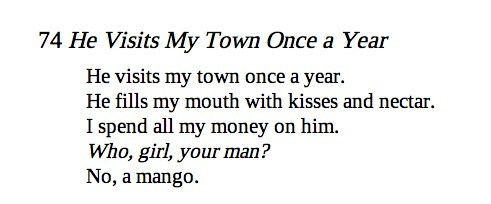
lmao i’m so happy and surprised to see how this thing blew up. this style of poetry is actually an entire genre in hindavi literature. it is a type of folk poetry called kahmukarni, and it involves two playful female speakers seemingly speaking about their lovers and ending in a wordplay. they’re very earthy-sounding in their folk performances, and they are traditionally sung by women. here’s another one by khusrow that i like:
p.s. these are all from sunil sharma’s translations (which is prob as good as it gets in translation)
Freelance worker lives in huge, gorgeous house/apartment in expensive area despite never seeming to be working
Characters work 8-5 office job with hour-long commute, but go to bed no earlier than midnight and get up in time for morning sex and long, leisurely cooked breakfasts every day
Do these characters even have jobs?
Single parent has way more communication with child’s teacher than is normal; leads to dating; administration somehow has no problem with this.
“I know I could never afford this mansion, but it’s OK I inherited it. No, paying property taxes isn’t difficult on my salary. I don’t even know how much the place is worth. Are property taxes a thing?”
There are two levels of cooking skills: gourmet food every time no recipe, and sets pot of boiling water on fire somehow. No one is ever in between these two skill sets. People on each level always end up dating each other.
Despite the gourmet meals described needing like seven pots to cook, no one ever does dishes.
Character shares a bottle of wine with their date (2 and half glasses each), and they both get falling-down drunk.
Later, one of them drinks an entire bottle of whiskey by themselves and does not die.
Were there any books or plays famous for being badly written almost to an archetypal hilarity before My Immortal? Like were there any 19th century memetic gothic romances or?
Even just within SF fandom, The Eye of Argon (1970) is a classic viral example of hilariously bad writing from pre-Internet days; there were contests at cons to see who could get the farthest reading it without cracking up.
William Topaz McGonagall’s poetry was considered hilariously bad in his day (late 19th century); according to Wikipedia, “He found lucrative work performing his poetry at a local circus. He read his poems while the crowd was permitted to pelt him with eggs, flour, herrings, potatoes and stale bread. For this, he received fifteen shillings a night.”
I don’t know much more about the history of memetically bad literature than these two examples, but hopefully people can add more!
Also, “A Tragedy” by Theophile-Jule-Henri “Theo” Marzials, considered by some to be the worst poem ever written in the English language. (Obviously I am in love with it and intend to somehow incorporate it into my wedding vows.) http://homepages.wmich.edu/~cooneys/poems/bad/Marzials.Tragedy.html
My advice when folks are struggling with writing in the third-person omniscient is
to Lemony Snicket it up. Give your omniscient narrator strong opinions
about what’s going on. Don’t fall into the trap of assuming that the
third-person omniscient perspective must also use the objective voice;
those are two separate things, and many of the most popular and successful writers who’ve written in the third-person omniscient do not, in fact, use the objective voice.
“Willingness to admit the narrative has a voice” is, I think, a big part of what makes young adult literature so much more engaging than a lot of books marketed at adults, particularly adult men.
Honestly, this is one of my favourite things, to the point where I start trying to headcanon which character from the story would be the 3rd person omniscient narrator, based on the unconscious bias in the writing. There’s usually at least one character with a similar personality to the writer.
I like to headcanon all the Terry Pratchett Discworld books are loosely being told well after the fact from Death’s POV for example.
The one thing everyone tells a young writer, the holy grail of all direction, is to read more. I think this is right, but misdirected. Because when you ask what, they’ll usually try to sell on gravity’s rainbow, infinite jest, etc- as vitally necessary hurdles. What they won’t tell you: read the takeout menu. Even if you order the same thing every time. Read your cousin’s long winded Facebook posts about gun control. Read baptist church signs. Read instructions. I have found that since I began living this way, most of the prose that has changed me wasn’t trying to.