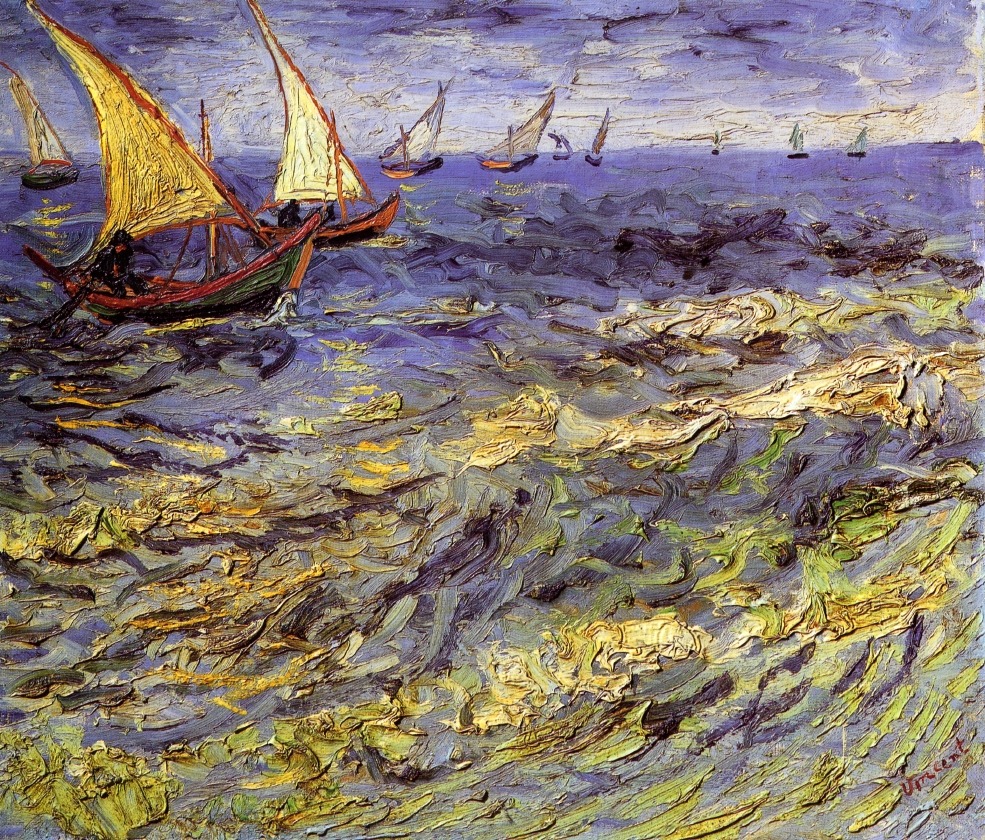
When Van Gogh was a young man in his early twenties, he was in London studying to be a clergyman. He had no thought of being an artist at all. he sat in his cheap little room writing a letter to his younger brother in Holland, whom he loved very much. He looked out his window at a watery twilight, a thin lampost, a star, and he said in his letter something like this: “it is so beautiful I must show you how it looks.” And then on his cheap ruled note paper, he made the most beautiful, tender, little drawing of it.
When I read this letter of Van Gogh’s it comforted me very much and seemed to throw a clear light on the whole road of Art. Before, I thought that to produce a work of painting or literature, you scowled and thought long and ponderously and weighed everything solemnly and learned everything that all artists had ever done aforetime, and what their influences and schools were, and you were extremely careful about *design* and *balance* and getting *interesting planes* into your painting, and avoided, with the most astringent severity, showing the faintest *acedemical* tendency, and were strictly modern. And so on and so on.
But the moment I read Van Gogh’s letter I knew what art was, and the creative impulse. It is a feeling of love and enthusiasm for something, and in a direct, simple, passionate and true way, you try to show this beauty in things to others, by drawing it.
And Van Gogh’s little drawing on the cheap note paper was a work of art because he loved the sky and the frail lamppost against it so seriously that he made the drawing with the most exquisite conscientiousness and care.
Brenda Ueland, If You Want to Write: A Book about Art, Independence and Spirit (via nyctaeus)
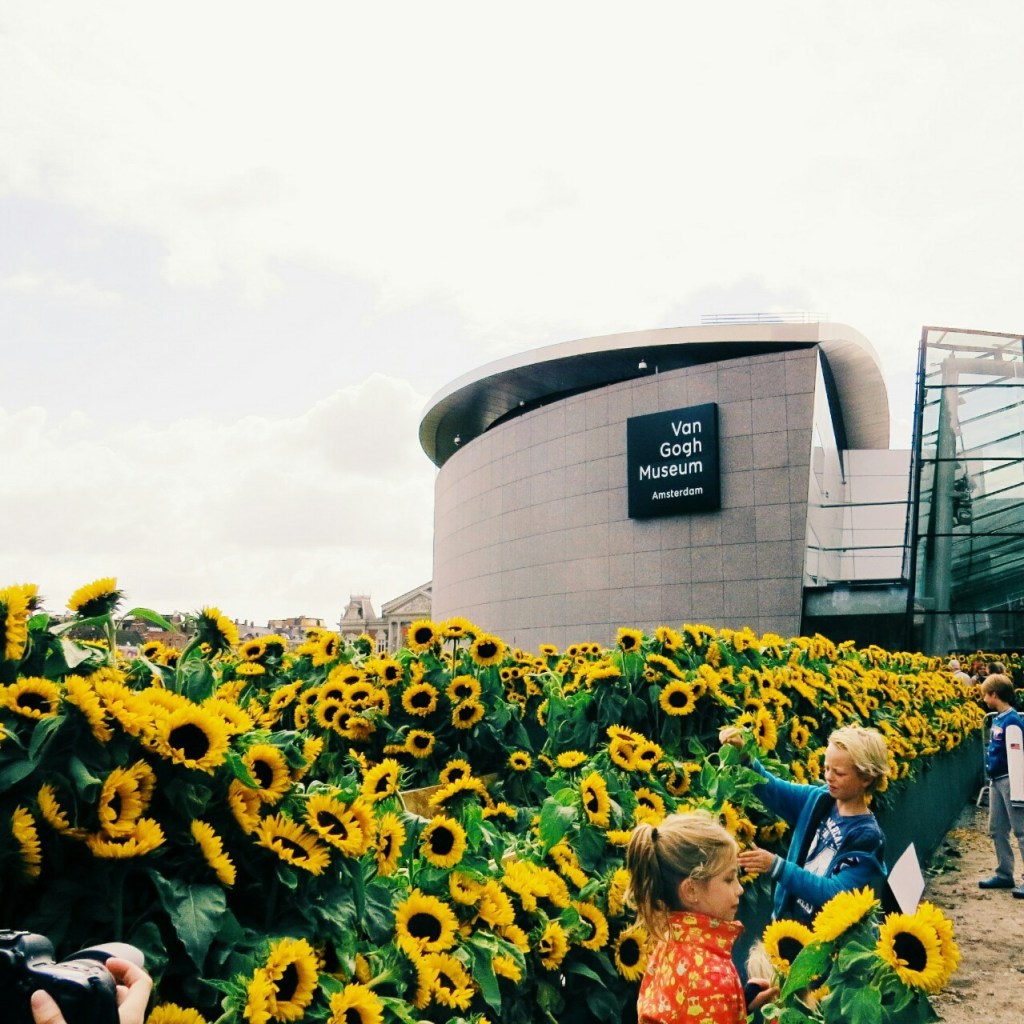
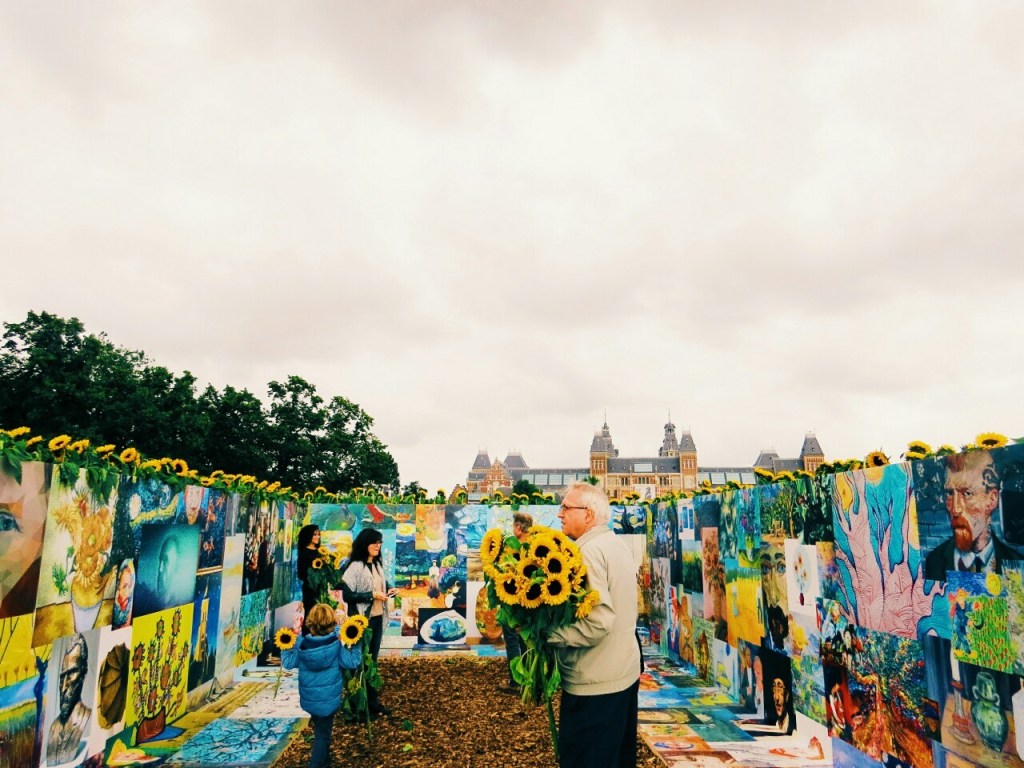
Van Gogh Museum in Amsterdam today, surrounded by a maze of 125,000 sunflowers where everyone was allowed to take home as many sunflowers as they wanted to.
Remember I said I’d write this? I wrote this! It’s also available on AO3.
Amy
When Amy Pond was nine years old, her art teacher presented a replica of Vase With 12 Sunflowers to the class, and asked every child to describe how it made them feel.
“Happy,” said most of the pupils, associating sunflowers with summer and sunshine and childhood.
“Sad,” said Mels.
Amy thought about it harder than anyone. “Proud,” she finally said.
“Why?” asked the teacher.
“I don’t know,” said Amy.
“Well,” the teacher said, smiling indulgently, “that’s not much good to anyone, then, is it?”
“Her name is on it,” Rory spoke up.
“Well spotted, Rory,” said the teacher. “But the Amy whose name is on here is a different Amy, who died a long time ago. She must have been a friend of Vincent’s.”
*
When Amy Pond was fourteen years old, she attended a talk at the local art museum. The subject was Van Gogh, his paintings and life.
Amy had not thought to dress up. Everyone else was in sensible clothes, suits, dresses. She was wearing a miniskirt. All eyes turned to her as she walked down through the rows of seats. Some of the glances were merely curious. Some were not.
The last available seat in the room was next to a middle-aged man who looked Amy up and down with obvious interest. Amy glared at him, did not adjust her skirt, and listened to the talk quietly and determinedly.
At the end, the discussion between the panelists turned to the mysterious inscription on Vase With 12 Sunflowers, and the woman’s name written there with love.
“It’s very likely that this Amy was a prostitute,” said one of the men.
*
When Amy Pond was nineteen years old, she and Mels went to Paris for a short holiday. After two days’ worth of Disneyland, Amy insisted on visiting the Louvre.
“You’re so boring,” Mels chided. “Just like an old lady.” But she came too.
When they got to the main gallery, it was packed with tourists and schoolchildren. All Amy could see was people’s backs, rather than the paintings she had come to get closer to. Mels elbowed a few people aside so that she could get a better view, but Amy realised she couldn’t be bothered. She felt incredibly disappointed, like she had suddenly been denied access to something belonging to her.
A young tour guide was giving a talk to a group of tourists, and she had reached Vase With 12 Sunflowers.
“People often ask who Amy was and the truth is we don’t really know,” the guide said. “But I like to think of her as a sort of…unattainable object for Van Gogh.”
“This is boring,” Amy said to Mels. “Let’s go.”
“Amy was his muse, his ideal of womanhood, perhaps…”
*
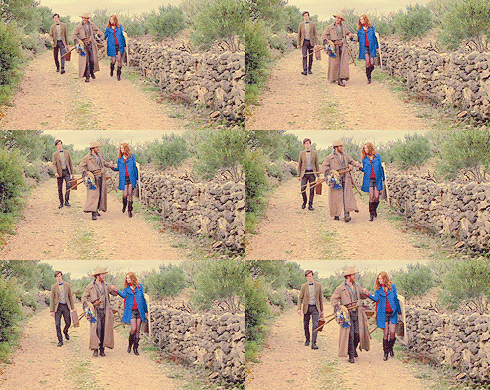
When Amy Pond was twenty-one years old, she went poking about in the TARDIS library.
“Amy,” said the Doctor, “I can’t help noticing you’re digging out all my books on Vincent Van Gogh. And some of those are from the thirtieth century, so do be careful with them.”
“I just want to look.”
“You want to look to see if you could have saved him,” the Doctor said gently, but (Amy thought) a little patronizingly.
“No,” said Amy.
“It’s understandable. You’ve suffered a lot of loss recently,” the Doctor said, before seemingly catching himself and saying, “Let’s go have some fun, eh, Amy?”
But Amy suddenly smacked the book she was reading with her fist, and stared at him with tears in her eyes. The Doctor hurried over to her, and as Amy tightened her fingers on his wrist they both stared at the text on the bottom of the page.
It is unlikely that “Amy” ever existed at all…she was most likely an imaginary figure concocted by Van Gogh to deal with his splintering reality...
*
When Amy Pond was twenty-three years old, she and her husband and her daughter and her Doctor visited the Great Galactic Art Gallery, which held fine paintings and artworks from every corner of the universe.
“Doctor,” she called to him with a slight gasp in her voice. He was giggling at a sculpture with River. “Doctor. Vincent is here.”
The Doctor came over and observed Vase With 12 Sunflowers, even brushing it with his fingertips a little. “See,” hesaid. “Itold him.”
But even as he turned away Amy found that she couldn’t. She pressed the little red button by the side of the painting, and a speaker into which visitors could ask questions popped up. “What would you like to know?” asked a robotic voice.
“Who is Amy?” asked Amy.
“Historians do not know,” said the voice, “but they believe she must have been a woman loved by van Gogh.”
*
When Amy Pond was thirty-seven years old, she bought a framed copy of Vase With 12 Sunflowers and hung it up in the New York apartment. When the sun set, the light hit it just right.
“That’s pretty,” Rory said to her. “You always loved van Gogh, didn’t you?”
“Yeah,” Amy said, her voice tinged with nostalgia. “Even met him once.”
Rory was eating a sandwich as he glanced at the painting, and Amy watched was amusement as his chewing suddenly slowed.
“Oh my god,” he said, after swallowing his food. “I remember we talked about it in school once. Vincent’s friend Amy. That’s you, isn’t it? You’re Amy!”
I often wonder about little Amelia Pond, growing up with her parents and Rory and Mels and a great love of art, drawing pictures of her Doctor long into the night – I wonder if that girl ever took note of the inscription on Vase With 12 Sunflowers. I bet she did. I bet when she went to art classes at school her teacher would discuss this mysterious Amy, say things like “We’ll never know who this woman was, only that Van Gogh must have loved her” and Amy Pond would smile because she knew it was her.
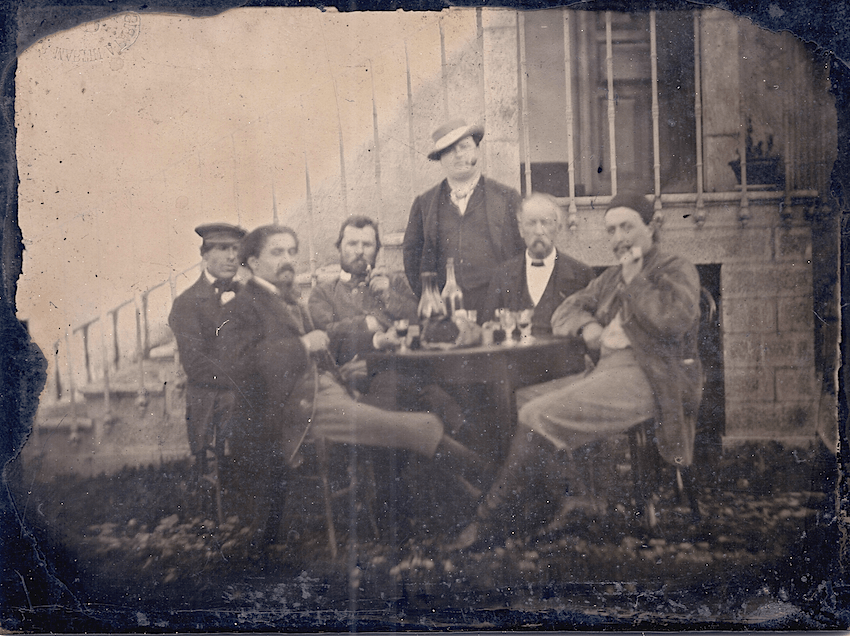
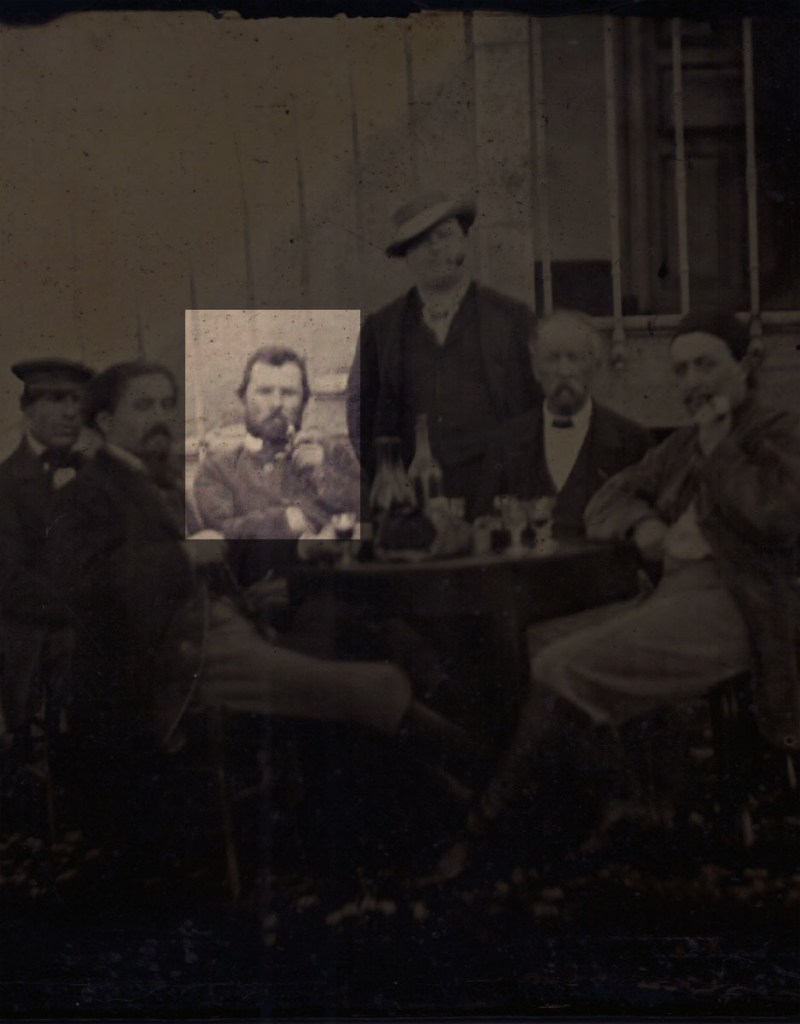
It looks like any other old photograph you might find at an estate sale, but the gentleman highlighted in the 2nd image is someone who’s never been seen in photographic form: Vincent Van Gogh!
A pair of collectors found the image at an estate sale and brought it to a team of experts in France who verified that it really was the famous painter.
It looks like any other old photograph you might find at an estate sale, but the gentleman highlighted in the 2nd image is someone who’s never been seen in photographic form: Vincent Van Gogh!
A pair of collectors found the image at an estate sale and brought it to a team of experts in France who verified that it really was the famous painter.