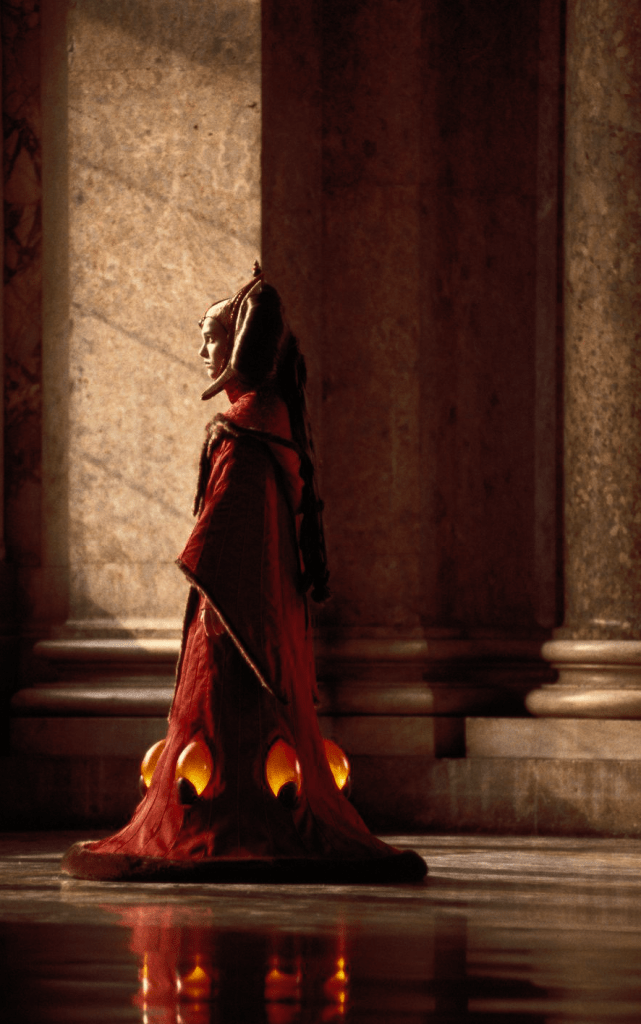
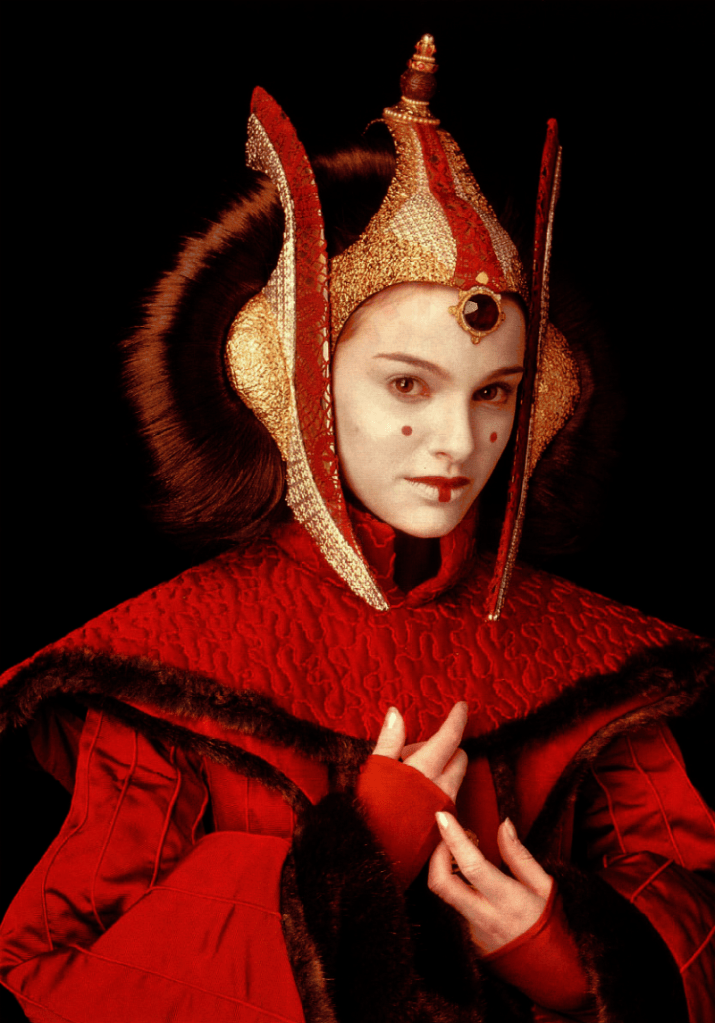
The brilliance of costume designer Trisha Biggar’s work in Episode I was first revealed in the sophisticated, otherworldly wardrobe of the young Queen Amidala, melding a great variety of cultures, traditions, and fabrics into a unique style that set the prequel costuming standard. The throne room gown is among the most complex pieces and shows the influence of Chinese Imperial Court styles.
“It took almost eight weeks to complete, and began with the manufacturing of an undergarment that resembled an upside-down ice cream cone. The shape of this undergarment was constructed using many narrow panels of canvas that were reinforced with rings of crinoline steel around the hem to keep the shape rigid and support the weight of the fabric, allowing it to skim the floor, creating a floating, gliding effect. The collar, hanging center-front piece, and sleeves were lined in a faux fur and decorated with gold metallic embroidery. The lights at the bottom were in a vac-formed Perspex (acrylic resin), color washed with French enamel varnish.”
when The Phantom Menace was filmed in 1999, the lights at the foot of the gown had to be powered by a car battery, which was carefully hidden between the actor’s legs during filming.