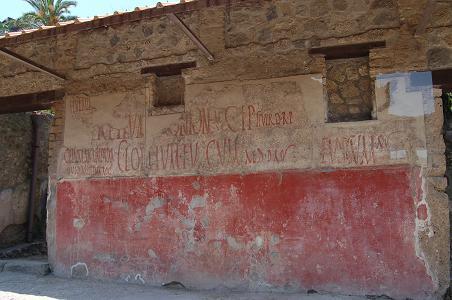
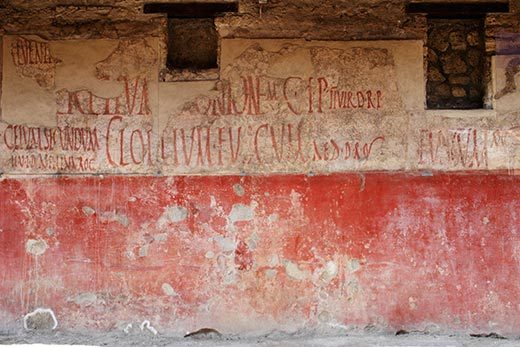
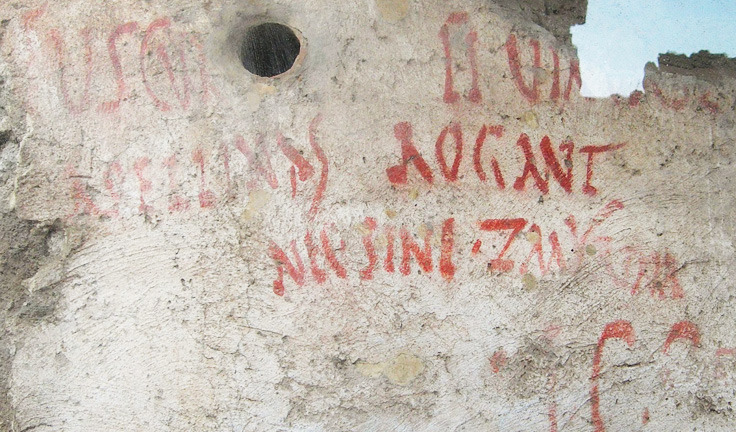
What I really love about the graffiti in pompeii is some people said really cute and insightful things, like:
I.7.8 (bar; left of the door); 8162: We two dear men, friends forever, were here. If you want to know our names, they are Gaius and Aulus.
II.2.1 (Bar of Astylus and Pardalus); 8408: Lovers are like bees in that they live a honeyed life
III.4.2 (House of the Moralist); 7698b: Remove lustful expressions and flirtatious tender eyes from another man’s wife; may there be modesty in your expression.
V.1.26 (House of Caecilius Iucundus); 4091: Whoever loves, let him flourish. Let him perish who knows not love. Let him perish twice over whoever forbids love.
VI.16.15 (atrium of the House of Pinarius); 6842: If anyone does not believe in Venus, they should gaze at my girl friend
VII.6.35 (Brothel of Venus; on the Vico dei Soprastanti opposite the Vicolo del Gallo);1645: May Love burn in some lonely mountains whoever wants to rape my girl friend!
VII.2.48 (House of Caprasius Primus); 3061: I don’t want to sell my husband, not for all the gold in the world
VIII.2 (in the basilica); 1811: A small problem gets larger if you ignore it.
VIII.2 (in the basilica); 1904: O walls, you have held up so much tedious graffiti that I am amazed that you have not already collapsed in ruin.
But then there are those types of people:
I.2.20 (Bar/Brothel of Innulus and Papilio); 3932: Weep, you girls. My penis has given you up. Now it penetrates men’s behinds. Goodbye, wondrous femininity!
I.2.23 (peristyle of the Tavern of Verecundus); 3951: Restitutus says: “Restituta, take off your tunic, please, and show us your hairy privates”.
II.2.3 (Bar of Athictus; right of the door); 8442: I screwed the barmaid
II.7 (gladiator barracks); 8792: On April 19th, I made bread
VIII.2 (in the basilica); 1816: Epaphra, you are bald!
VIII.2 (in the basilica); 1882: The one who buggers a fire burns his penis
VII.9 (Eumachia Building, via della Abbondanza); 2048: Secundus likes to screw boys.
VII.12.18-20 (the Lupinare); 2175: I screwed a lot of girls here.
history
I have been writing with a vile old pen the whole week, which is excessively ungallant. The fault is in the Quill. I have mended it and still it is very much inclin’d to make blind e’s. However these last lines are in a much better style of penmanship though a little disfigured by the smear of black currant jelly, which has made a little mark on one of the Pages of Brown’s Ben Jonson, the very best book he has. I have lick’d it but it remains very purple. I did not know whether to say purple or blue, so in the mixture of the thought wrote purplue which may be an excellent name for a colour made up of those two, and would suit well to start next spring.– John Keats
This is like the funniest thing in the world to me for so many reasons
- noted Romantic poet complaining about his pen being leaky like a petulant two year old
- also spilling jelly on his friends book
- and immediately trying to cover it up by LICKING IT #relatable
- “purplue”
- indigo, john
- the word you are looking for is ‘indigo’


It’s still technically Barricade Day 2015, so here’s my humble contribution:
Rapports sur les opérations et les faits militaires auxquels la garde nationale a pris part dans les journées des 5 et 6 juin
aka
“Reports on the Operations and Military Events in which the National Guard Took Part on the Days of June 5th and 6th”
These are French military reports produced for the government in the immediate aftermath of the June Rebellion. Composed less than a week after the fall of the barricades (12 June 1832), they contain eyewitness accounts of the actions of the Army, the National Guard, and the Paris Municipal Guard. While obviously very biased against the republicans, they represent a unique, fresh perspective on the events that Hugo depicts in Les Misérables.
The reports are all in French (and can be found via Google books), but I’ve done my own (very rough) translation of certain excerpts. Here’s an account of Lamarque’s funeral:
At Madeline, some young men who were marching under a particular flag, and who were called the “Amis du people,” wanted the soldiers, after having paid respect to the funeral wagon, to take up arms behind them. They addressed the troops, saying to them, “We are counting on you, my friends, you can count ‘on the Amis du people.’” These words corresponded with the dangerous proclamations that had been disseminated the night before in the barracks, with the goal of diverting the soldiers from their duty.
And here’s a description of the barricades around the Cloister of Saint-Méry. which Hugo used as the basis for his fictional barricade in Les Misérables:
Resistance was most strongly organized at the junction of Rue des Arcis, Rue Saint-Martin, Rue Saint-Méry and Rue Aubry-le-Boucher. There, paving-stone barricades had been established in each of the streets. The four houses that stood at the intersection had been barricaded, and paving stones, rocks and pieces of wood were being thrown from every window.
The rest of my (again, super fast and likely inaccurate) translations are below the cut, as well as a rough guide of the reports. Hopefully, some of you will dig in and suss out more good stuff that I haven’t found yet!
PDF: The Times of London’s full coverage of the June 1832 Paris Uprising
i humbly present: a digital download of every article in the times of london about the 1832 june uprising, from the 5th (the announcement of general lamarque’s death and upcoming funeral) to the 20th (accounts of the first trials of alleged conspirators and participants in the uprising).
DOWNLOAD HERE (pdf, 64 pages, 24 mb)
below the cut, i’ve put together some important contextual information: how the times gathered news on foreign events, what other events you’ll see mentioned, and the general editorial bias of the paper.
i’ve also made a little summary of each day’s coverage, so that if you’re overwhelmed by the full package, you can focus on the bits that interest you.
anyway, i hope you guys enjoy it/find it helpful!
bringing this back for barricade day 2k15!

Charles Marville, photograph of the Rue Mondétour taken from the Rue Rambuteau (former Rue de la Chanverrerie), circa 1865. Another “about as close as we’re gonna get” image of the site of Hugo’s barricade. I think the high-res version has done the rounds on Tumblr before, but damn if I can find it, so here it is again.
Note the lighter horizontal band in the lower half of the picture–that’s not a crease or any other kind of damage. It’s a ghost… or more likely several ghosts. The widened Rue Rambuteau became a busy thoroughfare, and due to the long exposure time on the photograph, any passerby would’ve been reduced to a faint blur at head height.


…What were people applauding with besides their hands in the 1910s? Flippers? Tentacles?
Presumay folks were slapping their knees or openly cheering/booing.
Everyone knows flippers didn’t come into style until the 30s, where the limited dexterity and lack of fingers made them a cheaper choice than hands.
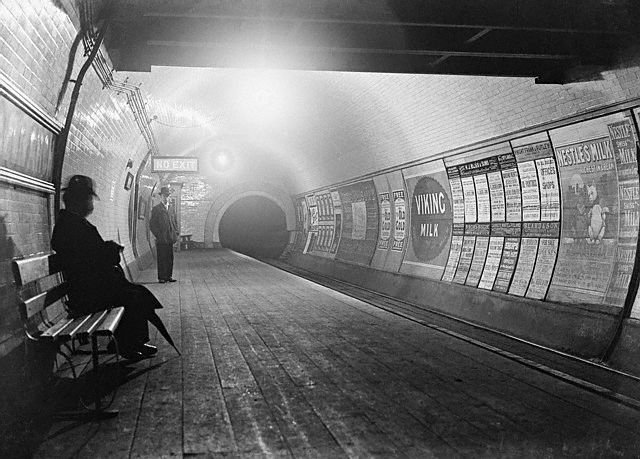


Historic Black and White Pictures Restored in Color
- Women Delivering Ice, 1918
- Times Square, 1947
- Portrait Used to Design the Penny. President Lincoln Meets General McClellan – Antietam, Maryland ca September 1862
- Marilyn Monroe, 1957
- Newspaper boy Ned Parfett sells copies of the evening paper bearing news of Titanic’s sinking the night before. (April 16, 1912)
- Easter Eggs for Hitler, c 1944-1945
- Sergeant George Camblair practicing with a gas mask in a smokescreen – Fort Belvoir, Virginia, 1942
- Helen Keller meeting Charlie Chaplin in 1919
- Painting WWII Propaganda Posters, Port Washington, New York – 8 July 1942
- Construction of the Golden Gate Bridge ca 1935
This is awesome.
Not something I’d typically reblog but I like.
This is bloody fantastic.
Honestly seeing old photos in color makes the past so much more tangible.