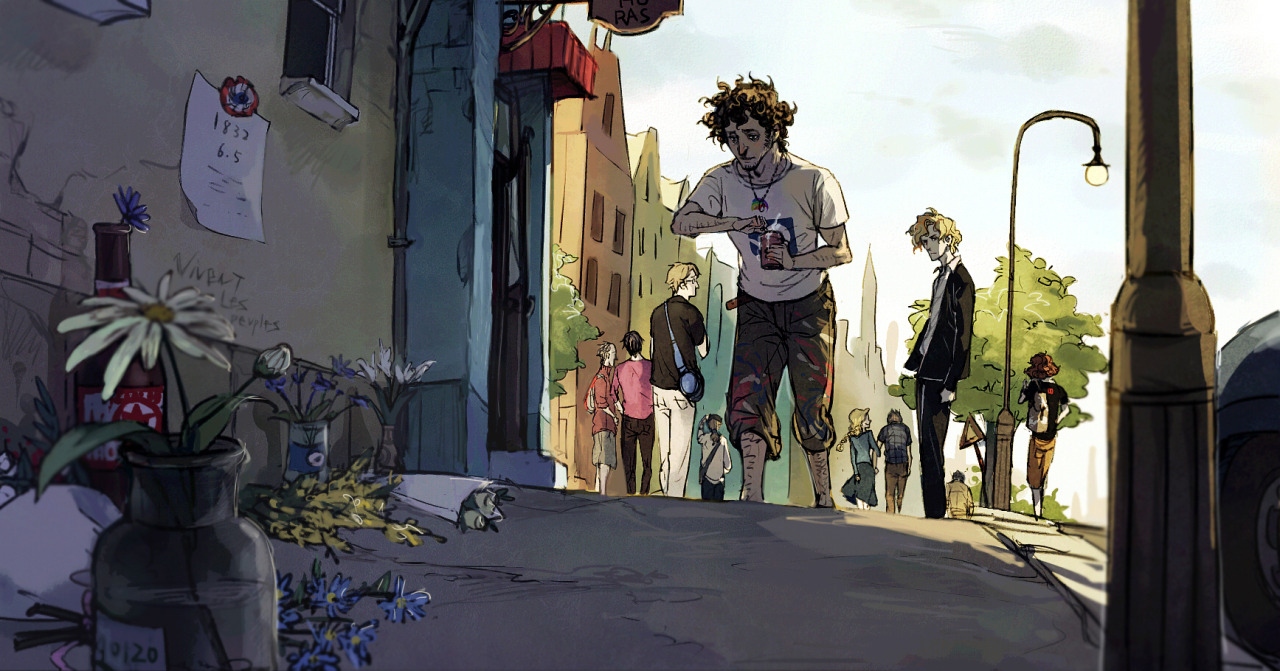
And somehow yet one more thing about Orestes Fasting And Pylades Drunk has popped into my head:
I suspect this is only relevant to a particular translation, as I don’t know how it goes in French, but over in Grantaire’s introduction we have (so help me, I know it by heart)-
The toad always has his eyes fixed on heaven. Why? In order to watch the bird in its flight. Grantaire, in whom writhed doubt, loved to watch faith soar in Enjolras
And then in OFPD we have-
“Might as well kill two birds with one stone, he said; and then, turning to Enjolras, he added gently, “If you don’t mind.”
So s’like…in his last moments of life, Grantaire gets to be a bird too, Enjolras’s equal. And even though the whole thing is probably just a accident of translations and colloquialisms, I like it…
I don’t think this was completely an accident
The majority of the lexis associated with Grantaire is pretty damn negative. Not only the whole “inordinately homely… impossible… dislocated, sickly, shapeless ideas” [There is a whole slew more, and the spleen thing, there is even a chapter titled ‘Night Begins to Fall on Grantaire’, oh Hugo]. A lot of this description also contains many plosive phonemes; “dead drunk… tender… deafening…troubled”. Yet in O&P we get “risen… live… clear and clean… immense blazing light…”. Positive lexis. The predominantly plosive phonemes are replaced with clear sonorants. This is a translator thing, but it’s still pretty damn important. On a phonological level alone, this could be read as an indicator of intense happiness, but
the words
and they’re Hugo’s
this is some of the most positive lexis ever associated with Grantaire in the novel.
d’you know what you could read this as?
The happiest he ever was is just before his death.
Oh, the words used in Grantaire’s last scene break my heart. In this translation you get ‘strong voice’ ‘risen’ ‘immense gleam’ ‘brilliant glance’ ‘firm stride’, and my favourite, ‘transfigured’…it’s all the exact opposite of what we got when we first met him.
I always wondered if you could read Grantaire being ‘dead drunk’ for the whole battle as being like a symbolic death? And that when he wakes (and instantly decides to die with Enjolras, probably without even thinking about it) it’s like he’s shed all the bad parts of himself?
Ooh yes, there was gonna be Actual Meta about Grantaire vs Tholomyes, wasn’t there?
Well. Everyone probably remembers that the character Tholomyes is directly compared to is Courfeyrac, except I think that’s more to say that while the two seem alike on the surface (Courf does have a slightly careless attitude to women, though) they’re actually very different, basically Courf is a good guy while we all know Tholomyes is a scumbag.
But anyway! By the time we’re in the Amis chapters and we meet Grantaire, seeing Tholomyes’ cruelty has trained the reader to be quite wary of ranting, drunken, unattractive and ironical men. And oh god, they have so much in common, they’re both constantly making references and showing off their cleverness, they both have their ways of drunkenly calling a nearby woman ugly:
[FT] O Josephine, face more than irregular, you would be charming were you not all askew. You have the air of a pretty face upon which some one has sat down by mistake.
[R] Matelote is of a dream of ugliness! Matelote is a chimaera. This is the secret of her birth: a Gothic Pygmalion, who was making gargoyles for cathedrals, fell in love with one of them, the most horrible, one fine morning. He besought Love to give it life, and this produced Matelote. Look at her, citizens! She has chromate-of-lead-colored hair, like Titian’s mistress, and she is a good girl.
(Yes, R, you did that very poetically, but it’s not your finest moment.) They also both seem to have this thing about women marrying rich men:
[FT] Girls are incurable on the subject of marriage, and all that we wise men can say will not prevent the waistcoat-makers and the shoe-stitchers from dreaming of husbands studded with diamonds.
[R] And then, I met a pretty girl of my acquaintance, who is as beautiful as the spring, worthy to be called Floreal, and who is delighted, enraptured, as happy as the angels, because a wretch yesterday, a frightful banker all spotted with small-pox, deigned to take a fancy to her! Alas! woman keeps on the watch for a protector as much as for a lover; cats chase mice as well as birds. Two months ago that young woman was virtuous in an attic, she adjusted little brass rings in the eyelet-holes of corsets, what do you call it? She sewed, she had a camp bed, she dwelt beside a pot of flowers, she was contented. Now here she is a bankeress. This transformation took place last night. I met the victim this morning in high spirits.
(It’s occured to me that R’s concern here seems to be for the woman, and he may well be right there, because the last pretty girl who hooked up with a frightful man was Fantine.)
So anyway, a first-time reader of the Brick might very well think on meeting R, ‘oh bloody hell, another uncaring self-absorbed arsehole.’ But, they’d be wrong! For a start, all Tholomyes’s speeches and sarcasms come from a place of arrogance, while Grantaire’s come from a place of deep depression. Tholomyes is perfectly content with his life of slacking around and using women, Grantaire is…not so, because he can see all the badness happening around him:
[FT] Live, O creation! The world is a great diamond. I am happy. The birds are astonishing. What a festival everywhere!
[R] I am growing melancholy once more. Oh! frightful old world. People strive, turn each other out, prostitute themselves, kill each other, and get used to it!
And of course, they differ on some key issues, like that one the whole book pivots around (love):
[FT] Ladies, take the advice of a friend; make a mistake in your neighbor if you see fit. The property of love is to err. A love affair is not made to crouch down and brutalize itself like an English serving-maid who has callouses on her knees from scrubbing. It is not made for that; it errs gayly, our gentle love. It has been said, error is human; I say, error is love.
[R] They must make a queer pair of lovers. I know just what it is like. Ecstasies in which they forget to kiss. Pure on earth, but joined in heaven. They are souls possessed of senses. They lie among the stars.
And there’s the One Big Difference, which is that Tholomyes doesn’t care one tiny bit about Fantine (or Cosette), while Grantaire loves Enjolras pretty much unconditionally and happily dies for him. Annnnnd I suppose that in there is the point Hugo was trying to make with the Grantaire-Enjolras story: “ARE YOU DRUNK AND CYNICAL AND LOUD? WELL, DON’T WORRY, IF YOU TRULY LOVE SOMEONE AND PLACE THEM ABOVE YOURSELF THEN YOU’RE NOT A THOLOMYES. ROCK ON.”
“There is, however, the other side, in which we are reminded that Diogenes was nothing but a ragpicker and a ragamuffin, a man of no intellectual worth (…) whose confused ideas are ultimately nothing but “a doctrine of inaction and negation of life.. His pessimistic one-sidedness concerning the value of human accomplishments, his contempt for practically all human beings, his unwillingness to recognise in anyone even the faintest trace of honesty and good intentions, his merciless campaign to debunk and undermine social and political institutions, his exaggerated and histrionic behaviour, his shamelessness and his pride about his shamelessness, the coarseness of his speech and manners, his reported inability to transcend the realm of the concrete and the particular, and his incapacity to understand and appreciate universal concepts – all these and other alleged uncomplimentary aspects of his life and personality have been emphasised by some scholars, from whose point of view, then, there is nothing worth studying about Diogenes (…) Nothing attractive or substantive, accordingly, can be found in him (…) and his life, characterised by exhibitionism and exaggeration, contained nothing edifying or worth remembering”
And while we’re on Diogenes/Grantaire comparisons, I came across this passage in the book “Diogenes of Sinope (the Man in the Tub)” (and when I say ‘book’ I obviously mean ‘free Amazon Look Inside preview’ because omg that is one expensive book) and it kind of blew my mind a little bit! Like, for all I’d been ‘hum yase look at all these personality parallels’-ing to myself, I hadn’t considered that Diogenes might be just as divisive a figure in his own fandom academic field as Grantaire kinda is for Les Mis folks? And for largely the same reasons? And that Diogenes-stans get equally irritated by Diogenese-detractors as do their Grantaire/Les Mis conspecifics? AND THEN THERE WAS THIS QUOTE which was also fascinating;
“It might be possible that in order to understand and appreciate the value of Diogenes as a philosopher and as a stereotype of Cynicism, one may have to be a Cynic oneself or at least have certain inborn Cynic tendencies (…) In order to grasp the significance of Diogenes’ life and philosophy, it is necessary to have within oneself at least some incipient dosage of Cynicism and have that rare philosophical ability to see behind and around things, to use Nietzsche’s phrase. As Diderot pointed out (…) “one may choose to become an Academic philosopher, or an Eclectic, or a Cyrenaic, or a Pyrrhoist, or a Skeptic, but one must be born a Cynic”.
Because, like, it’s basically what people were saying in this thread about not being able to identify with Grantaire? Some quotes
I think I just realised why I can’t identify with Grantaire as much as others, despite the fact that I do like him a lot. (and ngl, sometimes he makes me cry)
I’ll need to write it down when I’ve got time.
(Until then, though, does anyone feel they can’t identify with Grantaire either? He seems to be one of the most popular characters – and I can’t blame fandom, he’s a fascinating one! But I’m wondering if others feel this way, too, and have thought about why.)
I personally can’t identify with him for a number of reasons.
1. He is a cynic and believes in nothing (but Enjolras). I admit to being a cynic sometimes (mostly about myself), but not to believe in anything? I just can’t.
I can’t identify with Grantaire either – I’m a teetotaler who hates attention and never talks, I’m an overachieving nerd, my beliefs are super-idealistic, and I’m usually put off by people who just sort of SAY STUFF all the time. Etc. etc., I’m nothing like Grantaire!
I know that for me personally, it’s because I’m a strongly idealistic person. My mind cannot “dispense with belief,” though it tries; if it does, my heart will “dispense with friendship.” He takes “great care to believe in nothing” while I take great care to believe as much as I can. It’s my lifeline. He has “not one entire idea left in his mind” through skepticism while I cannot live without ideas.
I can’t identify with him because (1) I’m not actually cynical. I thought I was, or pretended to be, for a while, but you know, I can’t really keep it up, a
Like *flails* that’s exactly in line with what Navia is saying? (Except he’s being kind of snotty about it when like there is literally no reason to be down on someone for not being a C/cynic wow.). So, idk, what are our ~thoughts~, do you have to be born a cynic to “understand and appreciate the value” of Grantaire? (Like for my part idk that’s a little prescriptive & I wouldn’t ‘doubt’ anyone who does see themselves as understanding/appreciating him without personally being a cynic, that would be dumb). But! I’m interested to see if anyone does see their appreciation of him that way?? (I definitely drift into the arena of cynicism sometimes personally {tho try not to, like actually one of my new years resolutions was to be less cynical} so cant really id with those who don’t id with R in that way {but do hopefully ~understand and appreciate them :V})
Okay, I really want to write that whole ‘Grantaire is the son of Tholomyes and Favourite’ fanfic. Because I’m rereading the earlier bits of the Brick and things! keep! happening! …
Favourite:
I have the spleen, as the English say, butter is so dear! and then you see it is horrible, here we are dining in a room with a bed in it, and that disgusts me with life.
R:
Yes, I have the spleen, complicated with melancholy, with homesickness, plus hypochondria, and I am vexed and I rage, and I yawn, and I am bored, and I am tired to death, and I am stupid! Let God go to the devil! / I want a drink. I desire to forget life. Life is a hideous invention of I know not whom.
Favourite’s backstory:
Her father was an old unmarried professor of mathematics, a brutal man and a braggart, who went out to give lessons in spite of his age.
R’s childhood:
Gentlemen, my father always detested me because I could not understand mathematics. I understand only love and liberty.
And then there’s Tholomyes- him and R both have the ability to drunkenly rant for pages at a time: the main difference being that Tholomyes’ rants always come from a place of arrogance and Grantaire’s from a place of deep depression. And wouldn’t Tholomyes be exactly the sort of father who would despise his son for not understanding the aforementioned mathematics, therefore cutting himself off from his grandfather’s profession? OH GOD I WANT THIS STORY SO BAD. I’m gonna go through some tags and see if I can find whoever suggested the idea first…
Again [Marius] beheld Mabeuf fall, he heard Gavroche singing amid the grape-shot, he felt beneath his lips the cold brow of Eponine; Enjolras, Courfeyrac, Jean Prouvaire, Combeferre, Bossuet, Grantaire, all his friends rose erect before him, then dispersed into thin air. Were all those dear, sorrowful, valiant, charming or tragic beings merely dreams?
Still brickin’ and I have three thoughts on this bit: a) WOE b) I bet you anything that this was the bit that inspired Empty Chairs At Empty Tables and c) I always forget that Marius and Grantaire were friends, I’ve read so many otherwise excellent fanfics where Marius either doesn’t care for or barely knows R that it came as a pleasant surprise to see him included. (Although Joly, Feuilly and Bahorel aren’t there, alas.)
it really annoys me when people write a courfeyrac who just has no interest in political causes what so ever
courf was one of the big three aka one of enjolras’ main followers
he was interested
but modern! courf is always ‘yolo fuck enjolras lets wear bow ties and get drunk and have sex lol swag’
Exactly! Like, Courfeyrac may be a dandy and a ladies’ man but he’s also very serious about the cause. Hell, on the day they’re building the Barricade he shouts at Grantaire for not taking things seriously, basically.
Courfeyrac has passions outside the bedroom, Courfeyrac is political and Courfeyrac is very much capable of getting angry and fed up. He’s compared to the sun; sure he’s bright and radiant, but he can also burn you up.
i feel like a lot of people forget that all the amis are first and foremost political activists, like, the reason they’re fRIENDS is because they’re SUPER INTO SOCIAL JUSTICE AND REFORM AND ALSO REVOLUTION. bahorel was in revolutions independent of the amis! politics are important to the amis!!
YES THIS?? JEEZ COURF’S BFFs ARE LOGIC OF THE REVOLUTION ENJOLRAS AND PHILOSOPHY OF THE REVOLUTION COMBEFERRE. courfeyrac is the ENERGY AND THE VERVE AND THE WARMTH OF THE REVOLUTION, you can’t separate him (or any of the amis) from his politics. (except grantaire obvs bc what politics? does enjolras count as a political ideology?)
les amis de l’abc is actually a radical revolutionary group; these guys aren’t just meeting up for funsies (though obviously they also have funsies bc they’re all v good friends). this is also why it gets to me when any of the amis is characterized as rolling their eyes at enjolras being “”“too serious”“” about politics and that amis is usually courfeyrac and i just. no. (this isn’t to say that courf doesn’t bring the fun but there’s a balance there that’s too often missing in the way fandom deals with him)
Actually, even R is quite socially aware, or at least very philosophical. He’s well aware of great social injustices like poverty (particularly concerning children) and shows contempt for the way society is structured; the major difference between R and the others isn’t that he doesn’t aspire to the same ideals (his ranting makes it clear that despite what he says, he cares a lot), but rather he doesn’t believe anybody is going to make a difference as history always repeats itself and existence is fundamentally flawed.
R has ideals and spends a lot of time fantasising about what the world would be like it if were different (e.g: if he had money, if he were born somewhere else, etc) and criticising injustices (complaining of how people are starving in London when it’s such a place of excess, complaining about slavery in America, etc) but whereas the other Amis feel that they’re making some small difference to the course of the future at least, Grantaire is convinced things will never change no matter how much he or anybody else wants it to. When you compare R to some of the other sceptics in the Brick (that asshole from the first book that was complaining to Bishop Myriel and Tholomyés) R is actually quite the bleeding heart.
Tl;dr: Grantaire’s biggest distinction to the others is that he’s comparable in his beliefs to what we’d now call a nihilist whereas the others are idealists. He was probably once as idealistic and faithful as the others, but life left him jaded.