buddhistmamaduck:
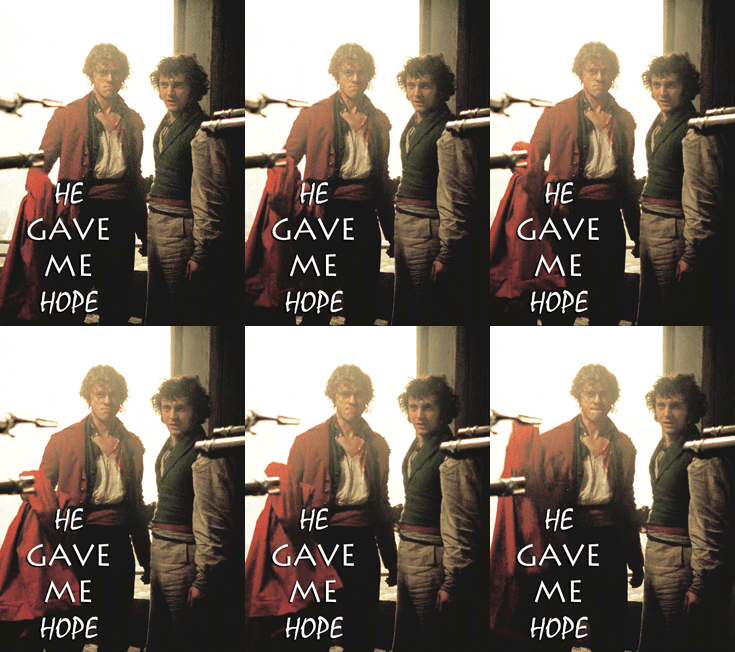
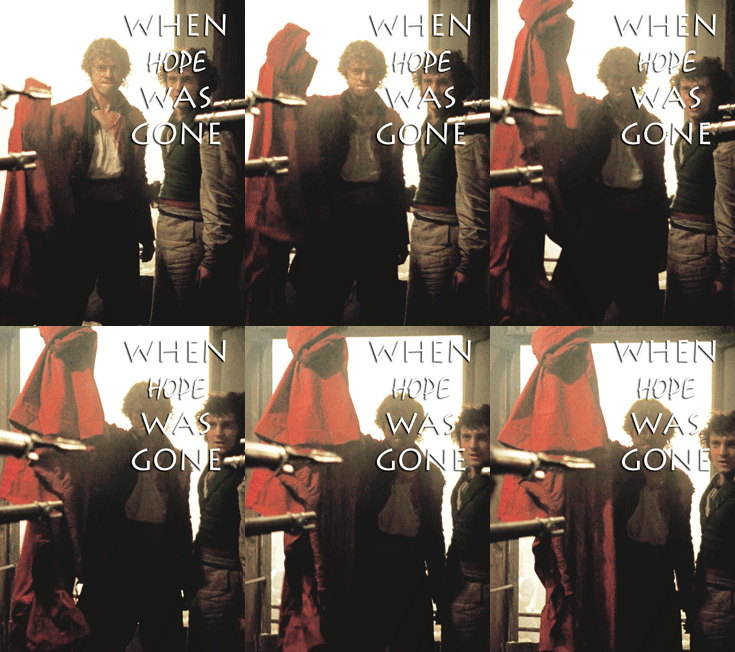
the warmest thing grantaire ever got from enjolras was the heat of his blood as the bullets pierced their bodies
no the smile Enjolras gave him just before that was much warmer
the warmest thing grantaire ever got from enjolras was the heat of his blood as the bullets pierced their bodies
no the smile Enjolras gave him just before that was much warmer
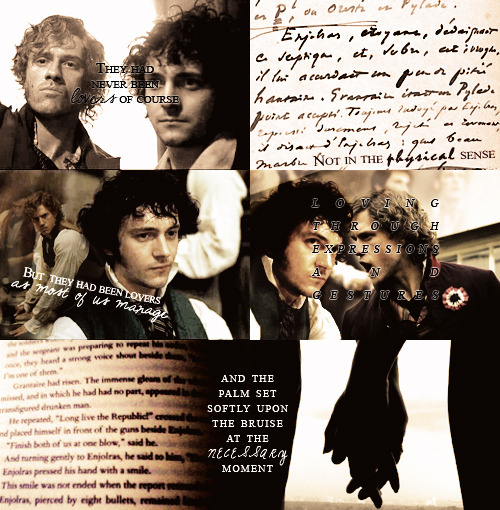
Sometimes I cry because the last thing Enjolras told Grantaire before dying is: “Grantaire, you are incapable of thinking, of willing, of believing, of living, and of dying”.
Then I remember that in Hugo’s manuscript, his last words actually were “Take my hand”And then I CRY HARDER OHMyGOD
Here’s the source, as found and translated by many folks cleverer than me!
Also worth reading for Hugo’s descriptions of E and R’s final fates: “They both die. Grantaire happy and heroic, Enjolras seeking his hand.”
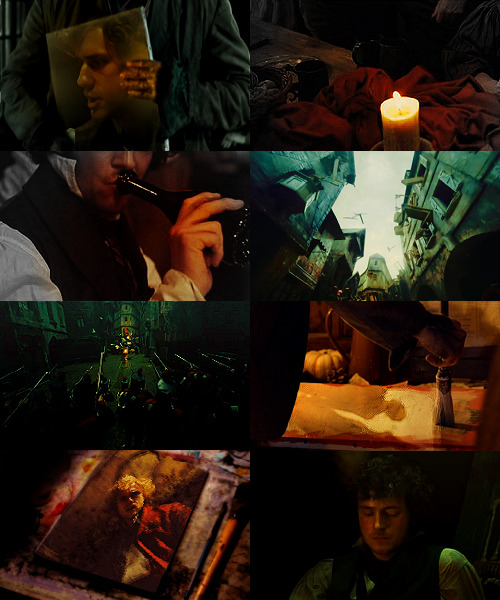
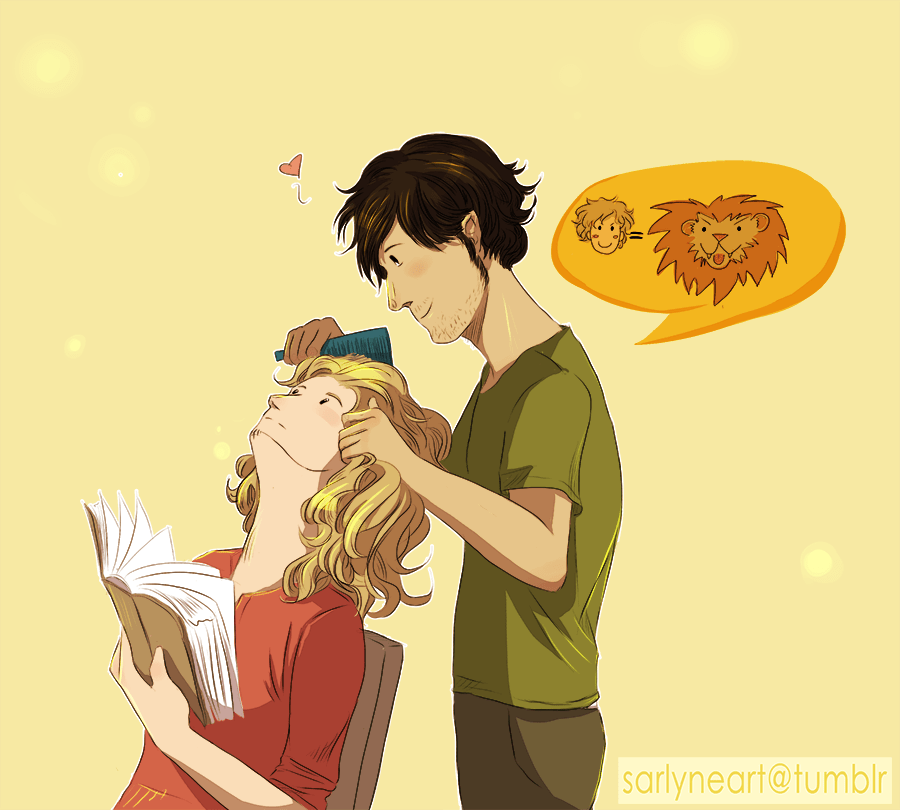
Les Miserables AU: Grantaire made Enjolras up
He knows the revolution will fail, he knows the world and his soul are both voids. He has nothing to believe in. He drinks.
From his position in the dark in the corner of the bar, he paints them all a leader- part man, part angel, leading them into battle. But his imagination only stretches so far. He takes the hand of this being he created. He dies beside him with joy. There’s still a little light in the endless darkness, there’s still a little light in him. But he can’t imagine living, let alone living with love. He buys red paint.
The barricades fall. He still drinks. His angel stares from the canvas half-accusing and half-pitying. Before long, only the paintings remain.
I fic’ed this – it’s here http://archiveofourown.org/works/1011411
OMG
READ THE THING
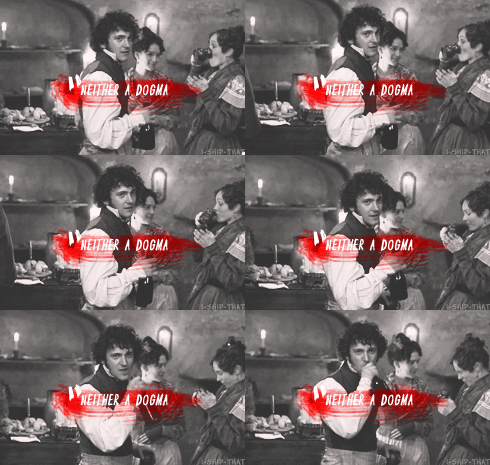
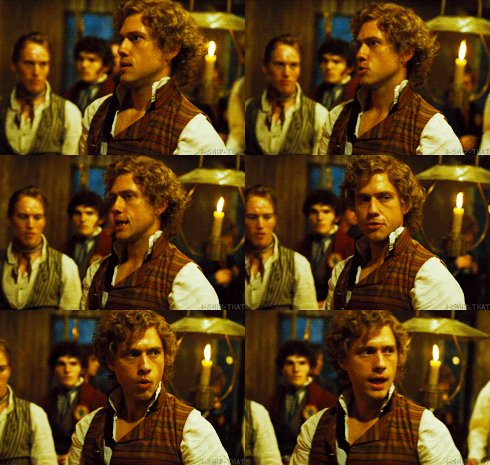
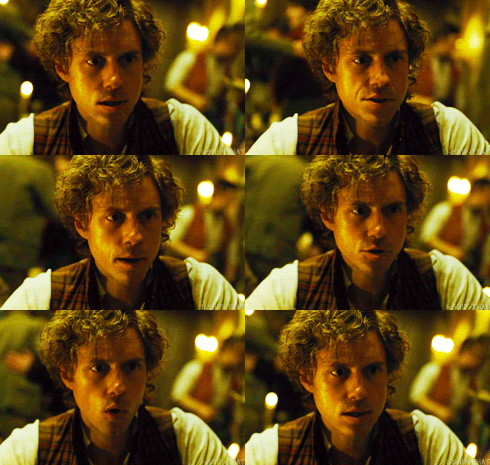
“It was a man: Enjolras. Grantaire admired, loved, and venerated Enjolras. In what manner had Enjolras subjugated him? By his ideas? No. By his character. […] A sceptic who adheres to a believer is as simple as the law of complementary colors. That which we lack attracts us. […] He had need of Enjolras. That chaste, healthy, firm, upright, hard, candid nature charmed him, without his being clearly aware of it, and without the idea of explaining it to himself having occurred to him. He admired his opposite by instinct.”
This is based on a long-ago prompt from Sclez! I hope it’s okay…
Title: The Drowning Man and the Candle
Rating: R (pun not intended)
Fandom: Les Miserables (bookverse)
Warnings: Grantaire being Grantaire (but I think the tone of this is…bordering on the optimistic? I don’t know.)
Summary: Combeferre and Courfeyrac try, in as kind a way as possible, to turn Grantaire away from Enjolras.
So, as has been abundantly clear over the past few weeks, my life has been consumed by Les Miserables. Again. This story, in both book and musical forms, has occupied a huge space in my heart since I was 10 years old. For reference, I’m turning 24 in two days. I’ve spent a lot of time with this story.
A lot (read: all) of the characters are extremely important to me, and I’ll probably wind up writing about many of them. But I wanted to talk about Grantaire (she said to the surprise of literally no one in the world). The earliest memory I have of neglecting the rest of my life to think thinky thoughts about Grantaire is of zoning out completely in eighth grade English class, so when I was 13 or 14. So I’ve had a decade to sort out my feelings, and this is what I’ve come up with.
The thing that has always captured me about this character, who is so vastly different from basically any other favorite character I have, is the way Hugo uses him to portray cynicism as a trap. It’s extremely easy to fall into (because let’s face it, there are a lot of horribly messed up things in this world), and desperately difficult to climb out of. After all, once you convince yourself that the world sucks – that people suck – how can you ever believe anything else? You’ll always be able to talk yourself out of whatever hope may arise. The cynic hurls himself to the bottom of the well, and then convinces himself that any ladder lowered down to him is bound to give way.
But that’s no way to live, and we can’t help but resist it – even if we find ourselves at the bottom of the well. Hugo beautifully outlines the contradiction of Grantaire: he has given up on humanity, but he cares for his friends. He can’t believe in anything – except Enjolras. By virtue of being human, the very thing he detests, he proves himself wrong. We’re never as bad as we think we are.
As a philosophy, “we’re never as bad as we think we are” doesn’t seem too inspiring at face value. But sometimes, that’s what you need to hold onto. My brain chemistry didn’t start causing real problems for me until quite a few years after my first intense ruminations on Grantaire. But when it did, my thoughts latched onto very serious real world problems. It was – and sometimes still is – very, very difficult to separate which fears were rational and which weren’t. Though I didn’t choose to be there, I found myself at the bottom of the well, convinced that people would not be able to make the world better.
But I knew that wasn’t me. I knew I wasn’t Hugo’s cynic. Hugo’s cynic wasn’t even that person, not in the end. I couldn’t always feel my real self, but I knew she was somewhere in the shadows of the well, waiting with an unbroken ladder and a heartfelt cry of “Long live the Republic!” I found conviction in affection, just like Hugo said. I have so many people to love in my life, and from that, I have held onto loving – and believing in – the world. Everyone is someone’s Enjolras, and I believe we can act like it. Essentially, I believe in what Grantaire believed in, but I’m just trying to apply it on a broader scale than he was able to.
I can’t be Enjolras all the time. Not many people can. I also don’t think I’d want to. But what I can try to be is the grasped hands, the permission, the smile. The meeting of fiery passion and tender devotion. You can’t separate The People from individual persons. By fighting for and loving both, I believe in change. I believe in anything.
I believe in you.