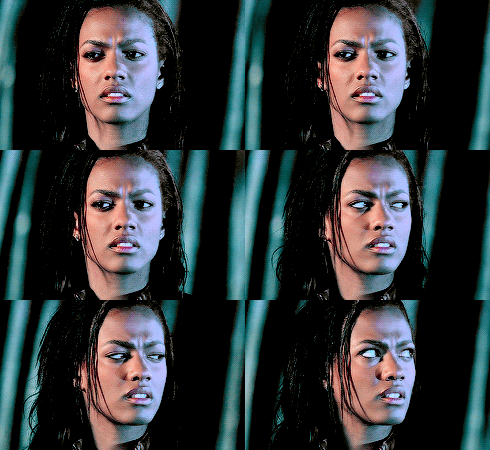
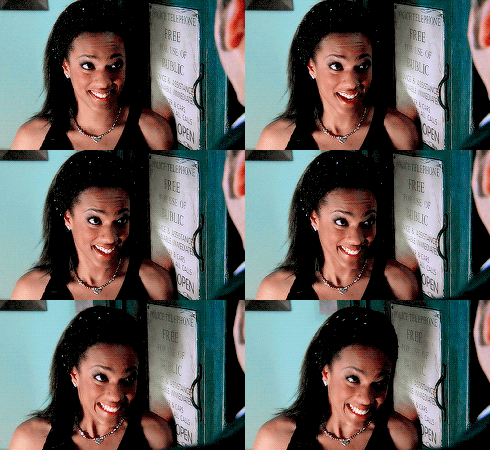
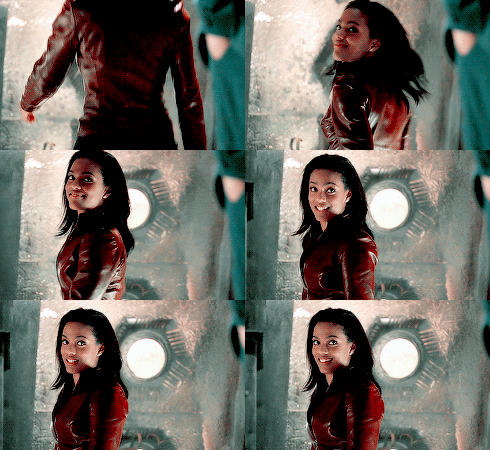
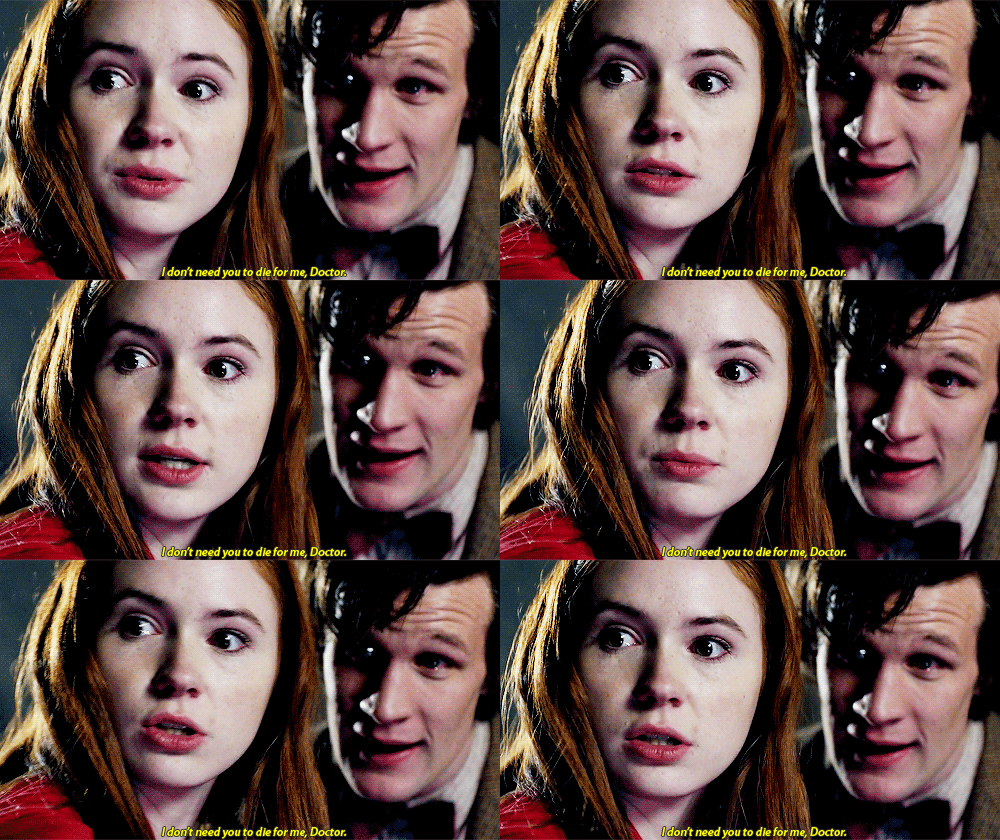
Not to be THAT person, but for a lesbian, Bill sure does have quite a lot of male love interests
All of whom she’s turned down, and all of whom have politely backed off afterwards. And that’s – two men in all, as far as I remember, her flatmate and the bisexual Roman soldier. I think it’s a bit disingenuous to call them “love interests” when every last bit of the interest is on their side.
although I’m finding it difficult to actually see some of the scenes, as they are very dark, The Eaters of Light seems to be a very good episode so far
Okay, that was definitely one of my fave episodes of the season. And the other one was Thin Ice. Conclusion: Doctor Who needs to have an all-woman-writers season, now
although I’m finding it difficult to actually see some of the scenes, as they are very dark, The Eaters of Light seems to be a very good episode so far
None of the Doctor’s Companions are less than extraordinary, but I feel Martha underwent some of the hardest trials of the recent Companions. While all the Companions have faced great danger and sacrifice, Martha had The Year That Never Existed. She had a year of knowing her family’s fate rested in the hands of an insane Time Lord, a year in which she traveled the world under deep privation, risking being killed at any time by any anonymous member of the Master’s forces, all to relay a story, an idea, to spread the legend of the Doctor so he could eventually save everyone. She did it alone, without any real hope of support or thanks or even a guarantee that it would work, under threat of death for herself, her family, and the Doctor, never knowing if this day her mother would die, or if her sister would be assaulted, or her father beaten and humiliated. If Jack would die yet again or the Doctor suffer more torture, and all of it, every bit of the fate of the world was lying in her hands.
This was not the harrowing experiences of Rose’s absorption of the time vortex, the tragedy of Donna being the most important person in the universe and then losing it all, of Amy and Rory’s whole lives being intertwined with the Doctor, of Clara going beyond the bound of death. Martha’s courage was not a dramatic statement, but a hard slog of devotion with no payoff for her other than a return of the status quo. And still she was able to gain the strength to move on with her life and make a differences for a long time down the road.
I really, really hope the next Doctor isn’t male/white/both. Surely the BBC are taking notice of all the comments saying it’s long past time? I just wish I had a little more confidence in those hopes, because still a bunch of media outlets are saying it’s Kris Marshall, another quirky white dude.
(Honestly? It probably won’t be Richard Ayoade. I forgot he’s presenting the new Crystal Maze show. But on the other hand it seems to be already filmed, so he could easily jump ship? OH I DON’T KNOW)
I really, really hope these quotes are taken out of context (it is The Telegraph)
Oh For FUCK’S SAKE!!
I judge every single person who reblogged this without doing a minimum of googling. I know I’m supposed to be a Moffat-praise blog, but I feel this needs to be addressed asap because of course, this has already turned into a shit storm.
Mark Gatiss was actually making extra effort to be sensitive about whitewashing! The original article can be found here, and it goes on about what Gatiss’s reasons for his hesitation were:
“This is [a] very difficult email to send, but I don’t think we can do this…these are soldiers from the South African war, they’ve just been fighting the Zulus. There weren’t any black soldiers in Victoria’s army”. (Mark Gatiss, quote by Telegraph, typo corrected by me)
Gatiss’s concern about diversifying the Victorian army was not due to historical inaccuracy, but because he felt uncomfortable diversifying one of white men’s most giant fuck ups. He felt uncomfortable casting a black actor as part of an army that has done incredible damage to the African continent.
People who actually watched the episode will have noticed that it was one giant satire of the greed and self-righteousness of imperialism.
And I can understand very much that Gatiss was hesitant to diversify that particular bit of history.
My frustration does not lie with OP’s implicit accusation of whitewashing – whitewashing absolutely has to go! My frustration lies with everybody else who clearly just jumped on the let’s-hate-[writer]-for-[buzzword] band wagon, when OP explicitly stated that this might be out of context and has since engaged in further discussion.
Crimes connected to European imperialism were indeed very, very, very white, and we need to be wary of blurring this part of history under the cloak of eliminating whitewashing. In my opinion, Gatiss is absolutely right to put this forward for debate. And you all need to thoroughly check which side of history you are on.
I’ll also begin with apologies to followers who aren’t here for this, but I think it’s important to add this correction to what I reblogged earlier. Further, this turns out to illustrate an exception to what I’ve previously taken as a rule, so I want to explore it.
On first reading (and probably influenced by the article’s framing), I didn’t think there was enough context to take this interpretation, though I acknowledged it as a possibility. Further explanation by two of the biggest Dr. Who fans I know of on tumblr has convinced me.
Speaking live on a complex issue, Gatiss may not have expressed himself perfectly (and the Telegraph’s clickbait journalism exploited that disgracefully), but even these comments further illustrate the point, as they really don’t fit with “historical inaccuracy” as his only motivation*:
But I thought: is this a specific example of where it’s slightly…I didn’t know what the answer was.
[about POC representation in television] To me it’s more about proper sensitivity rather than any kind of –
there’s no one standing over you, you just have to try your best at it.
So I have to retract the majority of what I wrote earlier: in this case non-traditional casting is a bit complex. To give an example that’s a little clearer to me because of my personal heritage, would a US production color-blindly cast a POC actor as a slave owner, in a story about pre-Civil War atrocities? Black slave owners existed, but unless that’s specifically the story they were trying to tell, it could be confusing, to say the least.
Caveat: ‘Whitewashing’ and ‘non-traditional casting’ are actually
different things. Swap terms and adjust positive/negative framing in the post above, and I agree.
Below the cut, a little more of my thoughts on the nuance of the issue Gatiss raised.