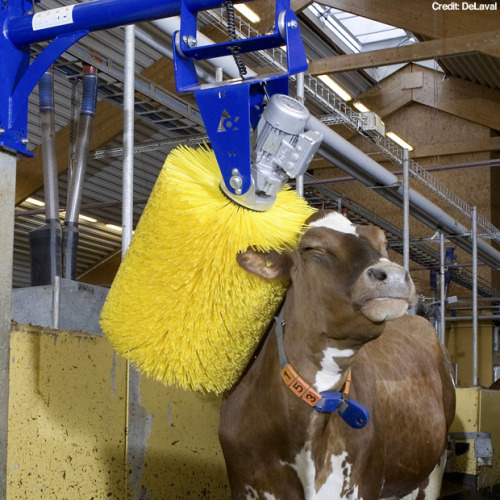
yes that does indeed say happycow. so. there have been A TON of studies on cows and grooming. the general summary: cows really like to be clean; they’re MUCH happier that way. if you don’t provide them a brush or something like that, they’ll use walls or fences to scratch against, possibly hurting themselves in the process.
but more to the point grooming is a way they calm themselves down, too. similar studies have found that it’s the first thing they do after being freed when they’ve been restrained.
which leads to brushes like the one above, or ones like this (one of my favourite cow photos ever):
cows: anxious and fussy but much happier when able to do self-care. SOUNDS FAMILIAR TO ME
THE POOR BABY GOT BRUSHED AWAY BY IT AT THE BEGINNING I LOVE COWS
my name is Cow when fur not cleen or when I am stressed to be seen to calm myself in nearby place I find a brush
so id like to tell you something, like, in the context of cryptid sightings
specifically, id like to tell you some things about cattle
they dont look like they move fast, but, in fact, they do. they move very fast, and theyre capable of doing so quietly
if a cow is black and has white spots, or if it is white and has black spots, both the white and black bits come together in the approximate shape of a cow
but in the dark, you cant see the black parts, and the white parts do NOT, form the approximate shape of a cow
what im saying is that i have at certain times been walking in the fields on a night with low visibility and i have, at certain times, seen an indistinct white shape zoom past me, and i am at least 95% sure it was a cow. and that if you see a white shape zoom past you in a field at night, it is also probably at least 95% of a cow
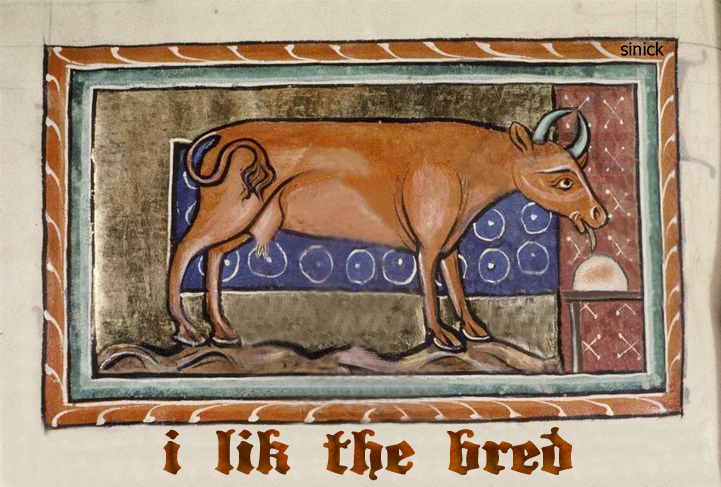
So “my name is Cow… i lik the bred” seems to be the Hot New Meme, and I like it. Here’s an odd thing about it, though; a lot of the cutsey animal talk I see on the internet (especially birb-speak) sometimes reminds me of Middle English, but “lik the bred” takes it even further and sounds downright Chaucerian, and it isn’t just the rhyme and cadence. Some of the “lik the bred” pastiches I see around don’t really work because they’re in just plain doggo-fran speak (haven’t decided if Doggo-fran and Birb are the same thing or not), but the ones that really hit all the same notes as the original have something going on with the mangled vowels and spelling that’s not the same as the mangling in Doggo and/or Birb. Maybe some time I’ll gather up some examples and look closely at the vowels and spelling and try and sort out precisely what’s up.
my name is Cow i make yu think of likking bred and tayking drink i studdy buks that i have herd so wen yur gon i rite the werd.
now yu may think wen reeding this “yu typ with hoofs, wy dont yu miss?” i ask yu now be pashent, plees i type with tung i lik the kees
Re: the OP – I don’t think Doggo-fran and Birb-speak are the same at all, but it’s tricky to articulate why (probably because I’m not actually a linguist).
I think Doggo-fran revolves around intentionally switching out syllables in words (or adding them onto mono-syllabic words) – although actually I’m not sure precisely what @runecestershire is referring to here but the other thing that comes to mind is the ‘bork’ meme speak which revolves mostly around the nonsense sentence structure ‘you are doing me a [verb]’. Both cases seem to me to be a lot more specific in usage than Birb-speak.
Birb-speak revolves more around intentionally bad spelling and grammar, often with an overblown sense of urgency to imitate something being typed (and thus spoken) loudly, at high speed and with little accuracy (although there are two slightly different memetic forms of Birb-speak – one originating from the @probirdrights Twitter and the other from the @importantbirds Tumblr and their styles, while similar, are not identical).
But the OP is indeed correct that proper-sounding ‘i lik the bred’ poems have a very specific structure and language to them which is distinct again from the other examples.
I have also noticed this! I thought I was alone in thinking they sounded like middle english!!
A few of the spellings used in the “i lik the bred” poems are almost exactly the same as those in my Chaucer text.
I thought this too…
this whole time i thought making it sound like middle english was like, the entire point because the first time i saw it was in a post about a ren faire
Yeah, the origin is the renn faire post so I think it is absolutely intentional that it sounds/reads more archaic than anything else. It’s got some of the same qualities as other animal-speak memes (all the way back to lolcats) except this cow is from ye olden days.