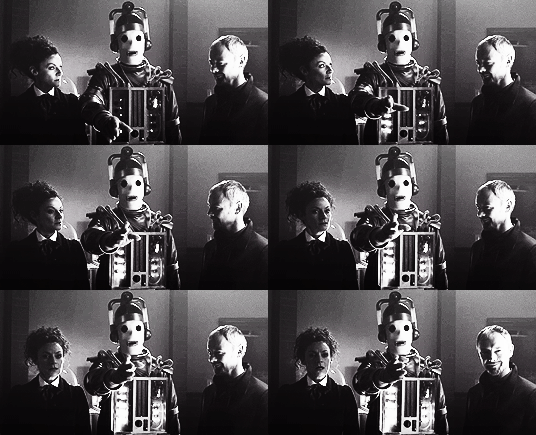
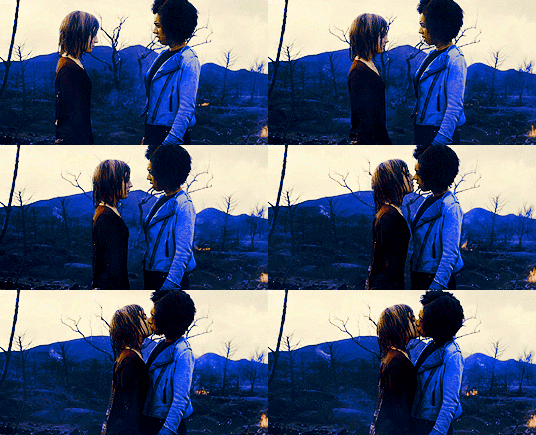
Okay, so: Amy Pond realises halfway through her wedding that there’s someone missing, that while she has gained her parents back she has lost something else. With two different timelines playing through her head, she stands up and calls, begs, for the Doctor. Reactions are…mixed. “The psychiarists we sent her to!” wails her mother. Aunt Sharon, Amy’s sole guardian in the previous version of her childhood, does this:
Which is not a look of sympathy.
If you’re anything like me, you may actually wince a little at that gif. My mental health can usually optimistically be described as ‘fragile’, but I’ve had the verbal version of Aunt Sharon’s facepalm hundreds of time. The reactions of both Sharon and Amy’s mother rather indicate that though they tried to help Amy – sending her to psychiarists and the like – they started to flail as soon as the going got rough.
We don’t know much about Amy’s mother, but we actually do know a bit about Aunt Sharon, and unfortunately none of it is positive. When the Doctor first meets seven-year-old Amelia, he’s surprised to realise she’s been left all alone in the middle of the night, but Amelia herself doesn’t seem too bothered, indicating that it’s not an uncommon occurrence. The laws on leaving a child alone at night are iffy about whether it’s an actual offence to leave a seven-year-old home alone, but it’s clearly not a million miles off. And the clock on the wall in the scene in question shows that Sharon was absent from at least 8:30 to 11:20 – god knows what she was up to, but she’s clearly well-off enough to afford a babysitter, or at the very least someone to check in on her very young niece, and she didn’t do those things.
What I’m getting at here is that Amy Pond, in the first version of her childhood, was pretty clearly neglected. There’s the above, but there’s more: she’s been living with Sharon for presumably quite a while, but doesn’t seem to have particularly warm feelings towards her – “I don’t even have an aunt” “You’re lucky”. When we actually meet Aunt Sharon, she seems nice enough, and has hired a psychiarist for Amy, but as soon as Amy says something she doesn’t like she crossly grouches ‘Oh, Amelia!’ Which, for a seven-year-old, would probably just reenforce ideas like ‘positive attention from adults is dependent on whether or not I fit in with their ideas about the world’. It’s no wonder she grows up to push everyone’s boundaries and behave immaturely.
You can debate til the cows come home about whether Amy is “really” mentally ill in a world where the Doctor actually does exist and it’s the people who don’t believe in him who are wrong (at the moment, I’m not gonna talk about that, I’ll just mention that yes, I think she’s got a similar brain to me), but – Amy’s family react to her, in the scenes we see, as if she’s a problem. That rings…
…awfully true, for people living with mental illness.
There’s one line that’s so important to Amy’s characterisation, and it comes right at the beginning. “Give me five minutes, I’ll be right back” says the Doctor. “People always say that,” says seven-year-old Amy. And she’s right: her parents have abandoned her by circumstance, and her aunt by choice. The Doctor then accidentally contributes to this cycle, making the adult Amy even more deeply mistrustful – but I think, all things considered, it wasn’t actually him who stole her childhood.
Reblogging this because today I learned that Aunt Sharon’s actress, Susan Vidler, played another (more fatally) neglectful parent at the start of her career: the mother of the baby in Trainspotting.
……….Also because I still very much stand by this 100%
Based on what we already know of Aunt Sharon, it’s… kind of obvious she neglected seven-year-old Amy to the point of what most people would call child abuse? And I hate that that goes so ignored by fandom, so I really wish this scene (detailed in the latest Doctor Who Magazine) had been left in.
From my perspective, this is a bit of a ‘kill your darlings’ moment.
I can see the obvious value in keeping the scene in because it establishes the context right off the bat, which is, functionally, helpful. But that’s also the problem with it: it’s hammering you over the head with the context from the get-go, whereas the episode’s final script makes you actually think about the context and infer its meaning.
Amelia is in her house, at night, alone. Why?
Amelia says her Aunt Sharon is “out” when the Doctor inquires about her parents. Red flags should be going up at this point.
Amelia consistently demonstrates apprehension and knowing scepticism towards adults, which we see develop across the series into full-on abandonment issues with an established history of her going to psychiatrists, and she has a general sort of inability to value herself.
The delivery in the show makes it so this scene is unnecessary. It’s all in there and it’s delivered wonderfully. It’s not really the script’s fault that the audience weren’t paying attention to it.
I suppose that’s always the problem with Amy and the fandom. Much of the strength of her character comes in its subtlety, the pain and repression in the silences building to the rare and shattering outburst. I adore it as is, it’s all there and so beautiful as presented, but a lot of people just won’t read the cues.
That’s something that really got me to relate to her right from the start, more than I think I personally relate to any other companion.
Amy suffers in silence because so many of the people she’s supposed to have been able to trust (her family, her psychiatrists, etc) have silenced her since she was a child.
“It’s not real,” they tell her. “You’re just making things up.”
They tried to make her “grow up” like this, which never actually dealt with what she thought and felt – it just shut her up so she could appear ‘normal’ like she’s ‘supposed’ to be. Naturally, she’s disillusioned and she has immense difficulty when it comes to trust and commitment. And it is those moments of anger where her pain has been building up in the background that just makes sense to me.
It is those moments early in Series 5 (like in The Time of Angels) where she just casually tells the Doctor to leave her to die, moments like that where people in the fanbase have deemed her to be “melodramatic” and “annoying”, where I’m rooting for her with all of my heart to discover that she’s not worthless.
I remember a lot of the little moments of Amy’s arc just had me… nodding. It’s not something I can really explain, but those little beats would happen and it’d just click in my head like “yes, that’s right”.
The little moment for me is when Amy stands up at the wedding and shouts for the Doctor and Aunt Sharon just… puts her head in her hands in a ‘oh god, this is so embarrassing’ way.
Based on what we already know of Aunt Sharon, it’s… kind of obvious she neglected seven-year-old Amy to the point of what most people would call child abuse? And I hate that that goes so ignored by fandom, so I really wish this scene (detailed in the latest Doctor Who Magazine) had been left in.
There’s a little girl waiting in a garden. She’s going to wait a long while, so she’s going to need a lot of hope. Go to her. Tell her a story. Tell her that if she’s patient, the days are coming that she’ll never forget. Tell her she’ll go to see and fight pirates. She’ll fall in love with a man who’ll wait two thousand years to keep her safe. Tell her she’ll give hope to the greatest painter who ever lived. And save a whale in outer space. Tell her, this is the story of Amelia Pond.
Maybe this speaks to tumblr’s bizarre ‘perfect pure progressive thing/trash awful anti-progressive thing’ dichotomy more than anything else (because a different more unknown white guy will be writing the new Doctor?) , but I’m sort of discouraged that the reaction to the 13th Doctor news from a lot of quarters has been “oh good, I can finally watch this show again, it is Progressive now”. And I don’t want to underplay the huge deal that a female Doctor is, it is a huge deal. But…
Bill Potts was a huge deal too. People who see themselves in her havewritten about herimportance at length. She was (heck, is, she’ll almost definitely be back for the Christmas Special, Pearl Mackie’s been spotted on set) a black, lesbian, working-class co-lead on one of the biggest sci-fi shows ever. Bill beamed out from a lot of the posters and from the children’s tie-in magazines. Bill kissed a girl on television, a full-on passionate overjoyed kiss, during family viewing hour on the BBC. Bill had natural hair. Bill became immortal (by choice) in a world where TV producers almost seem to hate gay characters getting happy endings. Bill was an audience surrogate who represented a lot of Brits who don’t see themselves represented on British TV often. It’s just –
The companion’s the audience surrogate. Everyone was encouraged to see themselves in Bill Potts. And she was the co-lead. That bears repeating. The Doctor’s one lead of Doctor Who and the Companion’s the other one.
If a black, lesbian, working-class co-lead wasn’t enough to get you to Finally Watch The Show Again, why is a white female co-lead what eventually manages to do it?
If a black, lesbian, working-class co-lead wasn’t enough to get you to Finally Watch The Show Again, why is a white female co-lead what eventually manages to do it?
a more articulated version of what I was trying to say yesterday, thank you.
I loved Bill so deeply and was wounded by the way she was treated that all those “I can finally watch DW” messages that have been pouring from twitter and tumblr, mostly coming from white queer people, feel like a personal attack.
^^
oh holy shit, she’s a lesbian?
oh fuck i’d better watch this show
She is a lesbian, and not only that, her being gay is implied to, at least in part, be the REASON she gets to be immortal. It’s sort of a huge fuck-you to the bury your gays trope.
What the fuck is wrong with me?
Why haven’t I gotten back to it?
Okay this is a good post, I’m not arguing with the central message, but I would like to say the reason Bill didn’t get me back into the show immediately (and I’m sure it’s the same for a lot of people):
I don’t trust Moffat.
I started the show during Davies era (admittedly, the end of it, but I watched all of series 4 on the air). To me, Doctor Who is about a variety of things, but the big one is the Doctor shows that ordinary, every day people are Extraordinary BECAUSE of their ordinariness. That’s what Doctor Who was about for me, in addition to other things.
Moffat killed that. Amy and Clara were mysteries to be solved, not ordinary people to celebrate. In addition, the plots were… obvious (sure, a lot of the Davies era plot twists came out of left field, but at least they were a SURPRISE), the villains lacklustre, and the diversity punch lines. I mean seriously, he had the “Thin Fat Gay Anglican Marines, why would we need names?” line, basically making the fact that characters were Queer a punch line.
Plus he’s classist as Fuck. He’s said repeatedly he hates Rose as a character (bc she’s a chav, p much); had the Doctor “instantly fall in love” (which isn’t something the Doctor does) with Madame de Pompadore basically because she was upper class; and reduced Rose to a pretty face (which, no, the Doctor loved Rose for actual reasons) in the 50th.
Plus he says biphobic and aphobic stuff in real life – bisexual people are “too busy with other things” to watch his show, and asexual people are “too boring” to write about
He also, essentially, erased Davies era. I’m on mobile and too tired to explain how. But he did, and for a lot of show fans, that was extremely upsetting. Not only was the era we missed gone, but it wasn’t even… part of continuity anymore. Fuck you too, Moffat.
So when Bill Potts came out, I was excited, but I didn’t watch. Because I didn’t trust this classist, homophobic piece of shit to handle it. I pretty much figured he would “bury your gays,” or at least make her a terrible character.
I’m glad I’m wrong, but that doesn’t erase the other sins of Moffat. One good season doesn’t make up for how painful Moffat era is in general for a fan of Davies era. I’m still hesitant about watching the show, even with a new showrunner and a female Doctor. The wounds are deep.
It’s easy to dismiss this if you didn’t start watching the show during Davies era, I know, but it’s still important to think about.
God, I really didn’t want this post to become about Moffat, but I suppose every Doctor Who post becomes about Moffat eventually-
So:
I’m so, so tired of seeing Amy and Clara reduced to just “mysteries to be solved”. The Doctor/Clara arc ended in the Doctor realizing he’d been wrong to reduce her to just a mystery, and Amy – Amy was a mentally ill sexual assault survivor (as of The Almost People), yeah? You may not like her, hardly anyone seems to like her, but you must be able to see that’s relatable, that’s…. more than everyone reduces her to, huh? A survivor? Day after day I see this argument come up and I’ve never been able to understand it, not once, how so many female characters written by sexists come into existence and suffer on the page (Sansa Stark? Gwen Stacy?) and people grant them separation from the men who wrote them, but not Amy, never Amy, no matter how metaphorically dead her author is.
Plus he’s classist as Fuck. He’s said repeatedly he hates Rose as a
character (bc she’s a chav, p much); had the Doctor “instantly fall in
love” (which isn’t something the Doctor does) with Madame de Pompadore
basically because she was upper class; and reduced Rose to a pretty face
(which, no, the Doctor loved Rose for actual reasons) in the 50th.
And this quote from 2005/6-ish, it hasn’t got a source, only a mention list of quotes, but I think I actually remember it from one of the BBC Doctor Who website videos, long since gone-
Any other specific classism not directed at Rose, I don’t know about, tell me if you’ve got a quote.
(Interestingly, back in 2008, Billie Piper said of Rose, “She’s a bit of a chav, god bless her” although that was probably just on the cusp before everyone realised what a shitty word ‘chav’ was.)
Plus he says biphobic and aphobic stuff in real life – bisexual people
are “too busy with other things” to watch his show, and asexual people
are “too boring” to write about
Yeah, I remember that, that’s true (well, to the best of my knowledge, he deleted his Twitter so long ago I can’t check.)
He also, essentially, erased Davies era. I’m on mobile and too tired to
explain how. But he did, and for a lot of show fans, that was extremely
upsetting. Not only was the era we missed gone, but it wasn’t even… part
of continuity anymore. Fuck you too, Moffat.
But this isn’t! That really, thoroughly didn’t happen! Unless you count putting Gallifrey back, which a) just returned things to how they were in all the other eras of the show and b) ….made the Doctor not an asshole who killed millions of children? Is that it? Because there’s nothing, nothing to imply that Rose, Martha, Donna, various planets, various planet-ending events etc didn’t happen. I keep hearing this “Moffat erased the RTD era!” and I honestly can’t work out where it came from, beyond the Gallifrey-returning thing. Because like… Eleven talks about Rose, Twelve talks about Jack, Donna’s words to the Doctor in The Fires of Pompeii are part of the plot in The Girl Who Died, there’s holograms of Rose/Martha/Donna in the TARDIS, the RTD-era Master comes back and references past events, there’s flashbacks to the RTD companions in The Doctor Falls… where did this come from?!
tl;dr I have some good news for you I guess?
I get the Moffat thing, I honestly do. I’ve seen some tweets from him and read interviews with him that make me want to punch the computer screen, but I’ve gradually realised over the years that a lot of stuff about him is exaggerated, and it’s kinda a shame if people deliberately skipped Bill (or continue to hate Amy and Clara) on the basis of those exaggerated things.