science


the-future-now:

This video game could literally train our brains to resist symptoms of disease

  • Some research already suggests that gaming can be good for our brains. Now, a study found that a specific type could help treat “brain fog,” also known as “cognitive impairment.”
  • Cognitive impairment is when the brain is slow at processing information. It’s a symptom that appears in people with Multiple Sclerosis, Alzheimer’s disease, schizophrenia and other illnesses — but it also shows up in head injuries, depression, fevers or simply as we age.
  • Scientists asked a group of about 200 MS patients to play computer games for 12 weeks, or about 60 hours in total.
  • Some played regular puzzle games thought to sharpen the brain, such as a sudoku, while others played adaptive brain games developed by a group called PositScience.
  • The PositScience games use something known as “adaptive cognitive training.” The game adjusts its speed or difficulty level in real time, based on how well players perform on simple tasks like remembering a sequencing of numbers or identifying a target on the screen.
  • Patients who played the adaptive games reported significant improvement in their thought processing, leading Charvet to believe that these games could revolutionize how diseases are treated. Read more (5/18/17)

follow @the-future-now

On ‘Obvious’ Research (Miri Mogilevski)

lookninjas:

kawuli:

violent-darts:

kawuli:

ineptshieldmaid:

The weirdest thing by far about the “Why didn’t they just ask a [person who experiences that type of marginalization/trauma/adverse situation]” response is that, well, they did. That’s literally what they’re doing when they conduct research on that topic. Sure, research is a more formal and systematic way of asking people about their experiences, but it’s still a way.

And while researchers do tend to have all kinds of privilege relative to the people who participate in their studies, many researchers are also pushed to study certain kinds of oppression and marginalization because they’ve experienced it themselves. While I never did end up applying to a doctoral program, I did have a whole list of topics I wanted to study if I ever got there and many of them were informed directly by my own life. The reason researchers study “obvious” questions like “does fat-shaming hurt people” isn’t necessarily because they truly don’t know, but because 1) their personal anecdotal opinion isn’t exactly going to sway the scientific establishment and 2) establishing these basic facts in research allows them to build a foundation for future work and receive grant funding for that work. In my experience, researchers often strongly suspect that their hypothesis is true before they even begin conducting the study; if they didn’t, they might not even conduct it.

That’s why studies that investigate “obvious” social science questions are a good sign, not a bad one. They’re not a sign that clueless researchers have no idea about these basic things and can’t be bothered to ask a Real Marginalized Person; they’re a sign that researchers strongly suspect that these effects are happening but want to be able to make an even stronger case by including as many Real Marginalized People in the study as financially/logistically possible.

At Brute Reason

See also: “well of course [traditional medicine thing] works, why didn’t you listen to people who said it does?”

Well, for starters, the placebo effect is a real thing, and also where do you think the idea came from in the first place?

People don’t do studies because they have no idea what’s going to happen. They do studies because they think they know how something works and they want to confirm that.

And then on top of it, we conduct “obvious” research because sometimes what everyone knows is still wrong.

Fifty years ago everyone knew, and would swear to you by their personal experience, that paddling kids with a wooden spoon never did them any harm and, in fact, was absolutely necessary if you wanted to raise kids that had any respect for authority.

Right now there are hundreds of people out there training horses who know, from their extensive personal experience, that aversive (aka punishment-style) discipline is absolutely central to horsemanship. Of course, repeated actual studies show they’re wrong. But they still know it from their own experience.

We KNEW that dieting worked! As a society, we KNEW it was calories in calories out, one to one ratio, dead simple, you could see it all the time why would you need to test it? Except it turned out that when we did, it turned out to be a WHOLE LOT MORE COMPLICATED THAN THAT.

Out there right now are all kinds of cops who know, from their own experience, that aggressive, tough-on-crime, jail-sentences-for-all methods are the only ones that work. They know it. This is their whole lives, they’ve lived it!  … They also appear to be dead wrong, by the data.

We KNEW, at one point, that cigarettes were GOOD for asthma. They cleared the tubes! We KNEW that the human uterine lining is meant to make a warm, nurturing nest for the fertilized ovum to settle into! We knew all kinds of damn things.

For that matter, it’s common-sense obvious to any kid on the playground that things that are heavier will fall faster than things that are lighter. We knew that once too. And everyone with the slightest common sense (many people say) can TELL that the world is more violent and dangerous now than it was in the 1950s.

Except it turns out absolutely none of this is true. We were wrong. In all of those cases the common sense, obvious, “anyone who has any experience with these things knows that” answers were absolutely wrong. But we didn’t find that out until we did the work.

So yes a lot – a LOT – of the time these things really totally are “I’m pretty damn sure what the outcome is, so I’m going to study it for those reasons.” But we also do this work so that when we turn out to be wrong, we find out.

(My field works a lot with child-development stuff. The current big mess is “screen-time”. Everyone – including such bodies as the American Association of Pediatricians, and so on – KNOWS that screen-time for kids under a certain age is bad for them!

So it’s becoming increasingly awkward when the well-controlled, rigorous studies keep showing that this is not the case. Same happened with TV. Always look.)

Fun story about that:

In 1909 Robert Millikan and Harvey Fletcher measured the charge on the electron in what’s know as “the Millikan oil drop experiment” (sorry, Harvey). They got it wrong. As Feynman told it:

It’s a little bit off because he had the incorrect value for the viscosity of air. It’s interesting to look at the history of measurements of the charge of an electron, after Millikan. If you plot them as a function of time, you find that one is a little bit bigger than Millikan’s, and the next one’s a little bit bigger than that, and the next one’s a little bit bigger than that, until finally they settle down to a number which is higher.

Why didn’t they discover the new number was higher right away? It’s a thing that scientists are ashamed of—this history—because it’s apparent that people did things like this: When they got a number that was too high above Millikan’s, they thought something must be wrong—and they would look for and find a reason why something might be wrong. When they got a number close to Millikan’s value they didn’t look so hard.

Good studies of things we “already know” are important, because sometimes what we already know is wrong.

sometimes what we already know is wrong.

tumblr_ofeyjjzAin1rmzi8jo1_1280

critical-perspective:

americansylveon:

shitpost-senpai:

snowystater:

bitty

Actually, This is how the webcam was invented. 

At Cambridge University, they were sick of checking the coffee pot level, so Quentin Stafford-Frasier wrote client software for a greyscale 128×128 camera hooked up to an acorn archemedes computer. 

Paul Jardetzky wrote the server program.

https://en.wikipedia.org/wiki/Trojan_Room_coffee_pot

Technology always comes full circle.

Necessity is the mother of invention.


fuckyeahphysica:

Using sound to put off fires

Researchers at the George Mason University are using 30-60 Hz acoustic wave signals to put off fire. This works because what sound is really a longitudinal wave traveling through space. i.e

                                                  Source

This work is quintessential because in places like the ISS fire extinguishers are not as effective as they are on earth because they spread out in all directions.

But sound waves on the other hand can be directed to quench the flame.

Have a great day!

IT’s Official: NASA’s Peer-Reviewed EM Drive Paper Has Finally Been Published

IT’s Official: NASA’s Peer-Reviewed EM Drive Paper Has Finally Been Published

simulpony:

ambris:

reisartjunk:

32ndartbomb:

reisartjunk:

I’m serious

Okay so this is one of the WEIRDEST FUCKING THINGS humanity has stumbled upon in science and it gives me a nerd boner that can be seen from Alpha Centauri.

  1. As far as we can tell, this fucking thing generates reactionless thrust. Let that shit sink in: The EM Drive does not require fuel. Only electrical power.
  2. It might be warping space. Emphasis on might because nobody fucking knows right now.
  3. Okay I know I said it already but AS FAR AS WE CAN TELL THIS IS A !!REACTIONLESS!! !!THRUST!! !!DEVICE!! you have no idea just how goddamn amazing that is

mark my words this fucking thing is going to REVOLUTIONIZE the design of satellites and scientific probes

and just think of the potential it might have if its thrust increases proportionately to the power fed into it


THIS IS FUKCIN HUGE MY DUDES

Reblogging this just to restate how fucking huge this is.

Imagine you blow air into a balloon and tie it off. Then when you untie it, you let the balloon go and it flies all over the place. This is how propulsion works. This is what Newton’s Third Law is based on. That the air is coming out and pushing the balloon forward.

The EM drive is moving forward when the balloon is still tied off at the end.

I heard about this theorized not some time ago and thought it was amazing!

The fact that it’s been thoroughly peer-reviewed and still stands up is nothing short of absolutely astounding.

This device works, and no one is quite sure how or WHY it does. It defies our current understanding of why physics work the way the way they do. Which mean basically means that we need to re-evaluate and refine our laws of physics because we have discovered empirical evidence that we’ve got something wrong. And trying to fix our math to accurately describe the universe is going lead to new discoveries about the fundamental nature of reality. IT’S MIND BLOWING.

Not to mention this device itself, if we can elaborate and expand on it, will change how we do propulsion. This might the next stage of propulsion technology. To the people a few decades in the future, combustion engine propulsion technology will seem as silly, outdated, and quaint as steam propulsion or horse-drawn carriages seem to us.

THE FUTURE APPROACHES.

god I’m such a nerd

This is hugely important stuff.

A lot of reports on this thing talk about how it “breaks the laws of physics,” but this is an inaccurate oversimplification. The reality of it is much more profound. If this thing indeed works, and the results we’ve gotten thus far can’t be explained by some sort of experimental error, it will redefine our understanding of physics. In other words, the laws of physics aren’t being “broken,” we’ve just been wrong about physics the entire time.


alithographicaart:

ucresearch:

Why we need GMOs to survive climate change

Genetically modified organisms get a bad rap for many reasons, but we’ve actually been genetically altering what we eat since the dawn of human history.

“For 10,000 years, we have altered the genetic makeup of our crops,”explains UC Davis plant pathology professor Pamela Ronald.

“Today
virtually everything we eat is produced from seeds that we have
genetically altered in one way or another.” (You can read more about Ronald’s thoughts on genetically engineered food here.)

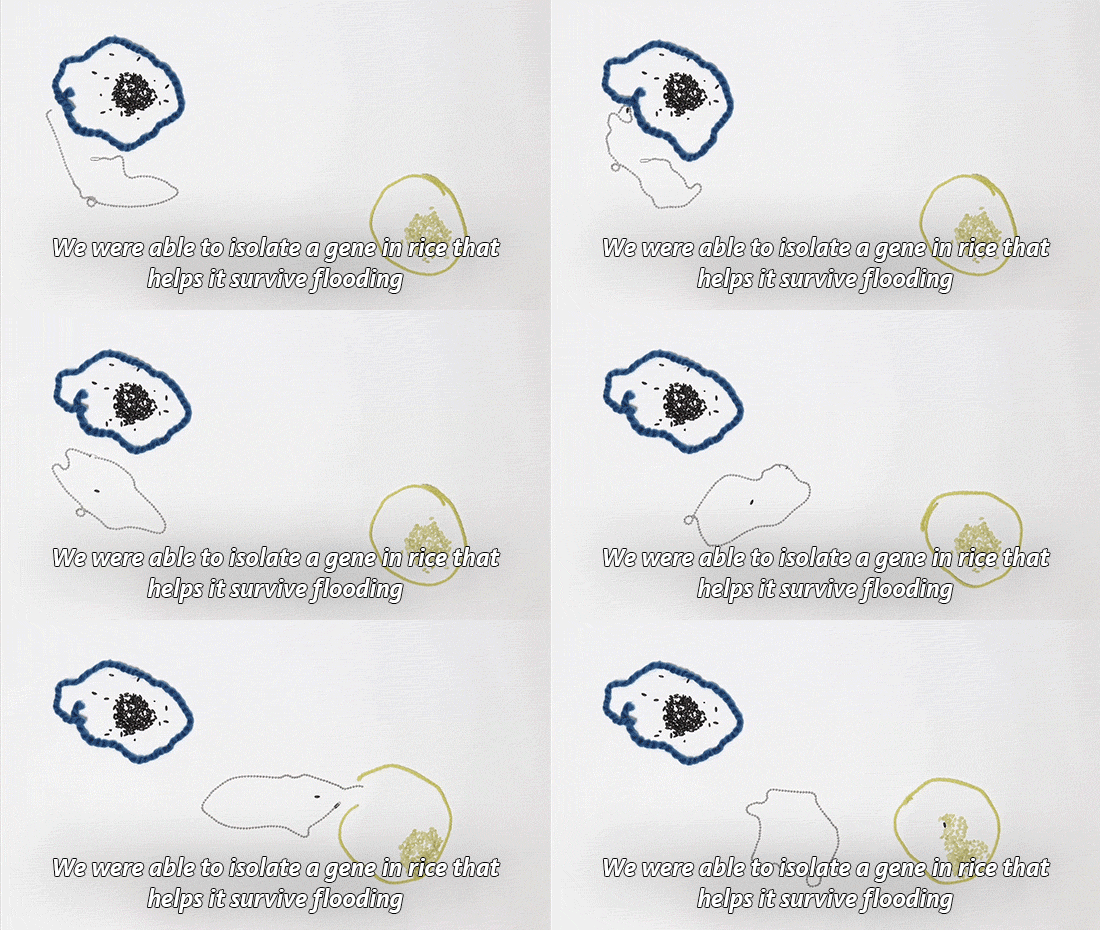
Right now her focus is on rice. It’s one of our basic crops and without it, we would struggle to feed much of the world.

With climate change, we’re seeing an increase in flooding in places like India and Bangladesh, which makes it harder to grow this important food staple.

So Ronald and her lab have developed a flood-tolerant strain of rice. It’s known as Sub1a or “scuba rice” and millions of farmers in South Asia are now growing it in their fields. 

Today is National Food Day, a day dedicated to hunger awareness. But as we focus on food insecurity, we need to talk more about how global warming will make the problem worse.

As our climate continues to heat up, it has huge impacts on what foods we are able to grow. Will our crops be able to survive droughts and floods? The University of California leads six labs that are working to develop other climate-resilient crops including chickpea, cowpea and millet.

Find out what other scientists are doing to improve our food.

Your daily reminder that GMOs are not evil – profit-mongering corporations are.