
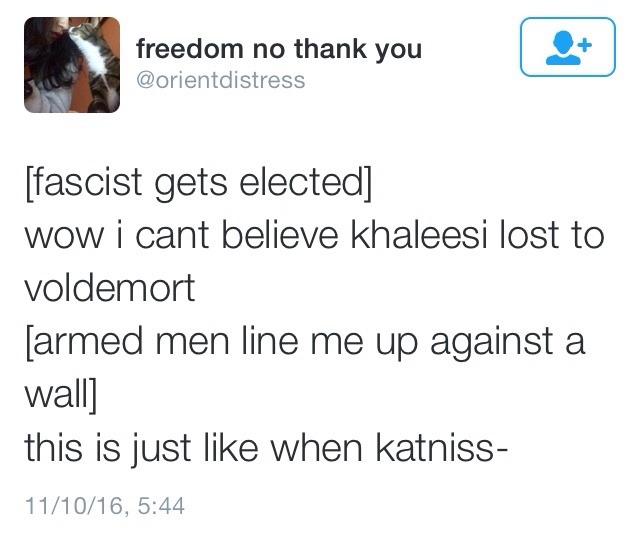
talesofthestarshipregeneration:
I know, I know. I get it. But I also believe that you gotta relate to people via the stuff they care about. You have to get people to care using the language/metaphors they already understand.
This is why scientists and science communicators are coached to use “natural” numbers – you don’t say something’s 200 meters long; you say it’s the length of 2 football fields. You say that something is as small as the period at the end of this sentence and that if you put all of the thing from end to end, it would stretch to the moon and back. People don’t think in microns and lightyears; they just don’t. You have to give them stuff that means something.
You don’t say that someone has a 20% chance of dying from the disease; you say that four out of five people survive it. You use the things people understand, even if the words sound painfully silly and you are dying of embarrassment just using them, because it just works better. The people can understand it, it’s meaningful to them, they’ll remember it, they will use it in their lives now.
It would be nice if everyone cared about research and data – if everyone was informed and engaged, and came out of the womb with a good grasp of the scientific method and a working knowledge of the civic institutions of their country. But they don’t and they’re not, so what are you going to do about it? Hopefully, you’ll give them the knowledge you have in a way that makes it easy to receive.
So when I ran off the rails in a tumblr post, getting overexcited about the impact of a restructured Supreme Court on the welfare of the USA in the next 50 years, I used Harry Potter metaphors. I cringed a little, because I feel like the SCOTUS is so interesting and important that we shouldn’t have to relate to it through the lens of decade-old YA literature, but I did it.
I said we “haven’t destroyed Scalia’s horcruxes” (Meaning: we can’t undo the legacy of a Justice even after their death, because the things they create to survive them are functionally immortal – except in very specific situations where people work together to deliberately destroy them in a special way.)
and “why are you focusing on your Defense Against the Dark Arts Teacher when the Wizengamot is corrupted” (Meaning: the temporary influence of a relatively powerless private individual is not as important as the stability of the functionally immortal, unchanging, supreme decision-making body that dictates the very fabric of society.)
In both cases, the metaphor is actually shorter than the meaning, and more people will get the impact – and even an interestingly nuanced context to remember it in. I know, it sounds so immature. I know, it shouldn’t take a spoonful of sugar. But if you believe the important thing is the message… then you’ll spoon out the sugar, act it out with sock puppets, take the kids on a field trip on a magic fucking school bus to make that message accessible.
And you know that I hate pop culture. But I’ll use it. I’ll use anything
– sports references, Harry Potter, memes, ALL CAPS DISCOURSE, Miss Fucking Frizzle – even if
it’s irritating to lots of people, if it means it makes a difficult thing
accessible to people who otherwise can’t get it.So I guess what I’m saying is that it’s worth it, if the message is.
But I totally get it if you roll your eyes.
considering that pop culture is based on human experiences and dreams and wishes and thought experiments I … really dont see why folk are acting like using it as a metaphor is somehow demeaning to the information that they want to share. Please get the fuck over yourselves.
Well, fair point. But ideally we wouldn’t need to, say, use fake characters to get people to understand that white supremacy is villainous. Ideally, people wouldn’t need a pop culture framework to get to a place of empathy and activism. Ideally you wouldn’t need to coat things with sugar to get people to care, or compare (living) people of color to (fake) Muggleborns.
I definitely saw the point being made in both tweets. And I am seeing notes from people who feel strongly about both sides – “Why are people so snobbish about pop culture when it is incredibly important to the fabric of our society” vs “why do people only care about genuinely serious shit when it reminds them of the fake struggles of fake predominantly-white teens.”* Both are good points. Both are also currently being held up as examples of privilege.
I think that’s why it can be read as demeaning – actually I think it’s
more disheartening than demeaning. If you really care about/are deeply
affected by something, it can be really disheartening to spoonfeed
people until they see it as important (at least in my perspective).What I think is important is the message that “sometimes pop culture is a frustrating way to relate problems to people, but it works, and if the message is important, you gotta use/respect what works.”
* I think there’s a lot of nuance there to unpack but I would be talking out of my ass if I tried, so I’m gonna leave it.
The pop culture hate is too often irrational and elitist tbh.
Also? It strikes me as a pretty ableist attitude. I’m Autistic, and I interpret most things through fiction. It helps me handle and understand a lot of stuff I otherwise wouldn’t be able to cope with. And there’s nothing wrong with that, it’s the way my brain works, and talking about how I ‘should’ process things differently and only in the way you approve of is ableist and useless
I’ve been puzzling over this for weeks now and I still got nothin’. I remember a good post I read about Les Miserables once, a story based on a real social revolution, which began with “Fiction is not inherently trivialization” and I agree with that totally. But on the other hand the money-making franchise-creating machines which spring up around things like Harry Potter or The Hunger Games often do trivialize them, and make you wonder what people’s motivations are for Tweeting about them: do they believe what they’re saying or do they just wanna shift a few more Katniss Funko Pops or Gryffindor scarfs from their online stores? Or do they just wanna gain social currency from sounding cool and approachable maybe? I wonder about that…
On the other hand I’ve seen photos of real-life protestors in real-life horrible situations making the Hunger Games salute at each other and that seems like one of the least trivial things in the world to me, but I imagine the key words there are to me.
And then there’s the fact that through no fault of their own some people just really do see the world better through a fictional lens which is fine, but also once stuff like Hunger Games hits the mainstream it ends up whitewashed in just about every sense which is the opposite of fine, and god there’s so much stuff just floating around right now about the power of stories but also which stories and who’re they about? Harry Potter might not be much use to you when you’re literally staring down deadly weapons but maybe something else might? I just don’t know.
