important

faithinhumanityr:

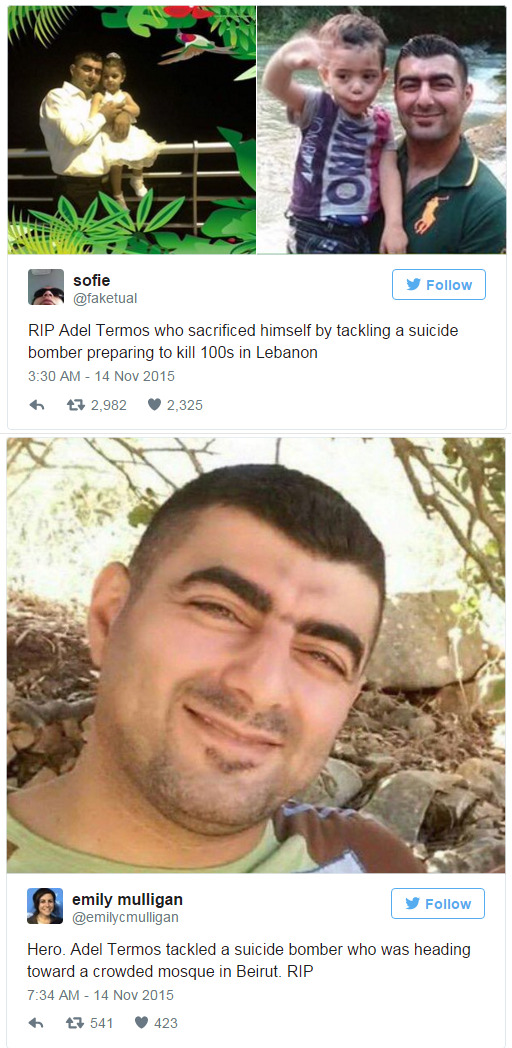
The bombings in Paris, Beirut and Baghdad have upset a lot of people and probably brought some of you to this website to restore some of your faith in humanity. Amongst all tragedy however, there is a story of a hero that needs to be told. Adel Termos deserves recognition, for his bravery saved many, many lives.

Mic.com; As the world continues to mourn the deaths of more than 120 people in Paris at the hands of alleged Islamic State militants, a hero has emerged whose actions likely saved the lives of countless people — and he’s nearly 2,000 miles away from Paris.

Adel Termos was walking in an open-air market with his daughter in southern Beirut’s Bourj al-Barajneh district Thursday when he heard a blast. A bomb had detonated. Glass and debris went flying. There was mayhem. When Termos noticed a second suicide bomber preparing to attack, he made a split-second decision to tackle the assailant.

The bomb went off, killing Termos. But his sacrifice likely saved dozens, if not hundreds, of lives.

“He tackled him to the ground, causing the second suicide bomber to detonate,” Elie Fares, a Beirut-based physician, told PRI. “There are many, many families, hundreds of families probably, who owe their completeness to his sacrifice.”

There is a quote by Fred Rogers that seems

appropriate

to me; “When I was a boy and I would see scary things in the news, my mother would say to me, “Look for the helpers. You will always find people who are helping.”

Why activism is a terrible hobby

yearoftheknife:

thosearewritingwords:

icecoldcaffeine:

gingerautie:

I recently saw a post where someone commented that the incredibly charged issue they were arguing about followed them home, and they couldn’t escape it. And it reminded me why this pattern I see of people (especially young people) where the majority of their downtime is spent on tumblr, and their tumblr is mostly some form of activism, from thought out long posts to clicking reblog on a petition, is so worrying to me.

Various forms of oppression are background noise to a lot of people’s lives. Fixing that is not likely to occur within your generation. It might get better, but the chances of it completely vanishing are minuscule. Some activists go home after dealing with bigotry all day at work, and talk about oppression on tumblr. And if they sit down and watch a TV show, they think about how it’s bigoted. If they have a musician they love, they feel obliged to think about how they’re problematic.

This is awful for you, your metal health, and the people around you. You burn out, you start blowing up at people for tiny things because you’re so tired of it. It makes you miserable and unpersuasive, it’s emotionally exhausting.

And this isn’t just me saying this. When my grandpa was training to do work with the labour party, he was told that you had to have a hobby to be good at it. Because otherwise it destroys you. You have to have something in your life that is totally disconnected from the horrific things you are seeing everyday.

If you can’t find TV shows to watch because you can’t switch off the social justice analysis part of your brain, do something else your activism can’t creep into. Take up knitting. Build shit out of cans. Play the recorder. Lock yourself in your bedroom and play minecraft. Whatever you do, please, please don’t let activism and fighting oppression take over every aspect of your life.

Have a separate activism tumblr and a cat pics/memes tumblr. Or blacklist activist things on your tumblr. Set aside some time where you don’t think about how shit the world is.

You have a right and an obligation to look after yourself. Please don’t drive yourself into the ground for the sake of social justice. You can’t fight all the time, and you’ll be no good at it if you can’t take a break.

Activists (irl activists) are told to clearly separate their two main tasks which are providing help and making demands. You cannot help anyone in an environment where you are also making demands. You cannot help anyone in an environment where you are also complaining about systematic oppression or asking for change.

Tumblr completely conflates the two. The result of this is:

> Tumblr transgender activists, for instance, tell transgender people they are valid and important, then in the same breath, in the same post and on the same blogs, remind transgender people that they are unloved and unwelcome by society, along with factual proof of transphobic violence.

This is incredibly destructive. I don’t think I even need to explain why. It’s the best way to crush transgender people’s self-esteem, bar none. The message it carries is, “even those on your side know the whole world hates you”. It’s just plain dangerous.

> In so-called LGBT safe spaces on tumblr, for instance, there is near-constant bickering about straight passing privilege versus monosexual privilege versus allosexual privilege. It often escalates to absurd levels of aggressiveness (because it’s the internet, duh) and occurs nearly everywhere, making safe spaces unsafe. The solution tumblr found is to build tiny, microscopic safe spaces for each minority within the LGBT.

Because segregation fixes everything. Spoiler alert: it only makes people more afraid of each other and breeds wariness, misunderstanding and conflict.

When you want to help a marginalized community, you either provide help to individuals, OR you raise awareness about their struggles and make demands for social change. You can have a blog for each, and if you do irl activism you most likely have a separate schedule for each.

The most basic rule for helping minorities is that shelters, help lines and safe spaces should never host debates. The most basic rule of safe spaces is: everyone fitting the requirements to enter is equally welcome, no questions asked, no debate allowed on anyone’s legitimacy or identity or privilege.

Safe spaces, shelters and help lines must be happy, uplifting places where people feel welcome, loved, and important. Otherwise they’re unsafe and toxic. If you can’t provide acceptance and compassion for all members in equal measure regardless of their background, privilege or opinion, you’re not fit for the job, stay away from administrating safe spaces.

Raising awareness and making demands is something tumblr does very well an OP explains well how compassion fatigue works and how destructive activism can be, so I’m not going to dwell on it.

Just remember that not everyone has the emotional strength for it, including those in the community you’re trying to help. Most men who have sex with men, for instance, don’t want to hear about how their community makes up 40% of the french population tested positive for aids. We know, and we also know that nearly 20% of that population has aids, but we also need to think about something less dreadful from time to time. It’s a matter of survival. Also, when you’re staring at your or someone else’s misery 24/7, you become so bitter you lose the ability to help anyone. Self-preservation makes us more useful, as activists. 

(Apparently a lot of tumblr activists missed the point of OP’s post, which was compassion fatigue, by a few hundred miles; and assimilated it with something like “hahaha I’m so privileged I can afford not to think about discrimination evar”. I’m not surprised.)

Great posts. I really liked the discussion of safe spaces by the second poster, since there’s an LGBTQ muslim group that I go to and recently we had a facilitator who was very debatey, and at one point cited an academic paper in response to someone’s story.

And it was weird.

Because while I definitely agree that some debate is required (especially behind the scenes) in order to make safe spaces safer for everybody, the way it was done made me feel like I was constantly being tested for how problematic I was, and that the facilitator was assuming I was problematic until proven otherwise—in part because of the contrast between their gentleness with the friends they’d invited to the space (and whose opinions they therefore already knew) and their manner with the rest of us.

Which—I’m happy to question and rethink my assumptions, but I don’t want to go to a safe space and feel like the facilitator is automatically assuming bad faith or unkindness on my part, or that I need to be carefully watched so that I don’t make the space unsafe for other participants. I mean, I’m a woman-liking-woman who wears the hijab; people make those assumptions about me (that I’m a danger to other LGBT people) all the time, even when they know my orientation. I don’t want to also face that in a safe space that’s supposed to be specifically for people like me.
this was a thing i had huge problems with a couple years ago that was really destructive, esp. since i didn’t have much opportunity to find new hobbies or go out and Have Fun. getting into drawing the things that i like and learning to focus on that has been super important

like i’m pretty sure one reason it took me years to find any fandom that i liked was bc i was actively avoiding anything that looked “problematic”, and the things i DID like i indirectly shamed myself for liking by constantly saying “i like [thing] even tho it’s problematic :/” instead of letting myself say “i like [thing]!!” sometimes. (not to mention the people jumping on my saying i like something by telling me all the Problematic things about it)

tumblr_nwv8m4KrM61szqwnwo1_1280

fieldbears:

wildwomanofthewoods:

mindblowingfactz:

In a private cemetery in small-town Arkansas, a woman single-handedly buried and gave funerals to more than 40 gay men during the height of the AIDS epidemic, when their families wouldn’t claim them.
Source

One person who found the courage to push the wheel is Ruth Coker Burks. Now a grandmother living a quiet life in Rogers, in the mid-1980s Burks took it as a calling to care for people with AIDS at the dawn of the epidemic, when survival from diagnosis to death was sometimes measured in weeks. For about a decade, between 1984 and the mid-1990s and before better HIV drugs and more enlightened medical care for AIDS patients effectively rendered her obsolete, Burks cared for hundreds of dying people, many of them gay men who had been abandoned by their families. She had no medical training, but she took them to their appointments, picked up their medications, helped them fill out forms for assistance, and talked them through their despair. Sometimes she paid for their cremations. She buried over three dozen of them with her own two hands, after their families refused to claim their bodies. For many of those people, she is now the only person who knows the location of their graves.

How have I never heard of this?

People like her should be remembered. And even more importantly, we must remember that there was a time in our history when we needed someone like her.

But what rings most dangerously prophetic about Salem is the ideology that suggests imagining the most helpless and vulnerable in our communities as the most powerful, in a kind of 1984-esque doublethink that provides a rationale for causing as much harm as one wishes to that group.

http://www.autostraddle.com/who-is-it-that-afflicts-you-312929/

This article is so good! And this quote sums up so much of what confounds me about our culture. Why do we do this? How do we keep getting away with it?

(via reindeerbee)

theunitofcaring:

Within any community of marginalized people it seems like there are going to be some people whose experience of discrimination was dominated by hostility (”we don’t serve people like you here” “if you’re gay I’m kicking you out of the house” “he’s retarded, he doesn’t even know that we’re making fun of him”), people whose experience of discrimination was dominated by internalized negative stereotypes (”I thought people like me were burdens on their families” ”I felt like if I didn’t marry a man and have kids, there was no other way I could lead a valuable live” “I thought that people like me having sexual desire was gross and disgusting”) and people whose experience of discrimination was dominated by invalidation (”you’re not gay, honey, it’s a phase” “you saying you’re mentally ill is insulting to people with real illnesses” “you’re really white for a black person”)

And obviously lots of people get all three heaped on them, or different things for different axes of marginalization, but I think that a lot of community discussions I’ve seen have broken down along the fault lines of people having experienced fundamentally different forms of discrimination.

And that’s how you get “who is more privileged” debates – is invalidation less oppressive than internalized self-hatred? If you haven’t experienced hostility, are you really oppressed? It’s also how you get the “oh, we’ve solved that” flavor of cluelessness – hostility is easier to see than invalidation and internalized negative stereotypes, and so once hostility has been made socially unacceptable some people might think the space has been successfully cleansed of bigotry.

Also, some solutions can be very frustrating if they’re for the wrong problem – for example, if you think someone’s problem is internalized self-hatred so you tell them “it’s not true that the other kids don’t like you! people won’t see you any differently for who you really are!” when, in fact, they’re dealing with hostility because yeah, the other kids are in fact bullying them for who they are.

I guess the only remedy I have to propose is to keep in mind that another person’s experience of discrimination may be really different than yours, and don’t immediately try to put it on a spectrum as “worse” (and so I should feel guilty over my relative privilege) or “better” (and so I need to defend my place of relative disprivilege). It’s a multi-dimensional space we’re working in. 

What Cultural Appropriation is NOT

chaotically-neutral:

Cultural appropriation is real and can be very harmful, but Tumblr en masse has grossly misdefined it. Here are some examples of what isn’t cultural appropriation:

– Eating food from another culture
– Properly practicing a religion from another culture.
– Listening to music from another culture
– Reading literature from another culture
– Learning a new language
– Respectfully wearing clothing from another culture in an appropriate setting, such as overseas, at a cultural event, wedding, etc.
– Buying crafts from local craftsman.
– Respectfully participating in cultural activities such as yoga, dreidel, and belly dancing
– Respectfully wearing or using non-sacred icons or art from another culture, such as Chinese pottery or in some cases, henna.
– Trying out instruments and tools from another culture, such as chopsticks or traditional writing instruments

Many people from other cultures are actually offended when Americans try to fight “cultural appropriation”. For example, many Japanese people thought that criticism of Avril Lavigne’s video was laughably ignorant at best and racist at worst. Also, in many countries, Americans who refuse to partake in cultural activities or traditional dress out of fear of appropriation are seen as snobbish and entitled. Additionally, many religions actively encourage evangelization. Saying that religions traditionally practiced by non-white people cannot freely spread has some very racist implications.

Being culturally literate actively fights racial prejudice or ignorance. Taking the time to learn another culture’s history, values, perspective, and traditions makes people better citizens. For example, understanding how various cultures and religions view illness will help me be a better nurse. Cultural competence can only help society, and it prevents genuine, offensive cultural appropriation.

There are definitely some gray areas when it comes to cultural appropriation. Some Christians find non-Christians using crosses in fashion offensive, while some do not, for example. Intent can also carry some significance. For example, someone may fully understand the sacred meaning of the ankh and feel a strong spiritual connection to it. Another person may just think it looks cool. Both wear an ankh ring, but one would definitely not be appropriating while the other has entered a gray area.

Some cultural practices overlap as well. Tattooing has been practiced around the world by many cultures that didn’t come into contact with each other, for example. Meditation has also been practiced around the world. Buddhist mediation is arguably the best known, but nearly every culture and religion has one or more varieties of it. (I personally like the method practiced in Ancient Ireland best, because it’s the only one I personally know that allows one to think exclusively in words. It’s not physically possible for an NLDer to “turn off” verbal thinking, so most other forms of meditation are inaccessible.)

Historically, separating cultures often leads to cultural incompetence, xenophobia, discrimination, stereotyping, and racism. Cultural appropriation is bad, but that doesn’t make cultural segregation good.

humansofnewyork:

“My husband and I sold everything we had to afford the journey. We worked 15 hours a day in Turkey until we had enough money to leave. The smuggler put 152 of us on a boat. Once we saw the boat, many of us wanted to go back, but he told us that anyone who turned back would not get a refund. We had no choice. Both the lower compartment and the deck were filled with people. Waves began to come into the boat so the captain told everyone to throw their baggage into the sea. In the ocean we hit a rock, but the captain told us not to worry. Water began to come into the boat, but again he told us not to worry. We were in the lower compartment and it began to fill with water. It was too tight to move. Everyone began to scream. We were the last ones to get out alive. My husband pulled me out of the window. In the ocean, he took off his life jacket and gave it to a woman. We swam for as long as possible. After several hours he told me he that he was too tired to swim and that he was going to float on his back and rest. It was so dark we could not see. The waves were high. I could hear him calling me but he got further and further away. Eventually a boat found me. They never found my husband.” (Kos, Greece)

A couple of important rhetorical questions.

withasmoothroundstone:

Well not sure if they’re rhetorical or not, but they’re not meant to be answered out loud, more meant to think what answers you might have and why.

  • What do you do when you catch someone doing what you think is both wrong and based in bigotry, and sie turns out to have a disability that caused whatever action is bothering you, to the point where it’s clear bias is not at work at all, let alone bigotry?
  • With disability in particular:  How do you handle it when someone seems to be interfering with someone’s access, and it turns out that they are merely ensuring their own access to whatever is going on, and that the problem is not one of them being wrong, but rather their access needs being in complete conflict?
  • Can you be friends with, or even be civil with, someone who disagrees with a value you hold dear?

I was going to write a lot to deal with this. In fact, I’d been going to write two posts, one dealing with the first two questions, the other (and more important) dealing with the last one.  But when I tried to write the last one, my computer ate it during a crash.  And when I went to write the others, I got hopelessly sidetracked.  So I’m just putting the questions out there as food for thought.

The first two really deal with how people handle complex situations in a context where we really, really want it to be simple, to be able to point a finger at one person and say “This person is wrong, and that other person is right.”  A very common reaction is to sweep under the rug any complexities, and refuse to acknowledge them in any way.

And the last one deals with how ideology can interfere with forming authentic and varied human connections.  And whether diversity of thought and opinion is a valuable thing or a nuisance or problem.  And whether it’s more important who a person is or what they believe.  And how we treat and view people we disagree with on things that are important to us.  And that’s the one that really deserves an entire post, and got a long, thoughtful post, until my entire computer froze and deleted everything.  Someday I might try to rewrite it, because this topic is extremely important to me.

But for now, they’re just questions.  Not “I want an answer to this from you” questions, but internal questions.  (Is that a thing? Is there a word for that?  I know the term rhetorical questions but that doesn’t sound quite right here.  It’s just the only term I know for questions that aren’t meant to be answered aloud.)