History geek note: Now I’m imagining an editorial cartoon from 1615 comparing “Ye Moderne Bible Reading Woman” with the good, old-fashioned women from 1315 who didn’t insist on learning to read the bible for themselves but were content to have a learned Man of the Church interpret it for them. I’d try drawing it myself if I could draw anything other then stick figures.
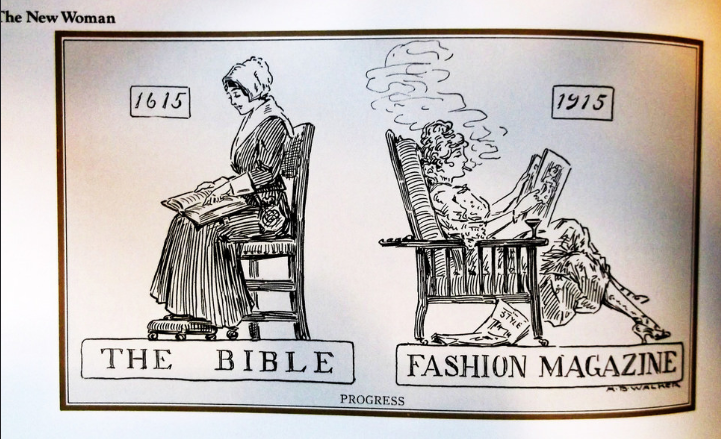
The editorial cartoon from 1615 you imagine actually exists! Or at least, something a lot like it.
This is an illustration from the 1600s. First picture shows the good old days, when people carried around lances to stab people with and we actually read literature and wore spurred boots. The second picture is THE DEGENERATE PRESENT, where all these 1600s millennials wear RIBBONS and play DICE and SMOKE and DRINK STUFF FROM SNAKE FLAGONS. Damn 1600s hipsters. It was better when I was your age.
Humanity, never change.
Look! Silvermarmoset posted an editorial cartoon from the 1600s, providing more proof that no matter what century you were born into you always just missed the good old days.
Reblogging this, it’s amazing.
Early 20th century British conservative cartoonist WK Haselden ran a whole series like this in 1920, where “Maud of the Eighties” (1880s, that is; sturdy, Victorian times) was faced with modern mores generally or “Gladys of Today” specifically:
I’m sure this was a hilarious, cutting insight at the time:
By the way, Haselden himself was all of eight years old in 1880. “Born in the wrong time,” I suppose they say.
It’s hard to say how much outright disapproval Haselden was expressing when you read, for example, the below – but as I have pointed out before, things like this that read to us today as awesome were usually intended to be read as unseemly and absurd at the time.
This is a more overt example of the same sentiment:
And before giving him too much credit, I hasten to add he was a staunch anti-suffragist:
Haselden did at least seem to recognize the ironies implicit in “good ol’ days” talk:
Whatever his level of self-awareness, he seems to have reached the conclusion that the chattering class will always be thus:
Indeed, in 1921 he anticipated this entire post!
There is a chance I originally reblogged this partially in the hope David would make amazing hay of it and I WAS NOT DISAPPOINTED
I adore this post from the bottom of my history-loving heart
The real tragedy about the barricade is that we don’t know how much is true. Victor Hugo was there at the June Rebellion, so what is fact and what is fiction? That question gives me chills because we’ll never know.
Charles Jeanne (who I think is probably actual real life Enjolras) wrote an in-detail account of the ACTUAL barricades in a letter to his sister after the fact
I’m so glad somebody asked this, because the answer is: when they finally ran out of ammunition, Charles Jeanne rounded up everyone who was still standing, went, “look, if we’re going to die, we might as well die fighting,” and led a suicidal ten-man charge against an entire flippin’ infantry column, armed with nothing but bayonets. The first few ranks of soldiers were so unprepared for such a spectacularly insane attack that they were too surprised to shoot. They crossed bayonets and tried to hold the insurgents off in hand-to-hand combat, but Jeanne’s swordsmanship was apparently aces, because he held off a bunch of them at once and covered his friends as they tried to breach the ranks. And once they were in, nobody could shoot them for fear of taking out their own guys.
So the last stand that the insurgents had intended as a noble suicide ended in them breaking through the ranks entirely and winding up in the next street over, outside the combat zone, going “well shit, what do we do now?” (I’m guessing the infantry column wasn’t very deep; central Paris at that point was a rabbit warren of narrow twisty streets, and assembling troops en masse for an organized attack was a logistical nightmare.) Unlike the National Guard, the army weren’t total chumps and got themselves turned around to give chase and start shooting once they weren’t at risk of friendly fire any longer… and that’s when all the civilians holed up in their houses went “no way, you’re not getting your hands on these crazy bastards” and started hurling furniture and crockery down on the soldiers’ heads. Jeanne was understandably distracted at the time, but afterwards somebody informed him that the barrage of unlikely projectiles included a piano. A piano. That is some straight-up Looney Tunes slapstick right there. No wonder Hugo went for the heroic death scene instead; if he’d stuck to real life, he probably would’ve gotten complaints that he’d wrecked his readers’ suspension of disbelief.
Anyway, someone opened an alley gate for them to shelter in and take stock of the casualties–most of them survived(!!!), but a few were pretty nastily wounded. Their host then had to lock Charles Jeanne in to keep him from charging right back out and taking on the whole goddamn army singlehanded. He probably would’ve broken down the door if the poor man hadn’t pointed out that going back out would give away his wounded comrades’ hiding place and the identities of the people sheltering them. They sat there listening to the gunfire gradually slow and go silent, and then in the middle of the night the ones who could still walk were allowed to slip away one by one at long intervals from each other. Charles Jeanne went straight home, slept like the dead for a few hours, was woken up at five in the morning with a warning that he’d been denounced and the building was surrounded, and then slipped out in disguise and managed to evade the police for four months before a former comrade ratted him out and he was arrested.
And this, ladies and gentlemen, is why Charles Jeanne’s letter is an absolute treasure that deserves to be available to anyone in Les Mis fandom who wants to read it. Incidentally, “how Actual Historical Enjolras survived the barricades by being too good at his suicide mission” is also one of the stories I tell when anyone asks me what the hell is so interesting about researching people nobody’s ever heard of from an obscure chapter of French history.
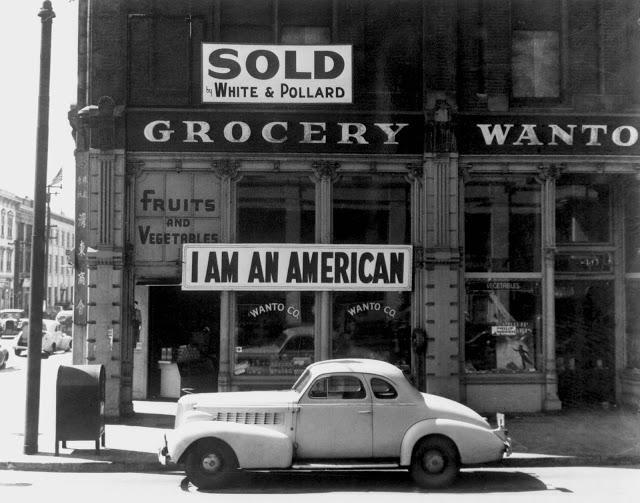
A Japanese American unfurled this banner over his business the day after the Pearl Harbor attack, 1942. Photographed just prior to the owners internment by Dorothea Lange.
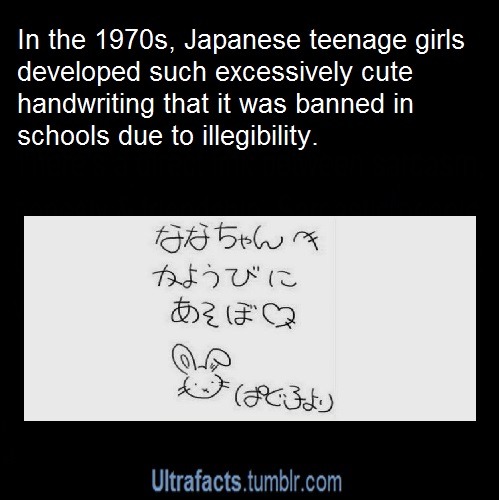
No, no, you have no idea. It actually IS the beginning of the whole so-called “kawaii culture”. And it started because girls started using mechanical pencils, which provided fine handwriting. After being banished (more precisely, during the 80s), this kind of writing started being used in products like magazines and make-up. And, during this time, icons we usually associate with the whole kawaii industry (like the characters from Sanrio) came to life too.
And what many people don’t realize is that this subculture was born as a way for young girls to express themselves in their own way. And it was also used as something against the adult life and the traditional culture, often seen as dull and boring and oppressive. By embracing cuteness, these young girls (and adult women, after a while) were showing non-conformation with the current standards.
So yep. Kawaii is important, and it all started with cute, simple handwritting a few hearts and cat faces in some girls’ school notebooks <3
!!!!!
NO OK THIS IS SO IMPORTANT!
This is also how the kawaii fashions started! Girls began dressing in cute and off beat styles for themsleves, they were criticized by adult figures telling them “you’ll never find a husband if you dress that way!” to which they began to reply “Good!”
All the japanese subcultures and fashions that evolved out of this became a rebellion to tradition and the starch gender roles and expectations the adults were forcing on the younger generations. As early as the 70s and still to this day you’ll see an emphasis on child-like fashion and themes in more kawaii styles and the dismissal of the male gaze with styles like lolita (a lot of western people assume lolita is somehow sexual due to the name of the fashion, but ask any japanese lolita and they will tell you that men hate the style and find it unattractive which is sometimes a large reason they gravitate towards the style – they can express their femininity and individuality while remaining independent and without the pressure to appeal to men)
Its so so so important to understand the hyper cute and ‘odd’ fashions of Japanese girls carry such a huge message of feminism and reclaiming of their own lives.
so are you telling me that Japan’s punk phase was really the kawaii phase
Yep. Kawaii has a lot in common with punk when you think about it. Fun quirk in cultures.
Medieval doodles in the margins? Blame the children
Surreal creatures in book by 14th-century Neapolitan monk added by two children a few centuries later, says academic.
The drawings of strange animals in the margin of a precious medieval
manuscript have been revealed as doodles by children, presumably bored
by the dense Latin text.
The book, now in the library of the University of Pennsylvania, was
written by a 14th-century Franciscan monk in Naples, and includes
astronomy and astrology tables, sermons, columns of biblical dates and
tables for working out any day of the week between 1204 and 1512 – all
thoroughly dull to the children into whose hands the manuscript fell a
few centuries later.
We have been remiss – this story has been getting passed around on social media and we are only just getting around to sharing it ourselves! It’s our manuscript: LJS 361, a collection of Astronomical and astrological tables. Included on a few folios are some marginal doodles which Dr. Deborah Thorpe from the University of York has identified as being drawn by children. Unfortunately the story linked above, from the Guardian, doesn’t identify the manuscript by shelfmark (a big no-no! Always identify your manuscripts, folks!), but here’s a link to another article (from the University of York) that does. And here is LJS 361 on OPenn. (Below is a clip from folio 26r.)