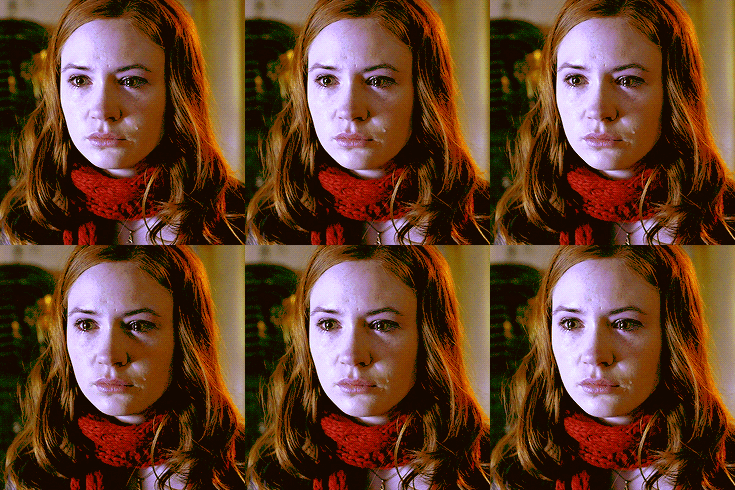
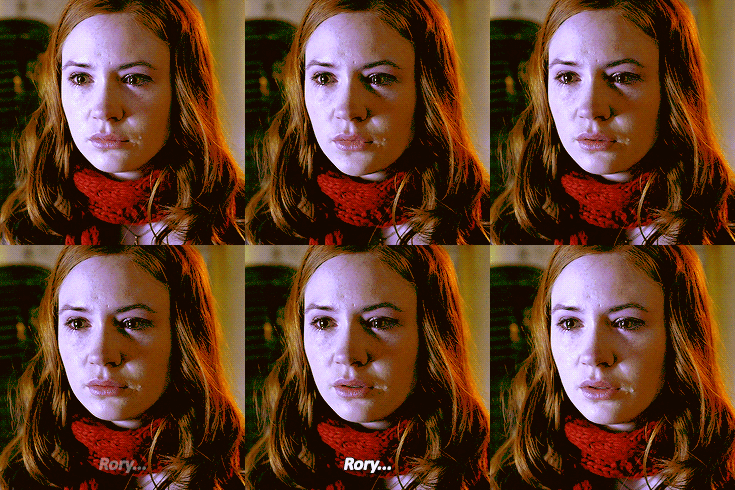
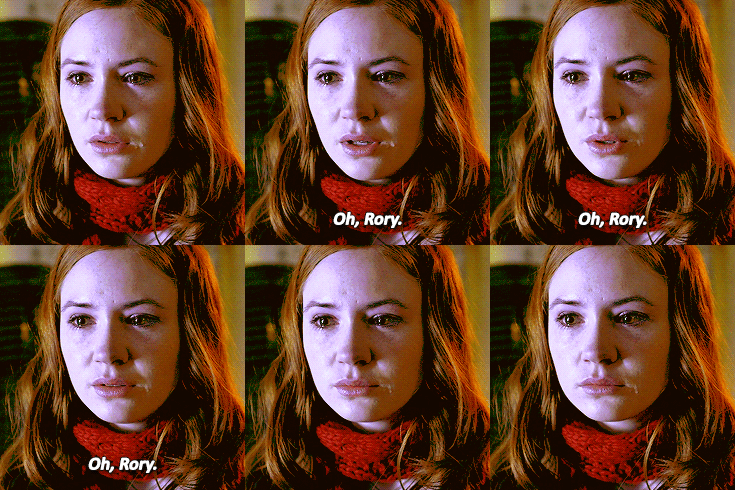
Well, so might you do, to protect everything you loved.
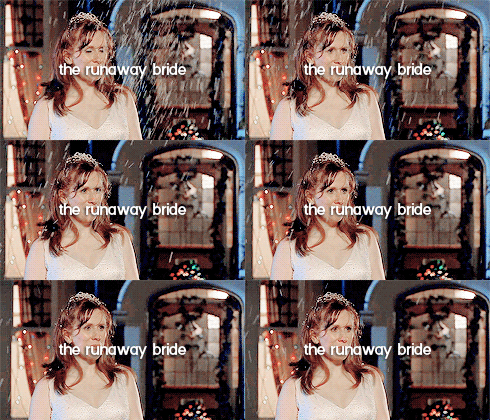
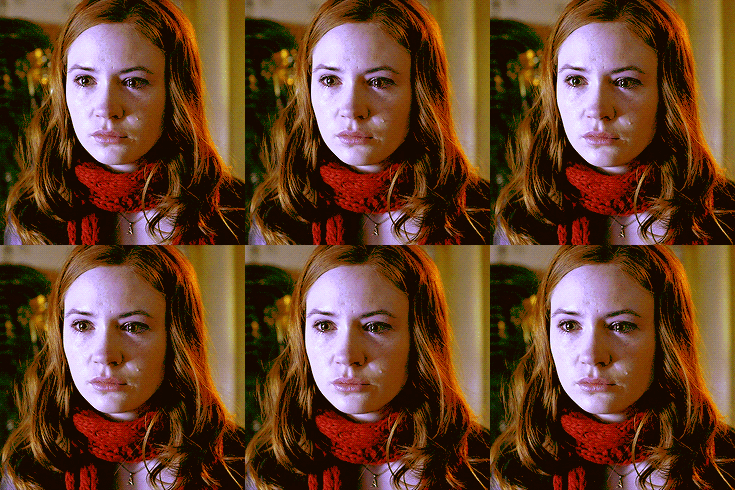
I think this quite nicely illustrates such a big difference between Amy and Clara:
On losing a loved one, Amy puts herself (and only herself, the Doctor didn’t have to get in the car with her) in danger to bring Rory back. But Clara? She’s going to drag the Doctor down with her, utterly destroy him if necessary, to get what she wants.
When I was a kid, I had an imaginary friend. The raggedy Doctor. My raggedy Doctor. But he wasn’t imaginary, he was real. I remember you. I remember! I brought the others back, I can bring you home, too. Raggedy man, I remember you, and you are late for my wedding!
Amy, when we first meet her, had an unimaginable amount taken from her. The crack not only ate away at her life and stole away her parents, it robbed her of the knowledge of what she had lost. What is left is an empty house in Leadworth, with an aunt who was neglectful enough that Amy, at the age of seven, was already used to fending for herself and entirely unshaken by an alien crashing in her backyard.
The truths that she does retain, the magic of reality in the form of her Raggedy Doctor, is something which no one believes. Even Rory is just playing a game. She’s the perpetual outsider in a village which does not even speak like her, full of people who think the impossible truth of her life is a mere story. Madness even, psychiatrist upon psychiatrist telling her it isn’t real.
The Doctor sees that lost little girl and feels kinship, and he takes her travelling, but he doesn’t share the tragedy of her past with Amy. Along the journey, Amy loses another person she loves, as Rory erased from existence. Amy was the girl running away on the night before her wedding. Now she’s just a girl running. And she’s grieving, without even understanding why.
Brave, wonderful, flawed, smart Amelia Pond. Who saves a star whale, empathises with a machine created by the Daleks, infiltrates a school of fish vampires, and brings joy into Vincent van Gogh’s last days. She’s so vibrant. But her freedom is tainted. It is there, in her very spirit, in every glorious thing she does, but it’s also an illusion. She’s stripped of knowledge and truth and her entire history. She doesn’t make sense.
So claiming all of it back is the single most important moment of series 5. All that damage the cracks in time waged on her life, on her mind, also give her the power to change, to retrieve, to heal. She brings back the parents she never had and always had. She brings back Rory Williams, the man she loves. And then, finally, she brings back the Doctor. Her Raggedy Doctor. Her stories are real. Even more than that, they become real.
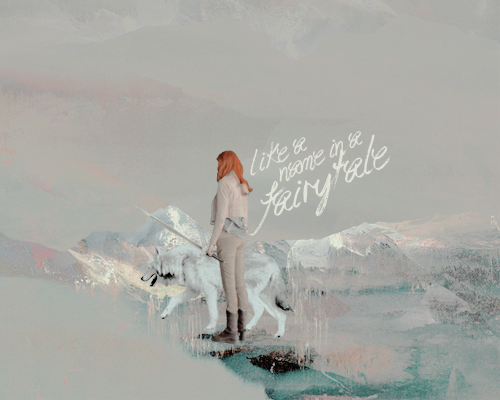
Amelia Pond single-handedly brings the fairytale back into the world, her world… and for everyone to see.
…But that scene in The Big Bang, when Amy remembers the Doctor back into existence during her wedding to Rory, her parents in attendence… that is her first major triumph. Because she claimed back what was stolen, because she proved the magical to be real, because she demanded the universe to give her what she wanted and the universe did just that.I have seen people argue that it somehow devalues her story prior to this point, but for me that’s the most hopeful moment of all. The lost girl, with the house that was too big, who grew up to not recall the loving family she had or the wonderful man she came to adore. And she just has the power to change it all.
Because she’s Amelia Pond.
Well this is interesting„,now I’m starting to rethink Amy’s arc…
(Agency might not be the best term to use. Power might be better.)
Amy, when we meet her in series 5, is a person who has an unimaginable amount taken from her. The crack not only ate away at her life and stole away her parents, it robbed her of the very knowledge of what she had lost – memories of a happy childhood, full of life, not alone in the empty house in Leadworth, with an aunt who was neglectful enough that Amy, at the age of nine, was already used to fending for herself and playing up her confidence.
The truths that she did retain, the magic of reality, an alien crashing into her backyard with the promise of adventure, is something which no one believes. Even Rory is just playing a game. She’s the perpetual outsider in a village which does not even speak like her, full of people who think the impossible truth of her life is a mere story. And a dangerous one at that, madness even, psychiatrist upon psychiatrist telling her it isn’t real, to the point that after twelve years, even she doubts it.
And throughout the series, the Doctor never tells her the truth. He sees that lost little girl and feels kinship, and he takes her travelling, but he never tells her of the mess, of the tragedy, that is her past. He doesn’t tell her why she’s grieving. And they watch powerlessly as Amy loses another person she loves, Rory erased from existence and her memories. Amy was the girl who was running away on the night before her wedding and now she’s just a girl running.
And she acts. Oh does she act. Brave, wonderful, flawed, smart Amelia Pond. But she’s stripped of knowledge and truth and her entire history. Her freedom is tainted. It is there, in her very spirit, but it’s also an illusion. She doesn’t make sense.
So claiming all of it back is the single most important moment of series 5. All that damage the cracks in time waged on her life, on her mind, also give her the power to change, to retrieve, to heal. She brings back the parents she never had and always had. She brings back Rory Williams, the man she loves. And then, finally, she brings back the Doctor. Her Raggedy Doctor. Her stories are real. (Even more than that, they become real.) She single-handedly brings the fairytale back into the world, her world… and for everyone to see.
“According to legend, wherever the Pandorica was taken, throughout its long history, the Centurion would be there, guarding it. He appears as an iconic image in the artwork of many cultures, and there are several documented accounts of his appearances, and his warnings to the many who attempted to open the box before its time. His last recorded appearance was during the London blitz in 1941. The warehouse where the Pandorica was stored was destroyed by incendiary bombs, but the box itself was found the next morning, a safe distance from the blaze. There are eyewitness accounts from the night of the fire of a figure in Roman dress, carrying the box from the flames. Since then, there have been no sightings of the Lone Centurion, and many have speculated that if he ever existed, he perished in the fires of that night, performing one last act of devotion to the box he had pledged to protect for nearly two thousand years.”
I actually thought the wheelchair was a shout out to dream warriors. I may just have missed the line about the leg when someone came into the room to say something to me.
i don’t know which Dream Warriors you mean, and Google is giving things that don’t seem to apply here. please give a link?
Shona’s comments about the male scientist’s actions are about 6 or 7 minutes in, on the version i streamed, anyway.
I would actually count the description of the male scientist’s actions as a definite plus, to the extent that I was actually kinda surprised to see it included on a problematic-stuff list. After three-odd seasons of the Doctor kissing people without permission, FINALLY we get a woman saying that ‘even’ an unwanted leg-touch (which the man thinks is perfectly fine and harmless) is actually totally gross. And it’s a woman doing the calling-out. (And then, interestly, the male scientist is the first to die and goes pretty much totally unmourned.) I dunno the spirit in which his character was intended, but I really did think those lines were a Good Thing.
in that sense you have a good point (and i did love that he got shlurped up by the tv unmourned, although i didn’t love that this was Troughton’s son’s debut in the show).
i guess it just seemed out of place in a kids’ christmas show? (although for realism reasons, you could be right about that) and the main reaction of the other ladies was more “ew” at her description than “ew” at his actions?
I just watched it again and here are (the slightly paraphrased) lines:
Shona: I was fine until he put his hand on my knee and then I was just grossing out.
[The two other women stare at the man]
Man: It was intended as a comfort!
Scottish woman: For whom?
Then Shona starts talking about his nose hair and then they’re a bit ‘ew’, I think.
I actually thought the wheelchair was a shout out to dream warriors. I may just have missed the line about the leg when someone came into the room to say something to me.
i don’t know which Dream Warriors you mean, and Google is giving things that don’t seem to apply here. please give a link?
Shona’s comments about the male scientist’s actions are about 6 or 7 minutes in, on the version i streamed, anyway.
I would actually count the description of the male scientist’s actions as a definite plus, to the extent that I was actually kinda surprised to see it included on a problematic-stuff list. After three-odd seasons of the Doctor kissing people without permission, FINALLY we get a woman saying that ‘even’ an unwanted leg-touch (which the man thinks is perfectly fine and harmless) is actually totally gross. And it’s a woman doing the calling-out. (And then, interestly, the male scientist is the first to die and goes pretty much totally unmourned.) I dunno the spirit in which his character was intended, but I really did think those lines were a Good Thing.
What I hate the most about Superwholock fandom bloggers: they flip out when ½ of their creepy fetishised gay ship has a relationship with a woman. “No! John/Castiel/The Doctor can’t be with Mary/Meg/Rose! He loves Sherlock/Dean/Captain Jack!!” Well, mewling infants, I have some news for you. A. bisexuality exists. It’s bi erasure and plain ol’ misogyny to say that your character could never ever be bi even though he’s had relationships with women and then to shit talk any woman he’s been with. B. ship whatever you want but your ship is not canon and never will be. Ever. Yeah there was that time captain jack kissed the doctor and we were all overjoyed but tbh that was the punchline of a bad joke. And all that shitty queerbaiting in Sherlock is going to remain just that: queerbaiting. So get over it.
((C. All three of these shows are misogynistic, have absolutely no representation, and are just poorly written. Moffat can eat a bag of dicks.))
Except…Captain Jack’s kissing the Doctor wasn’t the punchline of a bad joke?! Not remotely? I mean – this was a scene written by a gay man of a bi/pansexual man played by a gay man kissing another man. It was the first gay kiss in Doctor Who’s history (and remains still only one of two, sadly). It was one of very few gay kisses on British TV to be broadcast before the watershed and on a then explicitly ‘family’ show, and was written and acted specifically to undermine the concept of bisexuality being a joke:
“I thought that’s it, however I kiss Rose, I have to kiss him [the Doctor] in exactly the same way…I kiss them basically with the same tenderness. So it wasn’t like a kiss of ‘I finally get to kiss them’, it was a kiss of ‘I really care for you, I love you deeply and I have to say goodbye.” [John Barrowman, Doctor Who Confidential 1×13]
I won’t think too hard about your motivations for labelling that ‘the punchline to a bad joke’ – it’ll break my brain – but on the subject of whether Doctor/Jack was canon (as opposed to ‘a creepy fetishised gay ship’), it was, albeit one-sidedly: Jack flirts with the Doctor [Boomtown], speaks to him tenderly, cups his face and kisses him on the lips [The Parting Of The Ways; see above], and sympathetizes with Martha’s unrequited love for the Doctor with a ‘you too, huh?’ [The Sound Of Drums]. No, they weren’t in a official romantic relationship, but it certainly wasn’t a platonic relationship either. All those episodes were written by Russell T Davies, who is gay, as I mentioned before. His motivation for creating Jack was:
‘It’s time you introduce bisexuals properly into mainstream television” [source]
And Jack’s reactions to the Doctor – the flirting, the kiss – were a big part of that. So –
-I have no idea why everyone’s so up for erasing his importance these days. There are negative aspects to his portrayal, negative aspects to his creators and negative aspects to his fans – but, er…
…even if you accept the premise that a disproportionate amount of Doctor Who fandom is pushing Rose aside in favour of Doctor/Jack, otherwise erasing his bi/pansexuality, or treating Rose as a threat or an irritant (ten pages into the Doctor x Jack tag and I’ve still got nothing) – this post still doesn’t make any sense with regards to actual representation and fandom’s reactions to it! Bloody hell, the Doctor/Jack kiss wasn’t that long ago! How the hell are people finding it ‘a joke’ already?!