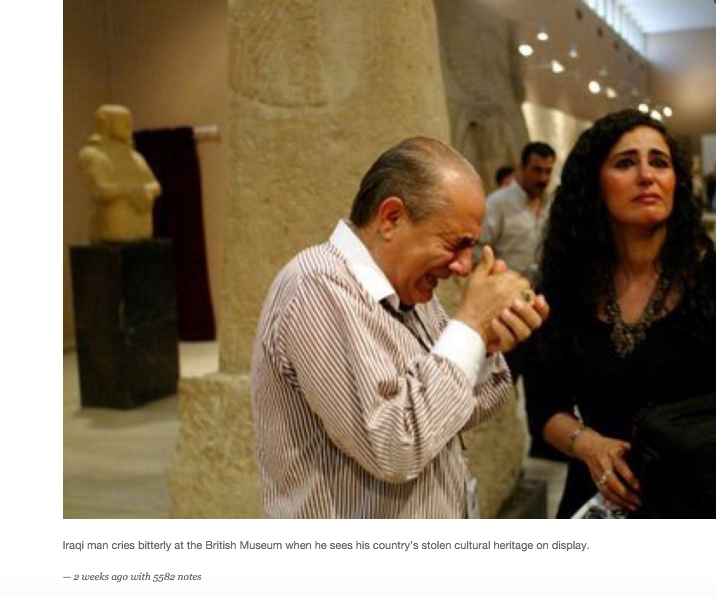
This is NOT a man crying inside of The British Museum, as captioned in @shako-makko‘s post or like @bitterarab suggested they emailed the BM director about. Instead, this is an Iraqi man breaking into tears after Iraq’s National Museum at Baghdad re-opened the Assyrian Gallery to display the Nimrud antiquities which were saved. (I felt this needed its own post).
This man is in Iraq. The Nimrud treasure on display is in Iraq.
This is one of several photographs run by National Geographic – photos via Reuters, Photographer Radu Sigheti.
A man breaks into tears during a visit to the Assyrian gallery when it reopened briefly to display the Nimrud treasure on July 3, 2003.
One of the most significant archaeological finds of the 20th century, the gold jewelry and other precious items excavated in the ancient Assyrian city of Nimrud werefound safe in a vault under the Central Bank in Baghdad in June 2003.
The history behind this suggests tears of joy, not bitterness. In 2003, U.S. troops failed to protect the National Museum from militants who broke in, looted, and destroyed some 5,000 artifacts. However, Museum workers believed that some of the Nimrud artifacts were safeguarded in a vault beneath the Iraqi Central bank.
There was one problem – the Bank had been flooded horrifically. No one knew if the Nimrud antiquities would still be there, and if they were, there was no way of knowing if they were completely water-damaged. More importantly, the country needed access to the Bank and its funds to pay salaries across the nation.
National Geographic Society (on the off-chance that the artifacts were there, and on the definite Iraqi need for the funds) spearheaded an archaeological survey to assess the damages done by militant forces and drained the flooded waters for the Central Bank of Iraq as a favor.
Gold jewelry and other precious items recovered from royal tombs excavated at the ancient Assyrian capital of Nimrud, and objects from the royal cemetery at Ur, have been found where they were stashed for safety—in a vault below the Central Bank in Baghdad—before the onset of the Gulf War in 1990.
The 2,800-year-old treasures—which are regarded by some archaeologists as rare and precious as the objects found in Pharaoh Tutankhamun’s tomb—were in three cases that had been sealed and secured in the underground vault. The cases were not found until last week because the basement of the bank was flooded, possibly deliberately by bank officials as a way to protect the treasures from looters.
A team from the television series National Geographic Ultimate Explorer in Baghdad organized the draining of well over half a million gallons (nearly two million liters) of water from the flooded bank vaults.
In May, the National Geographic Society’s Committee for Research and Exploration led the first trip to survey conditions of Iraq’s archaeological sites since the war there in April. Findings will be released next week.
“National Geographic Society has made a significant commitment to the recovery and preservation of the world’s cultural and historical antiquities,” said David Royle, executive producer of Ultimate Explorer and senior vice president of production for National Geographic Television & Film. “At a time when there are fears so much of Iraq’s cultural heritage has been looted, this is akin to finding the country’s crown jewels. Jason Williams’ tenacity on the story of the treasures of Nimrud and National Geographic’s resources combined to help authorities solve this mystery.
In addition to Jason’s group, a number of others representing the Society have been in Iraq during the past month to assist in the assessment and protection of that region’s vast archaeological treasures.” Williams said, “These are national treasures for Iraq that go to the very heart and soul of the Iraqi people. It is a thrill for me to be involved in their rediscovery and to bring them to the attention of the world.
“Draining of the Central Bank’s vault levels to gain access to Iraq’s currency reserves, needed to pay salaries throughout the country, led to confirmation that the cases containing the Nimrud treasures were still intact.
“We have assistance from our friends [at] National Geographic who brought [a] pumping system and hired people to [do] this job for us free of charge,” said Ahmed Muhammad, deputy governor of Iraq’s Central Bank. “We thank them very much for this favor,” he told the Ultimate Explorer team which helped the bank drain the water from the basement.
It took National Geographic three weeks to completely drain the bank.
The episode of Ultimate Explorer was set to air July 6, 2003 – three days after this photo of the small gallery re-opening to display these treasures took place.
The installation of these objects after they had been found in a single month is a rare case which speaks to the excitement and relief that these objects had been saved. Full Museum exhibitions are usually planned over the course of a year or longer. I would venture a guess and say this man is crying because he is moved, not because he is bitter.
It is noted in 2003 that the U.S. military was cooperative with archaeologists and that notably – U.S. drone/missile strikes had avoided most archaeological sites, seemingly very intentionally (see article).
Unfortunately, last year ISIL/Daesh began to obliterate the archaeological site of the palace at Nimrud. The place these objects come from has been severely damaged, and now, what remains is in the Baghdad museum.
Explosives at Nimrud.
ISIS counts on the angry international reaction to the destruction of pre-Islamic sites, says Danti. “They use it to tell the local population, ‘Well, they’re reacting to the destruction of these ancient idols, but do they really care about you, or your local mosque or these other issues that are affecting your life right now?“
The Mosul museum had been set to re-open, but was once again invaded by ISIL, and it’s small collection of about 180 objects was attacked.
Other archaeological and heritage sites which have been attacked in what UNESCO and the United Nations deems War Crimeshave included:
The burning of books at the Mosul Library
Khorsabad (site)
Jonah’s Tomb (inside a Mosque)
The city of Hatra (al-hadr)
The Crac des Chevaliers
The Saint Simeon Church in the ancient villages of northern Syria
Aleppo, including the Aleppo Citadel
The city of Palmyra, especially the arch of triumph, the temple of Bel, and the temple of Baalshamin. They also beheaded the world’s foremost expert on the ancient city – possibly for staying to protect the site he believed was in his stewardship, and rumored to have hidden, smuggled, or otherwise buried artifacts away from ISIL. I was told by a former colleague of his that Palmyra was essentially his life’s work.
Also Palmyra: September 3, 2015 by ASOR Syrian Heritage initiative, ISIL also destroyed seven ancient tower tombs in Palmyra since the end of June over two phases.[50] The last phase of destruction occurred between August 27 and September 2, 2015, including the destruction of the 2nd-century AD Tower of Elahbel, called “the most prominent example of Palmyra’s distinct funerary monuments”.[50] Earlier, the ancient tombs of Iamliku and Atenaten were also destroyed.[50]
26 July 2014 the destruction of the Virgin Mary Church, Mosul
The Dair Mar Elia (Saint Elijah) a 1,400 year old monastery, south of Mosul, was destroyed between late August and September 2014. The monastery was the oldest monastery in Iraq, its destruction went unreported until January 2016.
7th-century Al-Tahera Church, one of the oldest churches in the city, of Mosul
Another church in Mosul, which was reportedly “thousands of years” old, was blown up by ISIL in July 2015. According to Kurdish sources, four children were killed when the church was destroyed.[25]
As of 5 April 2015, ISIL destroyed the Assyrian Christian Virgin Mary Church on Easter Sunday in the Syrian town of Tel Nasri. “As the “joint forces” of Kurdish People’s Protection Units and local Assyrian fighters attempted to enter the town”, ISIL set off the explosives destroying what remained of the church.[29]
27 January 2015, ISIL had reportedly bombed large parts and expanses of the Nineveh Wall in al-Tahrir neighborhood of Iraq.[32]
In the Syrian city of Ar-Raqqah, ISIL publicly ordered the bulldozing of a colossal ancient Assyrian gateway lion sculpture from the 8th century BC.[33]
On 8 April 2015, the Iraqi Ministry of Tourism reported that ISIL destroyed the remnants of the 12th-century Bash Tapia Castle in Mosul.[43]
As of early July 2015, 20% of Iraq’s 10,000 archaeological sites has been under ISIL control.[44]
Please do not spread lies or misinformation about the above image. It is imperative that the National Museum in Baghdad is identified and protected as the steward of these artifacts.
Also stop emailing the British Museum director about the Nimrud objects on display in Baghdad. It’s just a hunch I have, but they’re not responding because that’s not what they’re in charge of (both as the director, and as the director of a totally different museum) and that is not how things work under international cultural heritage laws.